Watch Value Math: What You Really Get for Your Money
An original watch buying guide built on our own calculations from official specs: price per hour of power reserve, the weekend test for automatic watches, price per meter of water resistance, and the cheapest way to get sapphire.
We may earn a commission when you buy through links on this page. Learn more
Quick answer
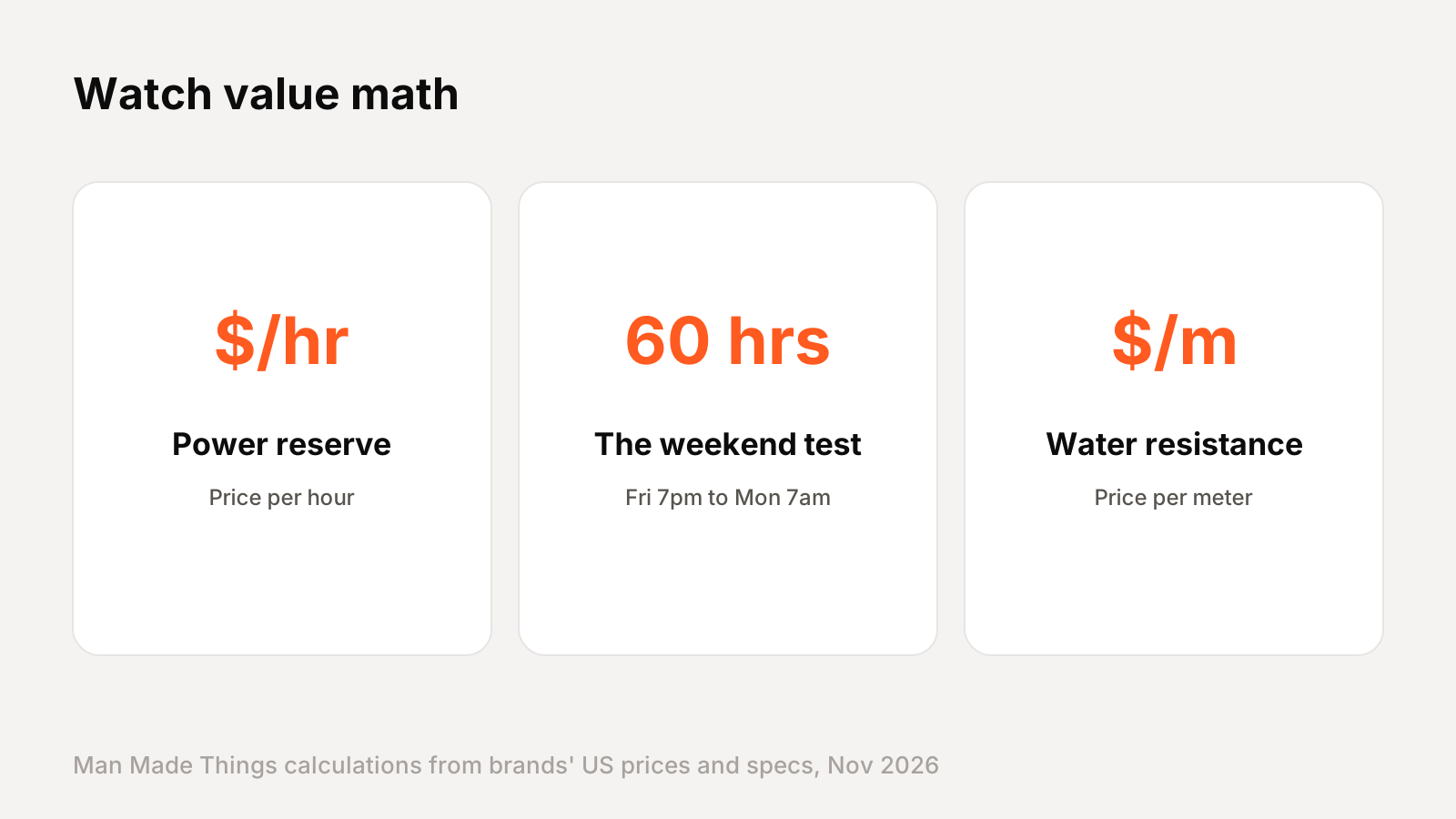
Divide a mechanical watch's price by its power reserve and some expensive watches turn out to be better value: the $675 Hamilton Khaki Field Mechanical works out to about $8.40 per hour of reserve, almost the same as a $350 Seiko 5 Sports at about $8.50. More importantly, an 80-hour watch survives a weekend off the wrist, while a 41-hour watch stops. For water resistance, a $99.95 Casio G-Shock costs about $0.50 per meter of rating, versus about $2.90 for a Tissot Seastar 1000.
Watch reviews talk a lot about heritage, finishing and feel. Those matter. But when you're choosing between two watches, a few simple numbers can tell you a lot about what you're actually paying for.
So I ran the numbers. I took the official prices and specs of every watch we've covered on Man Made Things, all from the brands' own US websites, and worked out a few ratios: price per hour of power reserve, price per meter of water resistance and the price of a sapphire crystal.
To be clear, these are my calculations from the makers' published specs as of November 2026, not test results. They don't measure beauty, finishing or how a watch feels on the wrist. They're a way to see value on paper, and they turned up a few surprises.
1. Price per hour of power reserve
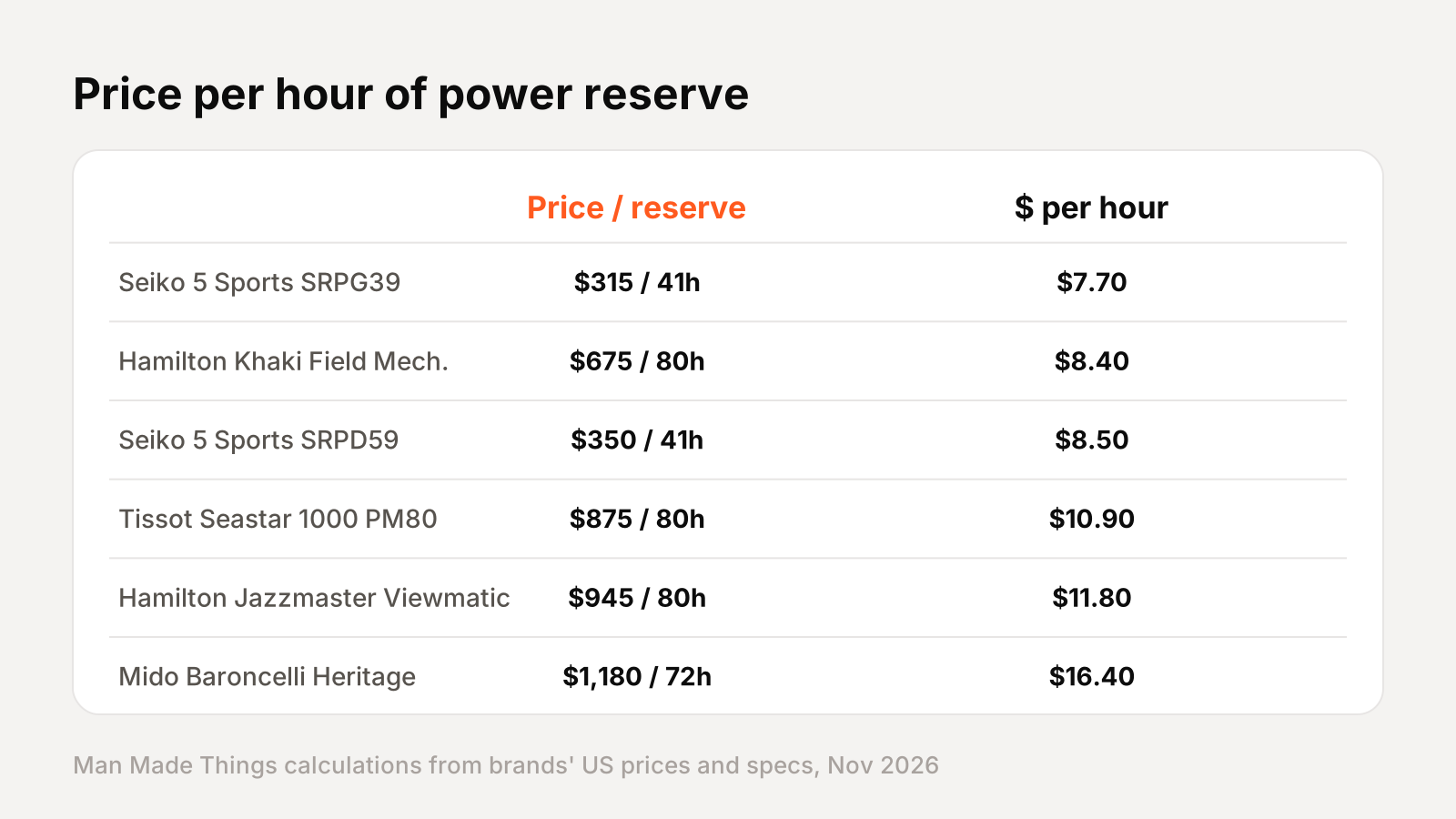
Power reserve is how long a mechanical watch runs on a full wind. Divide the price by that number, and you get a rough measure of what each hour of running time costs.
| Watch | Price | Power reserve | Price per hour |
|---|---|---|---|
| Seiko 5 Sports SRPG39 | $315 | ~41 h | $7.70 |
| Hamilton Khaki Field Mechanical | $675 | 80 h | $8.40 |
| Seiko 5 Sports SRPD59 | $350 | ~41 h | $8.50 |
| Seiko 5 Sports SRPK89 | $415 | ~41 h | $10.10 |
| Tissot Seastar 1000 Powermatic 80 | $875 | ~80 h | $10.90 |
| Hamilton Jazzmaster Viewmatic | $945 | 80 h | $11.80 |
| Citizen Tsuyosa | $495 | 42 h | $11.80 |
| Citizen Promaster Air | $895 | 60 h | $14.90 |
| Mido Baroncelli Heritage | $1,180 | 72 h | $16.40 |
| Seiko Presage Enamel SPB495 | $1,400 | ~72 h | $19.40 |
The surprise: the Hamilton Khaki Field Mechanical costs nearly twice as much as a Seiko 5 Sports, but about the same per hour of reserve, because its 80-hour movement runs almost twice as long. The Tissot Seastar 1000, at $875, costs less per hour than the $495 Citizen Tsuyosa.
2. The weekend test
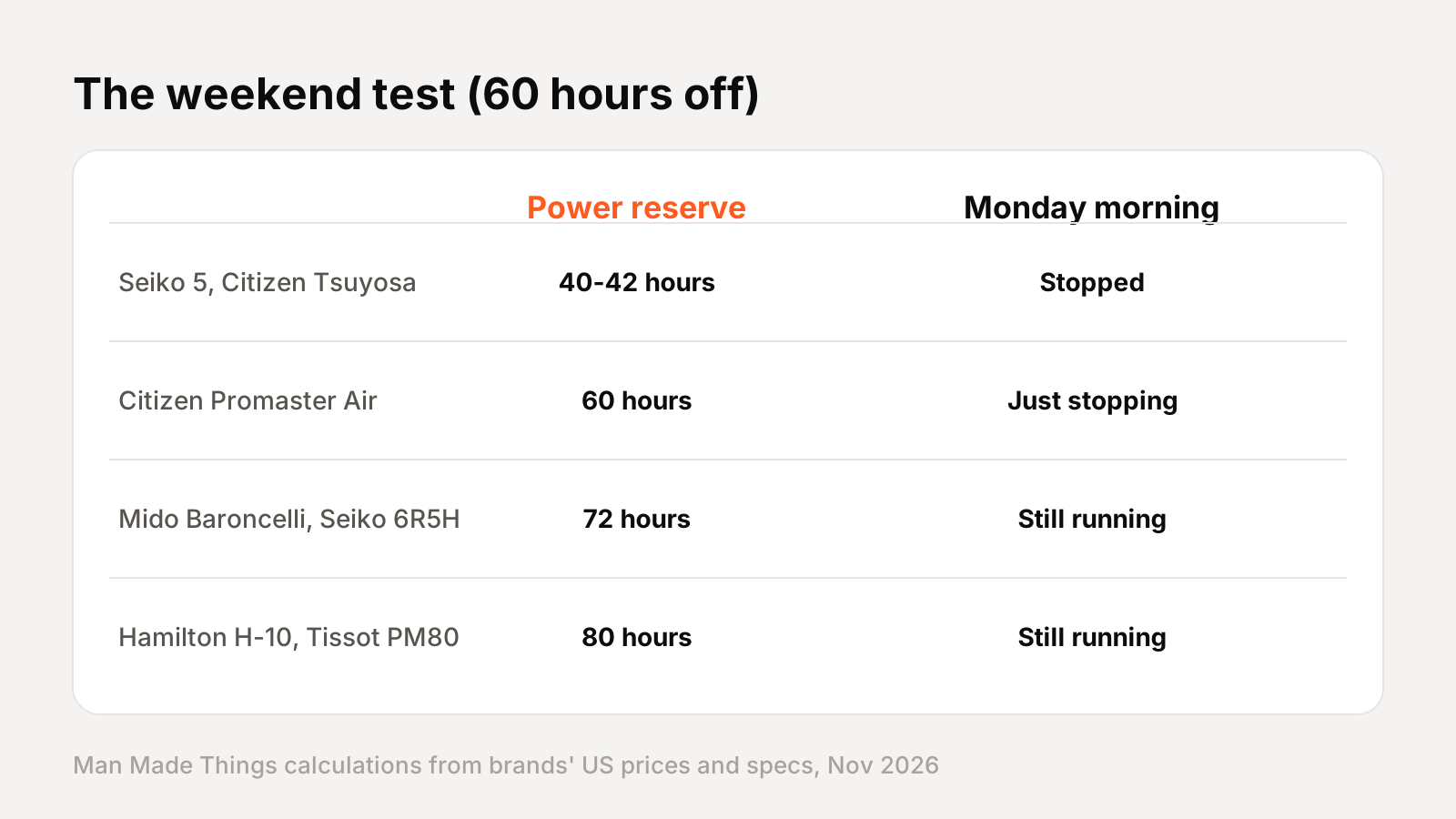
Here's a practical way to think about power reserve. Take your watch off at 7pm on Friday and pick it up at 7am on Monday. That's 60 hours.
- A watch with a 40–42 hour reserve (most Seiko 5 Sports, the Citizen Tsuyosa, the Timex Waterbury) will have stopped by Saturday afternoon. You'll need to reset the time and date on Monday.
- A watch with 72–80 hours (Hamilton's H-10 and H-50 movements, Tissot's Powermatic 80, Mido's Caliber 80, Seiko's 6R5H) will still be running on Monday morning.
If you wear one watch every day, this barely matters. If you rotate watches or take yours off on weekends, an 80-hour reserve is one of the most useful upgrades you can buy, and as the table above shows, it doesn't always cost more per hour.
3. Price per meter of water resistance
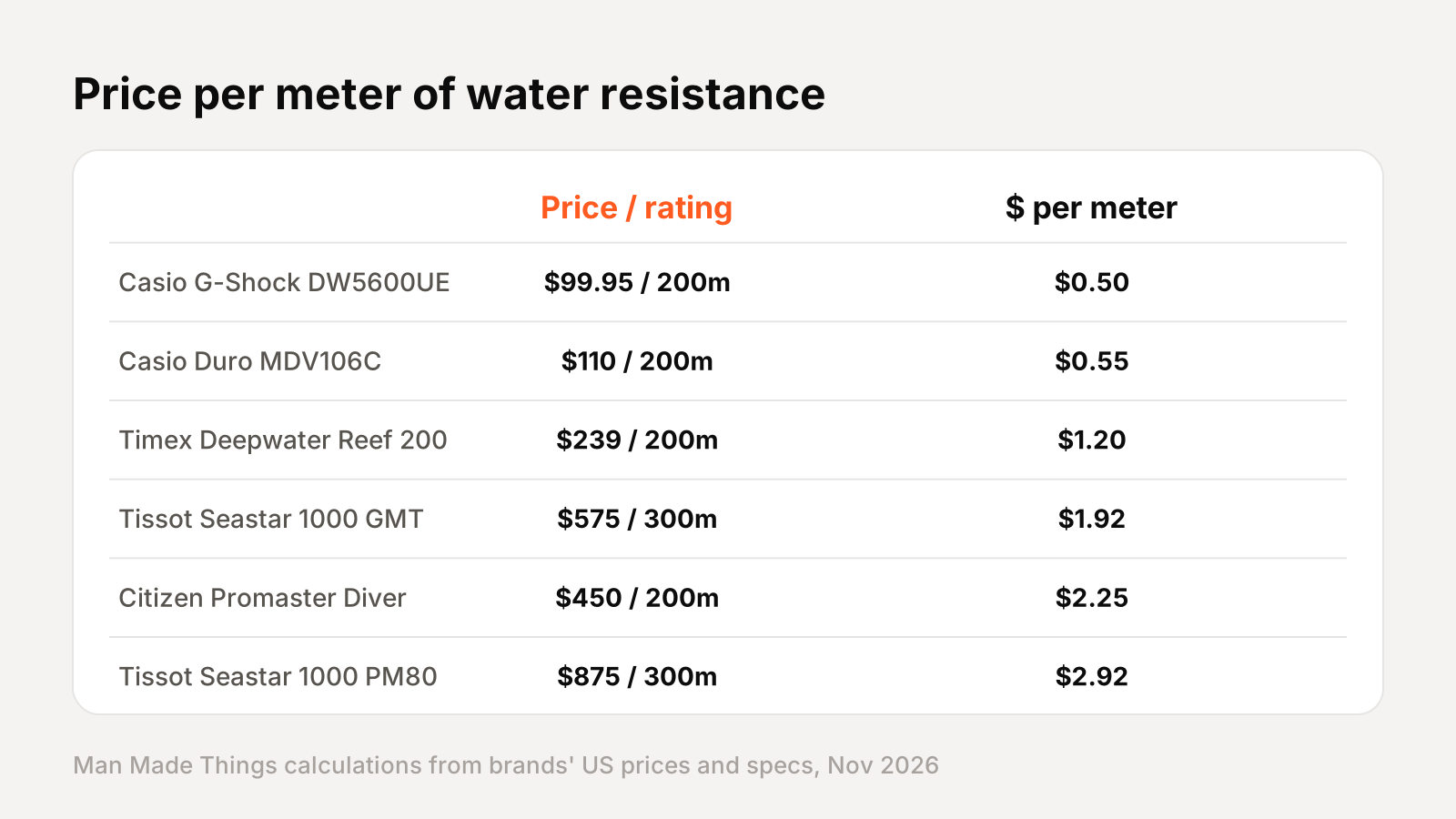
Water resistance is the other spec people compare. Divide the price by the rating in meters:
| Watch | Price | Rating | Price per meter |
|---|---|---|---|
| Casio G-Shock DW5600UE | $99.95 | 200 m | $0.50 |
| Casio Duro MDV106C | $110 | 200 m | $0.55 |
| Timex Deepwater Reef 200 | $239 | 200 m | $1.20 |
| Tissot Seastar 1000 GMT | $575 | 300 m | $1.92 |
| Citizen Promaster Diver Eco-Drive | $450 | 200 m | $2.25 |
| Seiko Prospex Solar Diver | $475 | 200 m | $2.38 |
| Seiko Prospex SRPE93 | $525 | 200 m | $2.62 |
| Tissot Seastar 1000 Powermatic 80 | $875 | 300 m | $2.92 |
If you only need a watch that can handle the water, a quartz Casio gives you a 200-meter rating for about $100. You pay more for mechanical movements, sapphire and finishing, not for extra water resistance.
One caution: the number on the dial is a rating, not a dive limit. As our De/code: a watch dial explains, Citizen says a 5 bar (50m) watch is for ordinary swimming, not free diving, and scuba diving calls for a watch marked "Diver's," like the Citizen Promaster Diver and Seiko Prospex models above.
4. The cheapest sapphire crystal
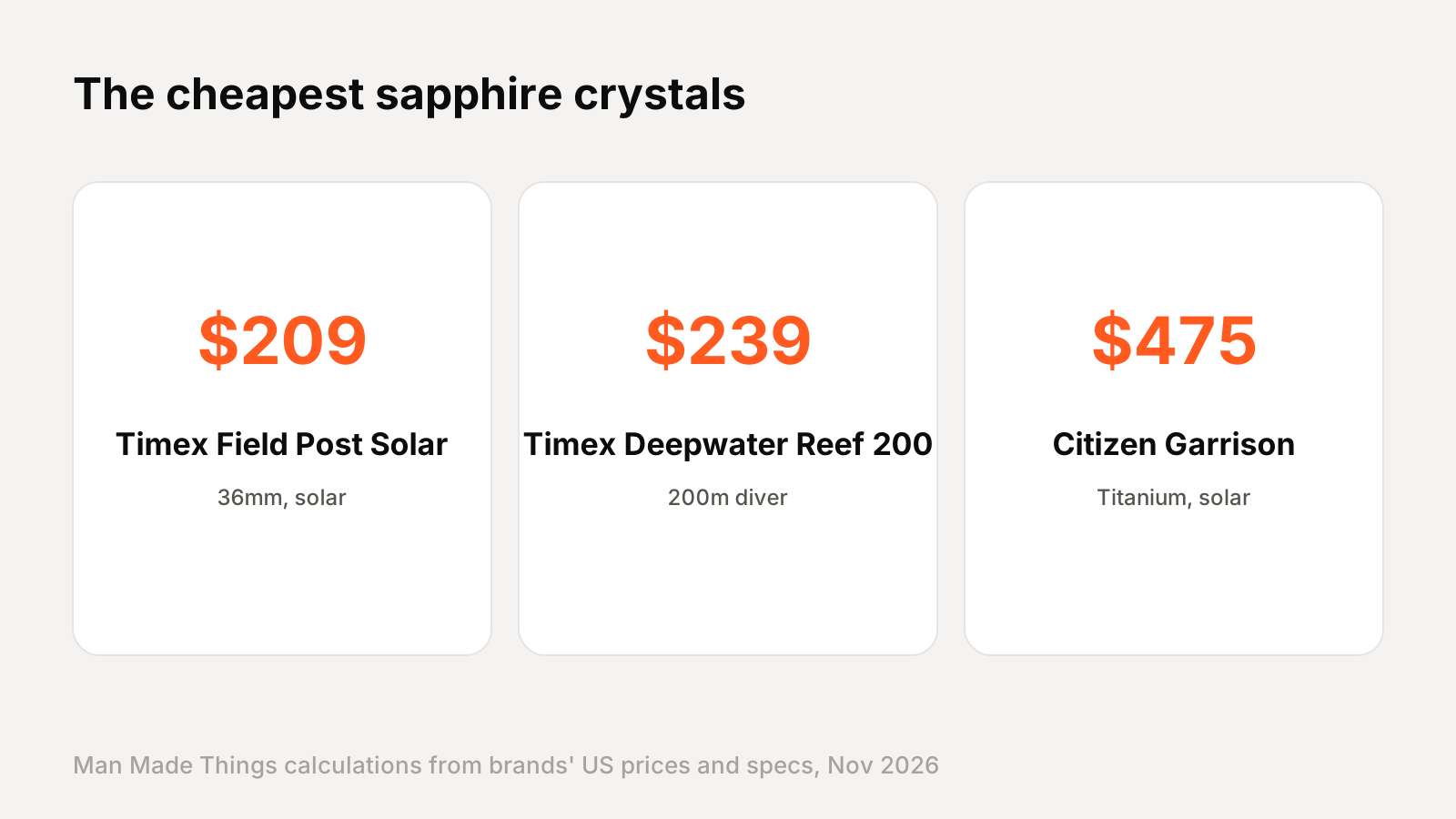
A sapphire crystal resists scratches far better than mineral glass; the Federation of the Swiss Watch Industry calls sapphire "the third hardest transparent material in existence." It used to be a premium feature. Among the watches we've covered, the cheapest with sapphire are:
- Timex Expedition Field Post Solar 36mm: $209, anti-reflective sapphire, solar quartz.
- Timex Deepwater Reef 200 41mm: $239, anti-reflective sapphire, 200m.
- Citizen Garrison Super Titanium: $475, sapphire and a titanium case.
By contrast, many Seiko 5 Sports models, even at $415, use Seiko's Hardlex mineral glass. That's a fair trade for an automatic movement at that price, but if scratches bother you, it's worth knowing. Read more in sapphire vs mineral crystal.
5. What the numbers don't tell you

Ratios are useful, but they're not the whole story.
- Finishing and design. A Seiko Presage enamel dial or a Mido Baroncelli at 7.3mm thin costs more because of how it's made and how it looks, not its specs.
- Comfort and size. Lug-to-lug length often matters more than diameter. Our wrist size guide explains why.
- Convenience. Quartz and solar watches don't need winding at all, and solar models run for months on a charge. If you want a grab-and-go watch, our best solar watches may suit you better.
- Joy. The best watch is the one you look forward to wearing.
How to use this guide: shortlist on looks and size, then use the math to break a tie. If two watches feel equal, pick the one with more power reserve per dollar or the sapphire crystal.
Frequently asked questions
What is a good power reserve for an automatic watch?
+
About 40 hours is common. 72–80 hours means the watch keeps running over a weekend off the wrist, which is the practical difference.
Which automatic watch has the best power reserve for the money?
+
Among the watches we've covered, the Seiko 5 Sports SRPG39 is cheapest per hour (about $7.70), but the Hamilton Khaki Field Mechanical (about $8.40 per hour) runs 80 hours, enough for a weekend.
Is a higher water resistance rating worth paying for?
+
Only if you need it. A $99.95 Casio G-Shock is rated to 200 meters. Mechanical dive watches cost more for their movements and finishing, not for extra water resistance.
What is the cheapest watch with a sapphire crystal?
+
Among our picks, the Timex Expedition Field Post Solar 36mm at $209.
Sources

Watches & Coffee Writer
Aditya is a passionate coffee lover who loves watches. He covers watches and coffee for Man Made Things.
More from Aditya →