How to Measure Your Wrist and Pick the Right Watch Size
Measure your wrist in two minutes with a string or tape, then use case diameter, lug-to-lug and thickness to pick a watch that actually fits.
We may earn a commission when you buy through links on this page. Learn more
Quick answer
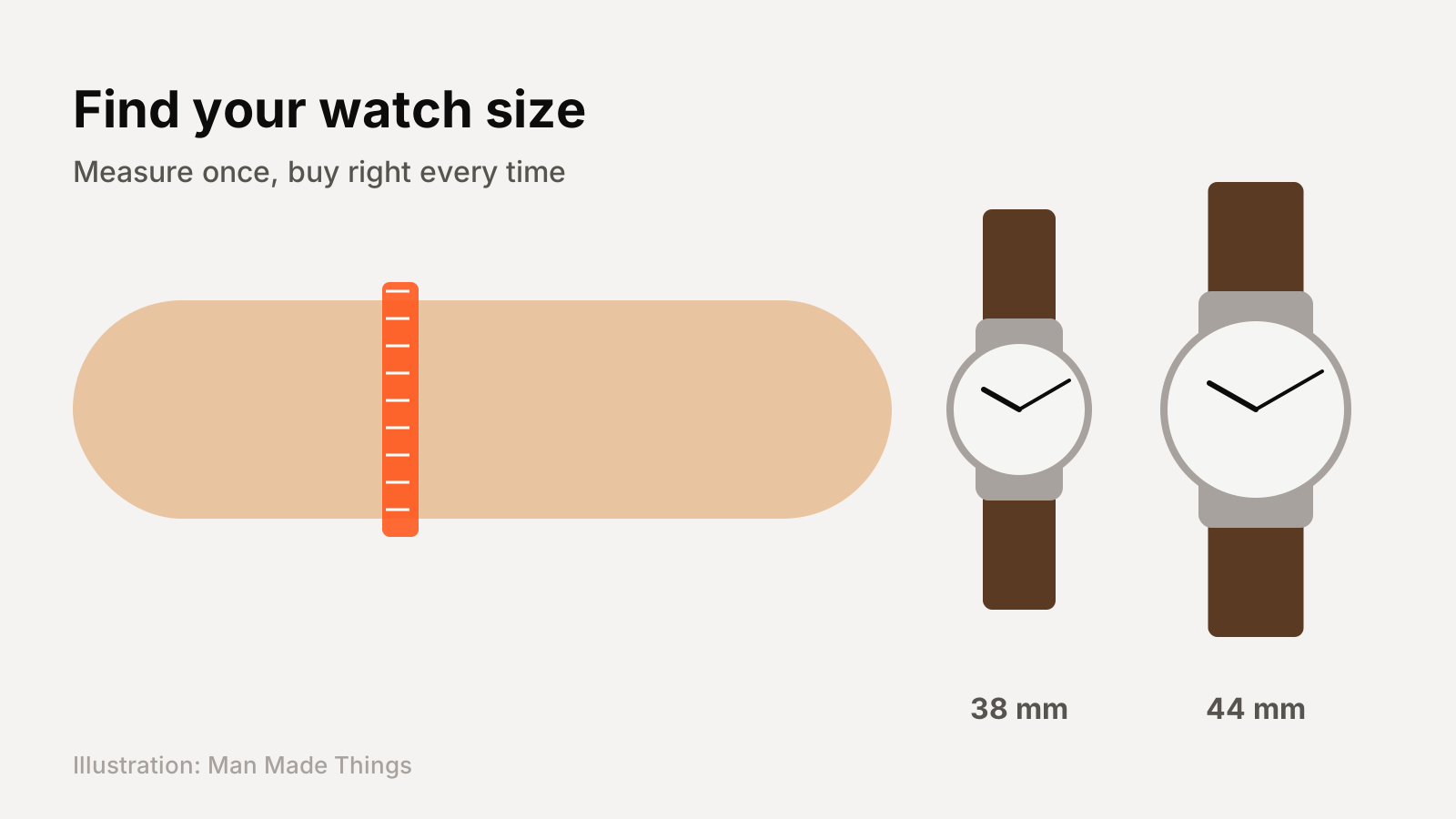
Wrap a soft tape or a piece of string around your wrist just above the wrist bone, mark where it overlaps and measure it with a ruler. As a starting point, Shinola suggests 38–42mm cases for 6–7 inch wrists and 44–46mm for 7.5–8 inch wrists. Then check lug-to-lug: the lugs shouldn't hang past the flat top of your wrist.
Buying a watch online has one big risk: it shows up and it's the wrong size. Too big and it slides around, catches on your cuffs and looks like you borrowed it. Too small and it can look lost on your wrist.
The good news is that you can avoid that with a piece of string and two minutes. Then three numbers on the spec sheet, the case diameter, the lug-to-lug length and the thickness, tell you almost everything about how a watch will wear.
This guide pulls together the official sizing advice from Timex, Hamilton, Tissot, Alpina, Shinola and Citizen, so you're not relying on guesswork. Let's get into it.
Step 1: Measure your wrist
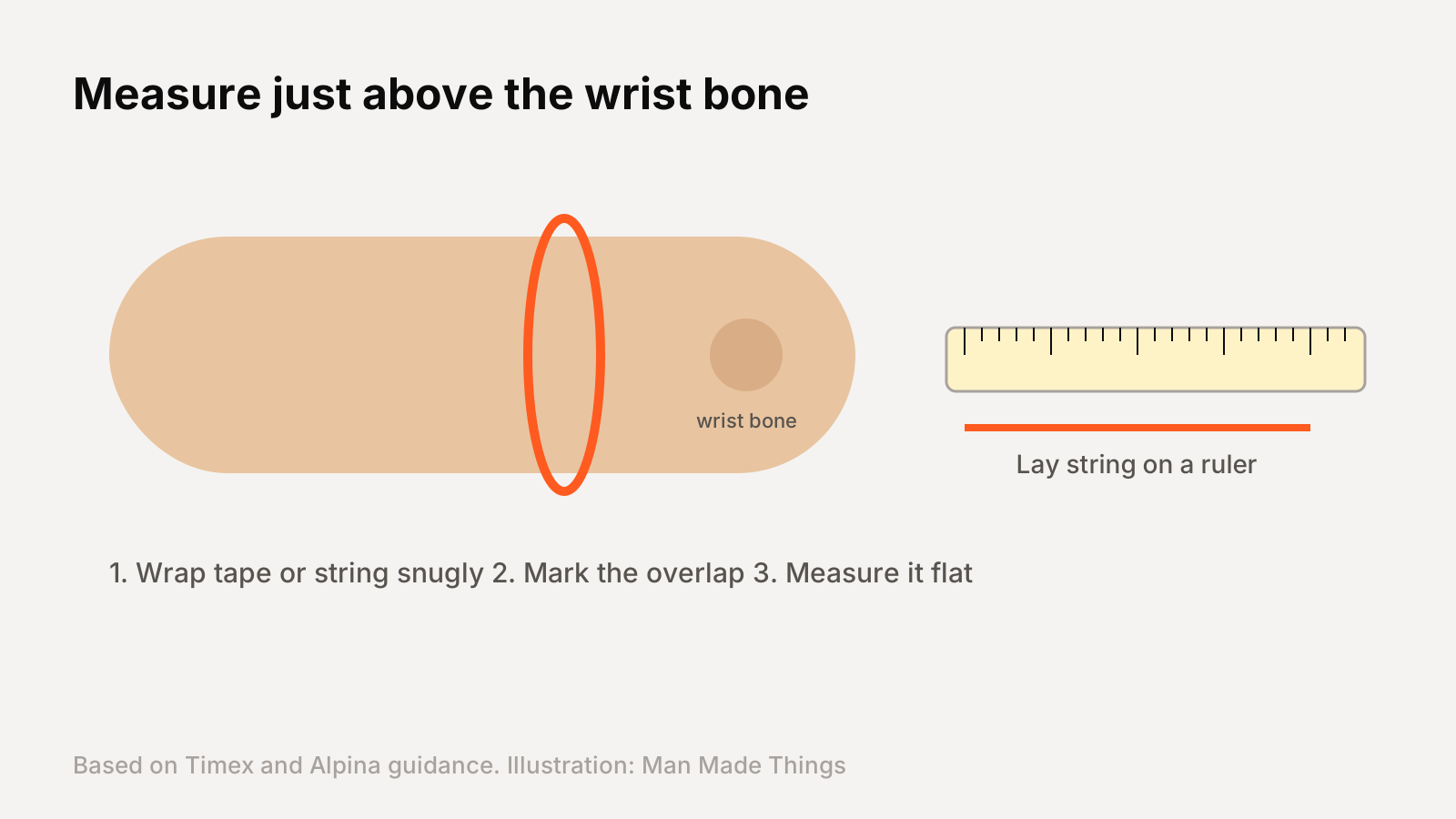
You don't need special tools. Timex suggests using a tape measure, or if you don't have one, wrapping a piece of string around your wrist and measuring it with a ruler. You can also measure the length of an old strap that fits you, not counting the buckle.
Where you measure matters. Alpina recommends wrapping the tape or string around your wrist just above the wrist bone, where a watch is typically worn, snug but comfortable. If you're using string, mark where it overlaps and measure that length against a ruler.
Want something more precise? Hamilton and Tissot both offer printable paper rulers on their websites. Print them at 100% scale, cut them out and wrap them around your wrist. Hamilton suggests leaving enough room to slip your little finger between the strap and your wrist.
Write the number down in both inches and millimeters. You'll use it for every watch you look at from now on.
Step 2: Pick a case diameter
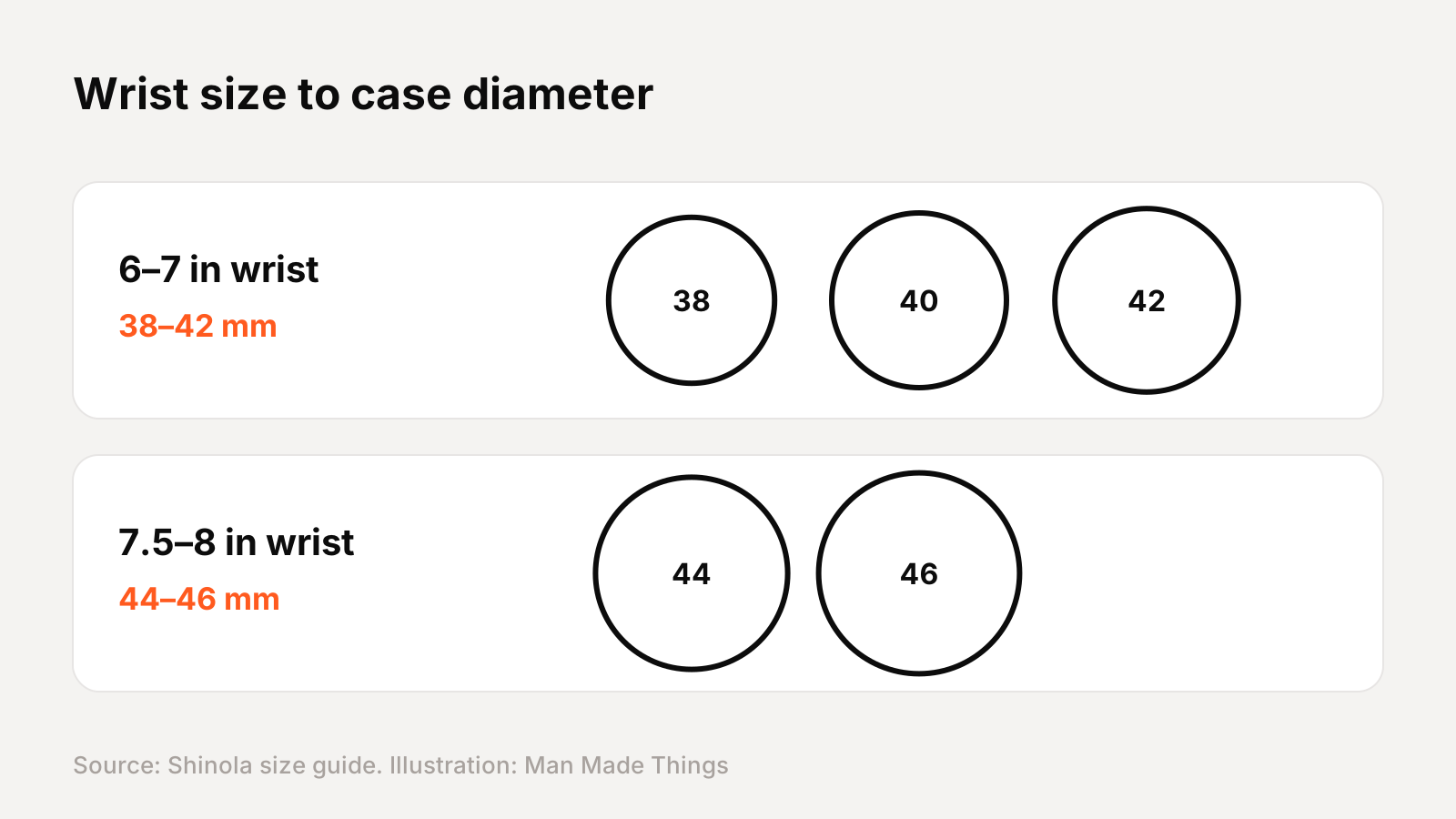
Case diameter is the width of the watch, usually measured without the crown. It's the number you'll see most, such as 38mm or 42mm.
Shinola gives one of the clearest official rules:
- Wrists of 6 to 7 inches: a 38, 40 or 42mm case.
- Wrists of 7.5 to 8 inches: a case between 44 and 46mm.
For context, Timex says men's watches tend to be 38 to 46mm and women's 26 to 36mm, while Shinola calls 38 to 42mm a unisex range. Brands don't agree on exact ranges, so treat them as guides, not rules.
My honest advice: when in doubt, go smaller. A slightly small watch looks intentional and classic. A watch that's too big almost always looks wrong.
Step 3: Check lug-to-lug length
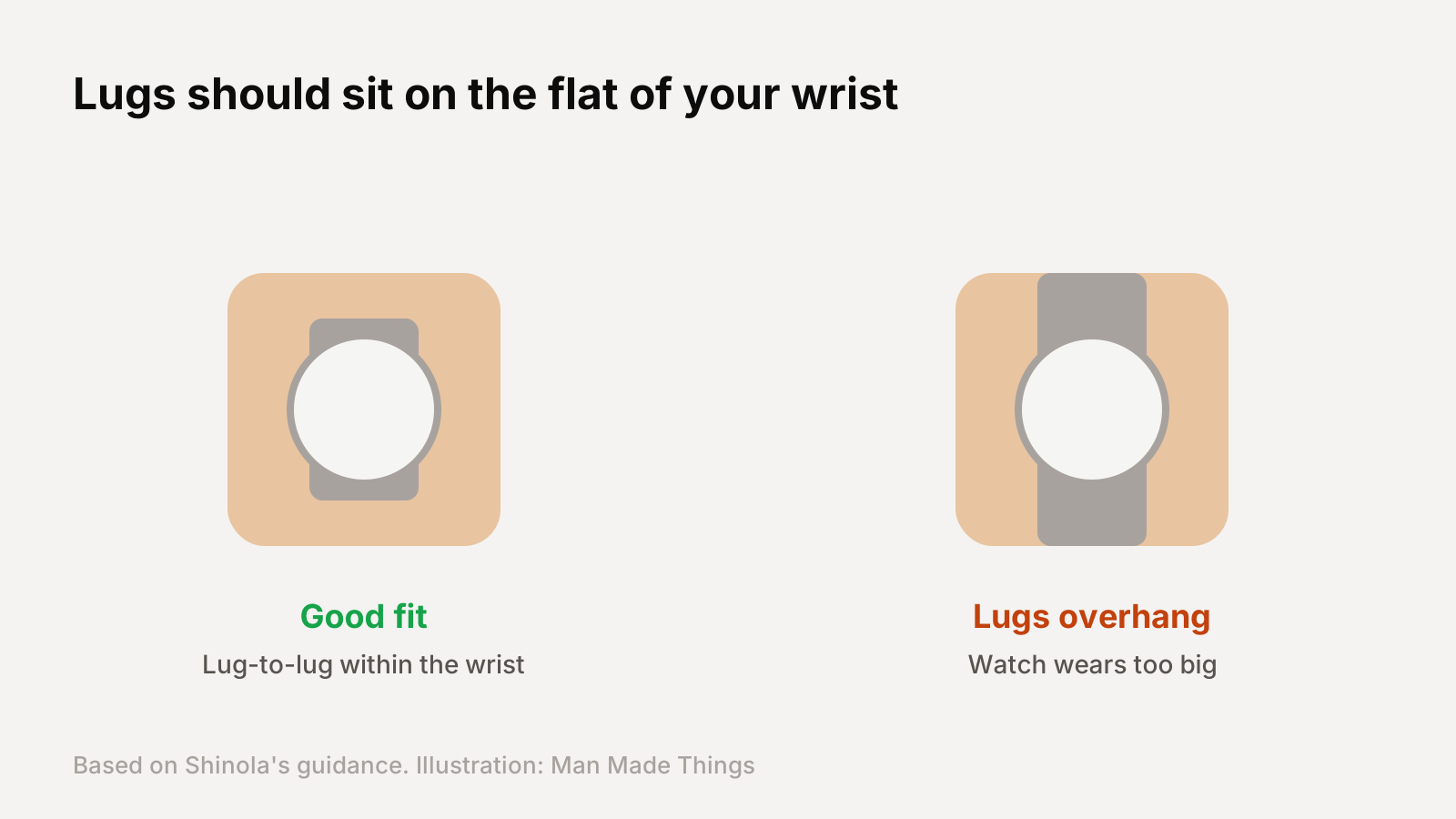
This is the number most people ignore, and it's often more important than diameter. Lug-to-lug is the distance from the tip of the top lugs to the tip of the bottom lugs, where the strap attaches.
Shinola puts it well: the lugs should fit on the flat surface of your wrist without overhanging. It suggests a lug-to-lug distance of about 75 to 95% of the width of the flat part of your wrist.
That's why two 42mm watches can wear completely differently. A watch with short, curved lugs hugs the wrist and wears small. A watch with long, flat lugs sticks out past the edges and wears big. If a spec sheet lists lug-to-lug, compare it to a watch you already own that fits well.
Step 4: Don't forget thickness
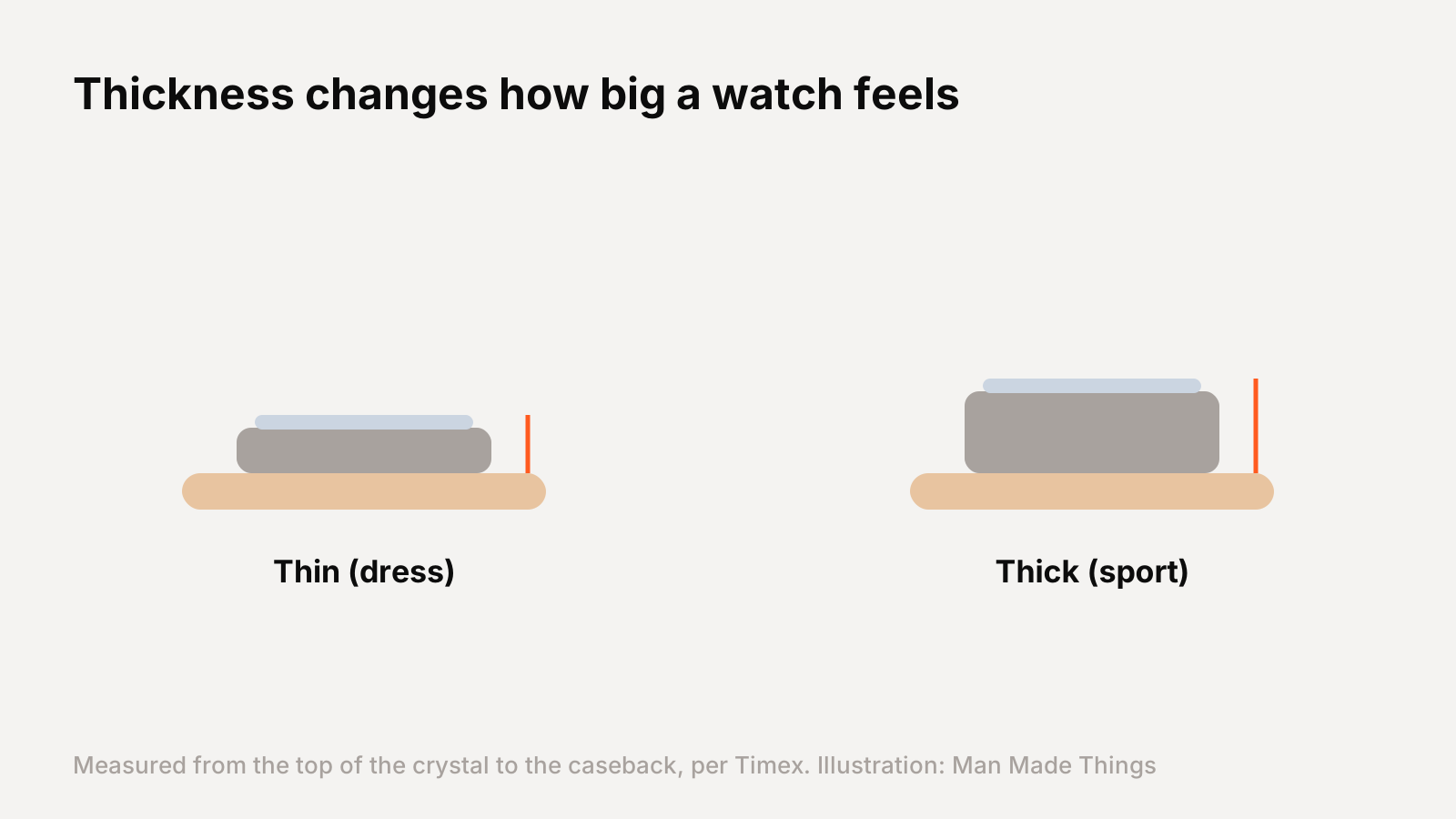
Timex notes that case thickness also affects how oversized a watch appears on your wrist. Thickness is measured from the top center of the crystal to the middle of the caseback.
A thick watch sits higher, catches on shirt cuffs and feels heavier, even if its diameter is modest. Timex also points out that the more complications a watch has, the thicker it tends to be.
As a rough guide, dress watches are often under about 12mm, while sporty dive watches commonly run 12 to 14mm. If you wear long sleeves a lot, thinner will be more comfortable day to day.
Step 5: Size the strap or bracelet
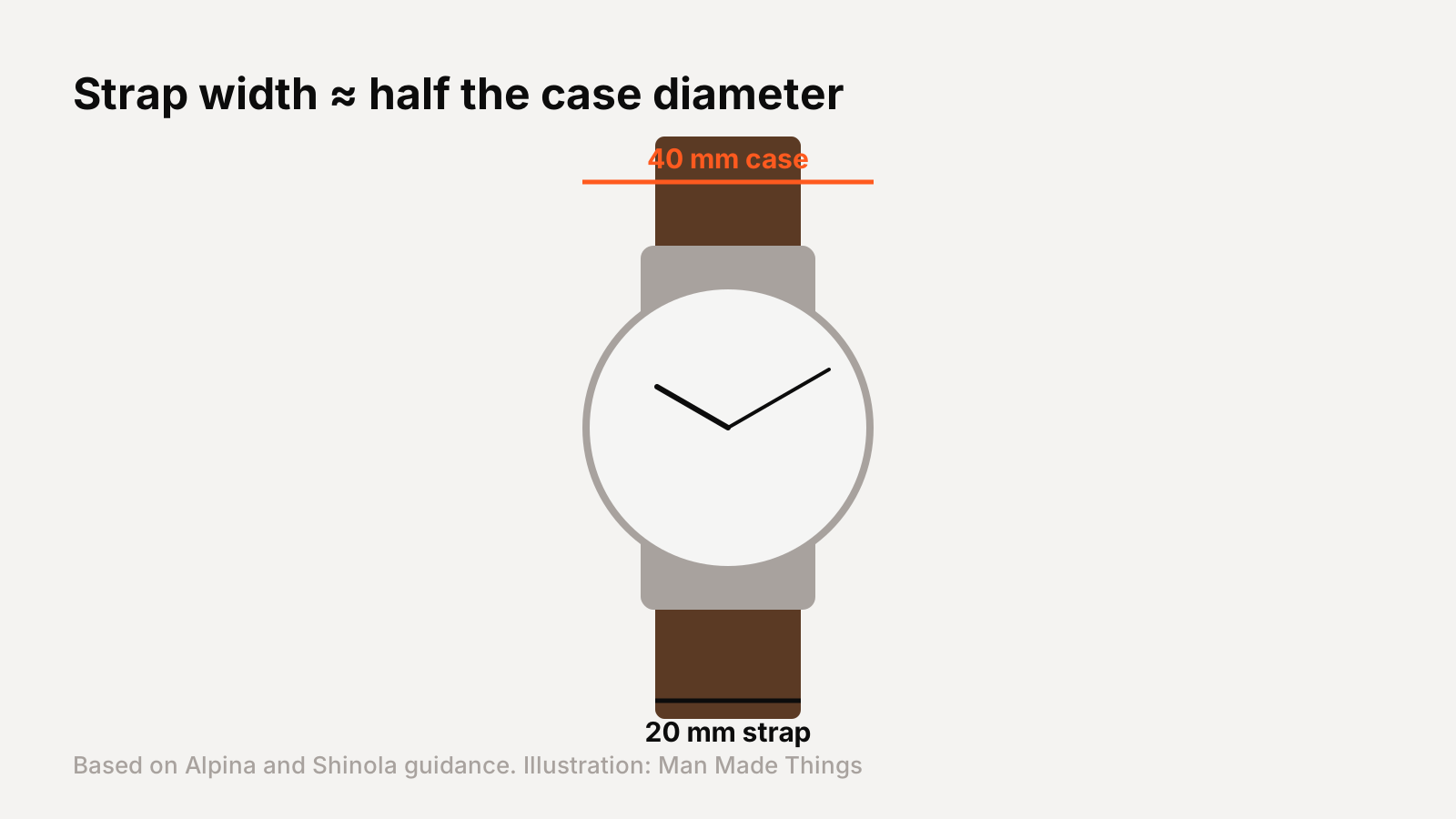
Alpina and Shinola give the same handy rule for strap width: about half the case diameter, so a 40mm watch usually takes a 20mm strap. Common widths are 18, 20, 22 and 24mm.
For length, Alpina suggests the band should be within about half an inch of your wrist circumference.
Metal bracelets need sizing by removing links. Citizen says you can have this done by the store where you bought the watch or an authorized service center, and some of its bracelets come with a tool to do it yourself. Hamilton offers free sizing when you buy from its online store. Leather straps are simpler: just pick a different hole on the buckle.
Also, Timex notes that leather or fabric straps make a watch look slimmer, while metal bracelets make it look and feel larger. If a watch is on the edge of too big, try it on a strap.
One last trick before you order: use a watch you already own as a reference. Note its diameter, lug-to-lug and thickness, and decide whether it feels too big, too small or just right. That single comparison tells you more than any chart. You can also print a circle at the exact size of the watch you're considering, cut it out and hold it on your wrist in a mirror. It looks silly, but it works.
Frequently asked questions
How do I measure my wrist for a watch?
+
Wrap a soft tape or a piece of string around your wrist just above the wrist bone, snug but comfortable. Mark the overlap and measure it against a ruler.
What watch size is right for a 7-inch wrist?
+
Shinola suggests a 38–42mm case for wrists of 6 to 7 inches. Also check that the lug-to-lug length doesn't overhang the flat top of your wrist.
What does lug-to-lug mean on a watch?
+
It's the distance from the tip of the top lugs to the tip of the bottom lugs. It often affects fit more than case diameter.
What strap width does a 40mm watch take?
+
Usually about 20mm. Alpina and Shinola suggest a strap width of about half the case diameter.
Sources

Watches & Coffee Writer
Aditya is a passionate coffee lover who loves watches. He covers watches and coffee for Man Made Things.
More from Aditya →