De/code: A Watch Dial. What Automatic, Chronometer, 200m and Swiss Made Really Mean
Every word printed on a watch dial, decoded with official definitions: automatic, chronometer, officially certified (COSC), water resistance ratings, Swiss Made, jewels, antimagnetic, Super-LumiNova and more.
We may earn a commission when you buy through links on this page. Learn more
Quick answer
On a watch dial, "Automatic" means a mechanical movement wound by the motion of your wrist. "Chronometer, Officially Certified" means the movement passed COSC's 15-day ISO 3159 test, averaging -4 to +6 seconds a day. "200m" is a water resistance rating; Citizen says 20 bar suits free diving and water sports, while scuba needs a watch marked "Diver's." "Swiss Made" is a legal claim: the watch must be developed, cased and inspected in Switzerland, with a Swiss movement and at least 60% of its manufacturing costs in Switzerland.
A watch dial is tiny, but it's crowded with claims. Some are marketing. Some are regulated by law. A few are backed by days of laboratory testing. From a distance, they all look the same.
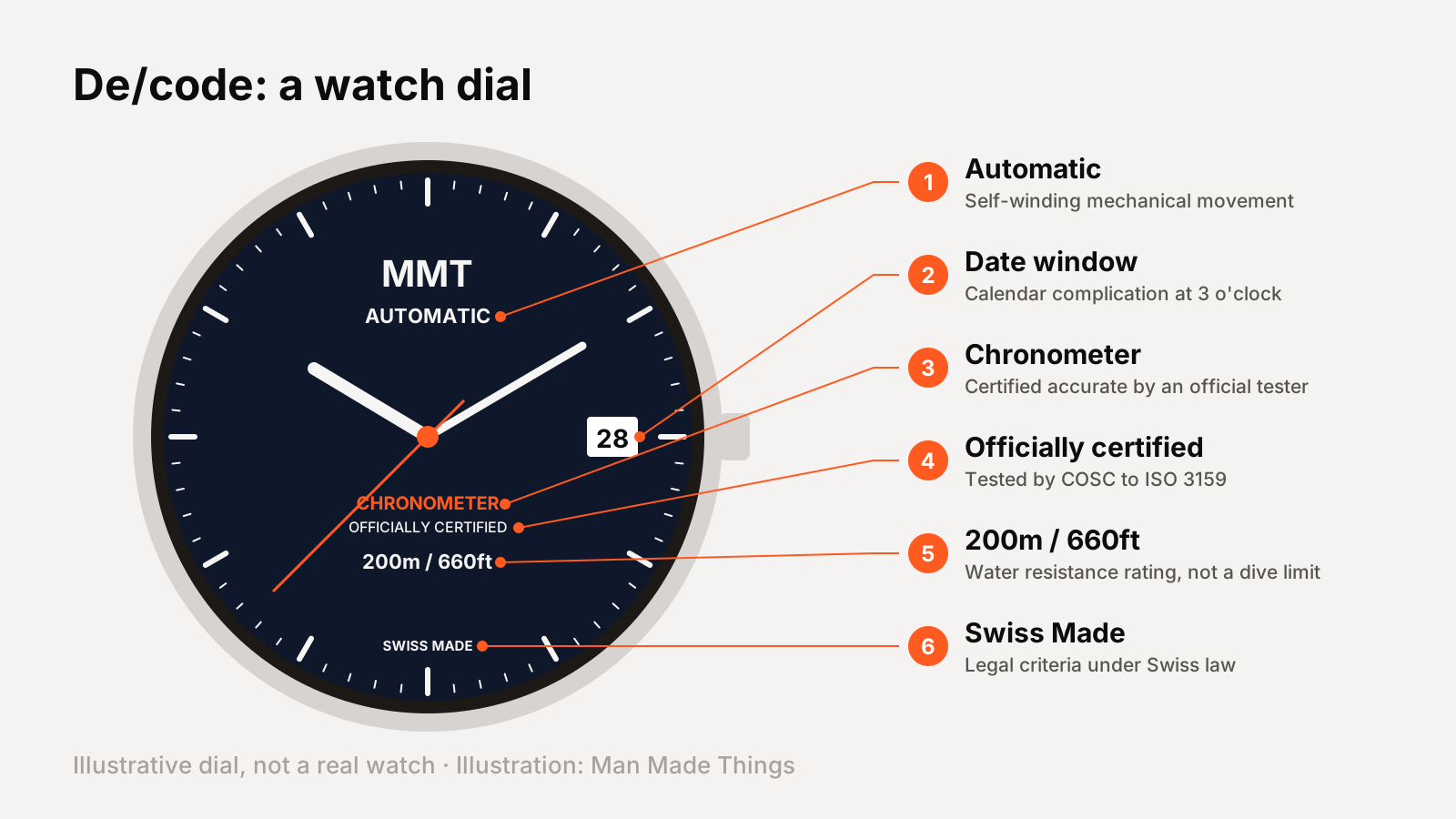
This is the first De/code, our new format that takes one label and explains every word on it. Today it's a watch dial. Above is an illustrated dial (not a real watch) with the six terms you're most likely to see, and below we decode each one, plus the small print that turns up on many others.
Every definition comes from an official source: the Federation of the Swiss Watch Industry (FH) and its watch dictionary, the Swiss ordinance on "Swiss Made" watches, COSC, the Swiss chronometer testing body, and the official sites of Omega, Seiko, Citizen and Incabloc. Where sources disagree, we say so.
1. Automatic
What it means: the watch has a mechanical movement that winds itself as you wear it.
The FH dictionary explains that an automatic, or self-winding, watch winds its mainspring through a freely rotating rotor moved by the wearer, and that modern rotors wind in both directions. Omega puts it simply: the mainspring is "wound automatically by the natural motion of the wearer's arm."
Citizen says a fully wound mechanical watch generally runs about 40 hours or more. Many newer movements go much longer. Tissot's Powermatic 80, for example, offers up to 80 hours. That figure is the power reserve, which the FH defines as how long a watch runs on its own stored energy.
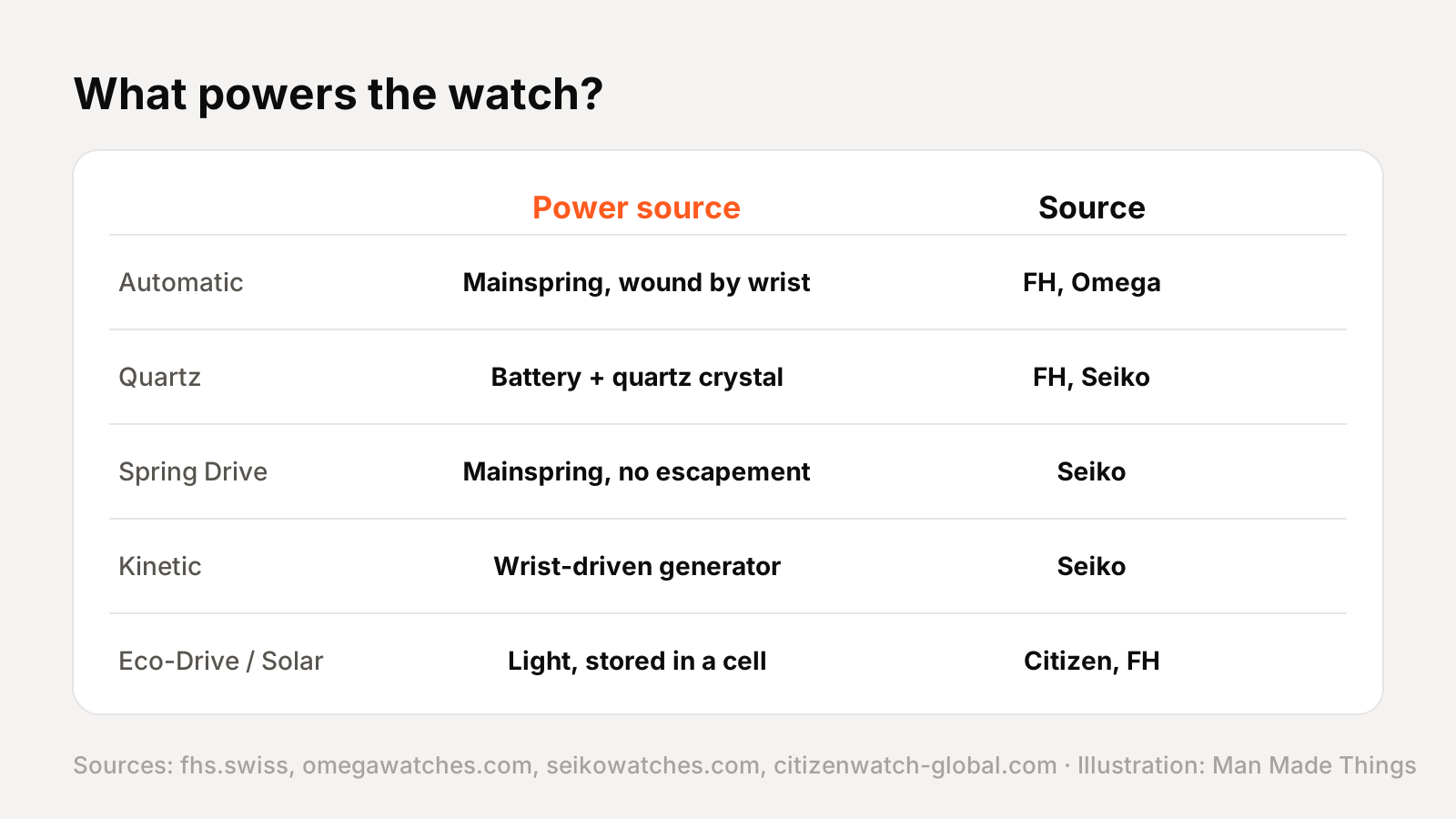
Other movement words you'll see:
| On the dial | What powers it | Source |
|---|---|---|
| Quartz | A battery and a vibrating quartz crystal | FH, Seiko |
| Spring Drive | A mainspring, regulated electromagnetically, without an escapement | Seiko |
| Kinetic | Wrist motion drives a generator that charges a cell | Seiko |
| Eco-Drive | Light of any kind, stored for over 6 months on a full charge | Citizen |
| Solar | Photovoltaic cells charging a battery | FH |
Seiko sold the world's first quartz watch, the Quartz Astron, on December 25, 1969. For self-winding picks, see our best automatic watches under $500; for light-powered ones, our best solar watches.
2. The date window (and other complications)
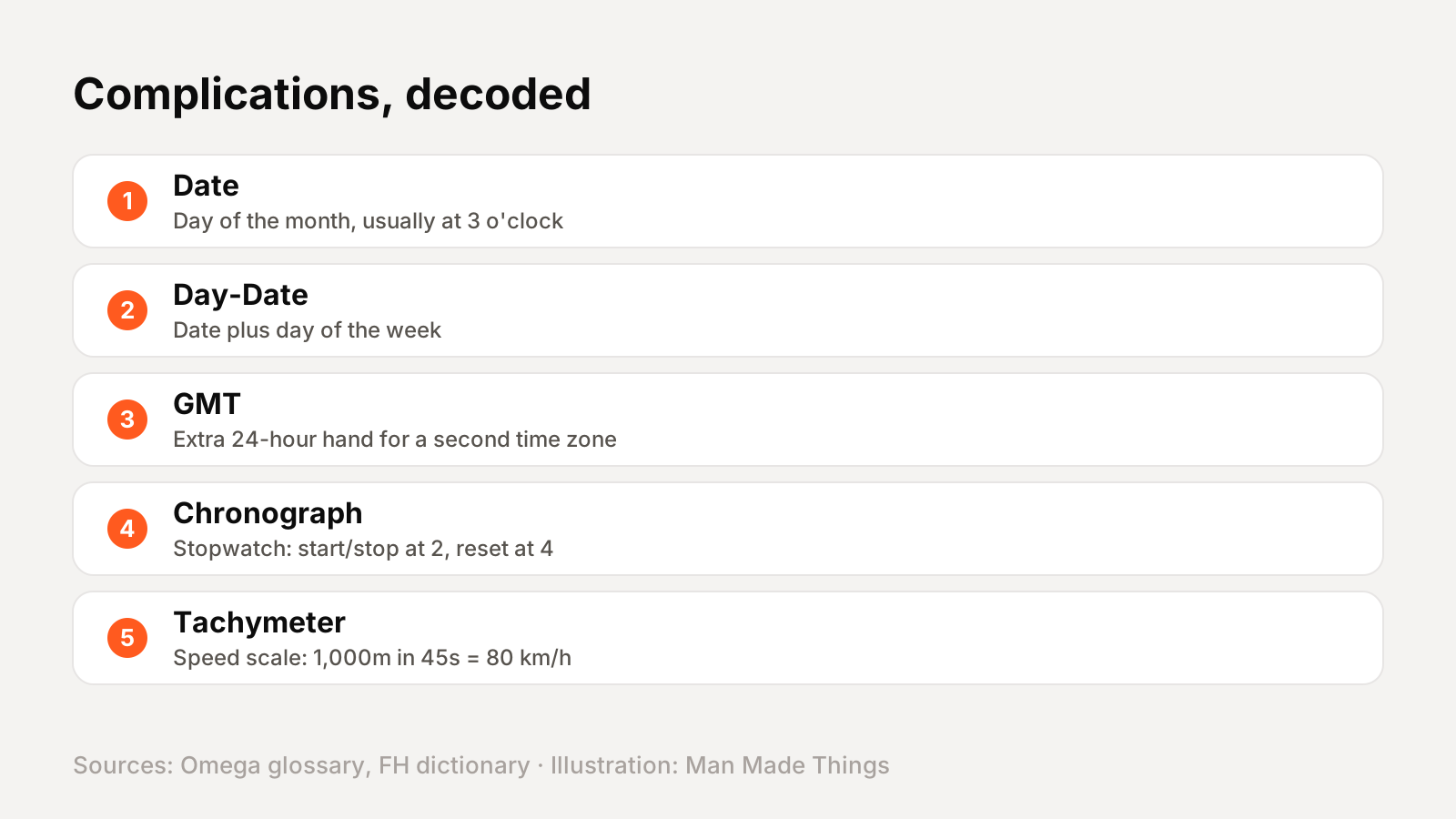
What it means: a small window, usually at 3 o'clock, that shows the day of the month.
Anything a watch does beyond telling the time is called a complication. The common ones, as Omega and the FH define them:
- Day-Date: windows showing both the date and the day of the week (Omega).
- GMT: an extra hour hand and a 24-hour scale, so you can track a second time zone (Omega). The name comes from Greenwich Mean Time, adopted in 1884 (FH). Here's how to use a GMT watch.
- Chronograph: "a mechanism for measuring time intervals" while still showing the time (Omega). The start/stop pusher is usually at 2 o'clock and reset at 4 o'clock (FH).
- Tachymeter: a scale for reading speed over a fixed distance. The FH's example: cover 1,000 meters in 45 seconds and the scale reads 80 km/h.
3–4. Chronometer and "Officially Certified"
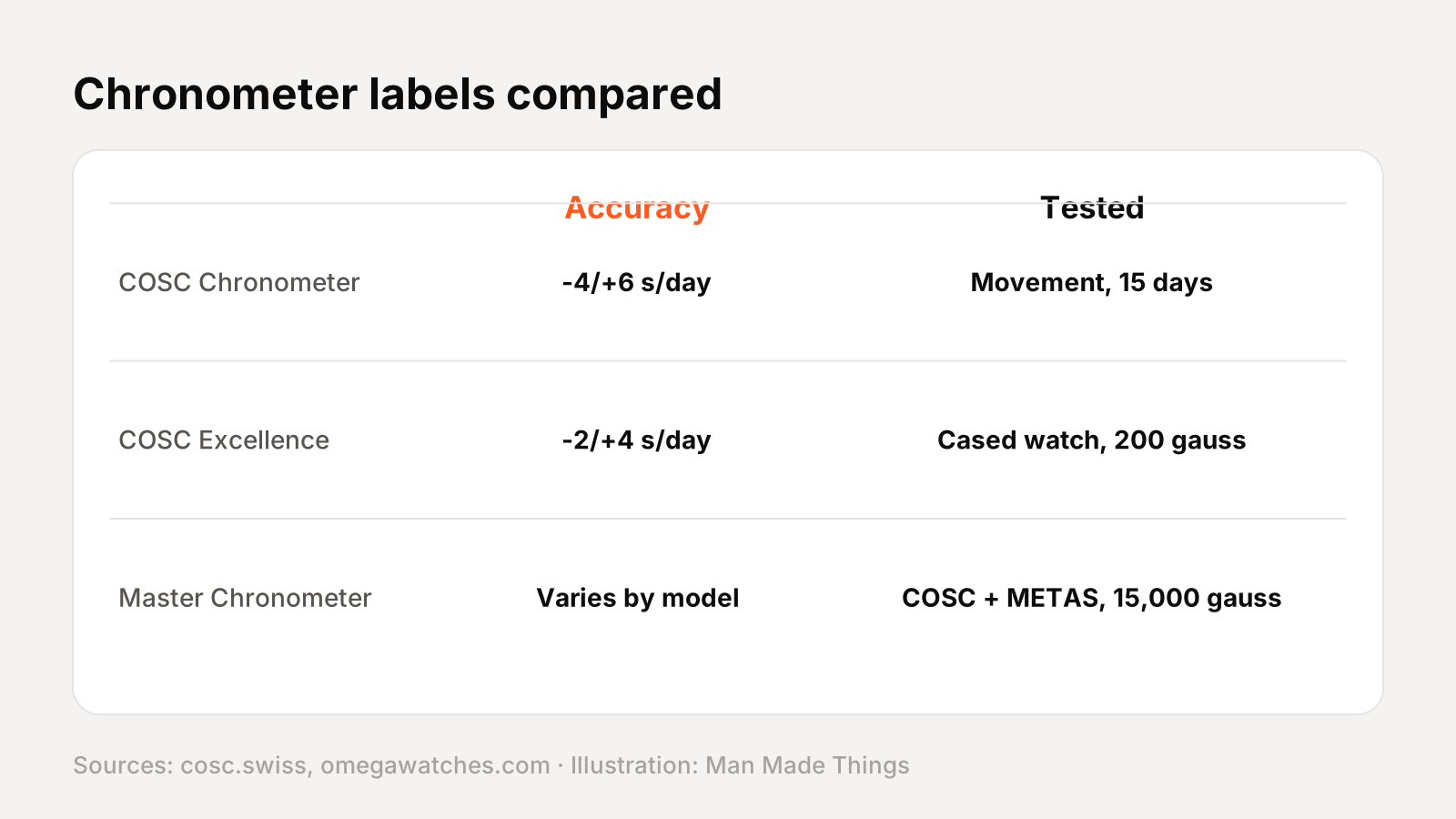
What it means: the movement passed an independent accuracy test. Without "Officially Certified," the word alone is a claim; with it, there's a certificate behind it.
COSC Certified Chronometer. COSC says its chronometers are certified by "an official, neutral authority in accordance with the ISO 3159 standard." Each mechanical movement is tested for 15 days, in 5 positions and at 3 temperatures (8°C, 23°C and 38°C). To pass, it must average -4 to +6 seconds a day and meet all seven criteria. Each certified movement gets a unique number engraved on it.
One nuance: the FH dictionary lists a looser -5/+8 seconds a day for small movements of 20mm and under, and Omega quotes -5/+8 for its 29mm Constellation.
Stricter labels you may see:
| Label | Who tests | Key numbers |
|---|---|---|
| Chronometer (COSC) | COSC | -4/+6 s/day, 15 days, movement only |
| Excellence Chronometer | COSC | -2/+4 s/day after the chronometer test, cased watch, runs in a 200 gauss field |
| Master Chronometer (Omega) | COSC, then METAS | Eight more tests over 10 days, resists 15,000 gauss |
Omega's Master Chronometer tolerances vary by model. Omega lists 0/+5 seconds a day for its Aqua Terra 41mm and 0/+6 for its Diver 300M 42mm, for example. Quartz watches can be COSC-certified too, against COSC's own specifications inspired by ISO 3159.
5. 200m / 660ft
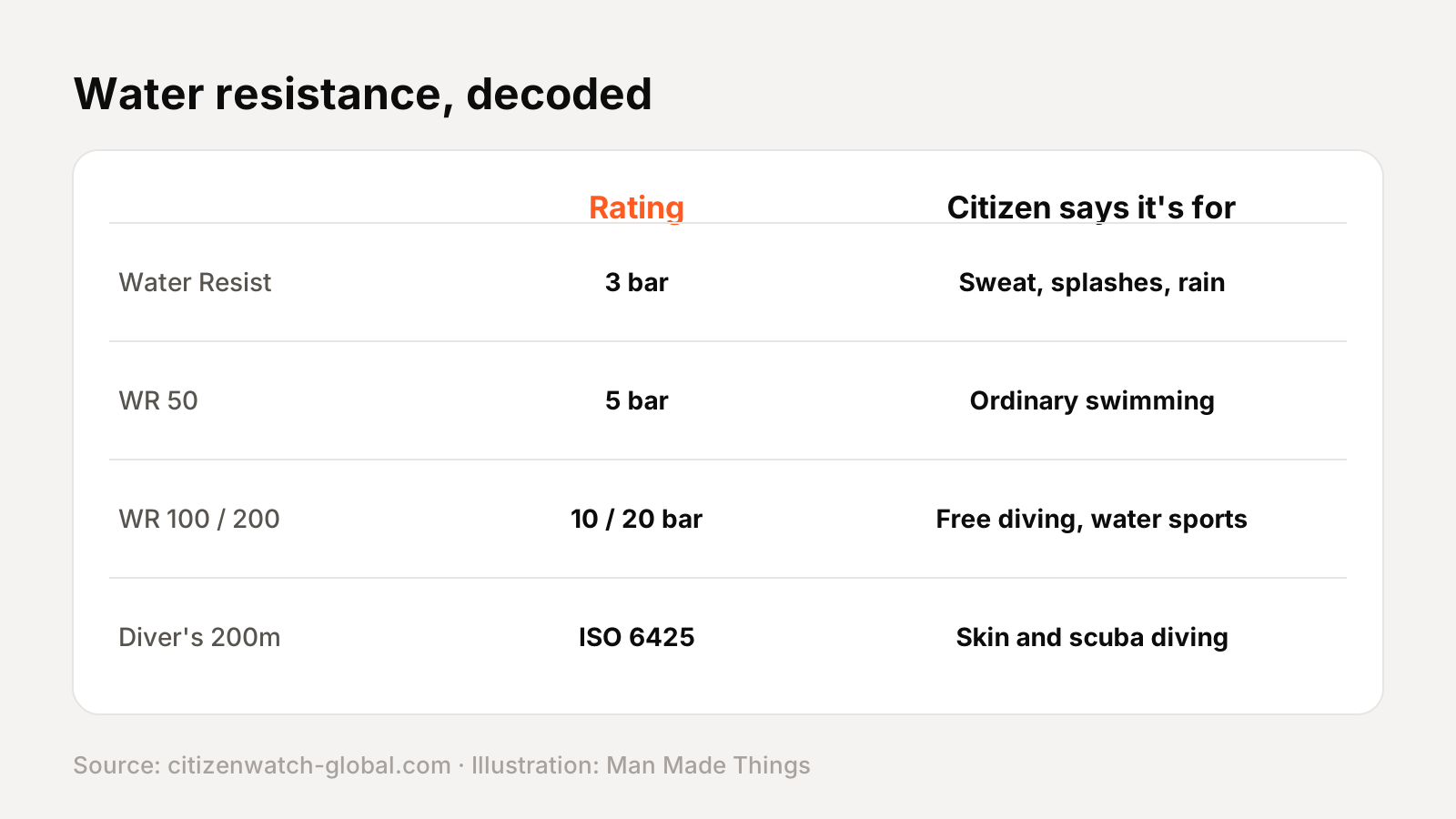
What it means: the watch's water resistance rating. It's often printed in meters, but brands also use bar or ATM. Citizen notes that 1 bar equals 1 atmosphere, or 10 meters of water.
Don't treat the number as a safe diving depth. Citizen, for example, says a 5 bar (50m) watch suits ordinary swimming but not free diving:
| Marking | What Citizen says it's for |
|---|---|
| Water Resist (3 bar) | Sweat, splashes and rain |
| WR 50 (5 bar) | Frequent water contact and ordinary swimming |
| WR 100 / 200 (10 / 20 bar) | Free diving and water sports |
| Diver's 200m | Skin and scuba diving |
The word "Diver's" matters. The FH says a diver's watch must be rated to at least 100m and add a dial legible in the dark, a way to track dive time, shock and magnetic resistance and a sturdy strap, under the ISO 6425 standard. Omega describes the dive bezel as one that "turns in only one direction," so it can't accidentally overstate your remaining dive time. Here's how to use a dive bezel.
Sources don't fully agree on showering. The FH says even a basic 2 bar watch handles hand-washing and showers, while Seiko says showering is OK from 5 bar. Both Citizen and Seiko say to avoid hot water and saunas, and Citizen says not to use the crown or buttons while the watch is wet.
6. Swiss Made
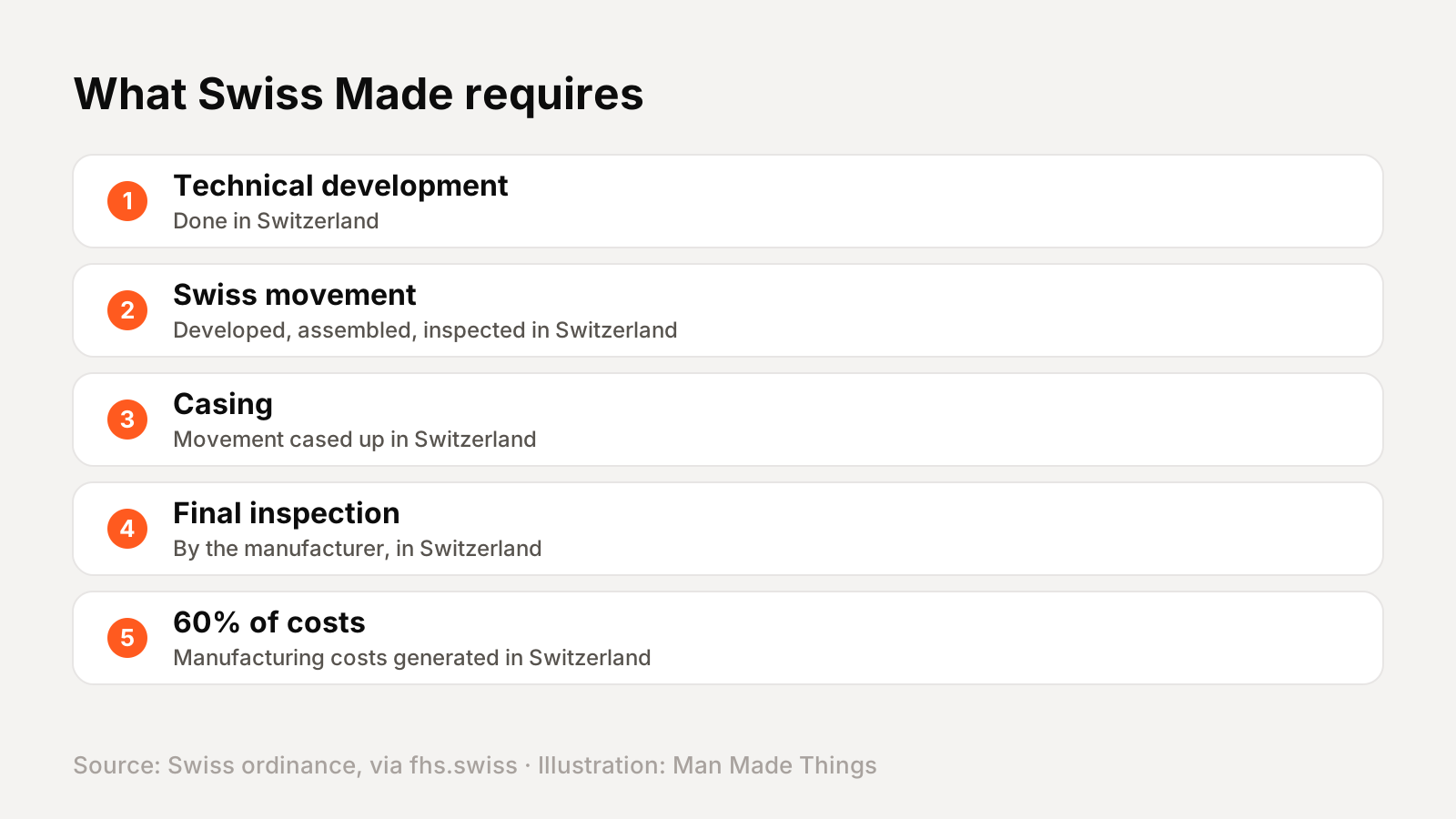
What it means: a legal claim, governed by a Swiss ordinance on the use of "Swiss" for watches, strengthened from January 1, 2017.
Under the ordinance, a watch is Swiss only if:
- its technical development took place in Switzerland;
- its movement is Swiss;
- the movement is cased up in Switzerland;
- the manufacturer's final inspection happens in Switzerland; and
- at least 60% of its manufacturing costs are generated in Switzerland.
Costs such as packaging, transport, marketing and the battery don't count toward the 60%. The FH says the 2017 rules introduced a minimum Swiss value for "the watch as a whole, rather than for the movement alone."
"Swiss Made" vs "Swiss Movement": a movement is Swiss if it's developed, assembled and inspected in Switzerland, with at least 60% of its manufacturing costs there and at least half the value of its parts Swiss-made. A watch that doesn't qualify as Swiss can still say "Swiss movement," but the ordinance requires "movement" to be written out in full, in the same typeface, size and color as "Swiss."
The small print: other words you'll see
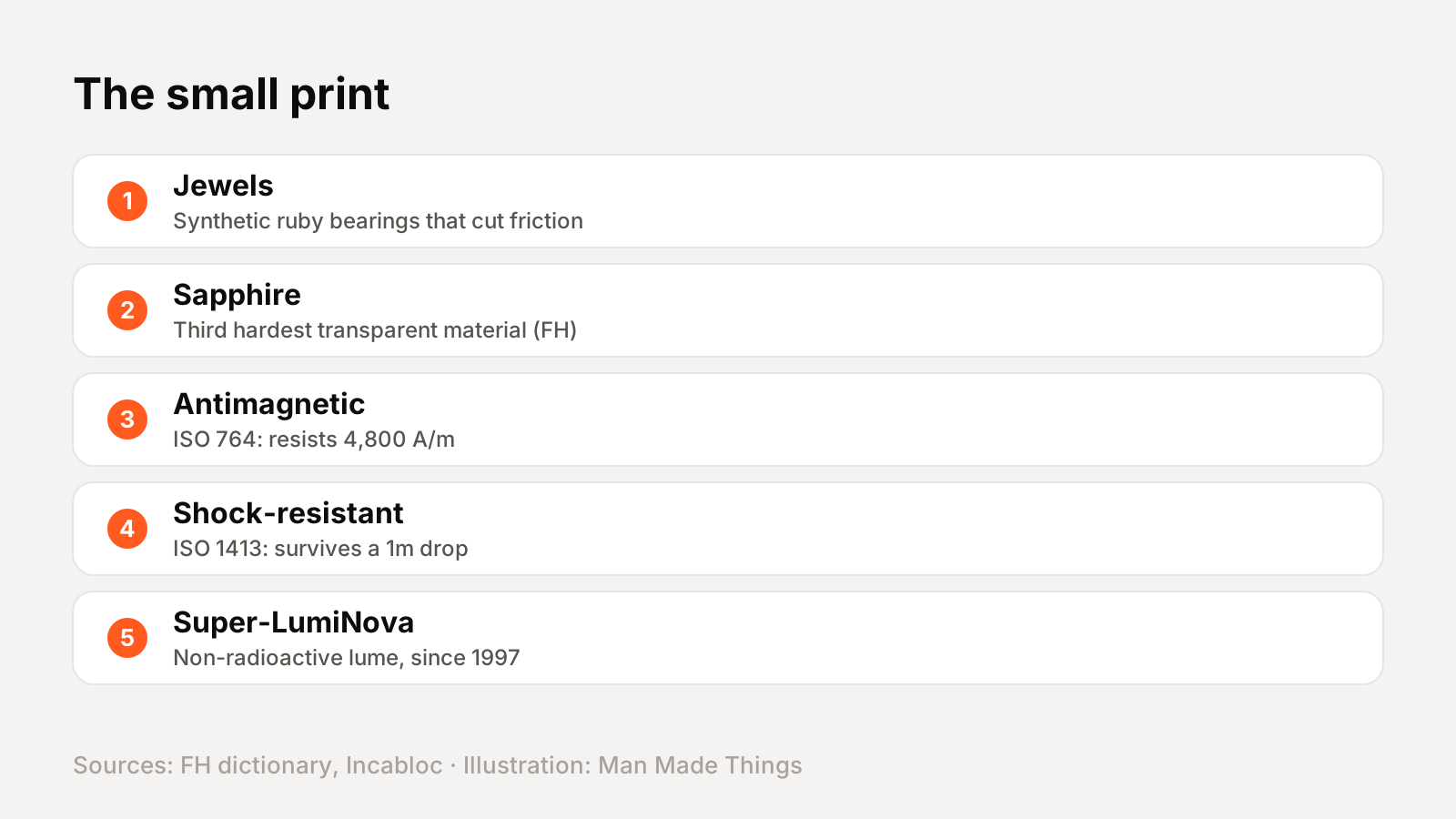
- Jewels (e.g. "21 Jewels"): "The jewels of a watch are bearings," says the FH, usually synthetic ruby. Incabloc says their main purpose is to minimize friction. No official source we found explains what a specific jewel count signifies, so don't read too much into it.
- Sapphire: synthetic corundum, which the FH calls "the third hardest transparent material in existence." It reflects almost twice as much light as mineral glass, which is why many sapphire crystals get an anti-reflective coating. More in sapphire vs mineral crystal.
- Antimagnetic: meets the ISO 764 standard, which simulates exposure to a 4,800 A/m magnetic field, according to the FH. Brands like Omega use the word for far higher resistance, up to 15,000 gauss.
- Shock-resistant: under ISO 1413, a watch must survive an accidental 1-meter drop onto a hardwood floor (FH). Incabloc, a common shock-protection system, says such a drop subjects the balance to about 5,000 g.
- Super-LumiNova / LumiBrite: non-radioactive glow-in-the-dark materials. The FH says Super-LumiNova has been on the market since 1997 and glows brighter than tritium, but fades after a few hours.
- Tritium: a radioactive hydrogen isotope used on dials since the 1950s, with a half-life of 12.32 years (FH). Many brands dropped it in the late 1990s.
The bottom line: "Swiss Made" and "Officially Certified" are the claims with the most behind them, through Swiss law and COSC's testing. A depth rating tells you what the maker tested for, but check what the maker says that rating is suitable for, not just the number. And "Automatic" just tells you how the watch is powered.
Frequently asked questions
What does "Officially Certified Chronometer" mean?
+
The movement passed COSC's ISO 3159 test: 15 days, 5 positions and 3 temperatures, averaging -4 to +6 seconds a day.
Can I swim with a 50m watch?
+
Citizen says a 5 bar (50m) watch suits ordinary swimming but not free diving. For scuba diving, use a watch marked "Diver's."
What does Swiss Made mean on a watch?
+
Under Swiss law, the watch must be developed in Switzerland, have a Swiss movement, be cased and inspected in Switzerland, and generate at least 60% of its manufacturing costs there.
What is the difference between Swiss Made and Swiss Movement?
+
Swiss Made covers the whole watch. Swiss Movement means only the movement qualifies as Swiss, and the word "movement" must be written in full.
What are jewels in a watch?
+
Bearings, usually made of synthetic ruby, that reduce friction in the movement.
Sources
- FH: Swiss Made
- FH: Strengthening Swiss Made
- Swiss Made ordinance (FH English translation, PDF)
- FH: Water resistance
- FH: Dictionary of watchmaking
- COSC: Certified chronometer
- COSC: Certified Excellence Chronometer
- Omega: Master Chronometer
- Omega: Glossary
- Citizen: Water resistance
- Citizen: Mechanical watches
- Citizen: Eco-Drive
- Seiko: Water resistance FAQ
- Seiko: Quartz knowledge
- Seiko: Spring Drive
- Seiko: Kinetic
- Incabloc: Shock absorbers
- Incabloc: Stones and sapphires

Watches & Coffee Writer
Aditya is a passionate coffee lover who loves watches. He covers watches and coffee for Man Made Things.
More from Aditya →