Distilled By, Bottled By or Produced By? How to Tell Who Really Made Your Bourbon
What 'distilled by', 'bottled by' and 'produced by' legally mean on a US whiskey label, how state of distillation is shown, and the bourbon types most people never notice, all from the federal labeling rules in 27 CFR Part 5.
We may earn a commission when you buy through links on this page. Learn more
Quick answer
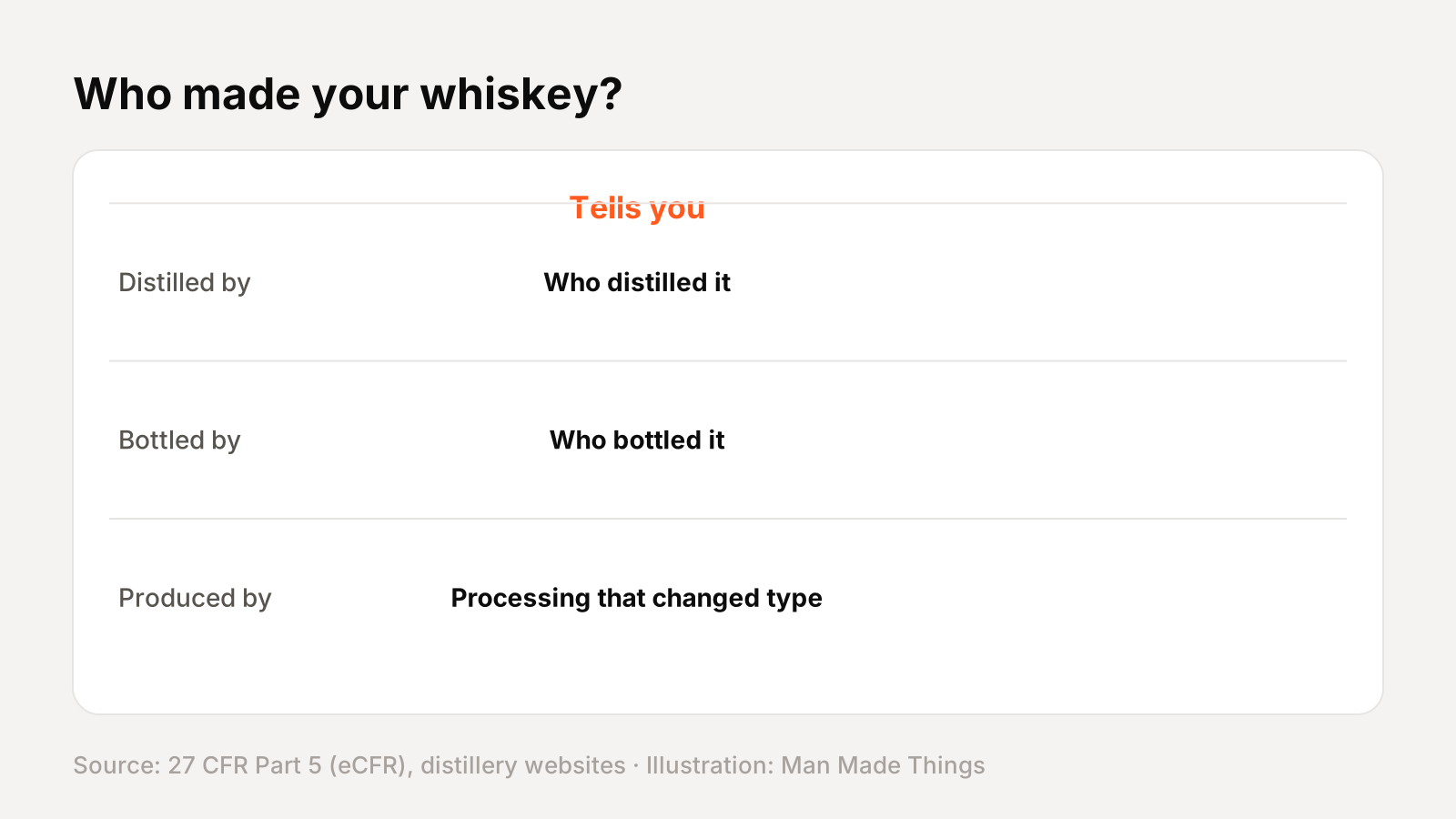
Under US labeling rules (27 CFR 5.66), 'distilled by' names the company that actually distilled the spirit, 'bottled by' names the company that bottled it, and 'produced by' indicates a processing operation that changes the class or type of the product. Only 'distilled by' tells you who made the whiskey. The label must also show the state where it was distilled, either through a 'distilled by' address, a state name like 'Kentucky' in the type, or a separate 'Distilled in' statement.
Pick up a few bourbon bottles and read the small print on the back. One says "Distilled and bottled by" a distillery in Kentucky. Another says "Bottled by" a company in a different state. A third says "Produced by." They sound interchangeable, but under federal rules each means something specific, and only one of them tells you who actually made the whiskey.
This matters because the company named on the front of a bottle isn't always the one that distilled what's inside. Sourcing whiskey from another distillery is legal, and the label wording is how you tell the difference.
Below are the exact rules from the US Code of Federal Regulations, Title 27, Part 5, the labeling rules for distilled spirits. For the basics of what "bourbon," "straight" and "bottled in bond" mean, start with our whiskey label decoder.
Distilled by, bottled by and produced by: the legal meanings
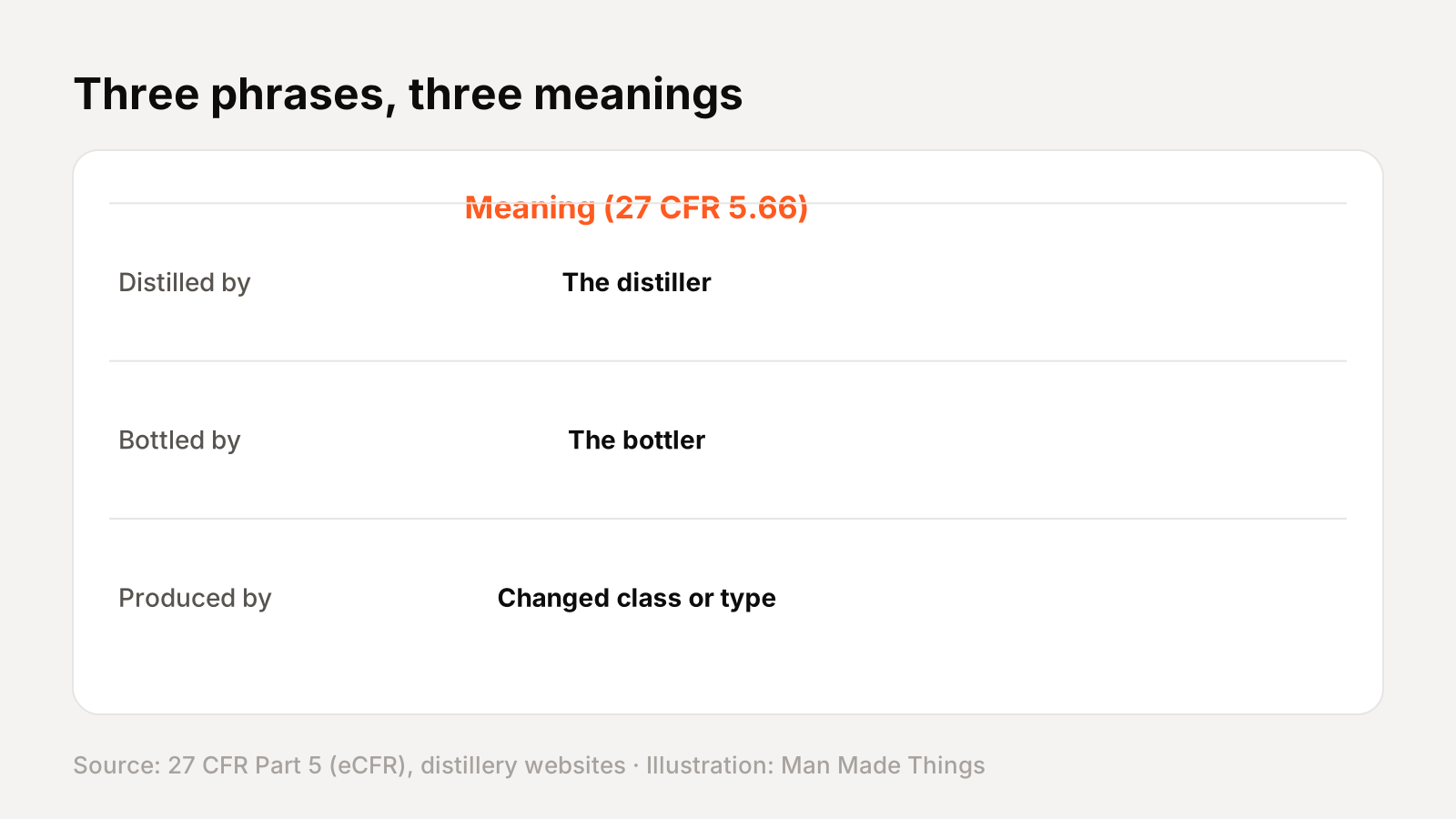
27 CFR 5.66 sets out what each phrase means:
| Phrase on the label | What it legally tells you |
|---|---|
| "Distilled by" | The company that distilled the spirit |
| "Bottled by" | The company that bottled it, which may not be the distiller |
| "Produced by" | A processing operation, "formerly known as rectification," that "involves a change in the class or type of the product" |
"Produced by" doesn't mean "distilled by." In the regulation, it refers to processing that changes the product's class or type. If you want to know who distilled the whiskey, look for the word "distilled."
The rules also say a label may not suggest that one company did all the work when several were involved (5.66(c)).
How the label tells you where it was distilled
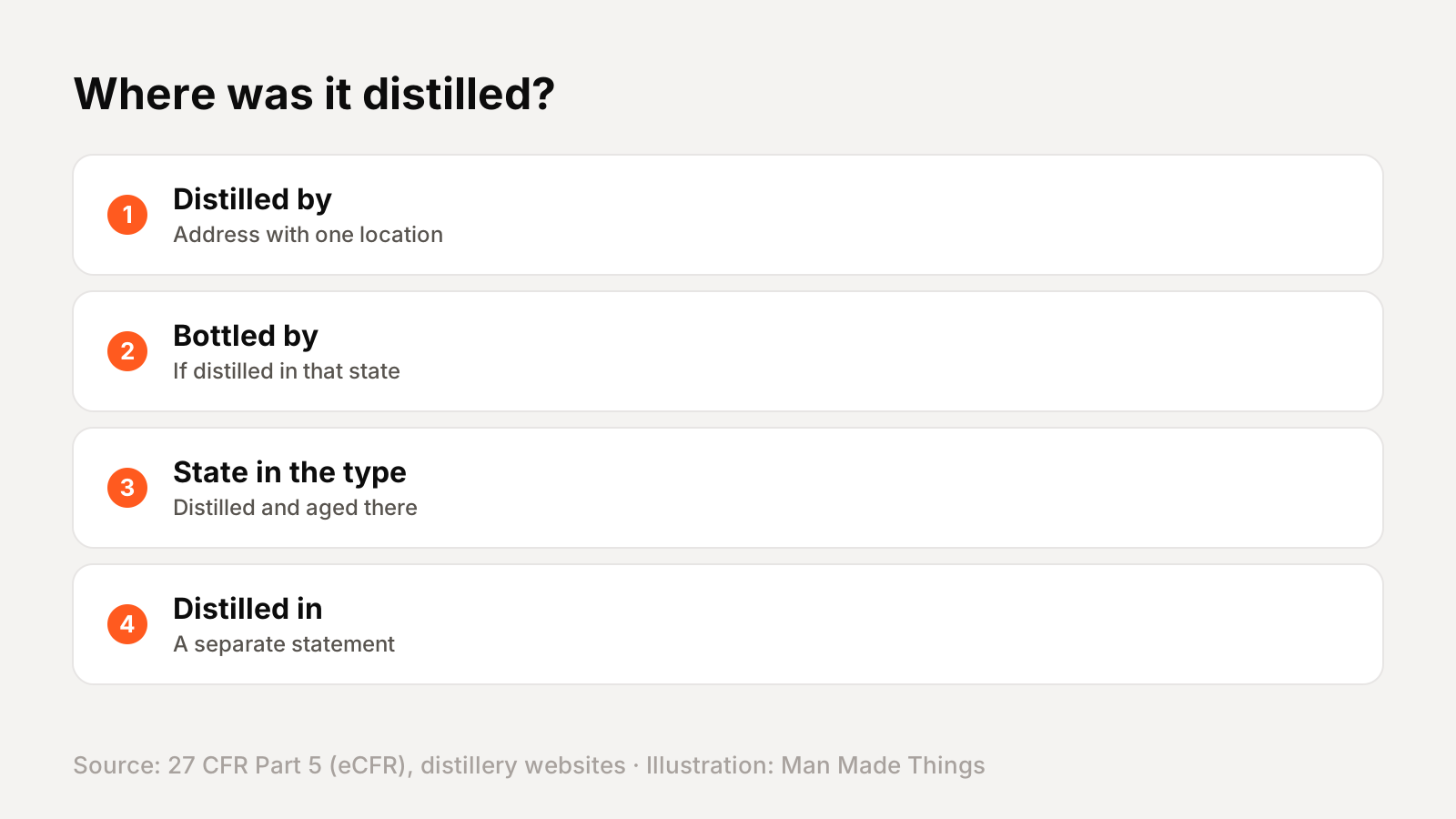
For bourbon and the other American whisky types in 27 CFR 5.143, the label must show the state of distillation (5.63(c)(4) and 5.66(f)). There are four ways to do it:
- A "distilled by" statement with a single location.
- The "bottled by" address, if the whiskey was distilled in that same state.
- A state name next to the type, such as "Kentucky Bourbon Whisky," which is only allowed if the whiskey was both distilled and aged in that state.
- A separate statement such as "Distilled in Indiana."
So a bottle labeled "Kentucky Straight Bourbon Whiskey" tells you it was distilled and aged in Kentucky, even if it was bottled elsewhere. A "Distilled in" line on a bottle from a company based in another state can be a sign that the whiskey was distilled by someone else.
Bourbon types most people never notice
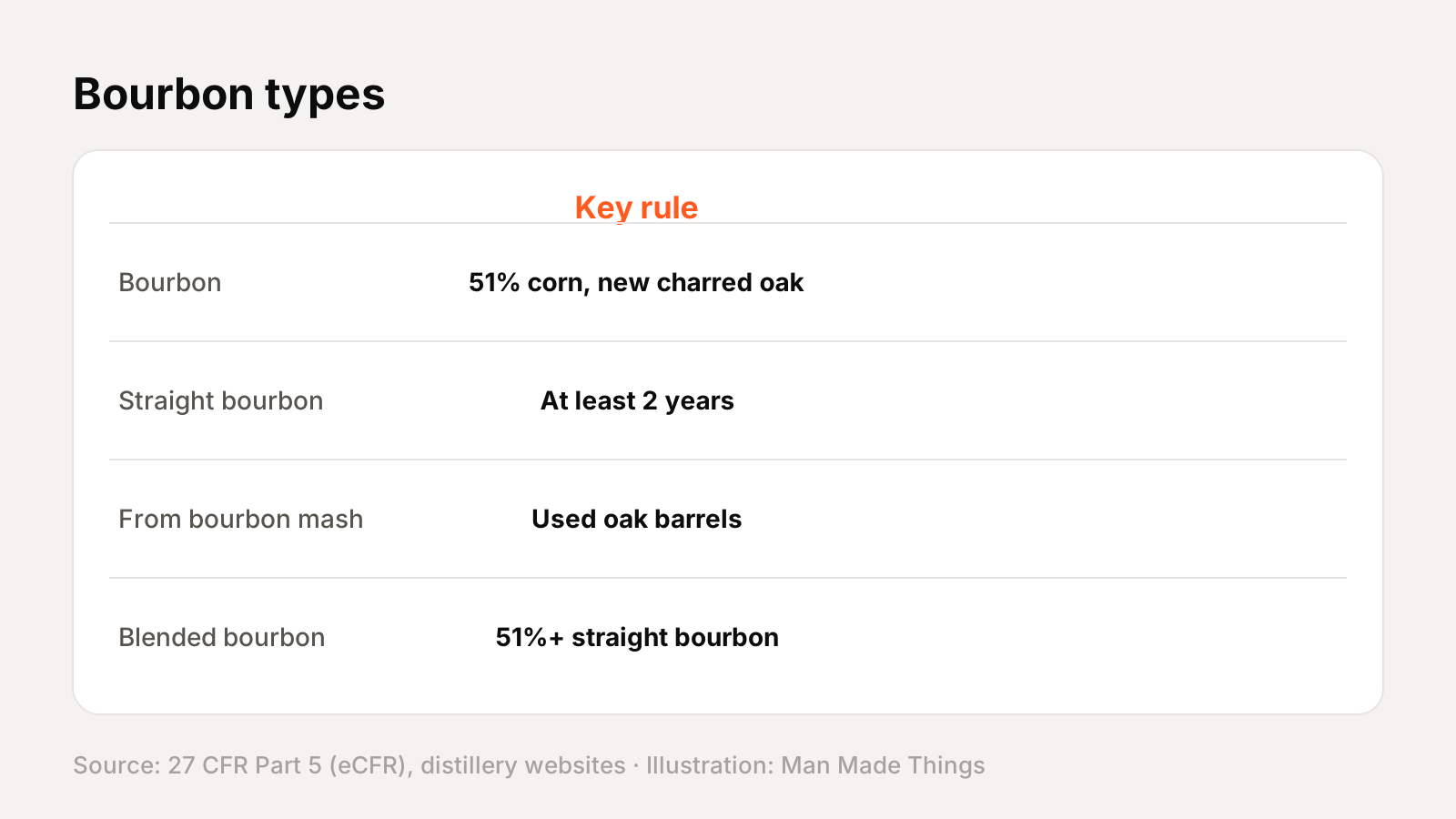
Everyone knows "bourbon" and "straight bourbon." The standards of identity in 27 CFR 5.143 define several more:
| Type | Key rule |
|---|---|
| Bourbon whisky | At least 51% corn, distilled at 160 proof or less, stored in charred new oak at 125 proof or less; no added coloring or flavoring |
| Straight bourbon whisky | Same rules, aged at least 2 years |
| Whisky distilled from bourbon mash | Bourbon-style mash, but aged in used oak barrels; may only be produced in the US |
| Blended bourbon whisky | At least 51% straight bourbon; the rest can be other whisky or neutral spirits (up to 49%) |
| Blended straight bourbon whiskies | Straight bourbons from different states, or from one state with coloring, flavoring or blending material added |
Read the full type name on the label carefully. "Blended bourbon whisky" can contain neutral spirits; "straight bourbon whisky" can't.
Geography: the regulation says "bourbon" may not describe any whisky "not distilled and aged in the United States."
Age statements: when they're required
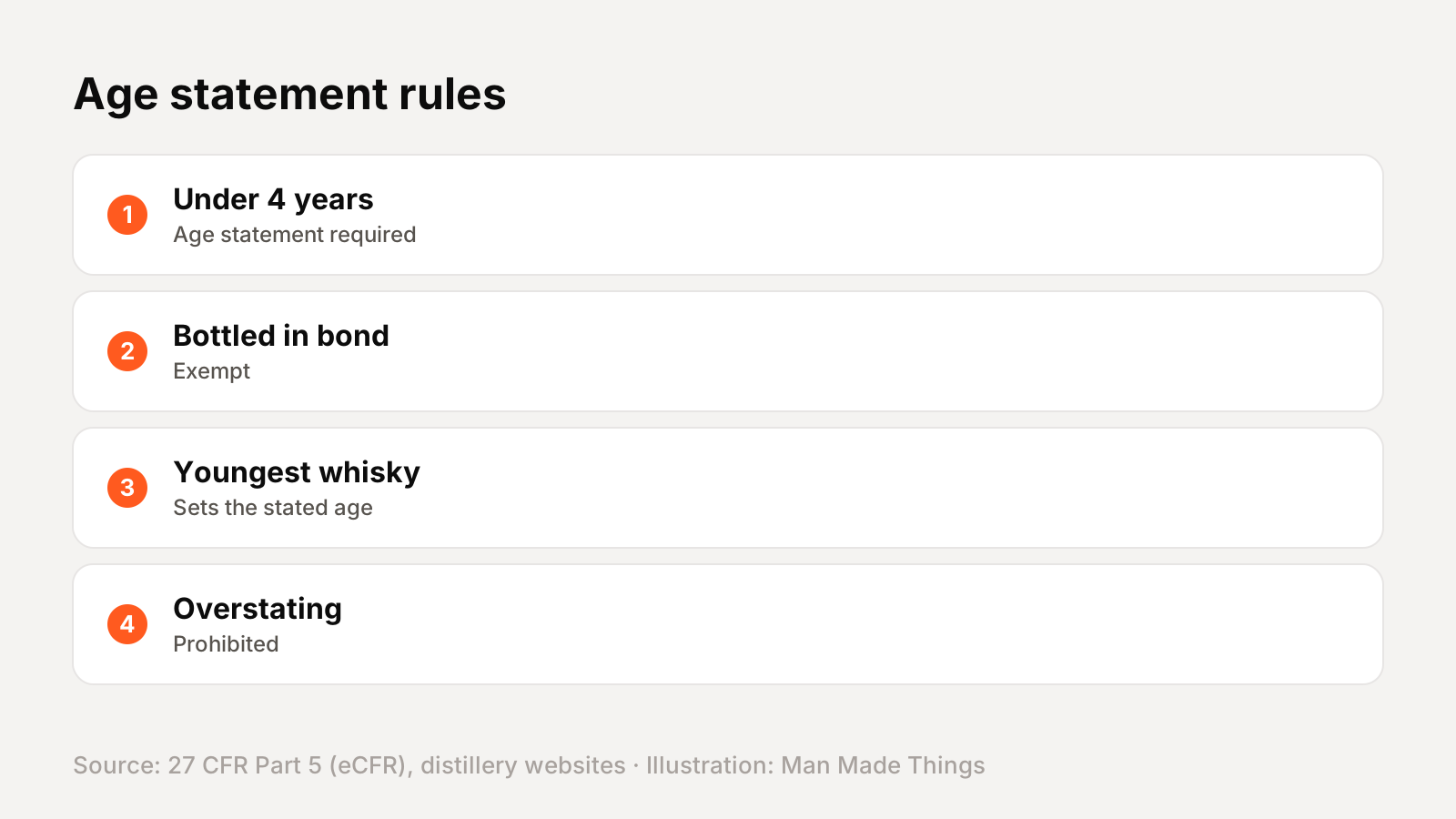
The age rules are in 27 CFR 5.74:
- Age is the time "after distillation and before bottling" that the whisky spent in oak barrels.
- Whiskies aged less than 4 years must carry an age statement, unless labeled "bottled in bond."
- So a straight bourbon with no age statement is at least 4 years old.
- The statement must reflect the youngest whisky in the bottle and may be given in years, months or days.
- Understating age is allowed; overstating is prohibited.
- A distillation date may only appear alongside an age statement.
A phrase on a brand website, like "aged between 6-8 years," isn't the same as an age statement on the label.
Proof, barrel proof and the terms that aren't defined
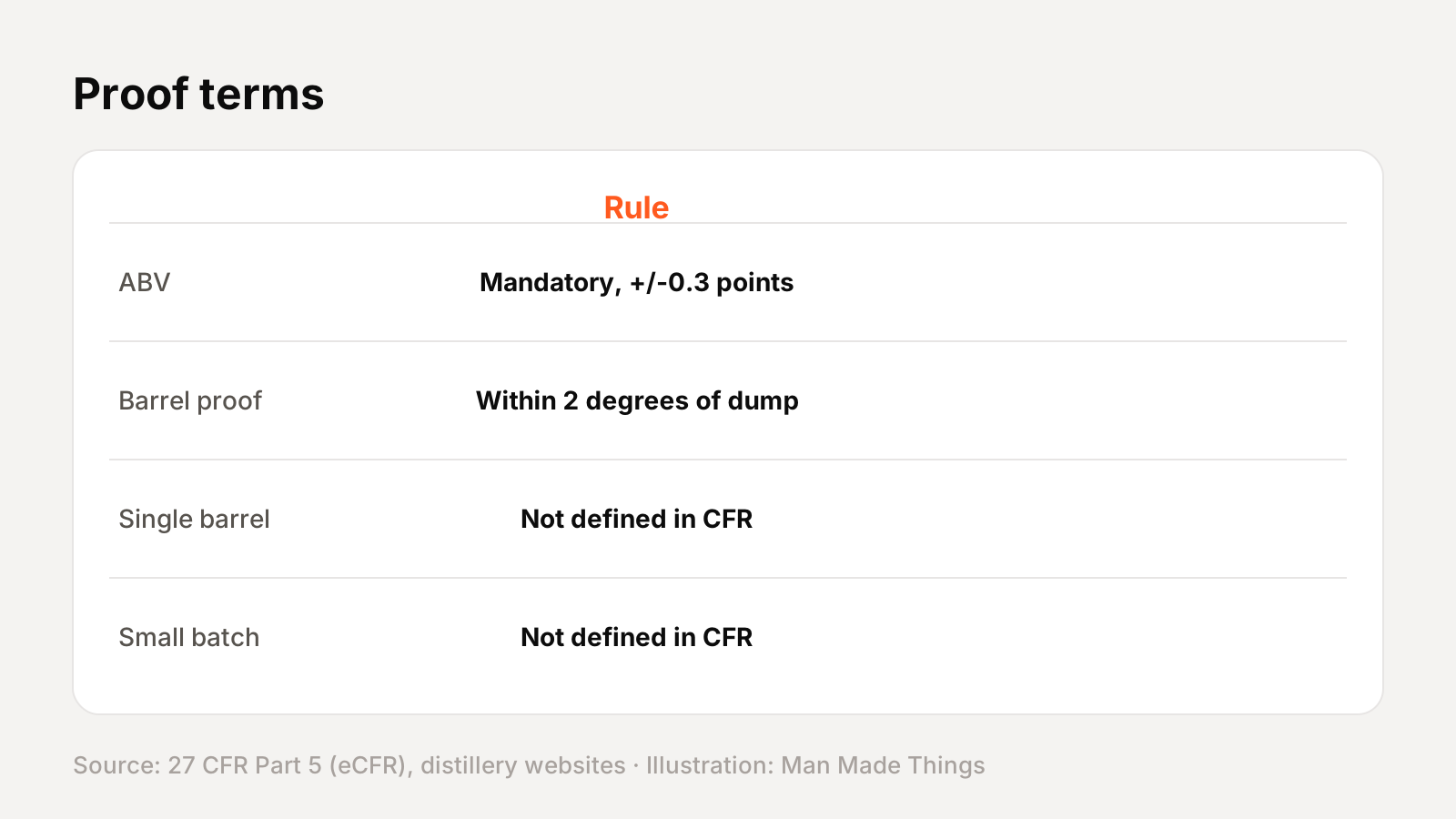
| Term | What the rules say |
|---|---|
| Alcohol by volume | Mandatory on the label (5.65); proof is optional but must appear in the same field of vision, with a tolerance of ±0.3 percentage points |
| Barrel proof / cask strength | Bottling proof is "not more than two degrees lower" than the proof when the spirit was dumped from the barrel (5.87) |
| Original proof / entry proof | Bottled at the same proof it entered the barrel (5.87) |
| Bottled in bond | One distiller, one distillery, one season, at least 4 years in wood, exactly 100 proof, with DSP numbers on the label (5.88) |
| Single barrel, small batch | Not defined in 27 CFR Part 5; they're marketing terms, still subject to the general ban on misleading statements |
For the full bonded rules, read bottled-in-bond explained.
DSP numbers: the clue on bonded bottles
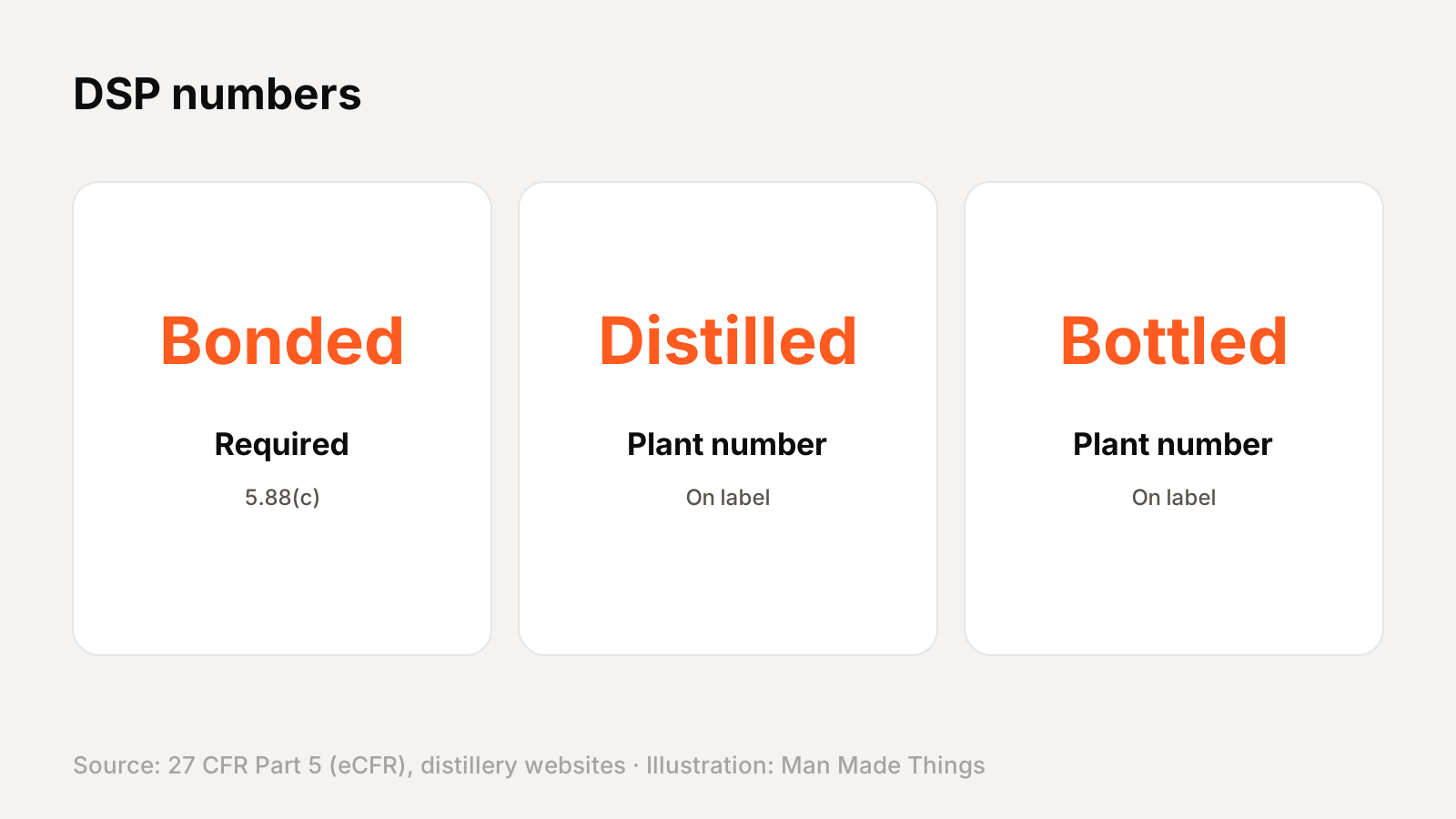
Every US distillery operates as a registered distilled spirits plant (DSP) with a permit number, such as "DSP-KY-" followed by digits for Kentucky. The general labeling rules don't require a DSP number on the bottle, but bottled-in-bond labels must show "the number of the distilled spirits plant in which distilled, and the number of the distilled spirits plant in which bottled" (5.88(c)).
That makes bonded bottles some of the most transparent on the shelf: the label tells you exactly which plant made the whiskey.
Real labels, decoded
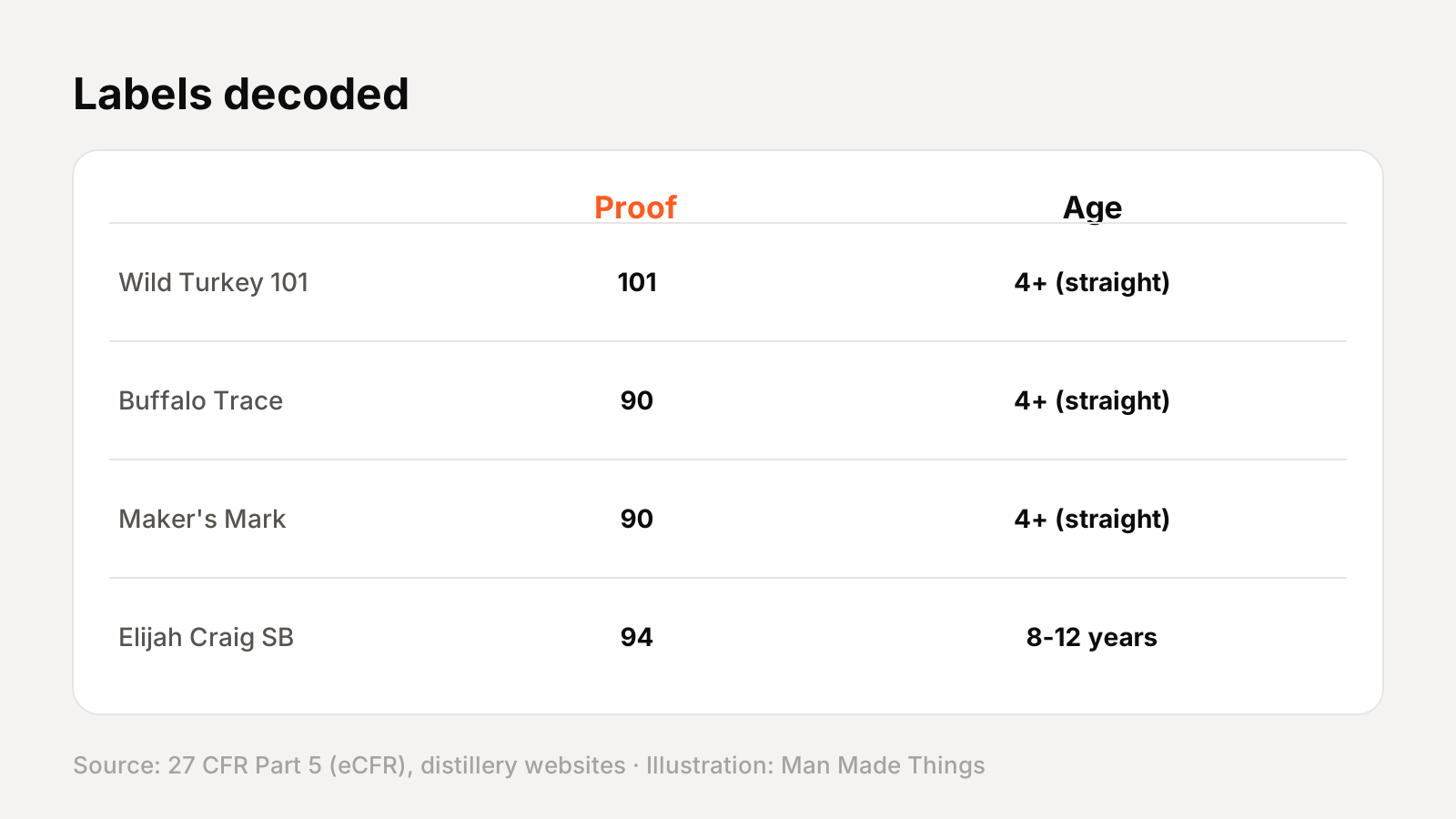
| Bottle | Type on label | Proof | Age |
|---|---|---|---|
| Wild Turkey 101 | Kentucky Straight Bourbon Whiskey | 101 | No age statement on the product page; at least 4 years under the straight rules |
| Buffalo Trace | Kentucky Straight Bourbon Whiskey | 90 | No age statement; at least 4 years |
| Maker's Mark | Kentucky Straight Bourbon Whisky | 90 | No age statement; Maker's uses wheat instead of rye |
| Elijah Craig Small Batch | Kentucky Straight Bourbon Whiskey | 94 | Heaven Hill lists it as 8 to 12 years old |
All four carry "Kentucky" in the type, which under the rules means they were distilled and aged in Kentucky. Specs from each distillery's official website, November 2026. Looking for bottles to try? See our best everyday bourbons.
Frequently asked questions
What does 'distilled by' mean on a whiskey label?
+
It names the company that actually distilled the spirit, under 27 CFR 5.66.
Does 'produced by' mean the brand made the whiskey?
+
No. Under 27 CFR 5.66 it refers to a processing operation that changes the class or type of the product, not distillation.
Does a straight bourbon without an age statement have a minimum age?
+
Yes. Whiskies under 4 years old must carry an age statement (unless bottled in bond), so a straight bourbon with no age statement is at least 4 years old.
Are 'single barrel' and 'small batch' legally defined?
+
Not in the federal labeling regulations in 27 CFR Part 5. They're marketing terms.
Sources
Editor-in-Chief
Rahul has been writing about gadgets and software since 2013, first at Thetechhacker and now at Man Made Things. He edits every review on the site and signs off on every verdict.
More from Rahul →