De/code: A Whiskey Label. What Bourbon, Straight, Bottled-in-Bond and Single Malt Really Mean
Every word on a bourbon or Scotch label, decoded with the actual US regulations and the Scotch Whisky Association's rules: bourbon, straight, bottled-in-bond, barrel proof, age statements, single barrel, small batch, non-chill filtered, single malt and blended Scotch.
We may earn a commission when you buy through links on this page. Learn more
Quick answer
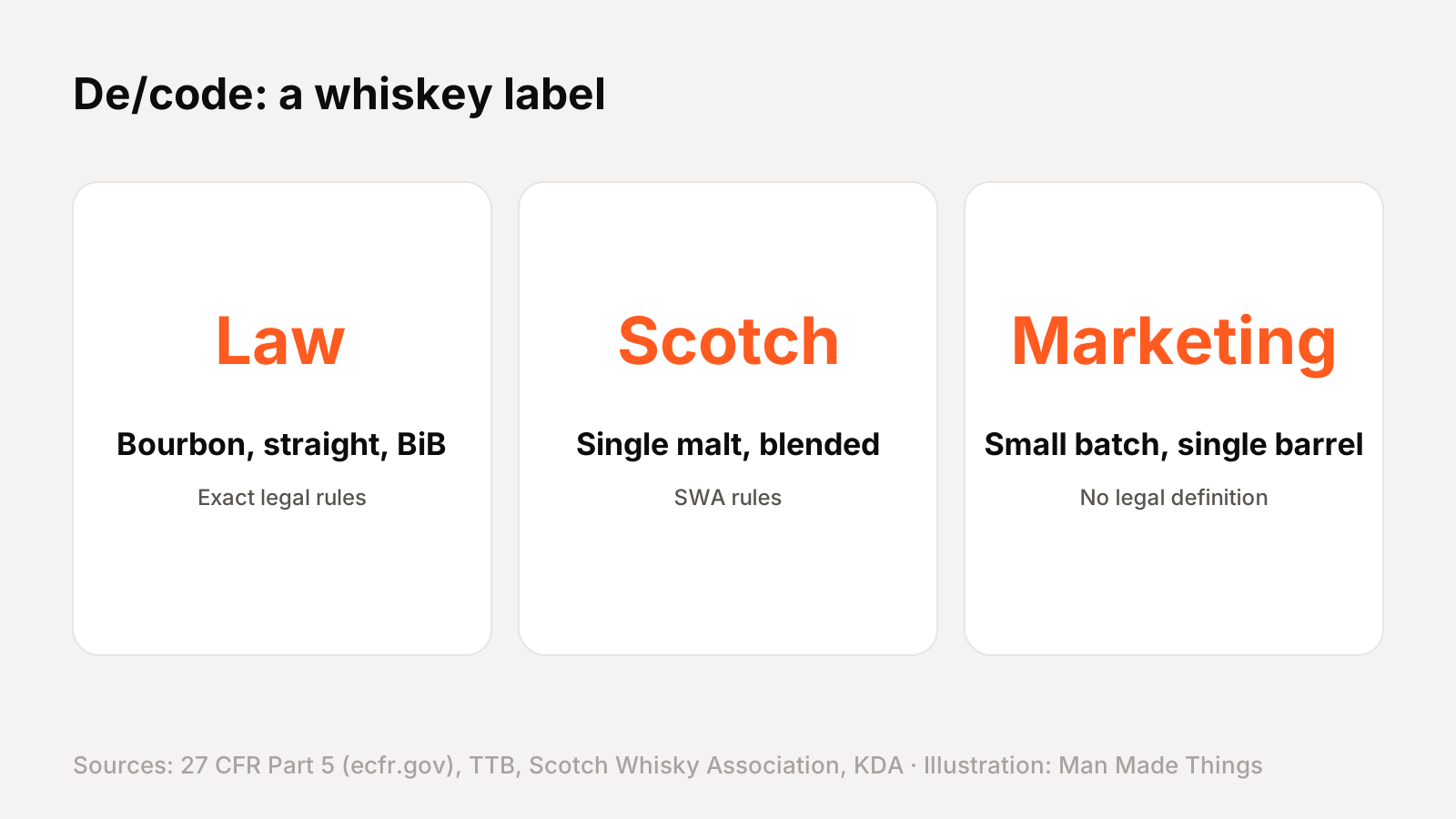
On a US whiskey label, "bourbon" means at least 51% corn, aged in new charred oak and made in the US. "Straight" means at least 2 years in new charred oak with nothing added. "Bottled-in-Bond" means one distiller, one distilling season, at least 4 years old and exactly 100 proof. "Barrel proof" or "cask strength" means bottled within 2 proof of the barrel. But "small batch" and "single barrel" aren't defined in federal regulations. On Scotch, "single malt" means malted barley from one distillery, distilled in pot stills, aged at least 3 years.
Whiskey labels are packed with words that sound important. Some of them are protected by law, with exact definitions down to the proof and the type of barrel. Others are just marketing, and mean whatever the distillery wants them to mean.
Knowing the difference helps you buy better bottles and avoid paying extra for a fancy word.
This De/code explains each term using the official rules: the US government's standards of identity for spirits (27 CFR Part 5, enforced by the Alcohol and Tobacco Tax and Trade Bureau, or TTB), the Scotch Whisky Association's guidance on the Scotch Whisky Regulations 2009, and, where there's no legal definition, the Kentucky Distillers' Association and distillers themselves. Where something isn't legally defined, I say so.
Bourbon
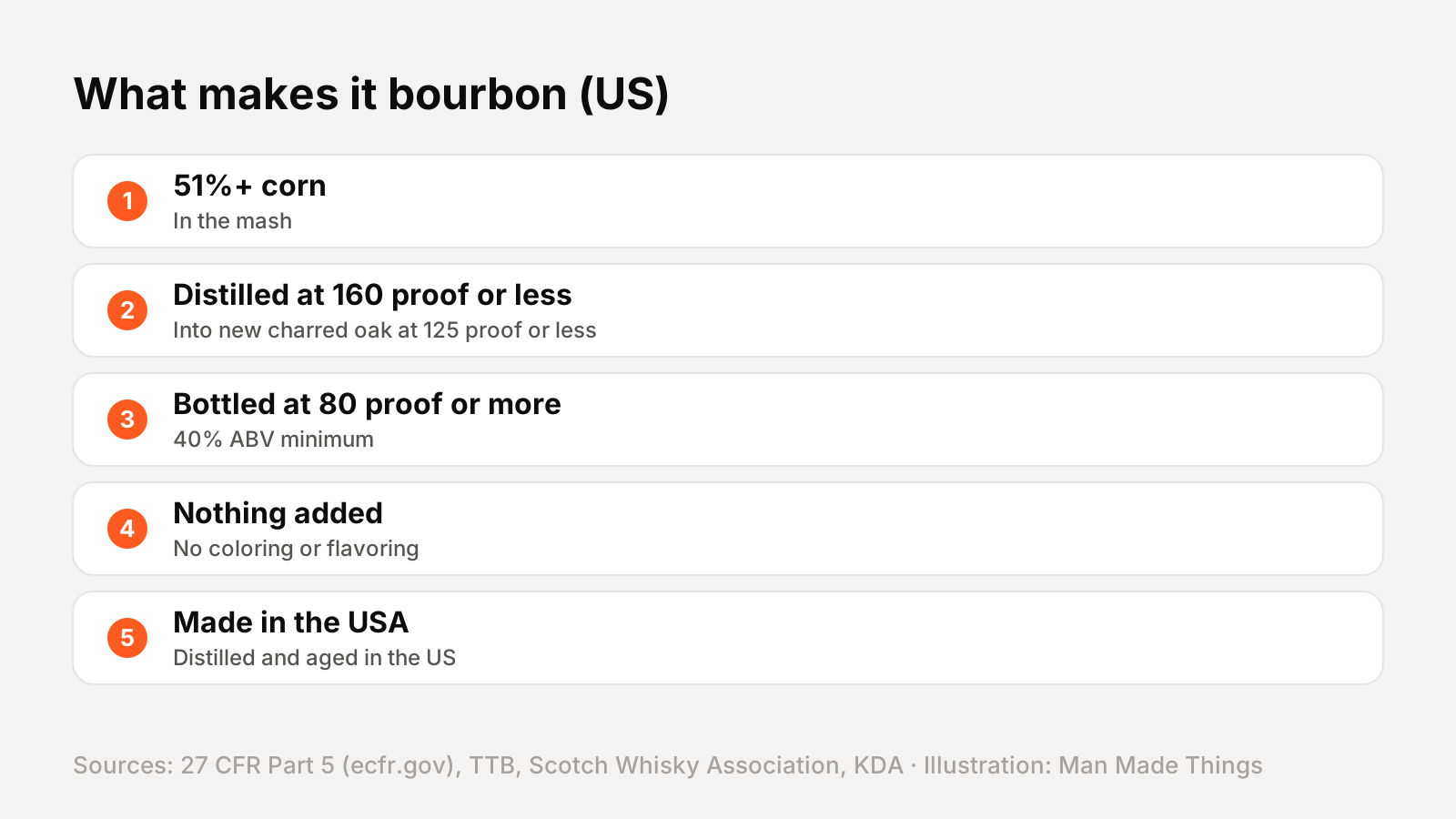
What it means: under US federal rules (27 CFR 5.143), bourbon must be:
- made from a mash of at least 51% corn;
- distilled at no more than 160 proof;
- stored in new charred oak containers, entering the barrel at no more than 125 proof;
- bottled at no less than 80 proof (40% ABV); and
- distilled and aged in the United States.
Unlike some whiskeys, bourbon can't contain added coloring, flavoring or blending materials.
A surprise: plain "bourbon" has no minimum aging time in the rules. It just has to go into the barrel. The two-year minimum applies only to straight bourbon, below.
Place names: a state on the label, like "Kentucky Bourbon," means it was distilled and aged in that state.
Straight
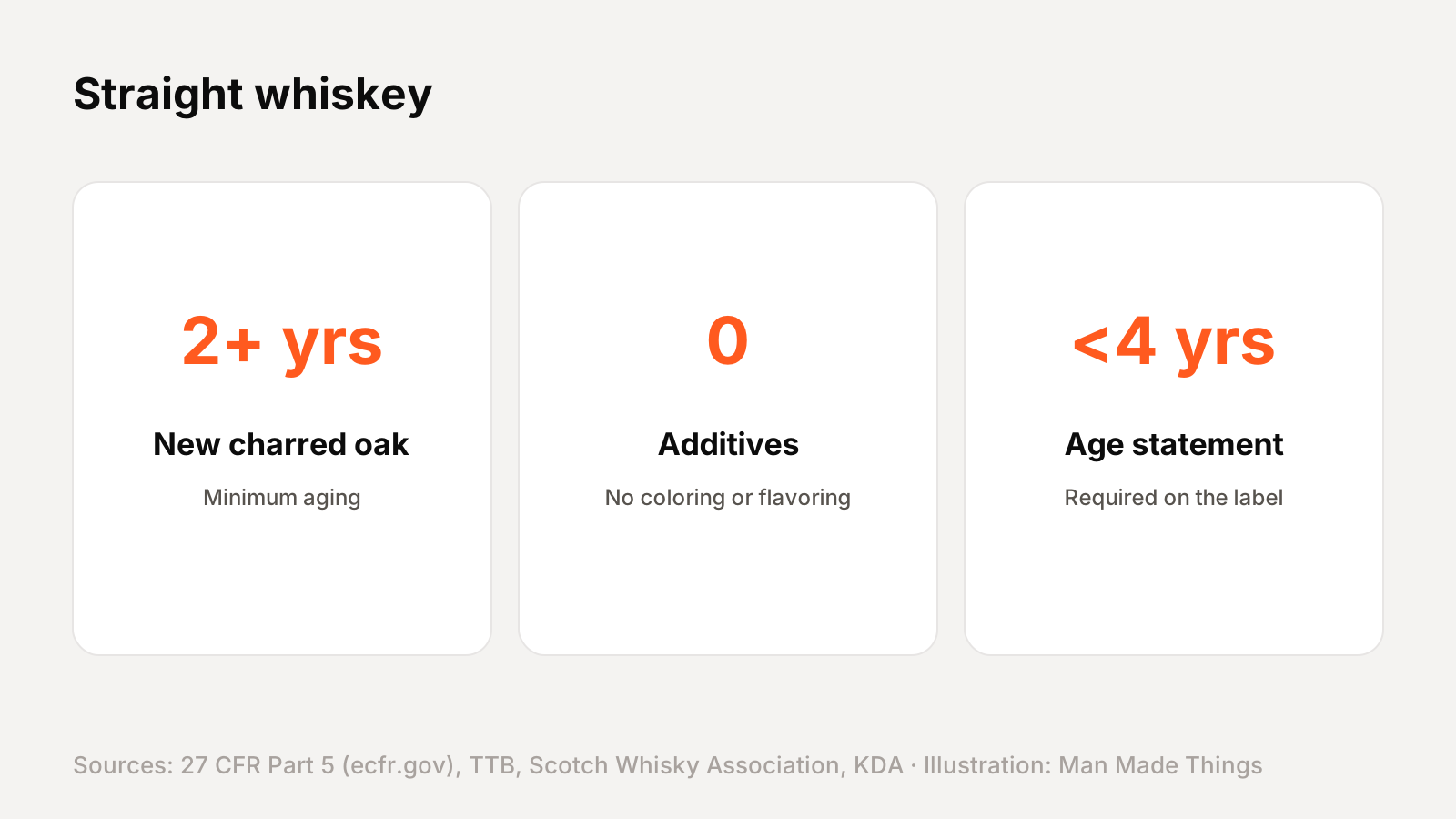
What it means: "straight" bourbon or rye has been stored in new charred oak for at least 2 years, with no coloring, flavoring or blending materials added.
The age statement rule: if a straight whiskey is aged less than 4 years, the label must say how old it is (27 CFR 5.74). So a straight bourbon with no age statement is at least 4 years old, unless it's labeled bottled-in-bond, which has its own rules.
Bottled-in-Bond
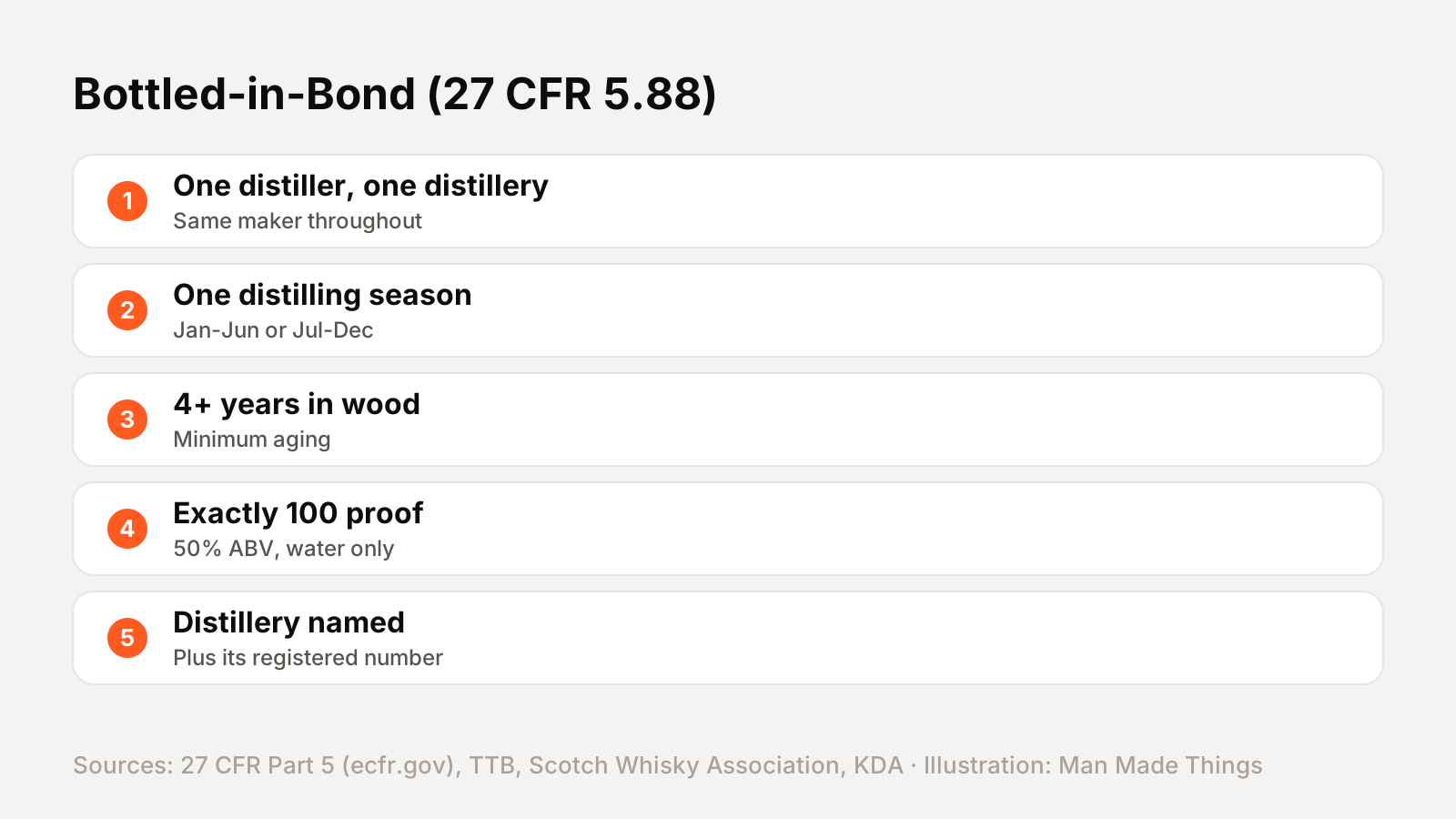
What it means: one of the strictest terms on any label. Under 27 CFR 5.88, bottled-in-bond spirits must be:
- distilled in the same distilling season (January–June or July–December), by the same distiller, at the same distillery;
- stored for at least 4 years in wooden containers;
- bottled at exactly 100 proof (50% ABV), reduced only with pure water; and
- labeled with the distillery's name and registered number.
The Kentucky Distillers' Association traces the term to the Bottled-in-Bond Act of 1897, which set these rules to guarantee quality. Imported spirits can use the term only if their home country allows it. Want more? See our bottled-in-bond explainer.
Barrel proof and cask strength
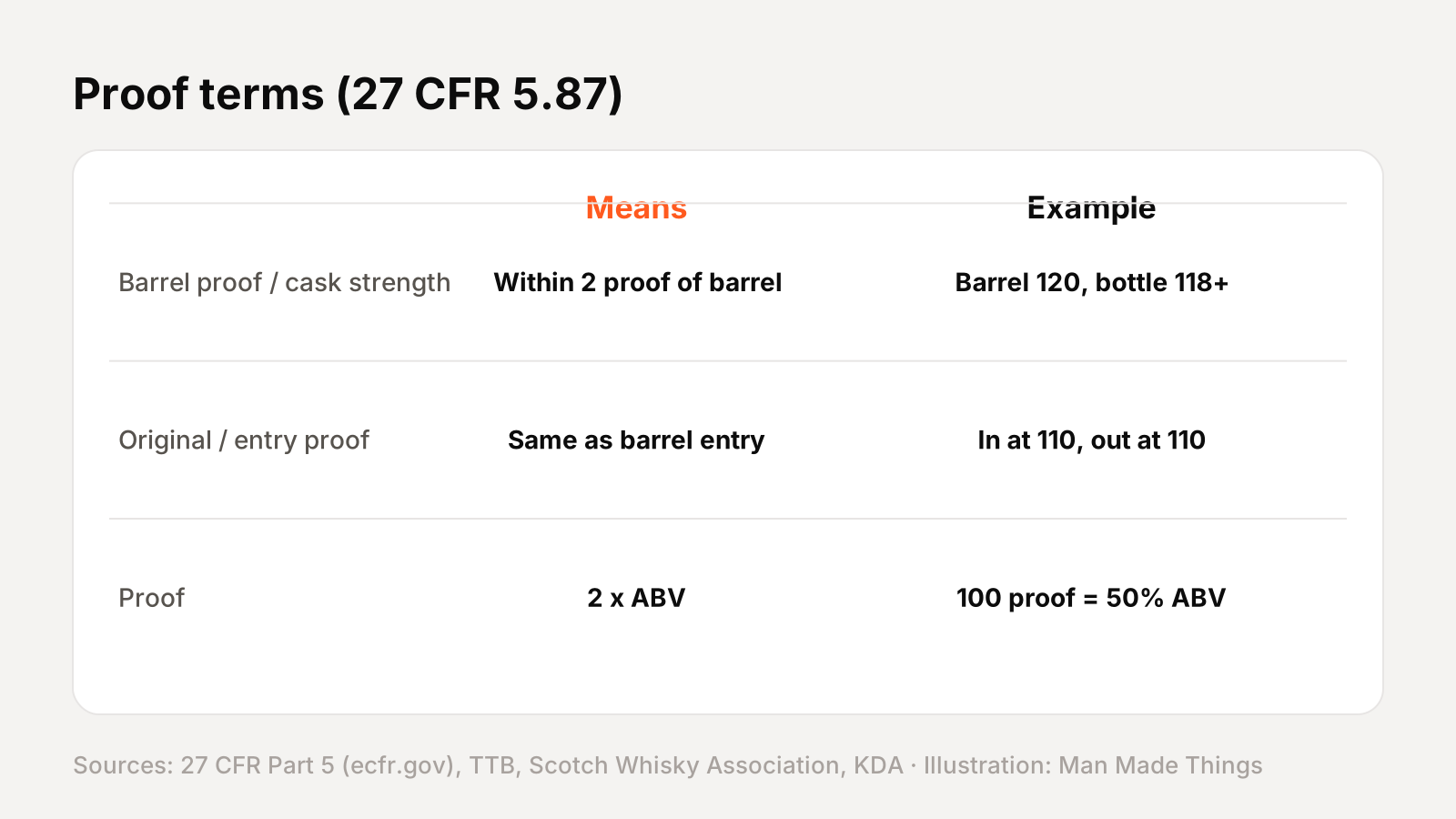
What it means: these terms are legally defined in the US (27 CFR 5.87).
- "Barrel proof" or "cask strength": the bottling proof is no more than two degrees lower than the proof when the whiskey came out of the barrel.
- "Original proof" or "entry proof": the bottling proof is the same as when the whiskey went into the barrel.
Proof vs ABV: US proof is simply twice the alcohol by volume, so 100 proof is 50% ABV. ABV is required on the label; proof is optional.
Age statements
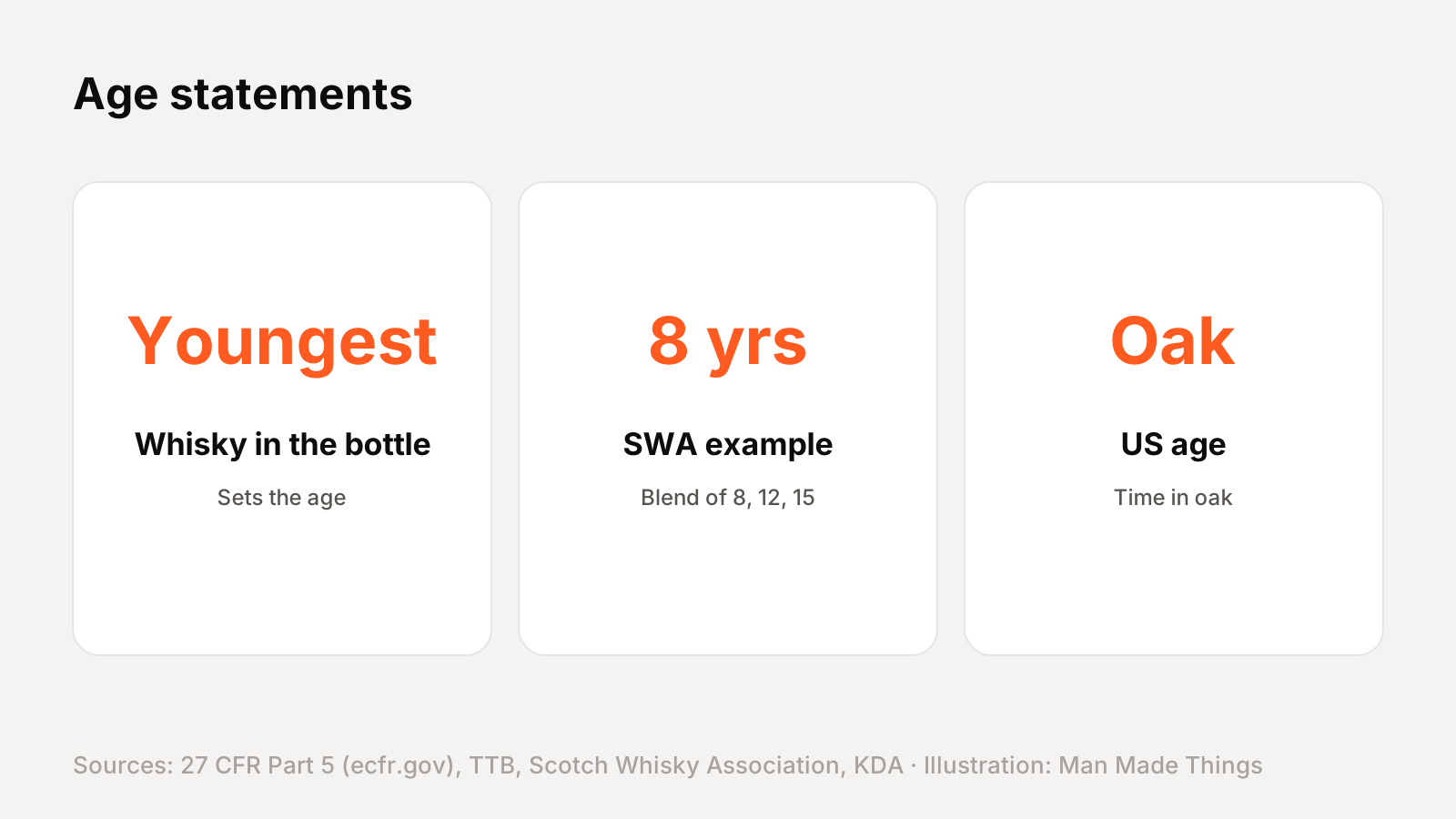
What it means: in both the US and Scotland, an age statement refers to the youngest whisky in the bottle.
The Scotch Whisky Association gives a clear example: a blend of 8, 12 and 15-year-old whiskies can only be called "8 years old." US rules (27 CFR 5.74) work the same way, and understating age is allowed, but overstating it isn't.
In the US, age means time spent in oak after distillation. For bourbon and rye, that's time in new charred oak.
Small batch, single barrel and non-chill filtered
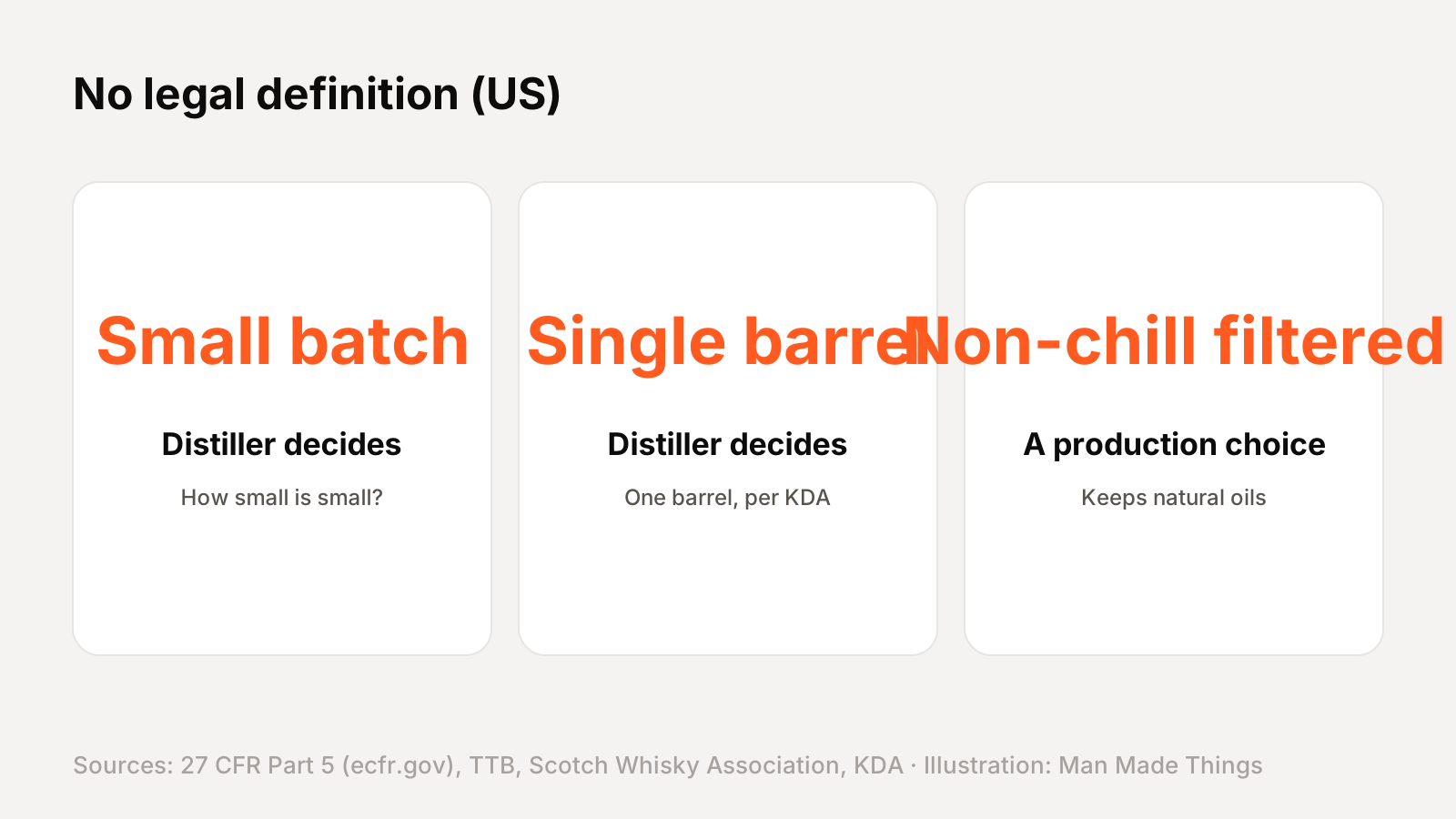
What they mean: these three popular terms aren't defined in federal regulations. None of them appears in 27 CFR. Each distillery decides what it means.
- Single barrel: the Kentucky Distillers' Association describes it as whiskey drawn from one barrel and not mingled with others.
- Small batch: the KDA describes it as mingling select barrels. There's no rule for how small "small" is.
- Non-chill filtered: chill filtering removes oils that can make whisky cloudy. Bruichladdich calls chill-filtering "a cosmetic process" that strips natural oils. Skipping it is a choice, not a regulated standard.
None of these terms is bad. They just tell you less than "bottled-in-bond" or "straight," which have legal rules behind them.
Scotch: single malt, single grain and blended
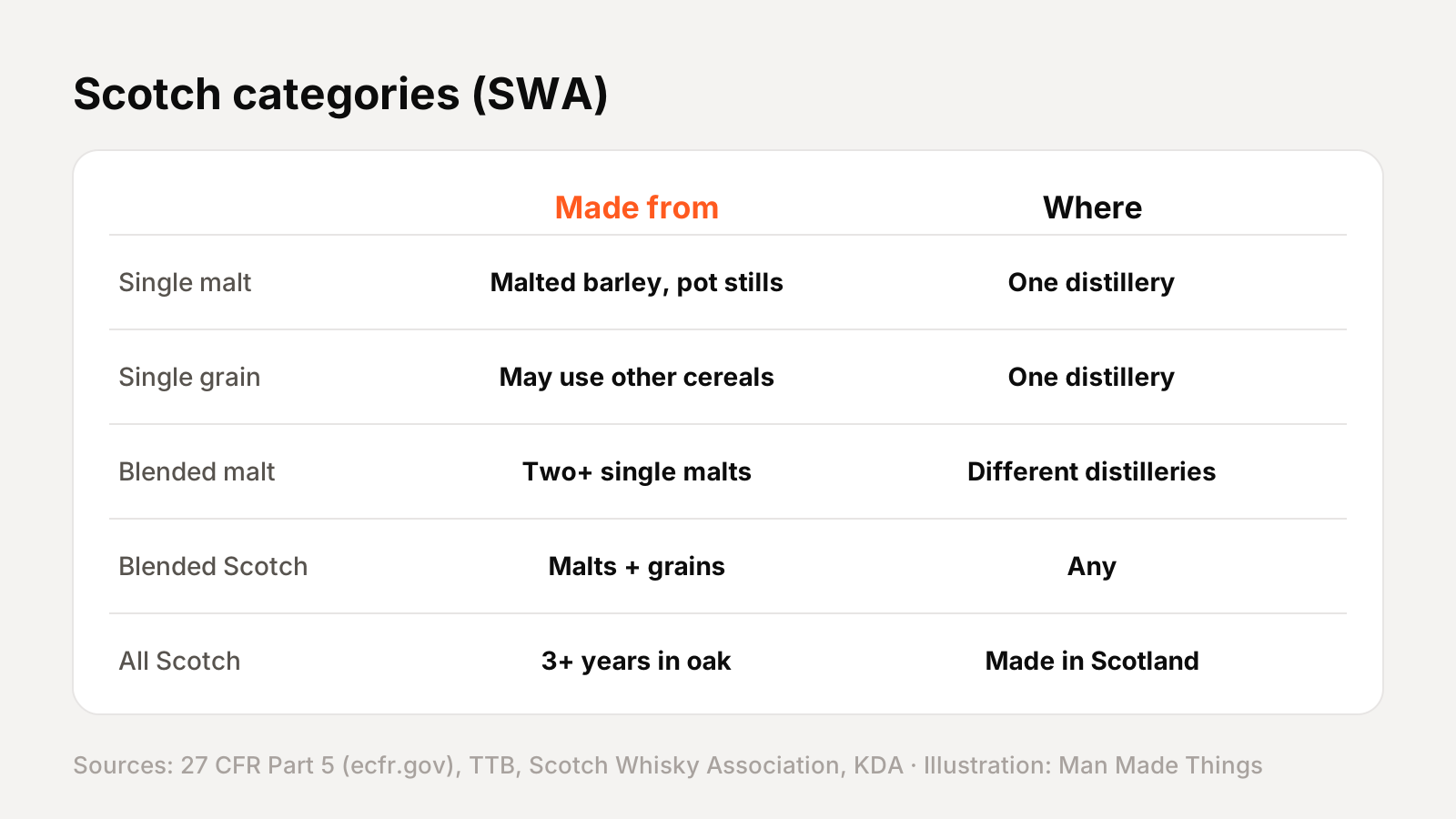
According to the Scotch Whisky Association, all Scotch whisky must be made and matured in Scotland, aged at least 3 years in oak casks of no more than 700 liters, bottled at at least 40% ABV, with no added flavoring or sweetening. The only coloring allowed is plain caramel, E150a.
- Single malt Scotch: made from only water and malted barley, at a single distillery, by batch distillation in pot stills.
- Single grain Scotch: made at a single distillery, and may use other cereals besides malted barley.
- Blended Scotch: one or more single malts blended with one or more single grains.
- Blended malt: two or more single malts from different distilleries. The SWA notes the old term "pure malt" is banned.
For more, see single malt vs blended Scotch and bourbon vs rye vs Scotch.
The quick cheat sheet
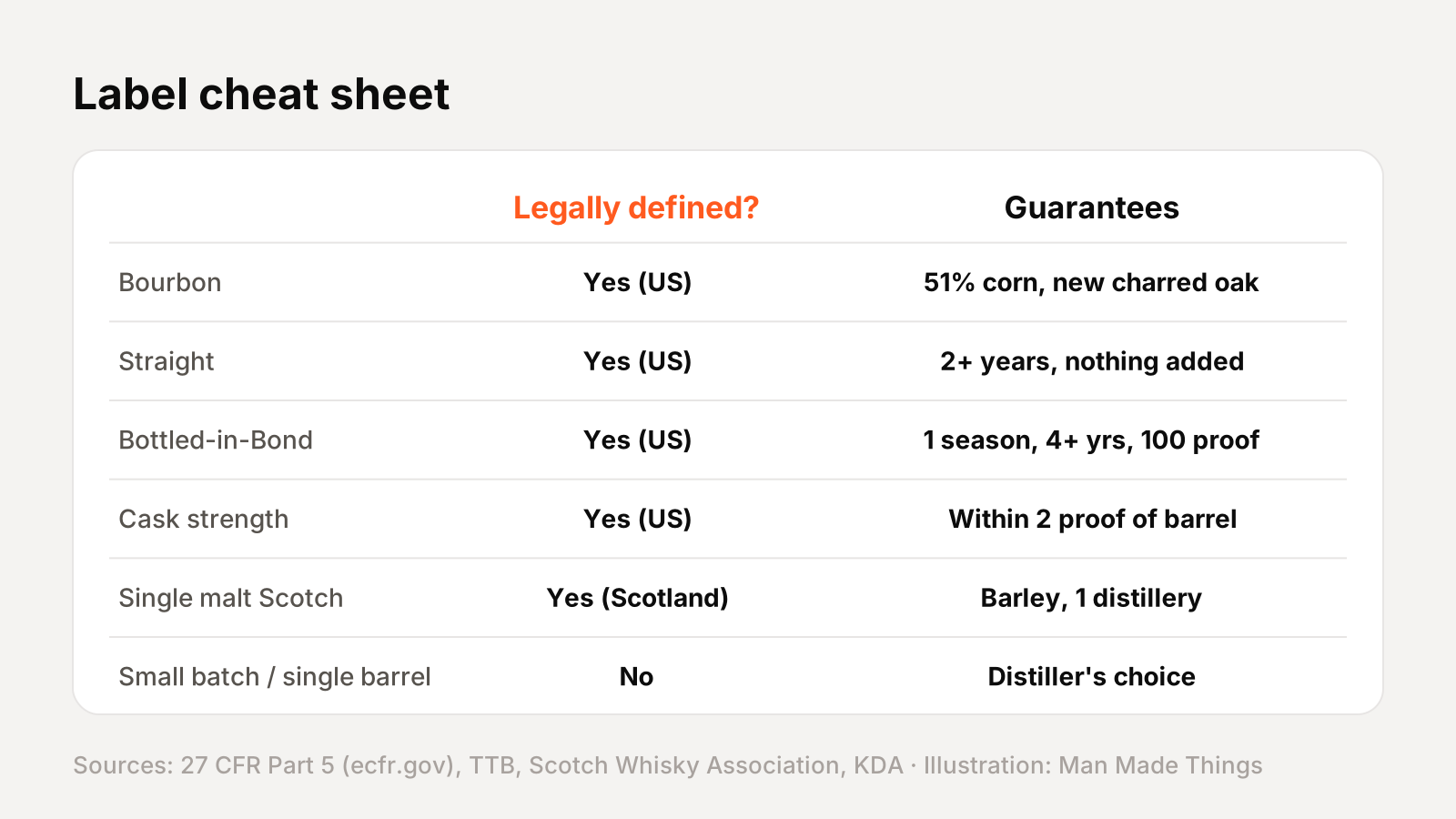
| Term | Legally defined? | What it guarantees |
|---|---|---|
| Bourbon | Yes (US) | 51%+ corn, new charred oak, made in the US |
| Straight | Yes (US) | 2+ years in new charred oak, nothing added |
| Bottled-in-Bond | Yes (US) | One distiller, one season, 4+ years, 100 proof |
| Barrel proof / cask strength | Yes (US) | Within 2 proof of the barrel |
| Rye | Yes (US) | 51%+ rye |
| Single malt Scotch | Yes (Scotland) | Malted barley, one distillery, pot stills |
| Small batch | No | Whatever the distiller says |
| Single barrel | No | Whatever the distiller says |
| Non-chill filtered | No | A production choice |
A note on spelling: US rules allow either "whisky" or "whiskey." The Scotch Whisky Association notes Scotch is usually spelled "whisky," and American whiskey usually "whiskey."
Serving it? Our best whiskey glasses can help.
Frequently asked questions
Does bourbon have to be aged a minimum time?
+
Not for plain bourbon under US rules, as long as it's stored in new charred oak. Straight bourbon must be aged at least 2 years.
What does bottled-in-bond mean?
+
One distiller, one distillery, one distilling season, at least 4 years in wood and bottled at exactly 100 proof, under 27 CFR 5.88.
What does cask strength mean?
+
In the US, barrel proof or cask strength means the whiskey was bottled no more than 2 proof below its barrel proof.
Is small batch legally defined?
+
No. Small batch and single barrel don't appear in US federal regulations, so each distiller defines them.
How old must Scotch be?
+
At least 3 years, matured in oak casks in Scotland, according to the Scotch Whisky Association.
Sources
- eCFR: 27 CFR 5.143 (whisky standards of identity)
- eCFR: 27 CFR 5.88 (bottled in bond)
- eCFR: 27 CFR 5.87 (barrel proof)
- eCFR: 27 CFR 5.74 (age statements)
- eCFR: 27 CFR 5.1 (definitions)
- TTB: Distilled spirits labeling
- Scotch Whisky Association: Guidance for producers and bottlers (PDF)
- Scotch Whisky Association: FAQs
- Kentucky Distillers' Association: Glossary
- Bruichladdich: FAQs
Editor-in-Chief
Rahul has been writing about gadgets and software since 2013, first at Thetechhacker and now at Man Made Things. He edits every review on the site and signs off on every verdict.
More from Rahul →