CHERRY XTRFY K63W Pro Compact Ultra-Wideband Review: Specs, Price and How It Compares
A research-based review of the CHERRY XTRFY K63W Pro Compact Ultra-Wideband: Cherry's official specs, features explained and how it compares with the rest of Cherry's gaming keyboards.
We may earn a commission when you buy through links on this page. Learn more
Quick answer
The CHERRY XTRFY K63W Pro Compact Ultra-Wideband is a 70% wireless keyboard with CHERRY MX Low Profile 2.0 Red switches, and Cherry's US page doesn't list a warranty period. It's best for players who want the fastest, most interference-resistant wireless in a compact board.
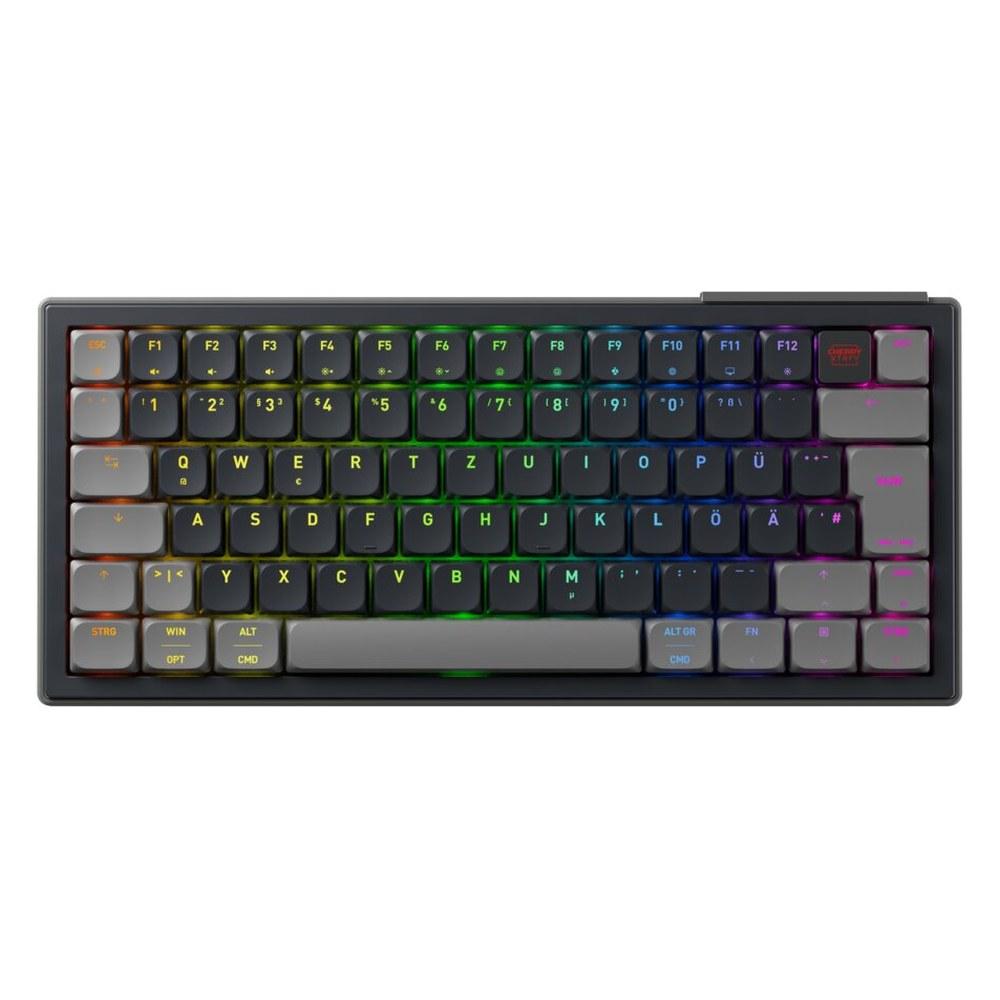
Cherry is best known for the MX switches inside other brands' keyboards, but it also makes its own gaming keyboards under the CHERRY XTRFY and CHERRY MX names. The K63W Pro Compact Ultra-Wideband is a 70% keyboard with CHERRY MX Low Profile 2.0 Red switches and Ultra-Wideband wireless and wired connections. Cherry quotes of a 6,000 mAh battery but no hours figure. Cherry doesn't sell direct in the US or publish US prices, so check retailers such as Amazon for current pricing.
A note on how we review: I haven't completed a hands-on test of the K63W Pro Compact Ultra-Wideband, so there's no star rating on this page. Everything below comes from Cherry's official US product page and properties table, with plain-English explanations and a comparison with the rest of Cherry's lineup. See every model in our Cherry keyboards guide, and for other brands, our best gaming keyboards.
Image: Cherry
Cherry
CHERRY XTRFY K63W Pro Compact Ultra-Wideband
The K63W Pro Compact Ultra-Wideband is a strong pick for players who want the fastest, most interference-resistant wireless in a compact board.
Best for: Players who want the fastest, most interference-resistant wireless in a compact board
Pros
- 01Ultra-Wideband wireless
- 028K polling wireless and wired
- 03Gasket construction
- 046,000 mAh battery
Cons
- 01No US price from Cherry
- 02No Bluetooth listed
- 03Not hot-swappable
What the K63W Pro Compact Ultra-Wideband is
The CHERRY XTRFY K63W Pro Compact Ultra-Wideband is Cherry's most unusual gaming keyboard: it uses Ultra-Wideband (UWB) wireless instead of standard 2.4 GHz. Cherry says UWB "delivers a stable, high-speed connection that stays clear of interference, even under demanding conditions."
It offers "a true 8000 Hz polling rate available in both wired and wireless modes," a low-profile 70% layout with CHERRY MX Low Profile 2.0 mechanical switches, a premium gasket construction and a high-capacity 6,000 mAh battery. A UWB dongle is in the box.
Cherry's low-profile boards use CHERRY MX Low Profile switches, from the flat wired MX 10.0N RGB to the Ultra-Wideband K63W Pro.
K63W Pro Compact Ultra-Wideband specs
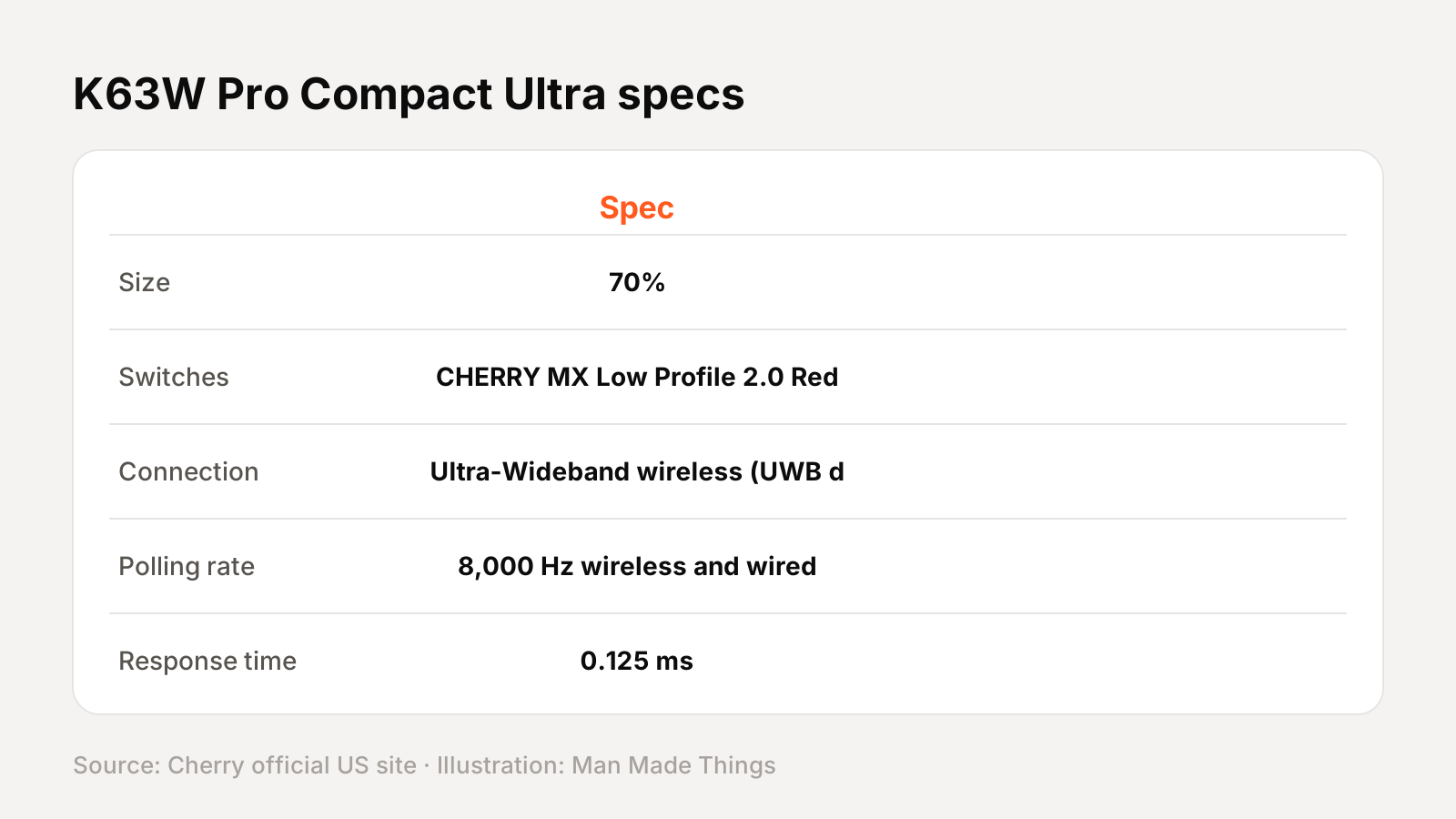
From Cherry's official US product page and properties table:
| Spec | K63W Pro Compact Ultra-Wideband |
|---|---|
| Size | 70% |
| Switches | CHERRY MX Low Profile 2.0 Red (mechanical) |
| Connection | Ultra-Wideband wireless (UWB dongle) or wired |
| Polling rate | 8,000 Hz wireless and wired |
| Response time | 0.125 ms |
| Battery | 6,000 mAh |
| Construction | Gasket |
| Onboard memory | Yes |
| Software | CHERRY Utility Software & Assistant |
| OS | Windows, macOS, Linux |
| Dimensions | 307 x 135 x 30 mm |
| US layout color | Black |
Prices and versions
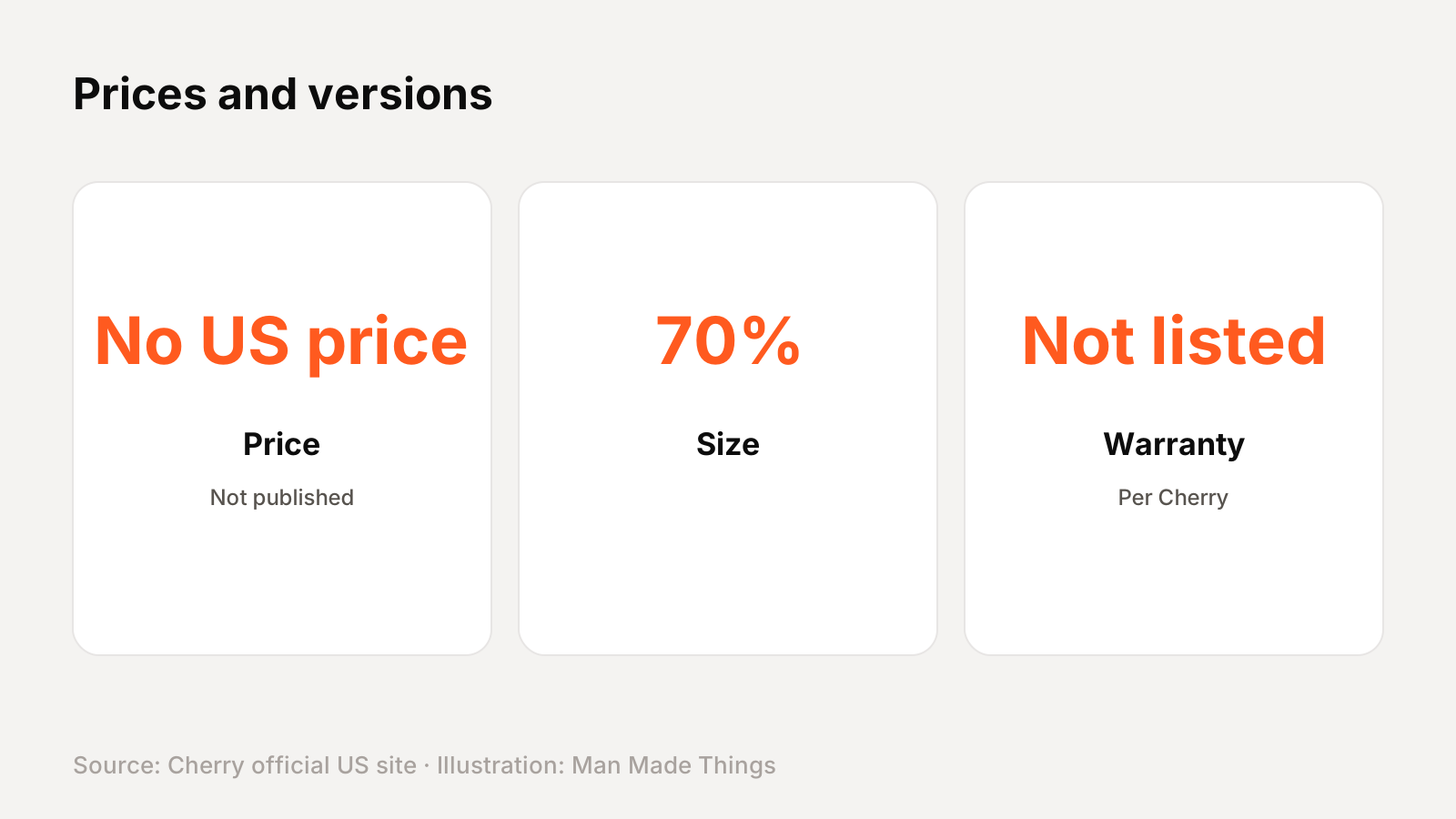
Cherry's US site lists the K63W Pro in a US layout in black with MX Low Profile 2.0 Red switches. Cherry doesn't sell direct in the US or publish US prices.
Cherry doesn't list Bluetooth for this model; it connects by its UWB dongle or cable.
Key features, explained
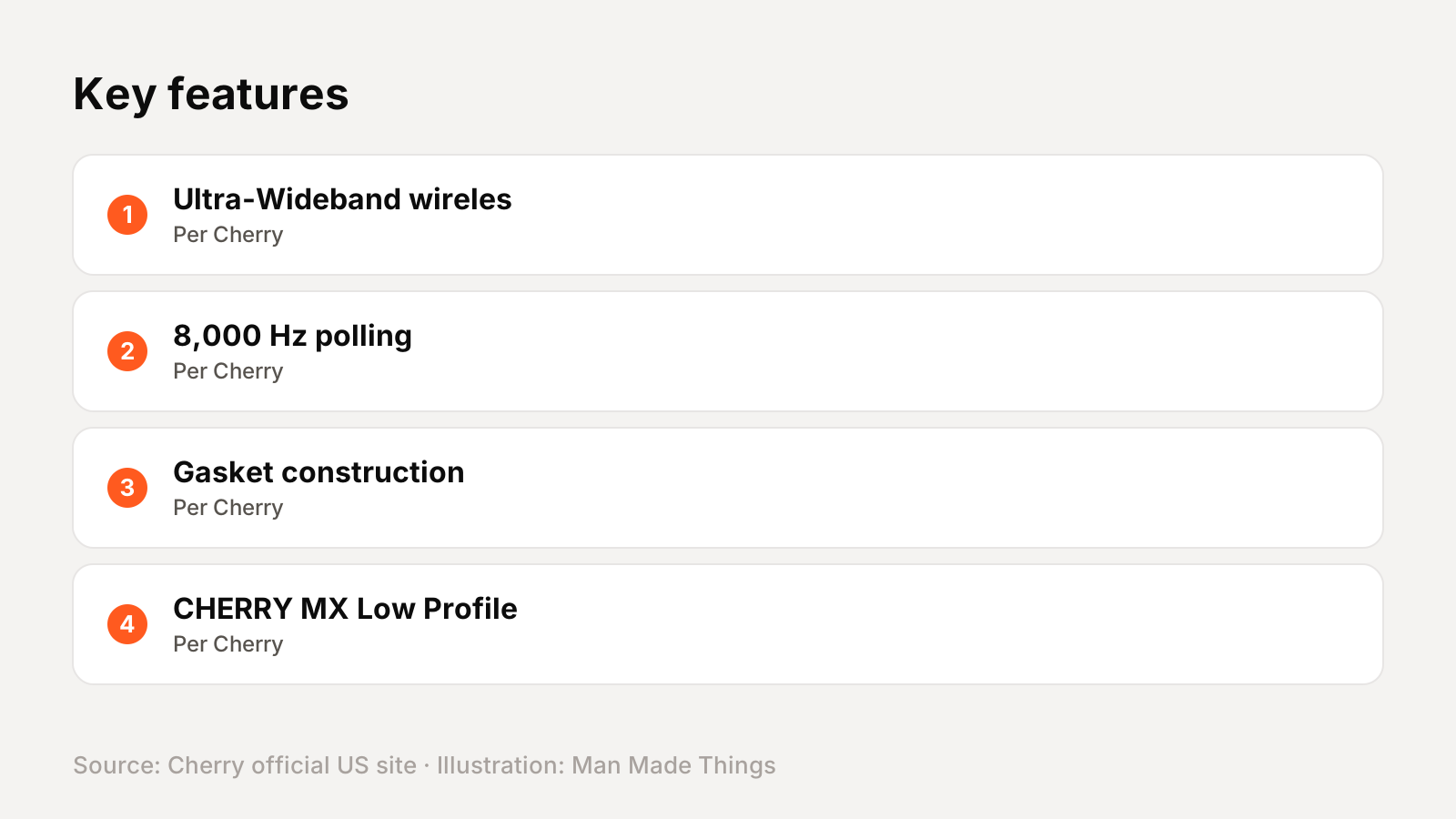
Here's what the main features on Cherry's product page actually do:
- Ultra-Wideband wireless: Cherry says UWB "delivers a stable, high-speed connection that stays clear of interference, even under demanding conditions." It uses its own UWB dongle rather than standard 2.4 GHz.
- 8,000 Hz polling: Cherry says the keyboard "reports your inputs up to 8 times per millisecond," for lower input lag.
- Gasket construction: the plate sits on soft gaskets, which Cherry says makes typing smoother. Some models add several layers of inner padding.
- CHERRY MX Low Profile 2.0: Cherry's revised low-profile mechanical switches, with what Cherry calls "a revised design and a precisely applied premium lubricant."
The switches, explained
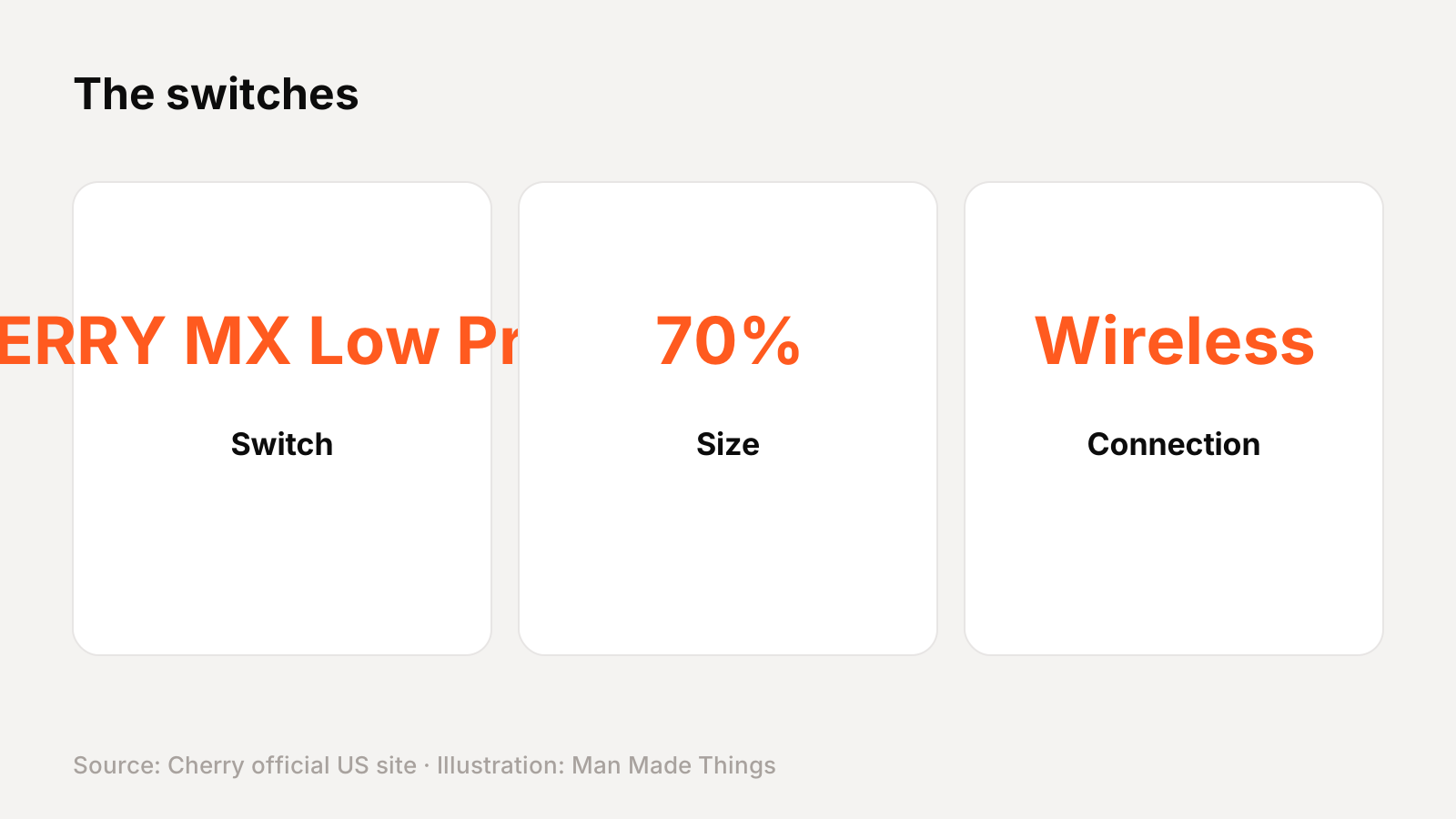
CHERRY MX Low Profile 2.0 switches are Cherry's updated low-profile mechanical switches. Cherry says they have "a revised design and a precisely applied premium lubricant" for a smoother feel. They register at a fixed point, so there's no adjustable actuation or Rapid Trigger.
How it compares with other Cherry gaming keyboards
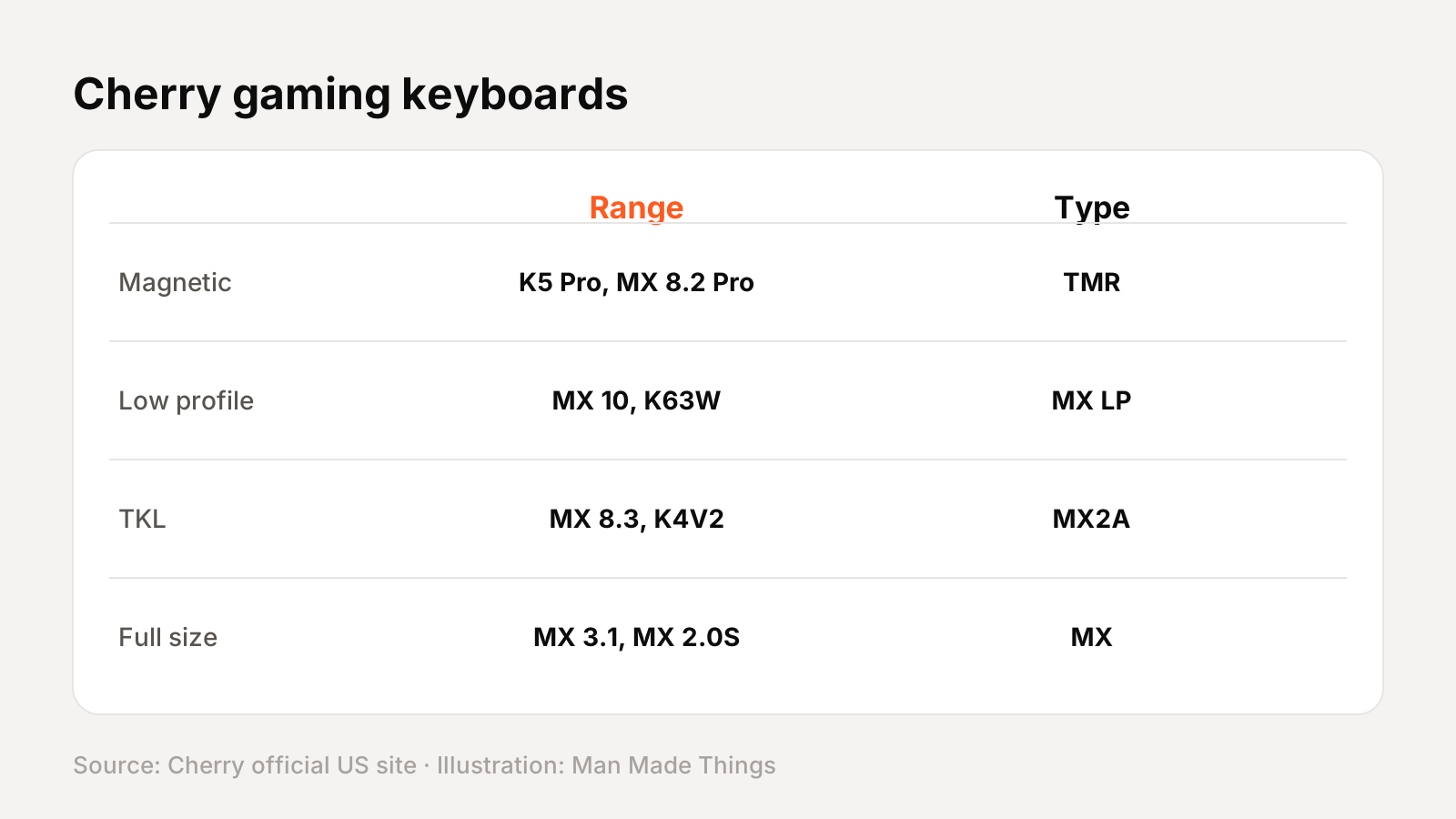
Cherry's current gaming keyboard lineup on its US site (Cherry doesn't publish US prices):
| Model | Size | Switches | Connection |
|---|---|---|---|
| K5 Pro TMR Compact | 65% | CHERRY MK Crystal magnetic | Wired |
| MX 8.2 Pro TMR Wireless | Tenkeyless (TKL) | CHERRY MK Crystal magnetic | Wireless |
| K63W Pro Compact Ultra-Wideband | 70% | CHERRY MX Low Profile 2.0 Red | Wireless |
| MX 10.1 Wireless | Full size | CHERRY MX Low Profile 2.0 Ivory | Wireless |
| MX 10.0N RGB | Full size | CHERRY MX Low Profile RGB Speed | Wired |
| MX-LP 2.1 Compact Wireless | 65% | CHERRY MX Low Profile | Wireless |
| MX 8.3 TKL Wireless | Tenkeyless (TKL) | CHERRY MX2A Red | Wireless |
| MX 8.2 TKL Wireless | Tenkeyless (TKL) | CHERRY MX2A or MX | Wireless |
| K4V2 RGB TKL | Tenkeyless (TKL) | CHERRY MX2A Red | Wired |
| K5V2 Compact | 65% | CHERRY MX2A Red | Wired |
| K33 Compact Wireless | 75% | Mem-chanical | Wireless |
| MX 3.1 | Full size | CHERRY MX2A | Wired |
| MX 3.0S Wireless | Full size | CHERRY MX2A or MX | Wireless |
| MX BOARD 3.0S | Full size | CHERRY MX | Wired |
| MX 2.0S | Full size | CHERRY MX or MX2A | Wired |
How to choose within Cherry's low-profile range
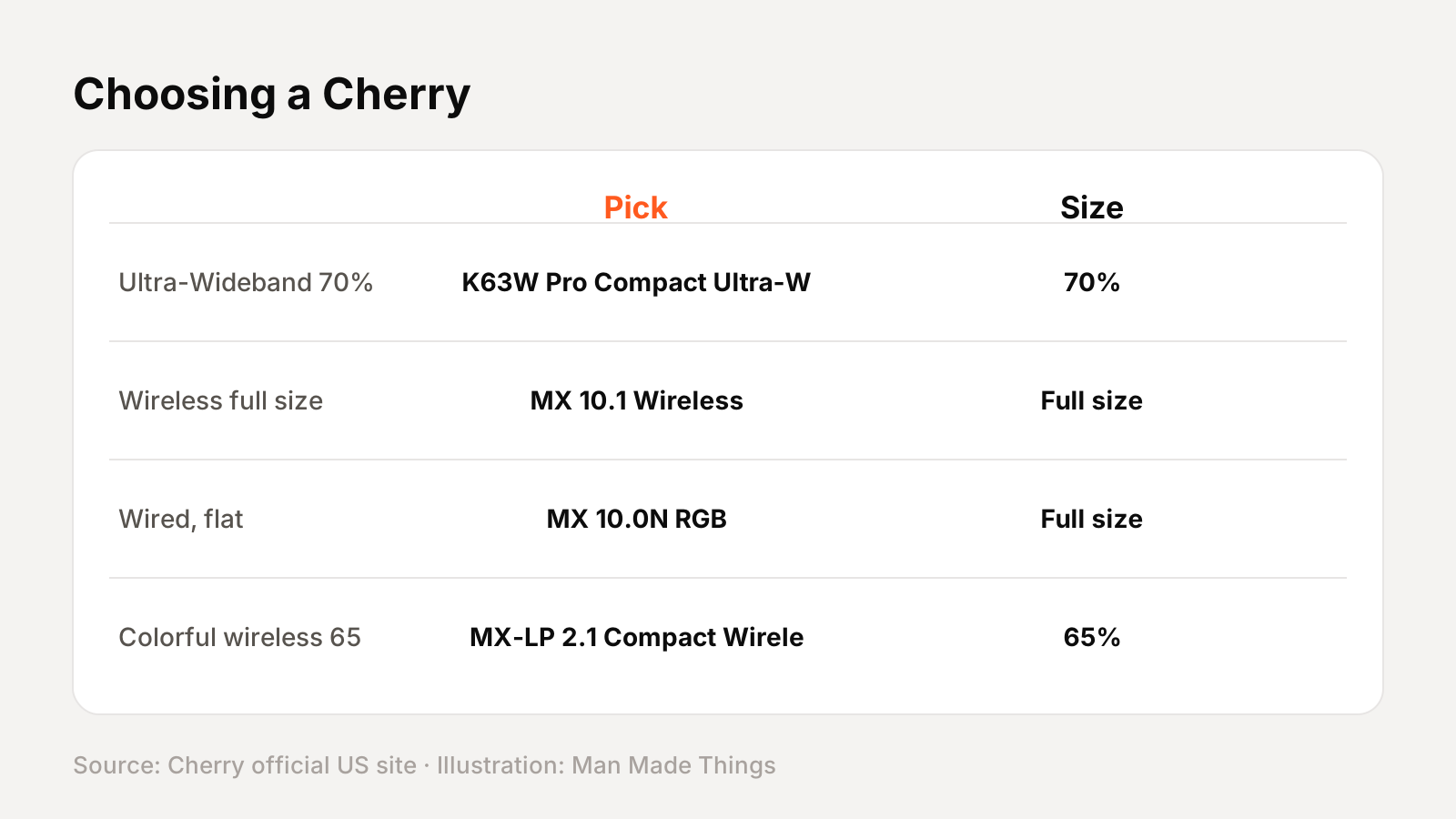
| If you want... | Consider |
|---|---|
| Ultra-Wideband 70% | K63W Pro Compact Ultra-Wideband (70%) |
| Wireless full size | MX 10.1 Wireless (Full size) |
| Wired, flat | MX 10.0N RGB (Full size) |
| Colorful wireless 65% | MX-LP 2.1 Compact Wireless (65%) |
CHERRY software, explained
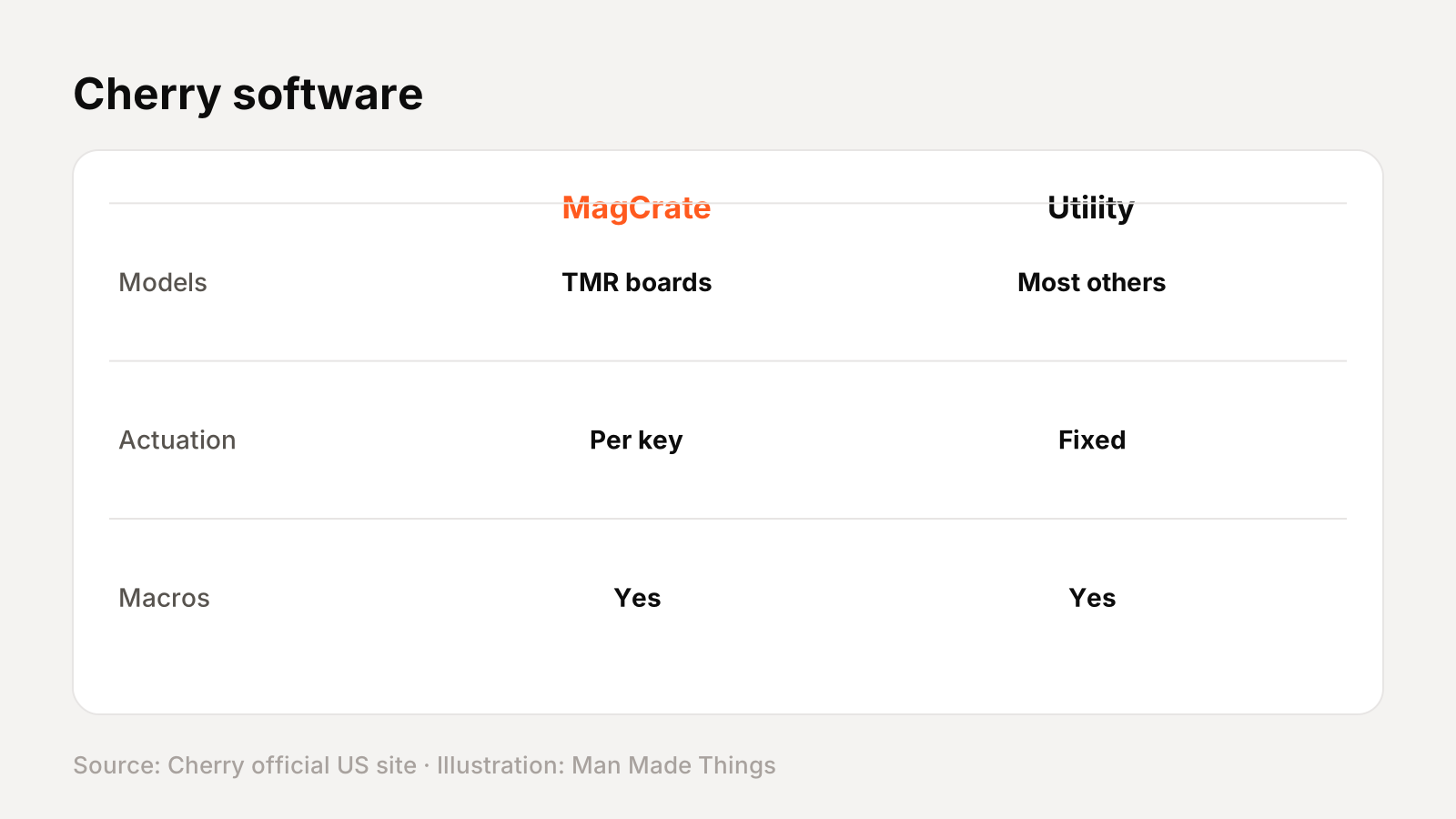
Cherry gaming keyboards use one of three Cherry programs, depending on the model:
- CHERRY MagCrate is for the magnetic TMR boards (K5 Pro TMR Compact and MX 8.2 Pro TMR). Cherry says it lets you "adjust actuation points per key, enable advanced features like RT, Mod Tap, Dynamic Key Travel (DKS) and SnapKey, assign macros" and set lighting.
- CHERRY Utility Software & Assistant handles key assignments and lighting on most other models, such as the MX 3.1, MX 8.3 and K63W Pro.
- CHERRY KEYS is Cherry's free key-assignment tool, listed for the MX 10.0N RGB.
Some boards, like the K4V2, let you adjust lighting without any software.
Keyboard terms, explained
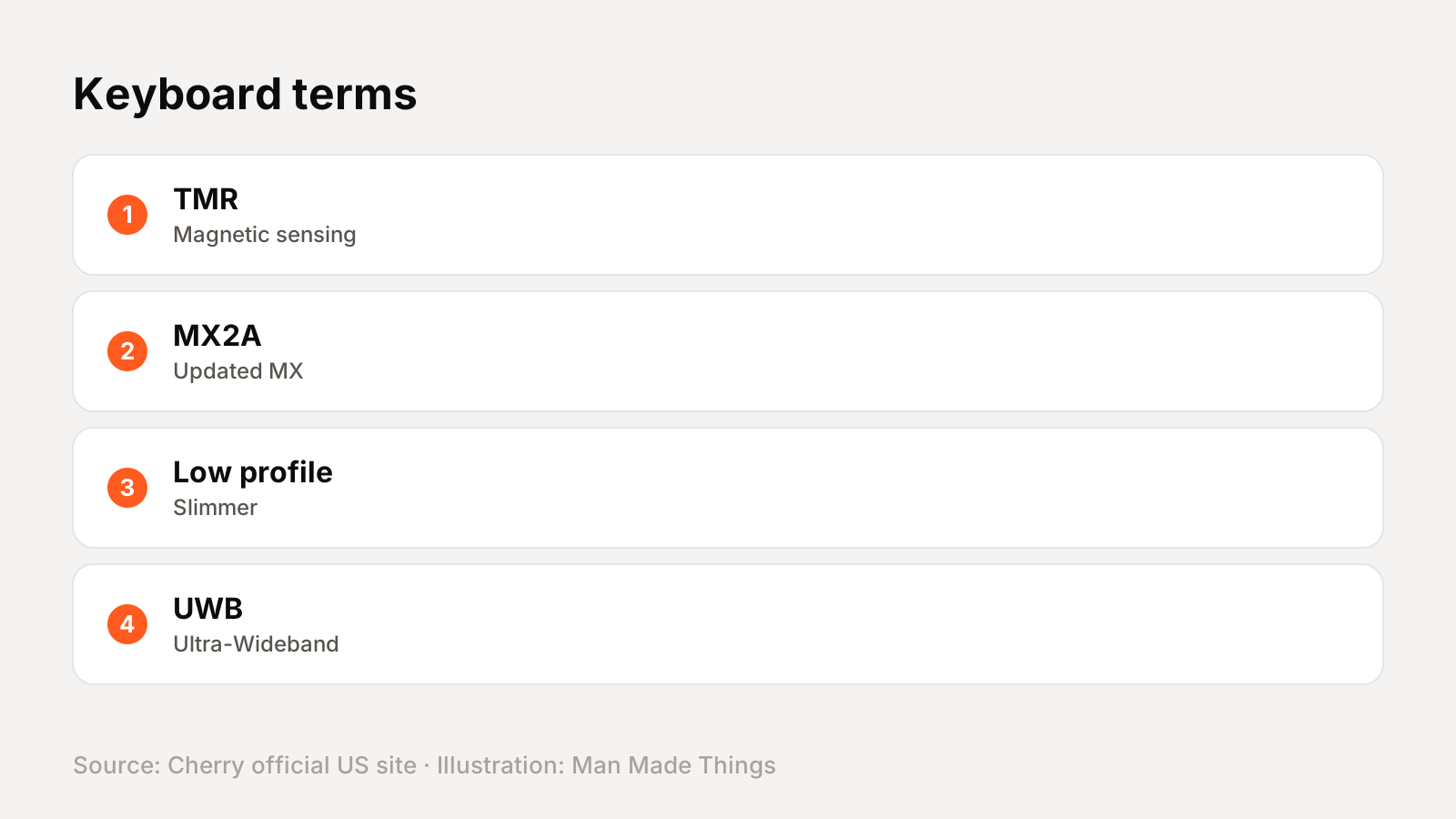
| Term | What it means |
|---|---|
| TMR | Tunnel Magnetoresistance, a magnetic sensor that measures key position |
| Rapid Trigger (RT) | The key resets as soon as it starts rising, for faster repeated presses |
| SnapKey | Cherry's handling of opposing key presses (SOCD) |
| MX2A | Cherry's updated MX switches with new lubrication and springs |
| Low profile | Shorter switches and keycaps for a slimmer keyboard |
| Hot-swappable | Switches can be pulled and replaced without soldering |
| UWB | Ultra-Wideband, a wireless technology Cherry uses on the K63W Pro |
| Polling rate | How often the keyboard reports to the PC; 8,000 Hz is eight times the usual 1,000 Hz |
Getting the best from the K63W Pro Compact Ultra-Wideband
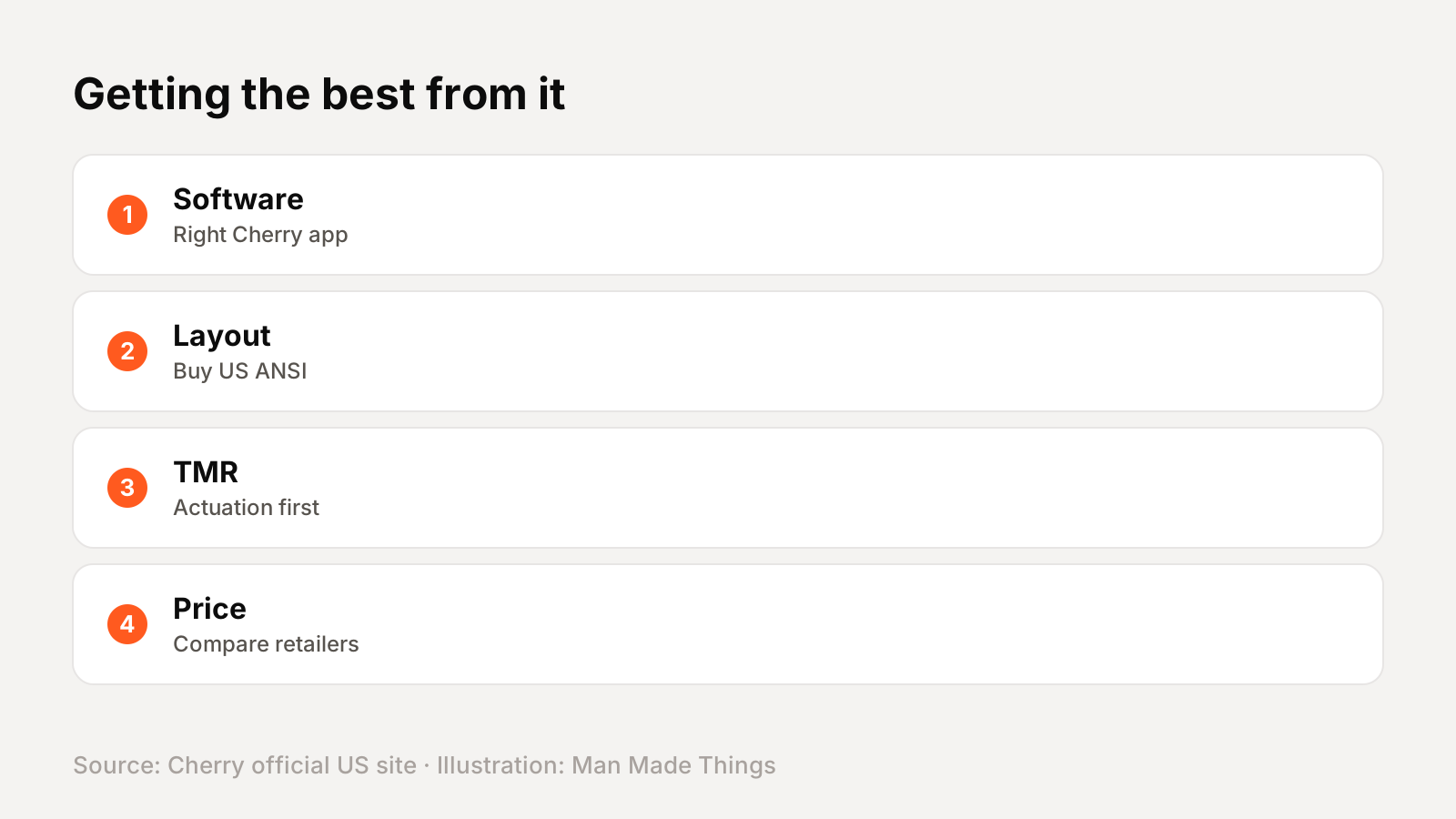
- Install the right Cherry software for your model: MagCrate, Utility Software or CHERRY KEYS.
- Check the US layout when buying; Cherry sells many regional layouts.
- Set actuation first, then Rapid Trigger on TMR boards.
- Use the included removal tool carefully on hot-swap boards.
- Compare retailer prices; Cherry doesn't publish US prices.
Buying and warranty
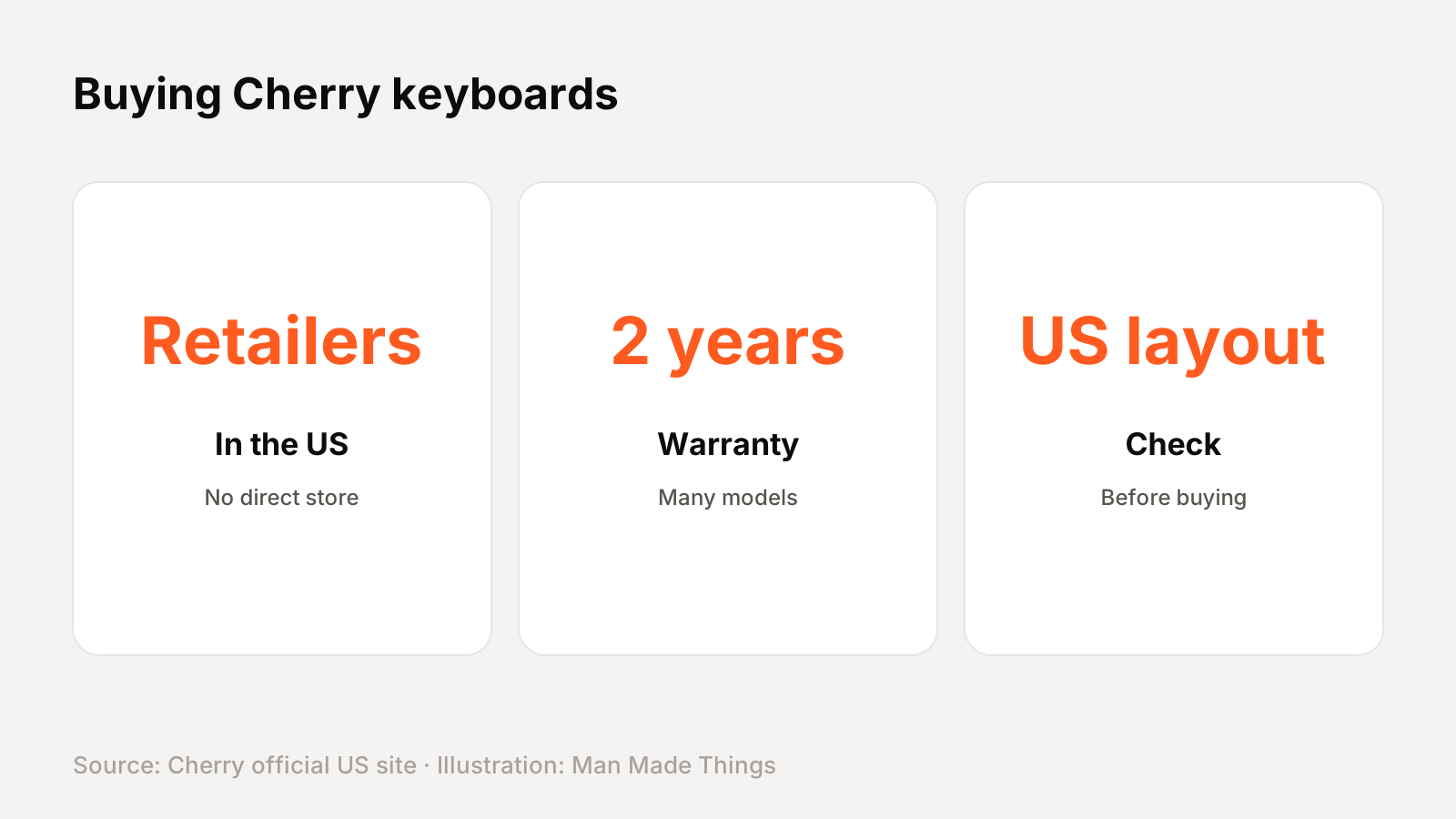
Cherry doesn't sell the K63W Pro Compact Ultra-Wideband direct in the US or publish a US price; its US site points to retailers, and its own web shop serves Europe. Check retailers such as Amazon for current US pricing and make sure you're buying the US (ANSI) layout.
Cherry's product pages list a 2-year warranty for many of its gaming keyboards, but not every model's US page states it, so check with the retailer.
Should you buy the K63W Pro Compact Ultra-Wideband?
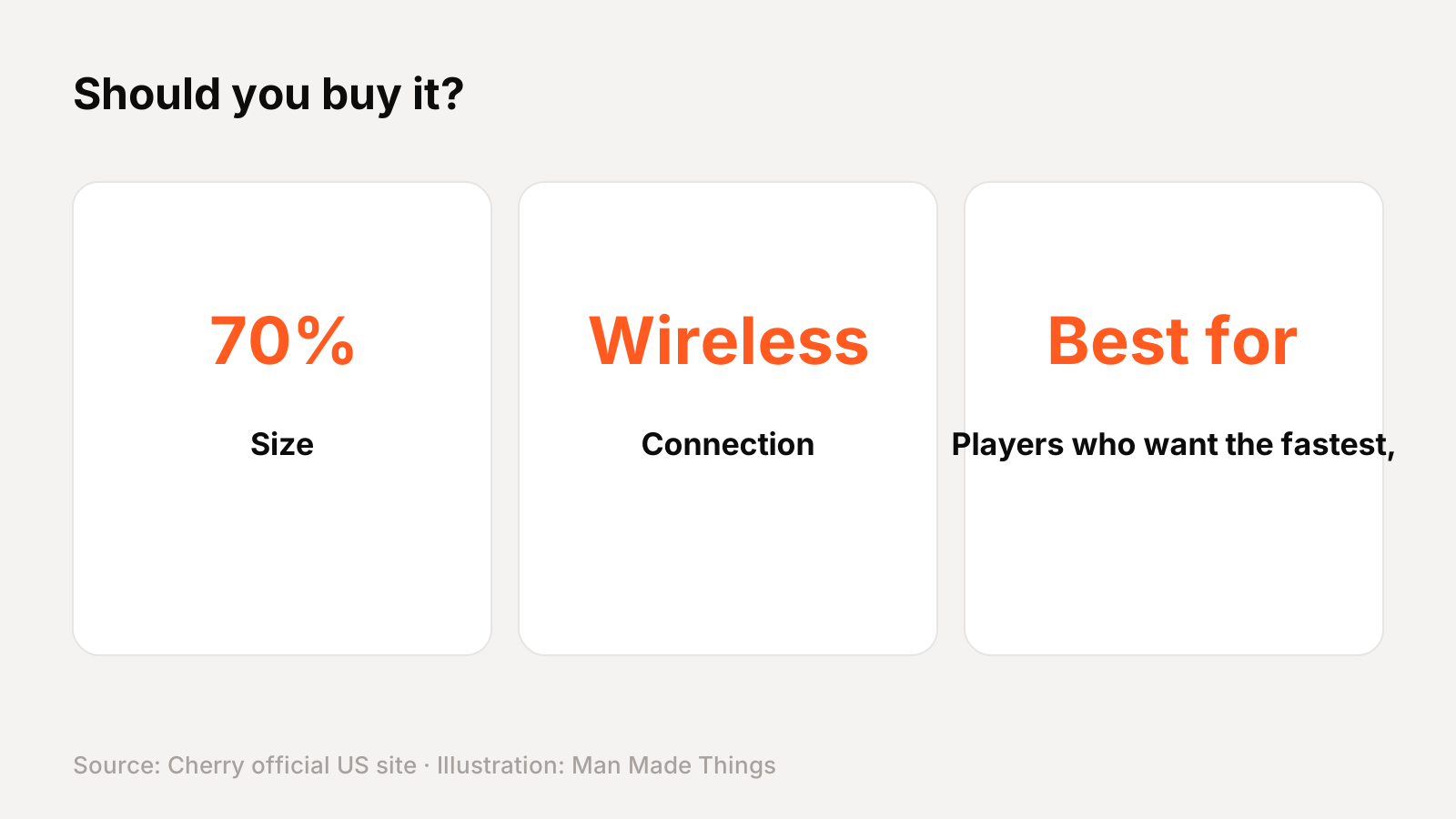
Who it's for: Players who want the fastest, most interference-resistant wireless in a compact board.
What we like:
- Ultra-Wideband wireless
- 8K polling wireless and wired
- Gasket construction
- 6,000 mAh battery
What to consider:
- No US price from Cherry
- No Bluetooth listed
- Not hot-swappable
Who should skip it: The MX 10.1 Wireless is a full-size low-profile board with Bluetooth and an LCD.
The bottom line: The K63W Pro Compact Ultra-Wideband is a strong pick for players who want the fastest, most interference-resistant wireless in a compact board.
CHERRY XTRFY K63W Pro Compact Ultra-Wideband specs
| Size | 70% |
|---|---|
| Switches | CHERRY MX Low Profile 2.0 Red (mechanical) |
| Connection | Ultra-Wideband wireless (UWB dongle) or wired |
| Polling rate | 8,000 Hz wireless and wired |
| Response time | 0.125 ms |
| Battery | 6,000 mAh |
| Construction | Gasket |
| Onboard memory | Yes |
Test report
Hands-on test report: in progress
We don't publish scores or test results until a real unit has gone through our routine: battery rundown at 50% volume, call quality outdoors, noise cancellation on a commute, fit over a full workday, and connection stability across devices. This review will be updated with measured results and a star rating once testing is complete.
Frequently asked questions
How much is the CHERRY XTRFY K63W Pro Compact Ultra-Wideband?
+
Cherry doesn't publish a US price or sell direct in the US, so check retailers such as Amazon for current pricing.
Is the K63W Pro Compact Ultra-Wideband wireless?
+
Yes. Cherry lists Ultra-Wideband wireless (UWB dongle) or wired.
What switches does the K63W Pro Compact Ultra-Wideband use?
+
CHERRY MX Low Profile 2.0 Red (mechanical).
What warranty does the K63W Pro Compact Ultra-Wideband have?
+
Cherry's US product page doesn't list a warranty period for this model.
Sources
Editor-in-Chief
Rahul has been writing about gadgets and software since 2013, first at Thetechhacker and now at Man Made Things. He edits every review on the site and signs off on every verdict.
More from Rahul →