The 5 Best Mechanical Keyboards With a Poppy, Satisfying Sound
Five gasket-mounted mechanical keyboards built for a satisfying typing sound: the Akko MU02, Wooting 80HE+, Keychron Q6 Ultra 8K, ASUS ROG Azoth and Mode Sonnet, plus what makes a keyboard sound poppy, thocky or creamy.
We may earn a commission when you buy through links on this page. Learn more
Quick answer
The Keychron Q6 Ultra 8K ($239.99) is the best keyboard for a satisfying sound for most people: a double-gasket aluminum full-size board with five layers of dampening and factory-lubed POM switches. The Akko MU02 ($139.99) is the best budget pick with a walnut case, the Wooting 80HE+ ($199.99) the best for gaming, the ASUS ROG Azoth ($249.99) the best wireless 75%, and the Mode Sonnet (from $289) the best custom kit.
A great mechanical keyboard doesn't just feel good; it sounds good. Keyboard fans describe sounds as "poppy," "thocky," "creamy" or "marbly," and today's best boards are designed around acoustics as much as looks, with gasket mounts, foam layers and pre-lubricated switches.
Epomaker, a keyboard maker, even publishes its own definitions: it describes a poppy sound as "a tight, percussive pop" and puts the most important factor down to the switch stem. Other makers here describe their boards in terms of "thock" and softened, controlled sound.
I picked five keyboards from five brands, from a $140 wooden board to a custom kit. Every spec and sound description below comes from the maker's own pages; I haven't made any listening claims of my own, and there are no star scores. Working on a Mac? See our best laptop stands to complete your desk.
Our picks at a glance
1. Best overall
Keychron Q6 Ultra 8K, Fully Assembled with Knob
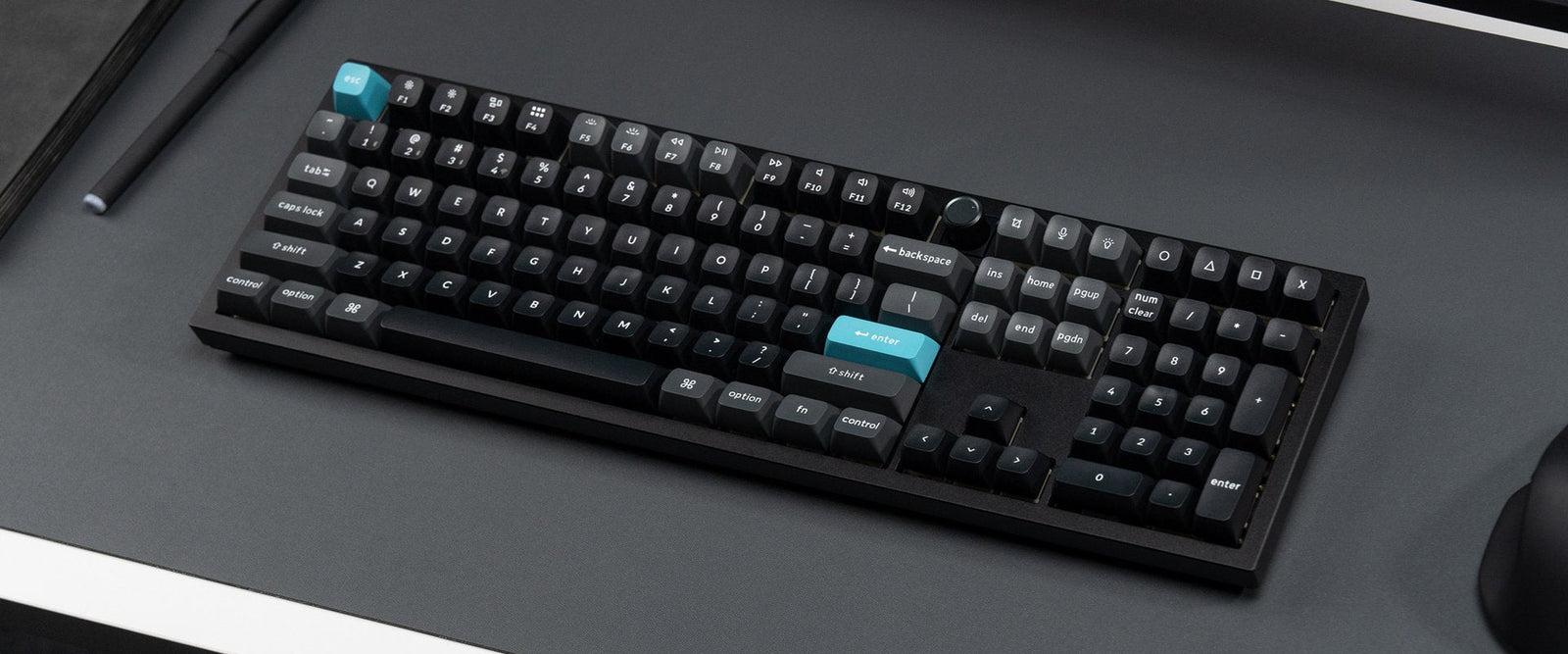
The Q6 Ultra 8K is the most thoroughly dampened board here. Keychron describes a double-gasket design that reduces acoustic resonance, with silicone pads between its CNC aluminum top and bottom cases, a PC plate and five layers of sound treatment: sound-absorbing foam, IXPE foam between the switches and the PCB, PET film, a latex bottom pad and bottom-case acoustic foam.
It ships with Keychron's factory-lubed Silk POM switches, with POM housings and stems, in Red linear, Brown or Banana versions, and the hot-swap sockets take 3- and 5-pin MX switches if you want to experiment. Keycaps are double-shot PBT in Keychron's KSA profile.
It's also a fully featured wireless board: 2.4 GHz with up to 8,000 Hz polling, Bluetooth 5.3 for up to three devices, and wired. Keychron quotes up to 660 hours with the backlight off from its 4,000 mAh battery. It runs ZMK firmware and Keychron's web-based Launcher, and works with Mac and Windows. The catch is weight: about 2.2 kilograms, so it stays put on your desk.
Pros
- 01Double-gasket with five dampening layers
- 02Factory-lubed POM switches
- 03Wireless with 8K polling
- 04Mac and Windows keycaps included
Cons
- 01Heavy at about 2.2 kg
- 02Full-size takes a lot of desk space
| Layout | 100% full-size with knob |
|---|---|
| Mount | Double-gasket |
| Case / plate | CNC aluminum / PC plate |
| Switches | Keychron Silk POM, factory lubed, hot-swap |
| Keycaps | Double-shot PBT, KSA profile |
| Connectivity | 2.4 GHz, Bluetooth 5.3, wired; 8K polling |
| Battery | 4,000 mAh, up to 660 h (backlight off) |
2. Best budget
Akko MU02 Mountain Seclusion
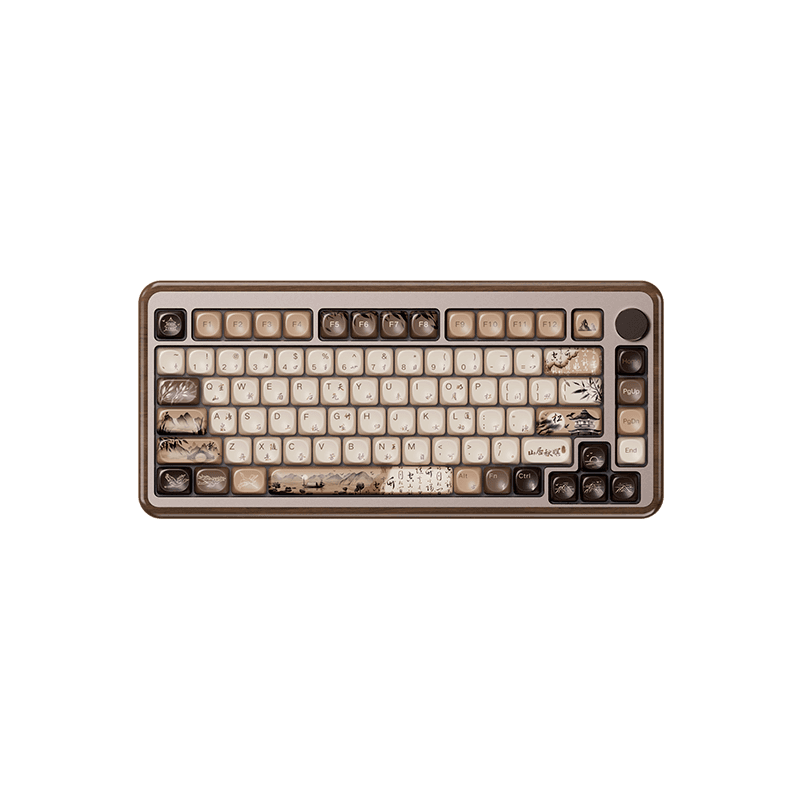
The MU02 is the most unusual-looking board here, with a real walnut wood case, and at $139.99 it's also the most affordable. Akko uses a gasket structure in a compact 75% layout.
Its sound comes from Akko's Rosewood linear switches, which Akko says provide "a pleasant thocky sound out of box," with a thin layer of factory lubrication. They need about 40 grams of force, with 4mm of total travel, and sit in 5-pin hot-swap sockets, so you can change them later without soldering. Keycaps are PBT with dye-sublimated legends, in Akko's rounded MOA profile.
It's wireless too, with Bluetooth 5.0, a 2.4 GHz receiver and USB-C wired, powered by a 4,000 mAh battery, and RGB is programmable with Akko's Cloud Driver software. Akko's page doesn't list the plate material, foam layers or weight, so it's less documented than the Keychron.
Pros
- 01Real walnut wooden case
- 02Lubed Rosewood linear switches
- 03Tri-mode wireless
- 04Lowest price at $139.99
Cons
- 01Plate and foam details not published
- 02Wood case needs more care
| Layout | 75% |
|---|---|
| Mount | Gasket |
| Case | Walnut wood |
| Switches | Akko Rosewood linear, lubed, hot-swap |
| Keycaps | PBT dye-sub, MOA profile |
| Connectivity | Bluetooth 5.0, 2.4 GHz, USB-C |
| Battery | 4,000 mAh |
3. Best for gaming
Wooting 80HE+, Dark ABS
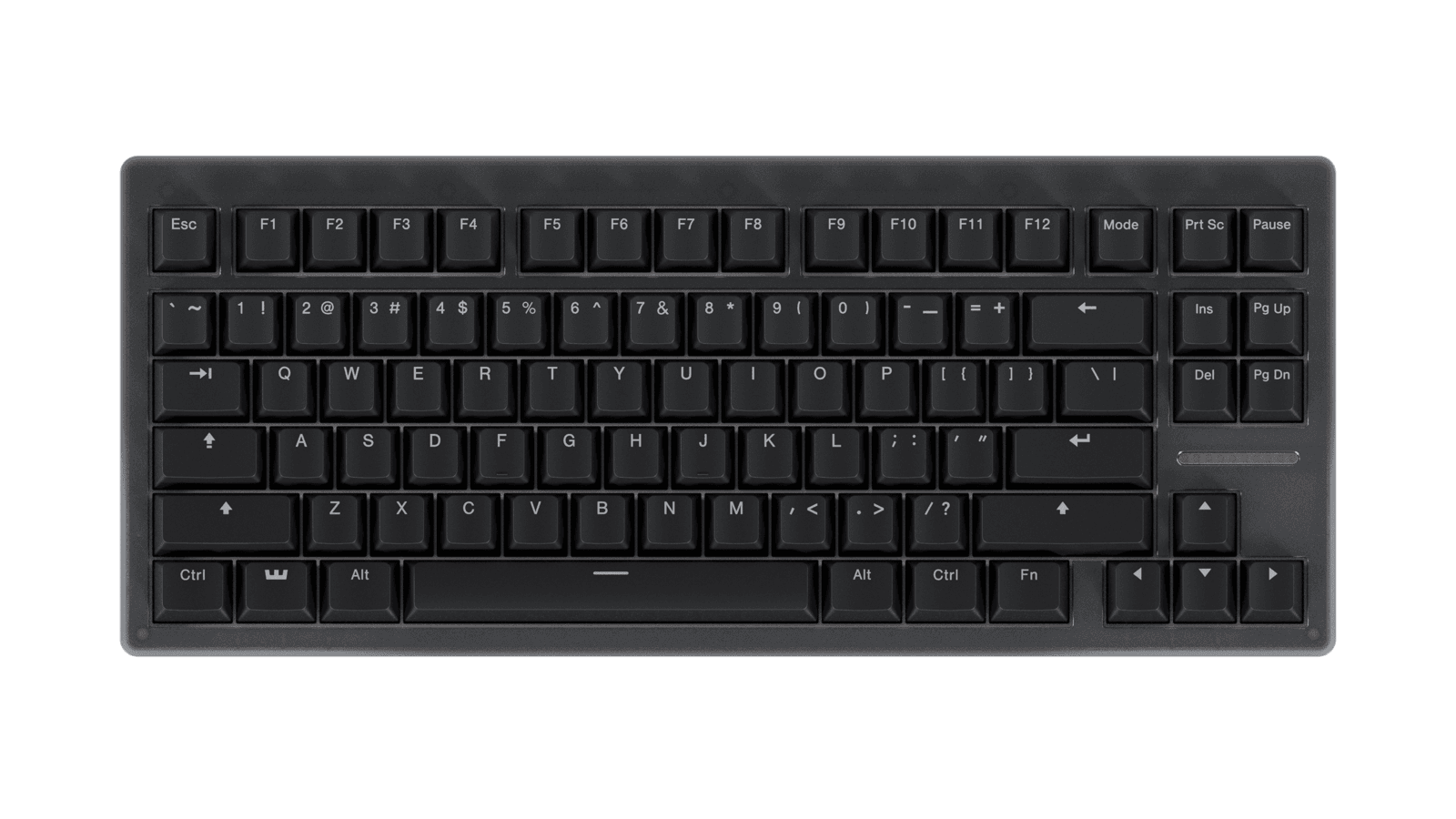
Wooting's 80HE+ is a gaming keyboard with magnetic Hall Effect switches that's still designed with sound in mind. Wooting says its silicone gasket absorbs impact, resulting in less noise and a softer typing feel, and that its FR4 plate keeps the sound soft and controlled rather than harsh or metallic.
It also includes bottom-case dampening foam, a painter's tape mod and PET film from the factory. Its Lekker Tikken Medium switches are magnetic Hall Effect switches, which Wooting describes as having a deep, slightly muted sound profile, with a full 4mm of travel.
For gaming, it's in a league of its own here: true 8 kHz polling, Rapid Trigger, and actuation adjustable from 0.1 to 4.0mm per key in Wooting's Wootility software. It's wired only, with double-shot PBT keycaps and a four-year warranty (two years on LEDs). The ABS version is $199.99; a zinc alloy version is $289.99.
Pros
- 01Gasket and FR4 plate for a soft sound
- 02Adjustable actuation and Rapid Trigger
- 038 kHz polling
- 044-year warranty
Cons
- 01Wired only
- 02Hall Effect switches, not traditional lubed linears
| Layout | 80% |
|---|---|
| Mount | Silicone gasket |
| Plate | FR4 |
| Switches | Lekker Tikken Medium (Hall Effect) |
| Dampening | Case foam, tape mod, PET film |
| Polling | Up to 8 kHz; Rapid Trigger |
| Warranty | 4 years |
4. Best wireless 75%
ASUS ROG Azoth
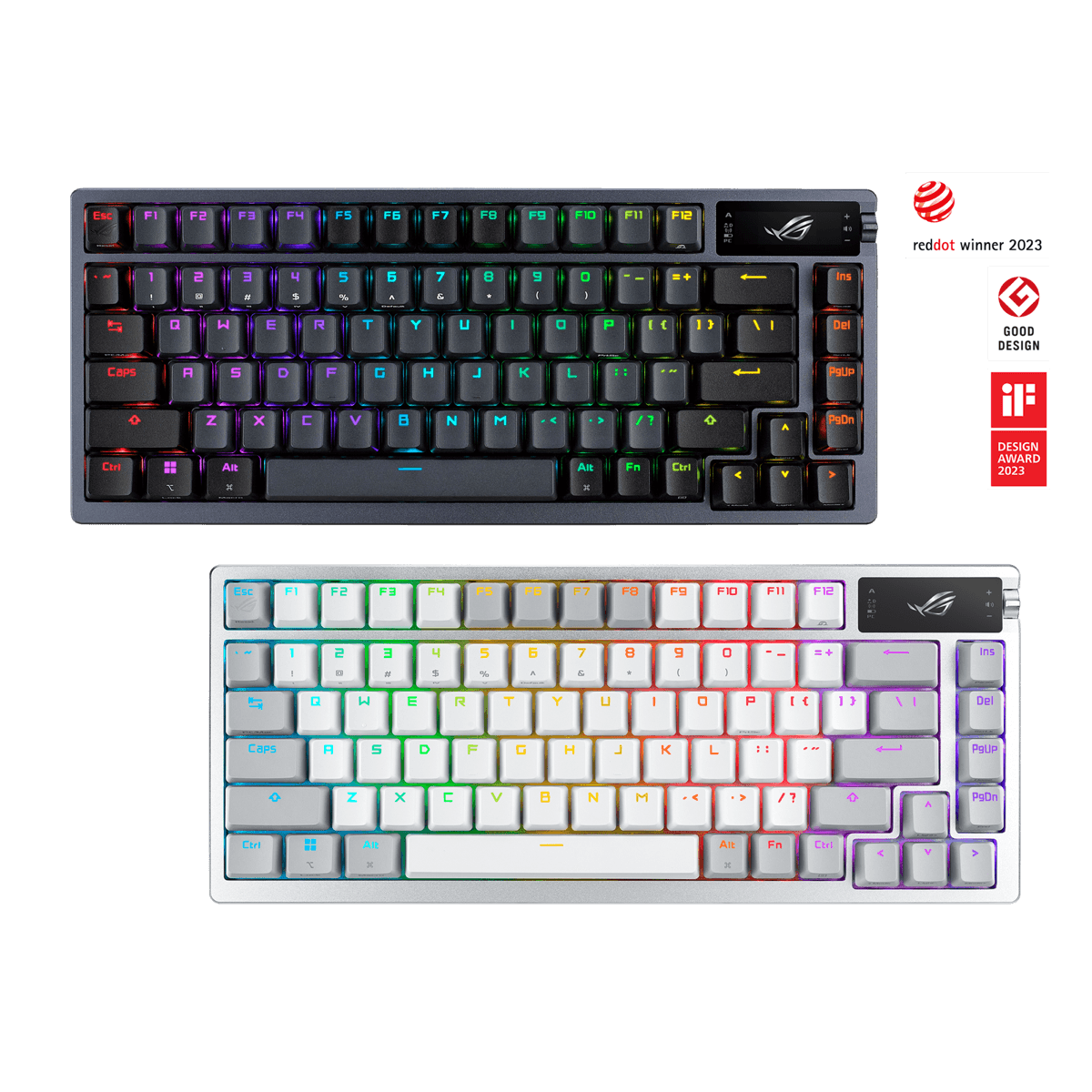
ASUS's ROG Azoth brings enthusiast keyboard features to a gaming brand. ASUS describes a silicone gasket mount with three layers of dampening foam, under a metal top cover, in a 75% layout.
Its hot-swappable ROG NX switches and stabilizers come pre-lubed, and ASUS even includes a lube kit with Krytox GPL-205-GD0, so you can tune the sound further yourself. Keycaps are ROG PBT double-shot.
It's wireless with Bluetooth 5.1 for three devices, ASUS's SpeedNova 2.4 GHz and wired USB, and ASUS quotes up to 2,000-plus hours of battery on 2.4 GHz with the OLED and lighting off. A small OLED display and a three-way control knob are unique touches. It works with Windows 11 and macOS, managed through ASUS Armoury Crate, and weighs about 1.2 kilograms.
Pros
- 01Gasket mount with three foam layers
- 02Pre-lubed switches and stabilizers
- 03Lube kit included
- 04Very long wireless battery
Cons
- 011000 Hz polling only
- 02Plate material not published
| Layout | 75% |
|---|---|
| Mount | Silicone gasket, 3 foam layers |
| Switches | ROG NX, pre-lubed, hot-swap |
| Stabilizers | Pre-lubed; lube kit included |
| Keycaps | ROG PBT double-shot |
| Connectivity | Bluetooth 5.1, 2.4 GHz, wired |
| Extras | OLED display, three-way knob |
5. Best custom kit
Mode Designs Sonnet (2026), Kit
The Mode Sonnet is for people who want to build their own keyboard and choose exactly how it sounds. It's a kit from $289, so switches, keycaps and stabilizers are extra.
Mode explains its sound choices in detail. Its Mounting Block System isolates the plate from the case, with options from the soft EPU Lattice block for the softest typing feel to a classic top mount. Microsuede pads between the case halves reduce harsh metallic sounds, a steel weight reduces resonance and cone-shaped feet prevent thudding.
You also choose the plate, and Mode describes each: POM is the softest with a muted sound, aluminum is neutral, carbon fiber is bright, and copper gives a deeper, open sound. Bottoms come in aluminum, walnut, maple, white oak or stainless steel depending on edition. It runs QMK/VIA and works with macOS, Windows and Linux. One caveat: most 2026 editions showed sold out, with only Studio Light available when I checked.
Pros
- 01Fully customizable sound
- 02Choice of plates and mounting
- 03QMK/VIA, Mac, Windows, Linux
- 04Premium aluminum and wood
Cons
- 01Kit: switches and keycaps extra
- 02Most editions sold out
- 03Wired only
| Layout | 75% |
|---|---|
| Mount | Mode Mounting Block System |
| Plates | POM, aluminum, carbon fiber or copper |
| Case | Aluminum top; wood or metal bottoms |
| PCB | Solder or hot-swap |
| Firmware | QMK/VIA |
| Weight | 4 to 7.5 lb assembled |
What makes a keyboard sound poppy, thocky or creamy?
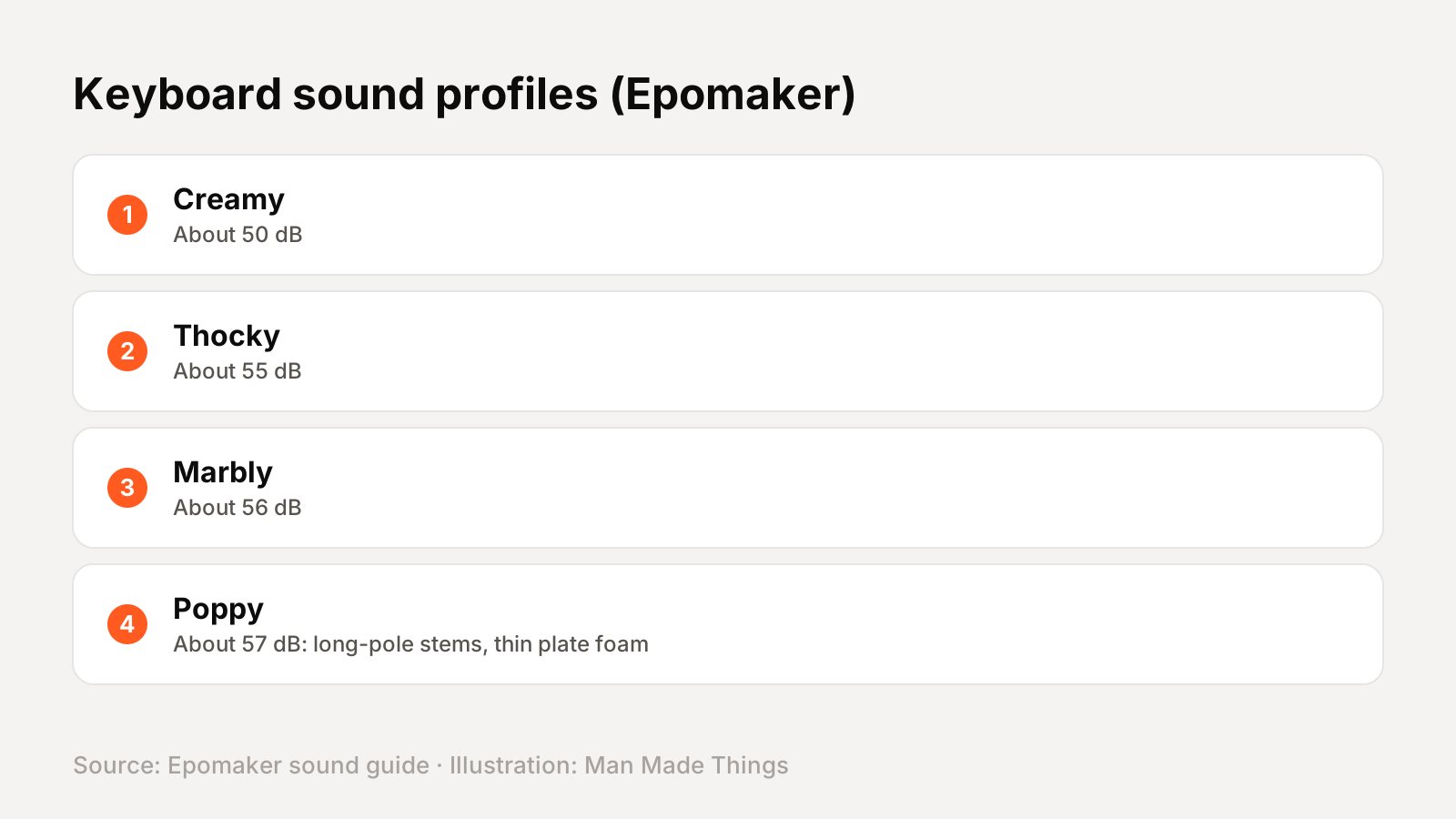
"Poppy" is a specific sound, and Epomaker explains how builders get it:
- Long-pole switch stems: Epomaker says these shorten bottom-out travel by about 0.5mm, giving "a tight, percussive pop," and calls it the most important factor.
- Less foam: poppy builds use only thin plate foam and skip bottom-case foam, according to Epomaker.
- Medium-hard plates: Epomaker suggests 1.5mm polycarbonate or 1.0mm aluminum.
- Compact cases: 60% to 65% layouts help.
Epomaker also measured the profiles with its own protocol: creamy at about 50 dB, thocky 55 dB, marbly 56 dB and poppy 57 dB. So poppy is the brightest and loudest of the four.
Most boards here lean toward a deeper, softer "thock." Wooting says a polycarbonate plate mutes higher frequencies and places an emphasis on thock, and Mode describes POM plates as muted and copper as deeper. If you want true pop, a lighter-dampened build with long-pole switches, like a Mode kit you configure yourself, gets you closest.
Gasket mounts, foam and plates, explained
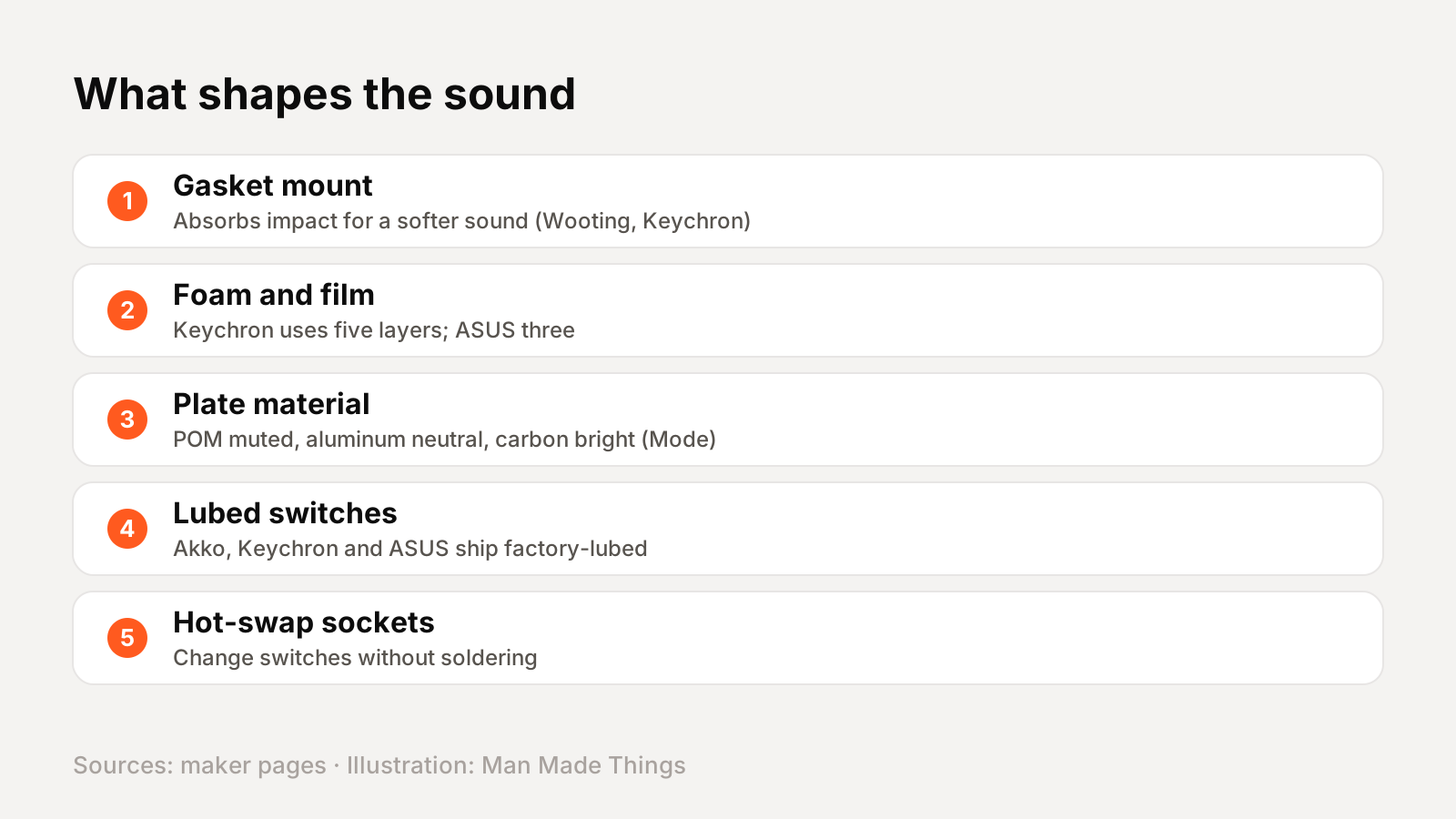
Every keyboard here is built around a few key parts:
- Gasket mount: the plate sits on soft gaskets instead of being screwed to the case. Wooting says its silicone gasket absorbs impact, for less noise and a softer feel; Keychron says its double-gasket reduces acoustic resonance.
- Foam and film: layers between the PCB, plate and case. Keychron uses five; ASUS uses three.
- Plate material: Mode says POM is softest and most muted, aluminum is neutral, carbon fiber is bright and copper is deeper. Wooting uses FR4 to keep the sound soft and controlled.
- Lubricated switches: Akko, Keychron and ASUS all ship factory-lubed switches, and ASUS even includes a lube kit.
- Keycaps: all five use PBT, in different profiles like KSA, MOA and OEM.
Hot-swap sockets, on the Keychron, Akko and ASUS, let you change switches without soldering, the easiest way to change how your keyboard sounds.
Which keyboard should you buy?
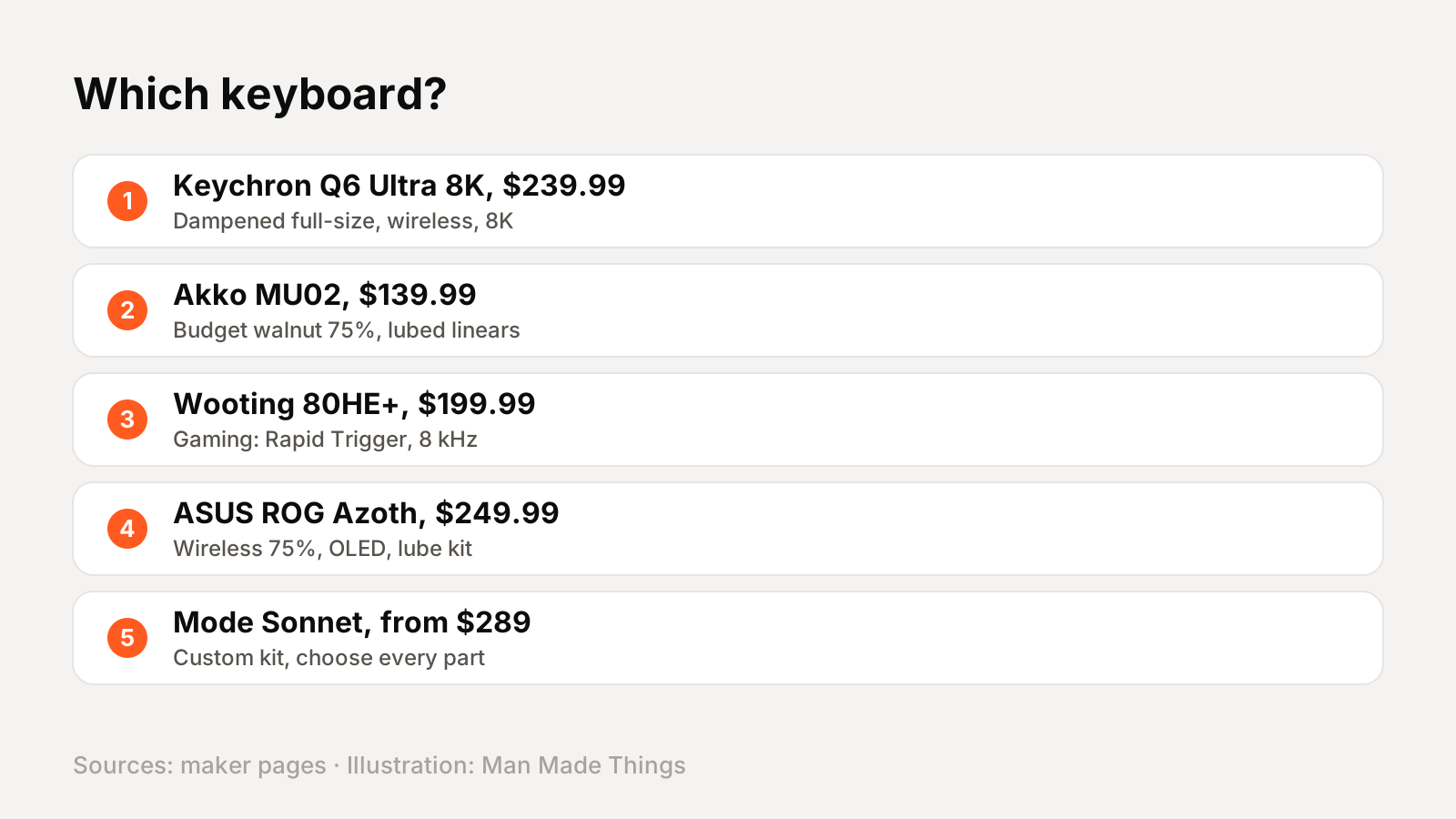
Buy the Keychron Q6 Ultra 8K if you want a full-size board with a number pad, heavy dampening and wireless, ready to use out of the box.
Buy the Akko MU02 if you want a beautiful, affordable wooden keyboard with lubed linear switches.
Buy the Wooting 80HE+ if you game competitively and want adjustable actuation and Rapid Trigger, with a soft, controlled sound.
Buy the ASUS ROG Azoth if you want a premium wireless 75% with an OLED display and the option to tune its switches yourself.
Buy the Mode Sonnet if you want to build a keyboard from scratch and choose every part that shapes its sound.
Pair your new keyboard with a clean desk setup: our best monitors for MacBook and best USB-C hubs for MacBook guides can help.
Frequently asked questions
What makes a keyboard sound poppy?
+
Epomaker says long-pole switch stems are the biggest factor, plus thin plate foam, no bottom-case foam and a medium-hard plate like 1.5mm PC.
What is a gasket-mounted keyboard?
+
One where the plate sits on soft gaskets rather than screwed to the case. Wooting says its silicone gasket absorbs impact for less noise and a softer feel.
Can I change the sound of my keyboard?
+
Yes. Hot-swap boards like the Keychron, Akko and ASUS let you change switches; ASUS even includes a switch lube kit.
What's the best budget keyboard with a good sound?
+
The Akko MU02 ($139.99), with a gasket mount, walnut case and factory-lubed Rosewood linear switches.
Sources
Editor-in-Chief
Rahul has been writing about gadgets and software since 2013, first at Thetechhacker and now at Man Made Things. He edits every review on the site and signs off on every verdict.
More from Rahul →