Portable EV Chargers vs Wall Chargers: Which Do You Need?
Portable EV chargers vs wall-mounted chargers explained with Department of Energy and maker facts: charging speeds, circuits, when a portable charger is enough, and portable picks from Grizzl-E and Lectron, plus the cords that come with some EVs.
We may earn a commission when you buy through links on this page. Learn more
Quick answer
A wall charger is permanently mounted and usually hardwired or plugged into a NEMA 14-50 outlet, delivering up to 48–50 amps. A portable charger is a cord you plug into an outlet and can take with you. Portable Level 2 chargers like the Grizzl-E Mini Connect ($349.99, up to 40A) or Lectron Explorer ($299.99 on sale, up to 24A) are plenty for most daily driving, as long as you have a suitable 240V outlet on a dedicated circuit. Choose a wall charger if you want the fastest home charging, a permanent outdoor install or smart features.
When you buy an EV, you'll quickly face a choice: buy a wall-mounted charger and pay an electrician, or use a portable charger that plugs into an outlet?
Both are "Level 2" chargers when they run on 240V, and both can fill your battery overnight. The differences are speed, flexibility and installation. This explainer uses the Department of Energy's Alternative Fuels Data Center (AFDC) and makers' official specs, as of November 11, 2026, to help you decide.
If you've already decided on a wall unit, see our best home EV chargers.
Our take: most people should start with whatever cord came with the car, plus a 240V outlet installed by an electrician. You can always add a wall charger later.
Our picks at a glance
1. Best portable Level 2
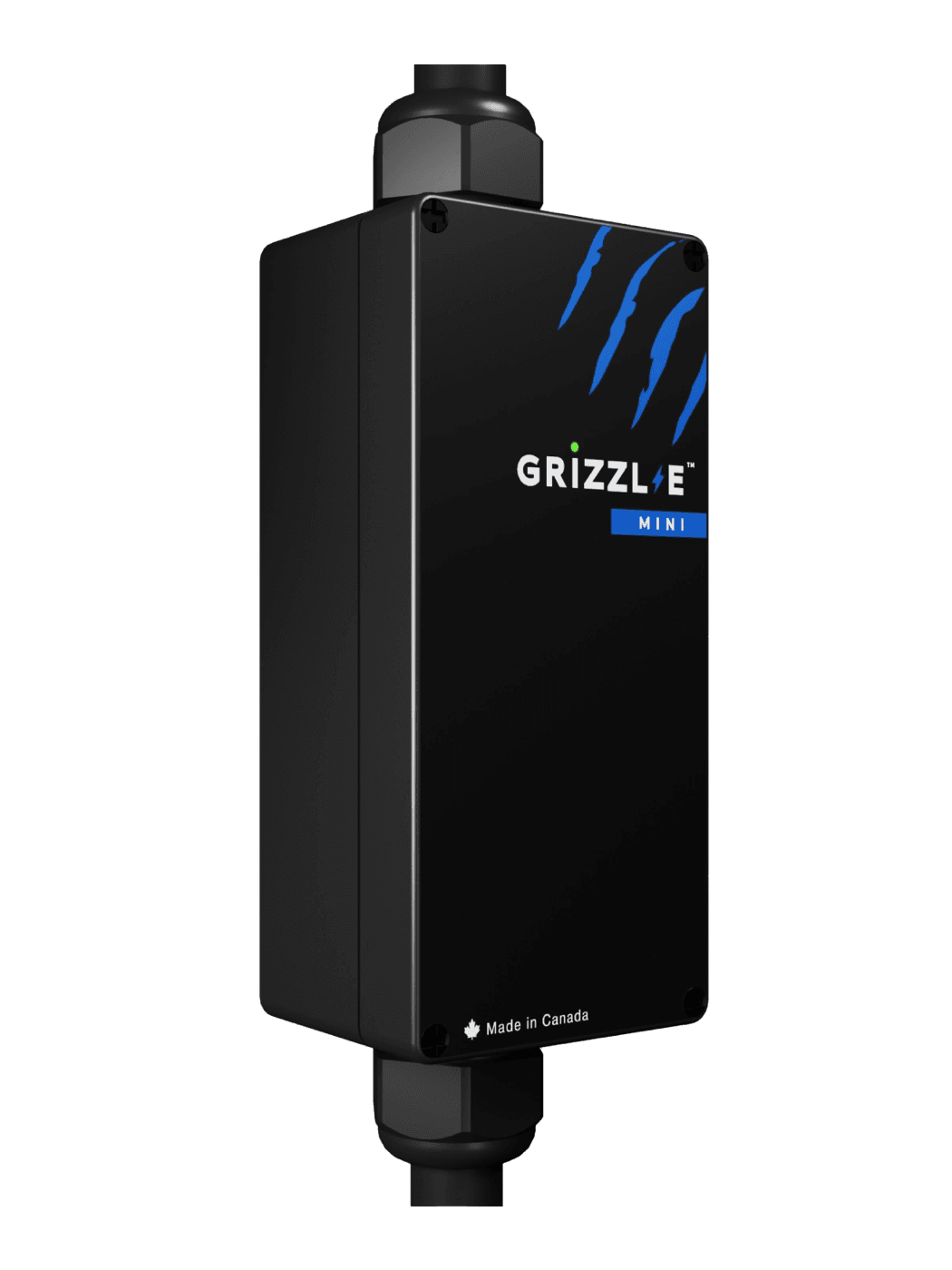
Grizzl-E Mini Connect 40A
The Grizzl-E Mini Connect is a compact charger you can mount or carry. It delivers up to 40 amps on a NEMA 14-50 outlet, nearly as fast as many wall units, and detects voltage automatically so it can also charge at Level 1. Grizzl-E says it includes four adapters and a soft carrying case, and it's Type 4 rated for outdoor use. It costs $349.99, though it was out of stock when we checked.
Pros
- 01Up to 40A, close to wall-charger speed
- 02Adapters and carrying case included
- 03Outdoor rated
Cons
- 01Out of stock when checked
- 02Needs a 240V outlet for full speed
| Output | Adjustable 7–40A, up to 10 kW |
|---|---|
| Plug | NEMA 14-50, with adapters included |
| Connector | J1772 or NACS |
| Cable | 25 ft |
| Rating | Type 4 indoor/outdoor, UL and cUL |
| Warranty | 3 years (5-year option) |
2. Best budget portable
Lectron Explorer Portable Level 1 & 2 (NACS)
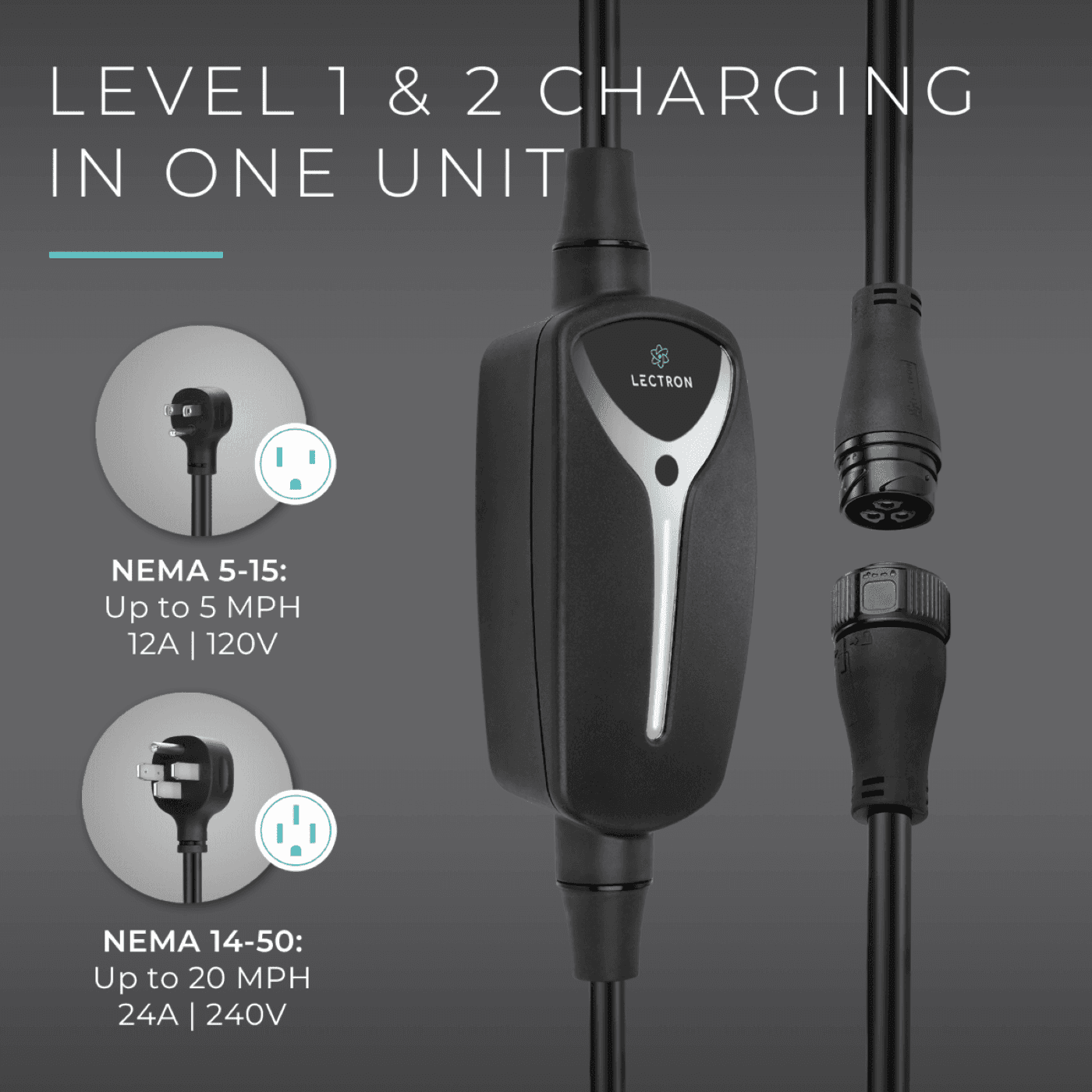
Lectron's Explorer works on both a regular household outlet (Level 1) and a 240V NEMA 14-50 outlet (Level 2), with plugs for each. At 24 amps on Level 2, it's slower than the Grizzl-E, but enough for most daily commutes overnight. It has a NACS connector and was on sale for $299.99 (list $359.99).
Pros
- 01Works on 120V and 240V
- 02Both plugs included
- 03Lower price
Cons
- 0124A max on Level 2
- 02NACS connector only
| Output | Level 1: 12A / 1.4 kW; Level 2: 24A / 5.7 kW |
|---|---|
| Plugs | NEMA 5-15 and NEMA 14-50 |
| Connector | NACS |
| Cable | 20 ft |
Portable vs wall charger at a glance
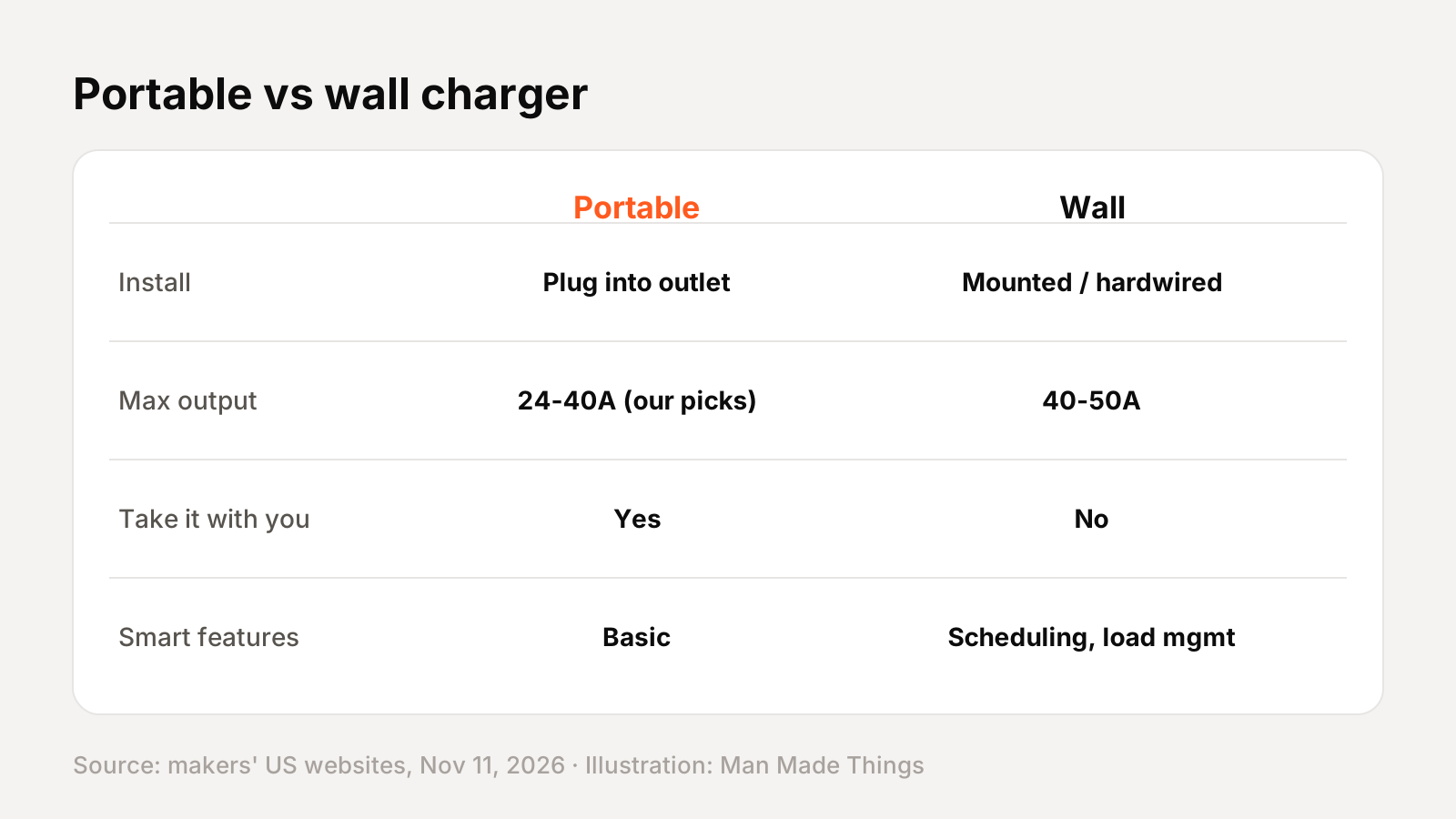
| Portable charger | Wall charger | |
|---|---|---|
| Installation | Plugs into an existing outlet | Mounted; hardwired or plugged in |
| Typical max output | 24–40A (our picks) | 40–50A (see our wall charger guide) |
| Take it with you | Yes | No |
| Smart features | Basic or none | Often scheduling, load management, solar |
| Price | ~$300–$350 (our picks) | ~$300–$700 |
The bottom line: if you have a suitable outlet and drive a typical daily distance, a portable charger is often enough. If you want the fastest home charging, outdoor hardwiring or features like load management, choose a wall charger.
How fast is each type?
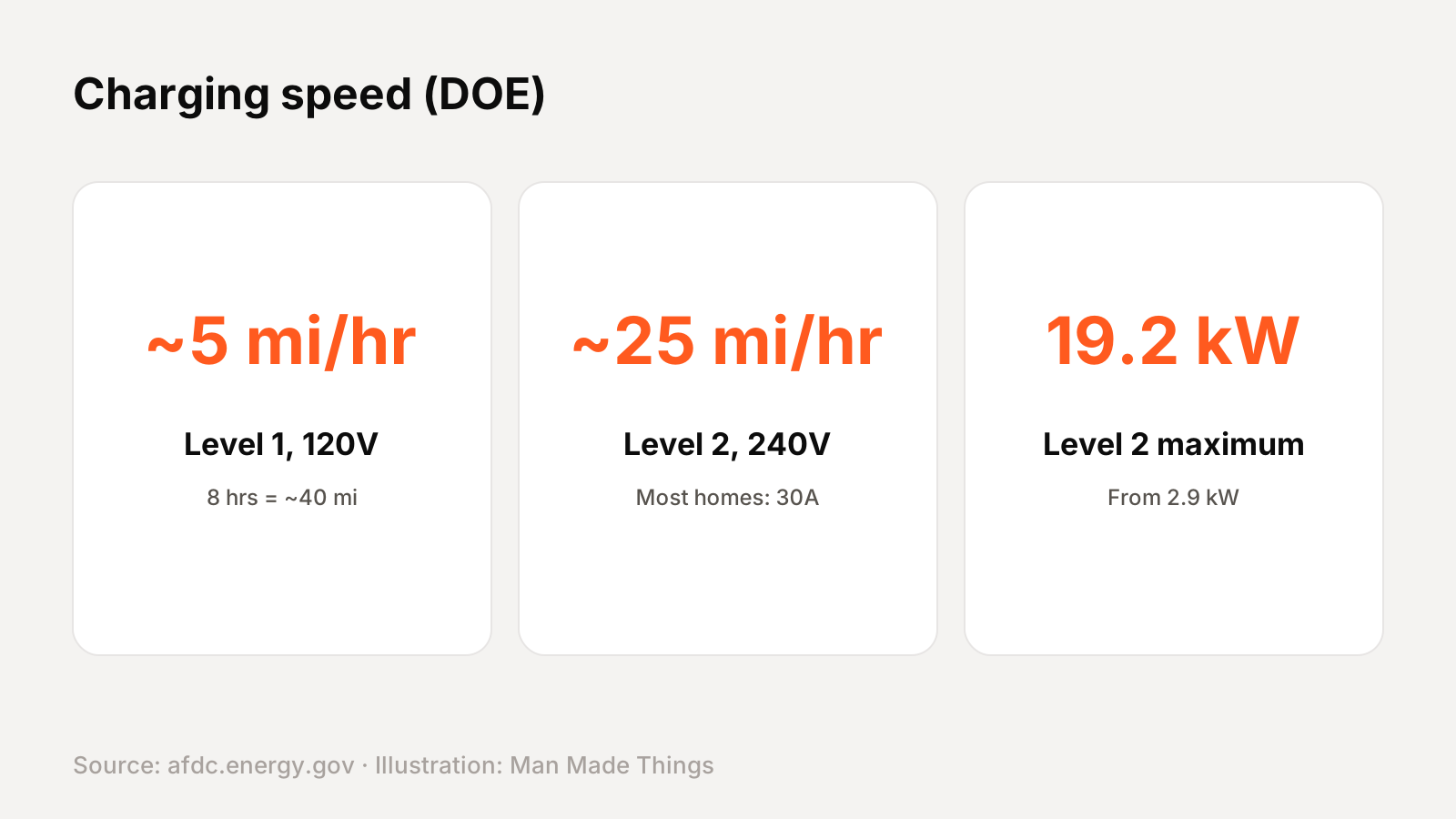
The AFDC gives these rough figures:
- Level 1 (120V): about 5 miles of range per hour. Eight hours adds about 40 miles.
- Level 2 (240V): about 25 miles of range per hour. Level 2 ranges from 2.9 to 19.2 kW, and the AFDC says most home units run at up to 30 amps (7.2 kW).
Faster chargers only help if your car can accept the power. Check your car's maximum AC charging rate. For example, Kia lists 11 kW for the EV3, and Toyota lists an 11 kW onboard charger for the bZ.
Check before you buy: the outlet and circuit
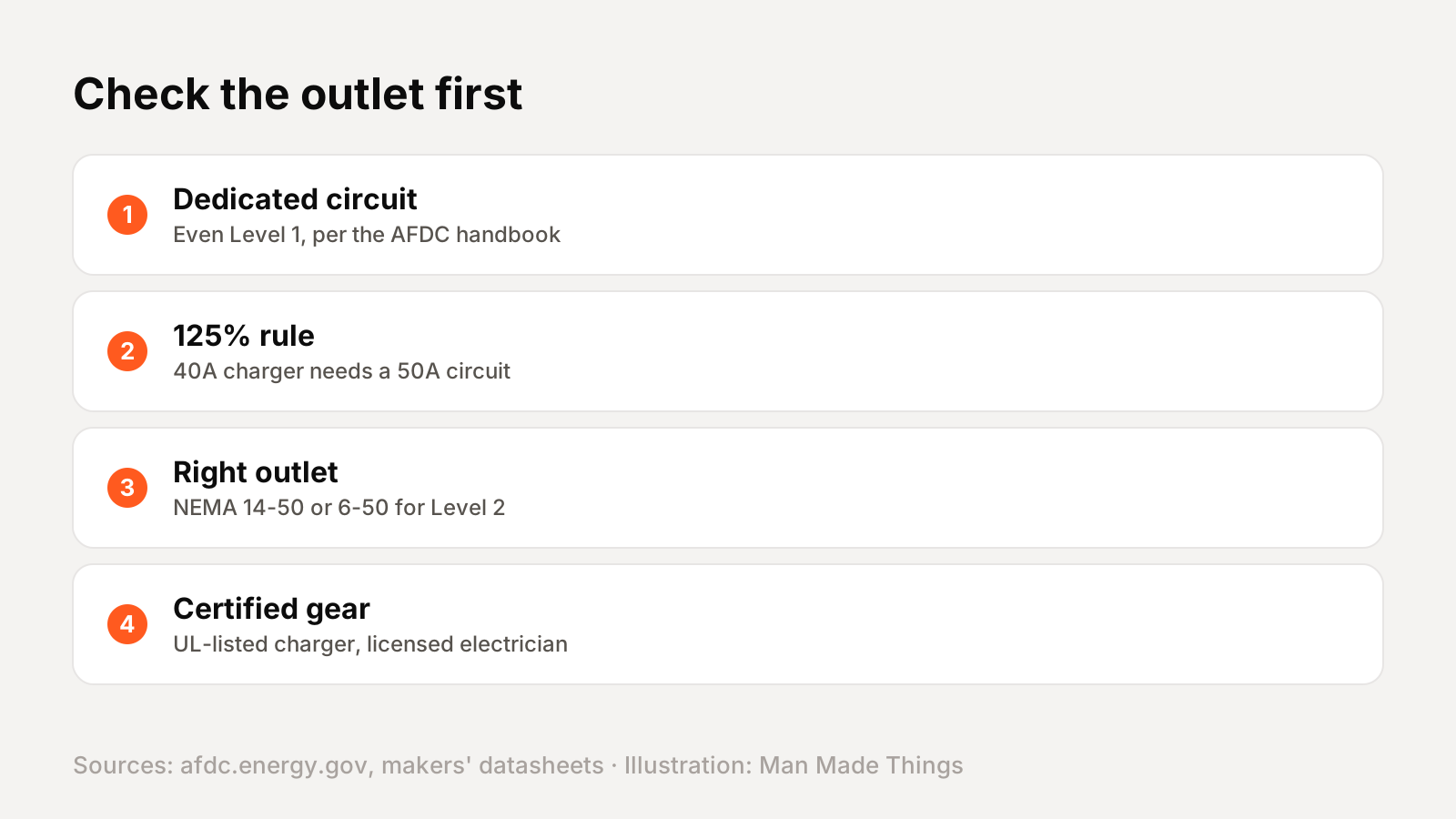
A portable charger is only as good as the outlet you plug it into.
- Dedicated circuit: the AFDC's consumer handbook says even Level 1 charging requires a dedicated branch circuit under the National Electrical Code.
- The 125% rule: EV charging is a continuous load under the NEC, the AFDC says, so a circuit must be rated for 125% of the charger's current. A 40A charger needs a 50A circuit; a 24A charger needs a 30A circuit.
- Certified equipment: the AFDC recommends safety-certified chargers and a certified electrical contractor.
- Extension cords: we didn't find official guidance on using extension cords in the sources we checked, so follow your charger's and car's manuals, and ask an electrician.
More on breakers in our best home EV chargers guide.
Does your EV already come with a charger?
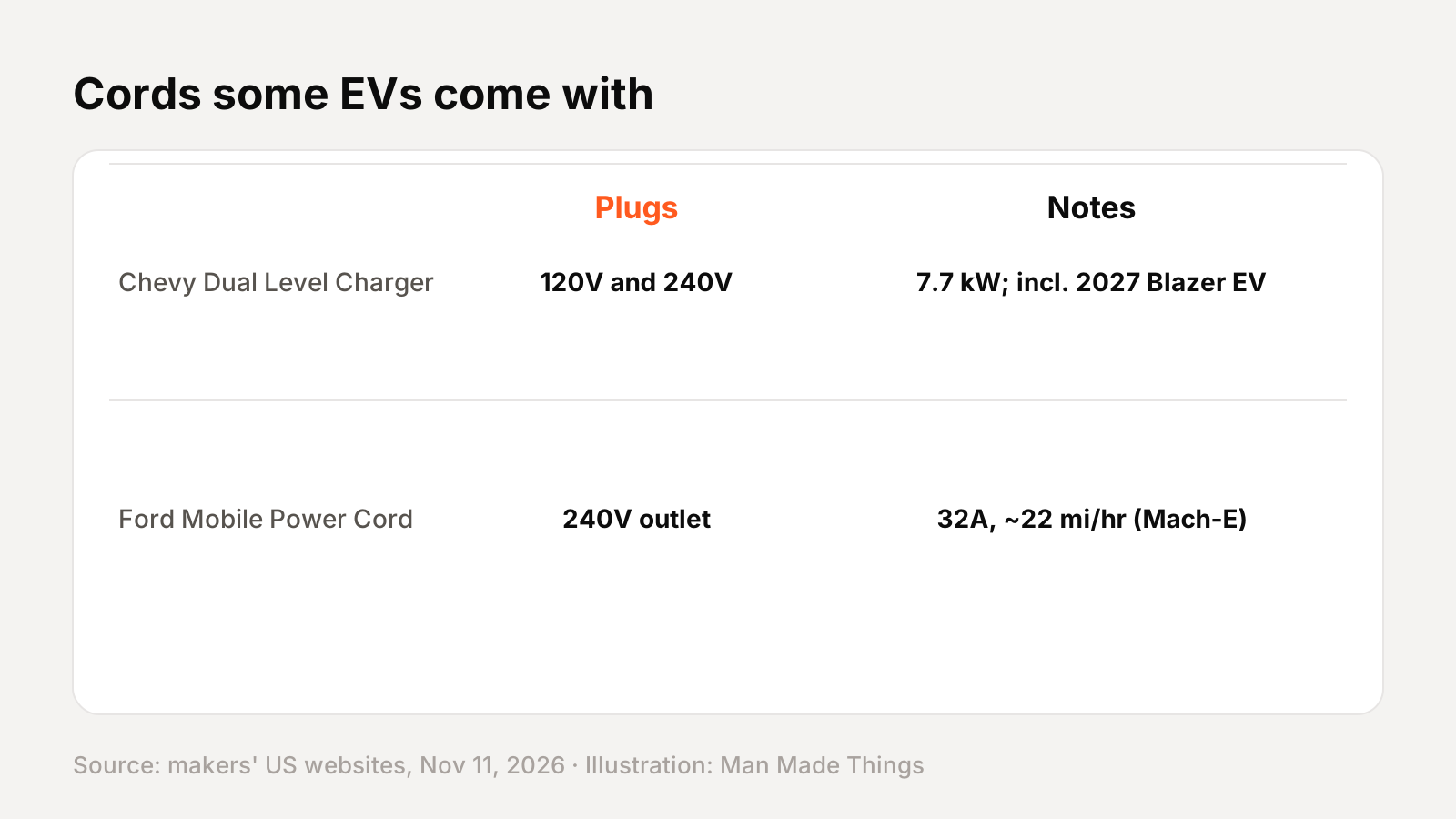
Before you buy anything, check what came with your car:
- Chevrolet Dual Level Charger: Chevy says it's portable, with changeable plugs for 120V and 240V (NEMA 14-50). Chevy lists it at 7.7 kW on Level 2, says it's included with the 2027 Blazer EV and available for the Equinox EV.
- Ford Mobile Power Cord: Ford offers a 32-amp Mobile Power Cord that it says adds about 22 miles of range per hour on a 240V outlet for a 2025 Mach-E.
If your car includes a Level 2-capable cord, you may only need an electrician to install a 240V outlet.
Which should you choose?
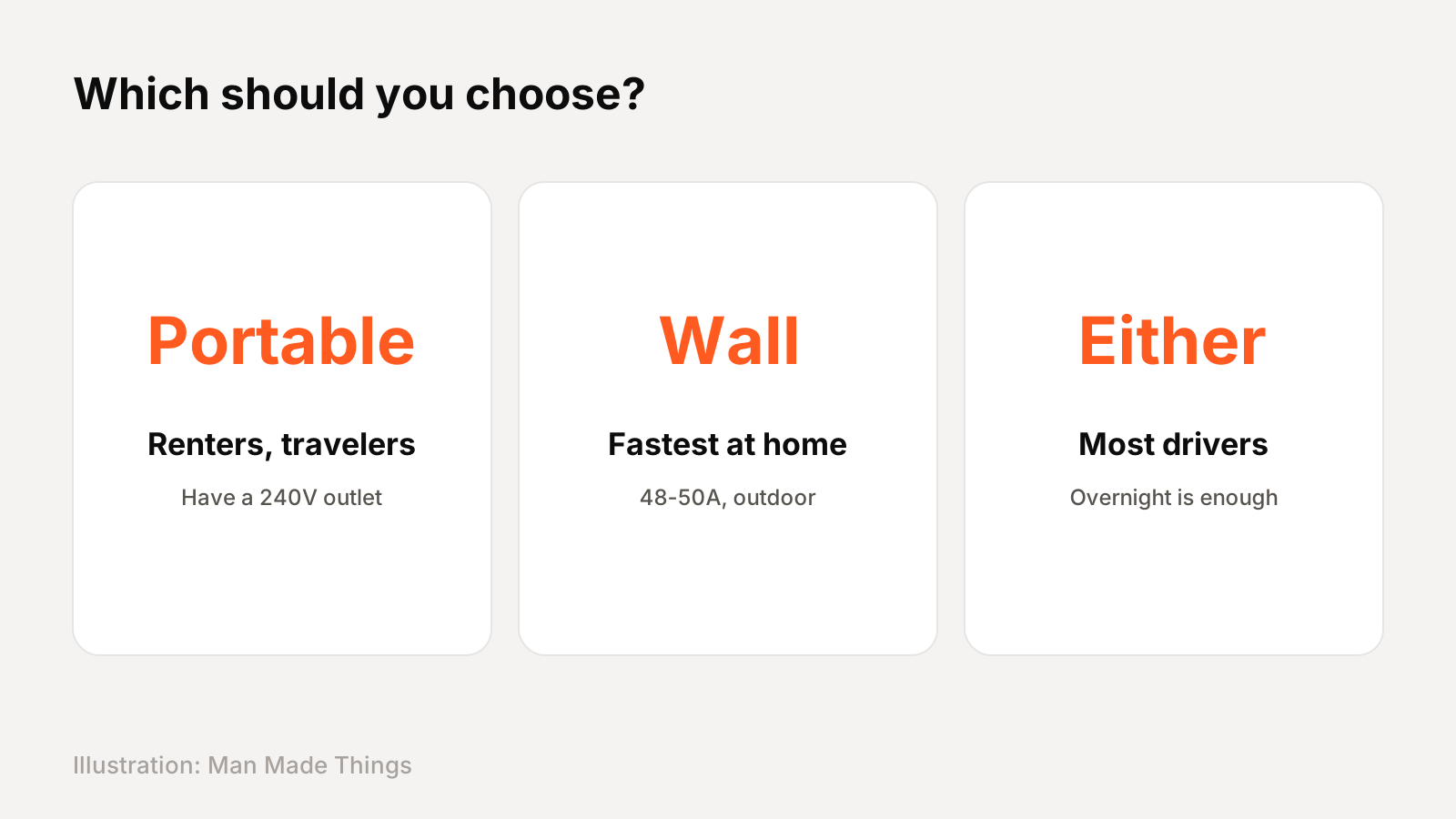
Choose a portable charger if you:
- rent or might move soon;
- already have a 240V outlet in your garage;
- want a charger you can take on trips; or
- drive moderate distances each day.
Choose a wall charger if you:
- want the fastest home charging (48–50A);
- need a permanent outdoor installation;
- want smart features like load management or solar charging; or
- have two EVs to charge.
Still choosing a car? Read our EV buying guide.
How long does a full charge take at home?
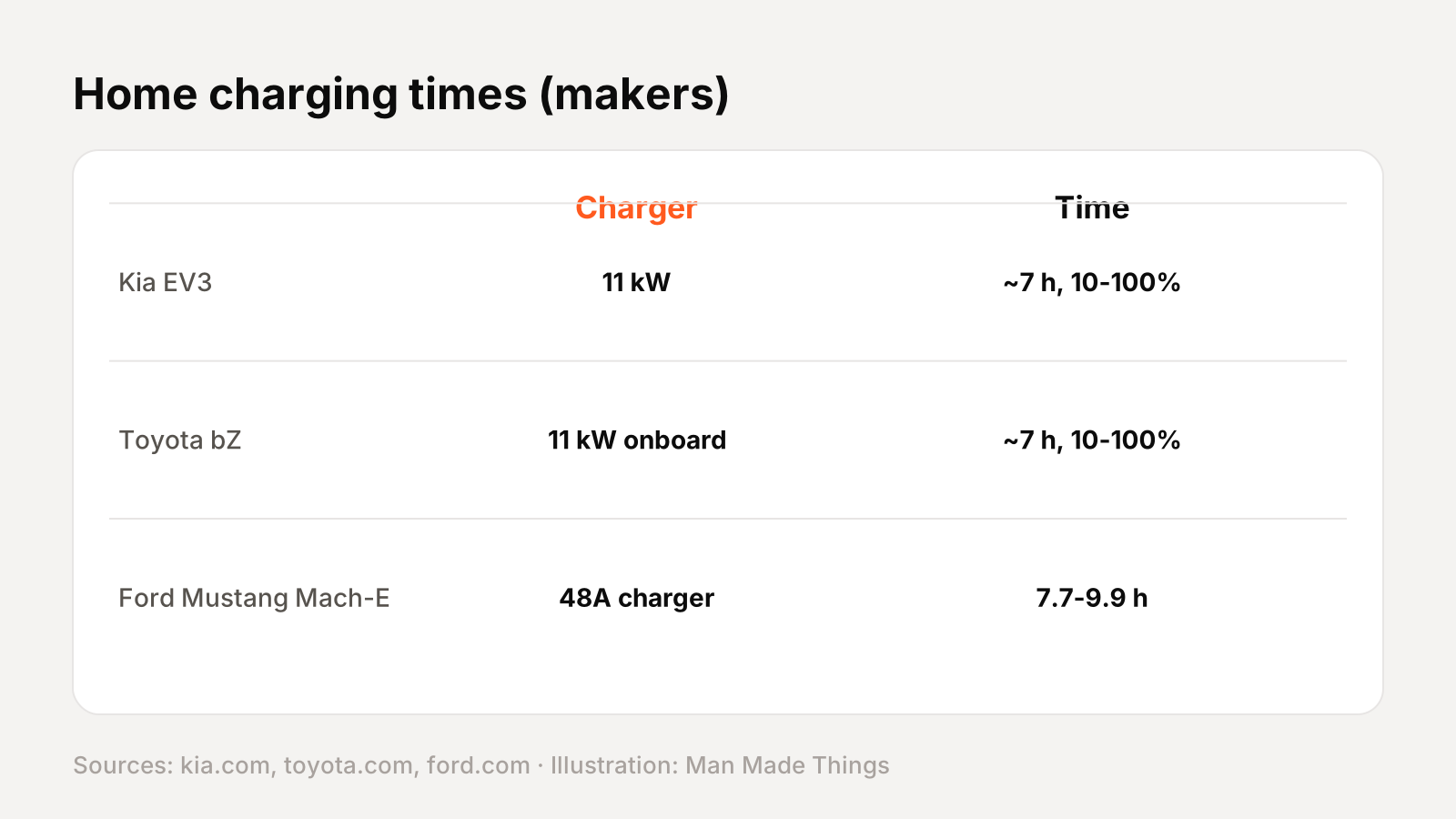
Makers publish home charging times, and they show why Level 2 is enough for most people:
- Kia EV3: about 7 hours from 10 to 100% at 11 kW, according to Kia.
- Toyota bZ: about 7 hours from 10 to 100% with its 11 kW onboard charger, says Toyota.
- Ford Mustang Mach-E: 7.7 to 9.9 hours on a 48-amp charger, depending on the battery, according to Ford.
Those times assume a charger fast enough to match the car. A 24-amp portable charger, like the Lectron Explorer's Level 2 setting, delivers about 5.7 kW, so a full charge would take longer. But you rarely charge from empty: most nights you're only replacing a day's driving. At the AFDC's rough figure of about 25 miles of range per hour on Level 2, eight hours overnight adds around 200 miles.
Frequently asked questions
Is a portable EV charger as good as a wall charger?
+
For many drivers, yes. A 40A portable charger like the Grizzl-E Mini Connect is close to many wall chargers. Wall chargers win on maximum speed, permanent installation and smart features.
Can I use a regular outlet to charge my EV?
+
Yes, at Level 1, which adds about 5 miles of range per hour, according to the Department of Energy. The AFDC notes it should be on a dedicated circuit.
What outlet do I need for a portable Level 2 charger?
+
Usually a 240V NEMA 14-50 outlet on a dedicated circuit, rated at 125% of the charger's current.
Do EVs come with a charger?
+
Some do. Chevrolet includes its Dual Level Charger with the 2027 Blazer EV, and Ford offers a Mobile Power Cord.
Sources
Editor-in-Chief
Rahul has been writing about gadgets and software since 2013, first at Thetechhacker and now at Man Made Things. He edits every review on the site and signs off on every verdict.
More from Rahul →