The EV Buying Guide Nobody Else Does the Math For
An electric car buying guide built on our own calculations from official specs: price per mile of EPA range, miles added per minute of fast charging, the cheapest extra miles you can buy, how much range each trim really costs you, and the home-charging checks to do before you sign.
We may earn a commission when you buy through links on this page. Learn more
Quick answer
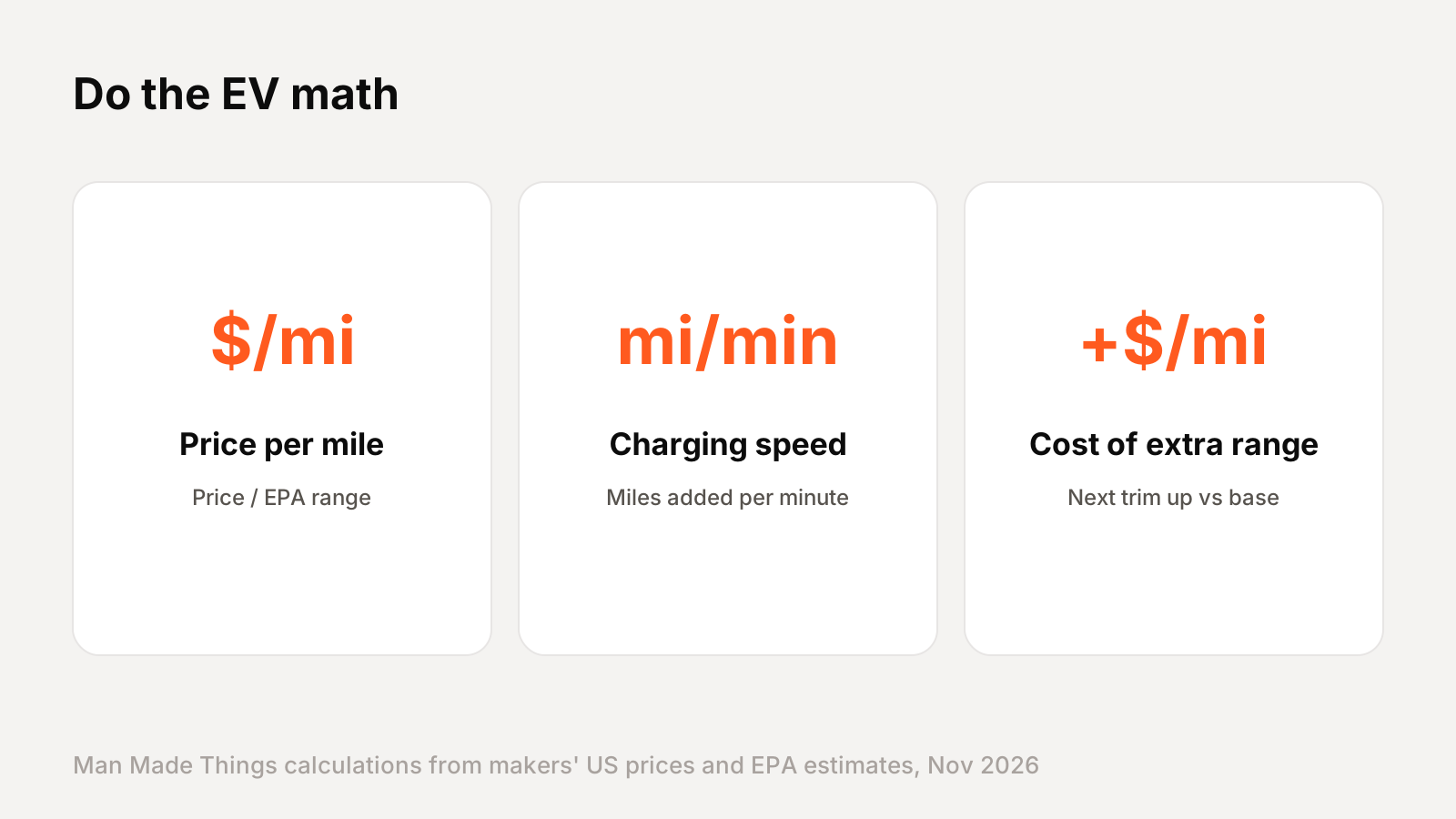
Don't compare EVs on price or range alone. Divide price by EPA range: the Chevrolet Equinox EV costs about $110 per mile of range, the Tesla Model Y about $125 and the Porsche Taycan 4S about $418. Compare fast charging in miles added per minute, not peak kW: the Lucid Gravity Grand Touring adds about 19 miles a minute by Lucid's claim, the Equinox EV about 8. And the base trim is often the worst value: the Kia EV9 Long Range adds 75 miles for $3,000, about $40 per extra mile.
Most EV buying guides tell you the same things: check the range, think about charging, look for incentives. All true, and not much help when you're choosing between two real cars.
So we did something different. We took the official prices and specs from our best electric cars of 2026 research, all from the makers' own US websites, and ran the numbers ourselves. The result is a set of simple ratios you can use to compare any EVs, plus the checks we'd do before signing.
A note on honesty: the calculations below are ours, based on each maker's claims and EPA estimates as of November 2026. They're not test results. Real-world range and charging speed change with weather, speed, battery temperature and the charger you use. Treat these numbers as a fair way to compare cars on paper, not a promise of what you'll get.
And one big change this year: the IRS says new EVs acquired after September 30, 2025 no longer qualify for the federal clean vehicle credit. Without that $7,500, value math matters more than ever.
1. Price per mile of range: the number to start with
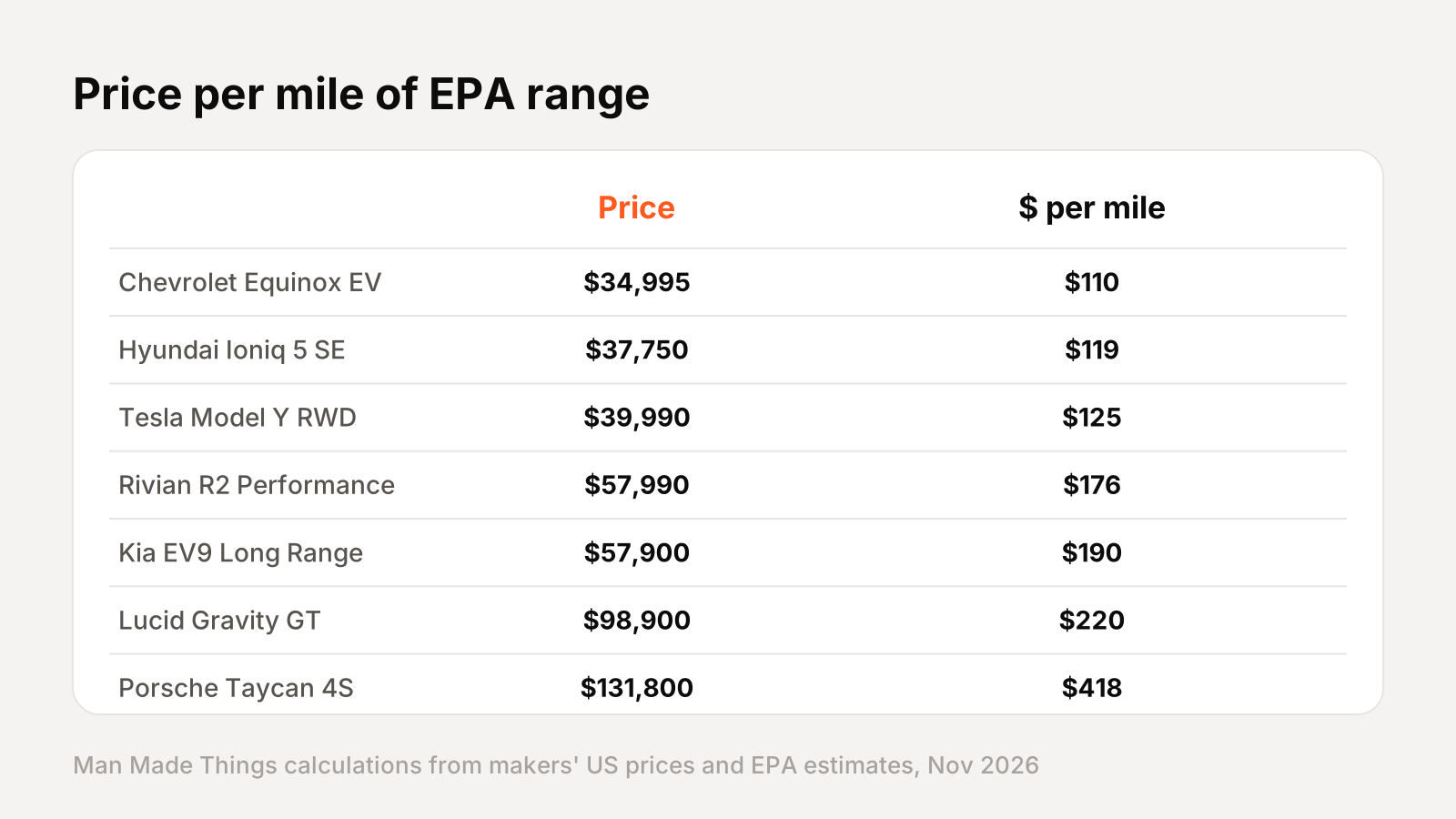
Divide a car's price by its EPA-estimated range. It's a quick way to see how much range your money buys.
| Car (trim) | Price | EPA-est. range | Price per mile of range |
|---|---|---|---|
| Chevrolet Equinox EV (LT 1, FWD) | $34,995 | 319 mi | $110 |
| Hyundai Ioniq 5 (SE, RWD) | $37,750 | 318 mi | $119 |
| Tesla Model Y (RWD) | $39,990 | 321 mi | $125 |
| Rivian R2 (Performance) | $57,990 | 330 mi | $176 |
| Kia EV9 (Light Long Range) | $57,900 | 305 mi | $190 |
| Lucid Gravity (Grand Touring) | $98,900 | 450 mi | $220 |
| Porsche Taycan 4S | $131,800 | 315 mi | $418 |
Prices are starting MSRPs before destination fees. A three-row SUV, a 656 hp Rivian or a Porsche will always cost more per mile, because you're also paying for space, speed or a badge. That's fine. The point is to know what you're paying for. If two cars suit you equally, the one with the lower number gives you more range for your money.
2. The base trim is often the worst deal
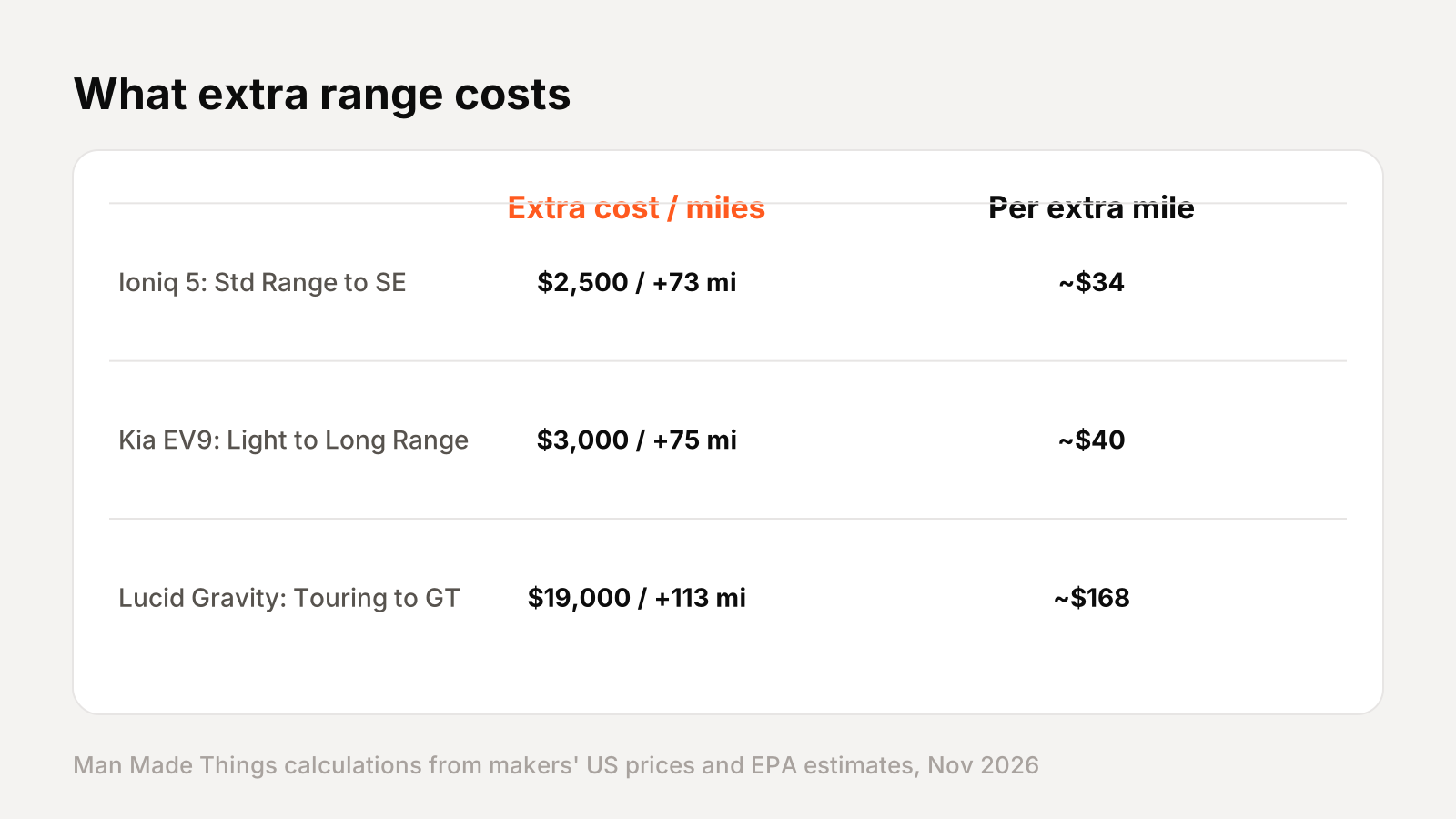
Here's something we rarely see spelled out. Compare the base trim with the next one up, and work out what each extra mile of range costs:
| Upgrade | Extra cost | Extra range | Cost per extra mile |
|---|---|---|---|
| Hyundai Ioniq 5: SE Standard Range to SE | $2,500 | +73 mi | ~$34 |
| Kia EV9: Light to Light Long Range | $3,000 | +75 mi | ~$40 |
| Lucid Gravity: Touring to Grand Touring | $19,000 | +113 mi | ~$168 |
Compare those with the price per mile of range of the cars themselves, from $110 to $418. At about $34 to $40 per extra mile, the Ioniq 5 and EV9 long-range upgrades are the cheapest range you can buy on this list. In both cases the cheapest trim actually costs more per mile of range than the one above it: the base EV9 works out to about $239 per mile, against $190 for the Long Range.
The rule of thumb: always price the next trim up before you buy the cheapest one. A small upgrade can buy a lot of range.
3. Ignore peak kW. Compare miles per charging minute
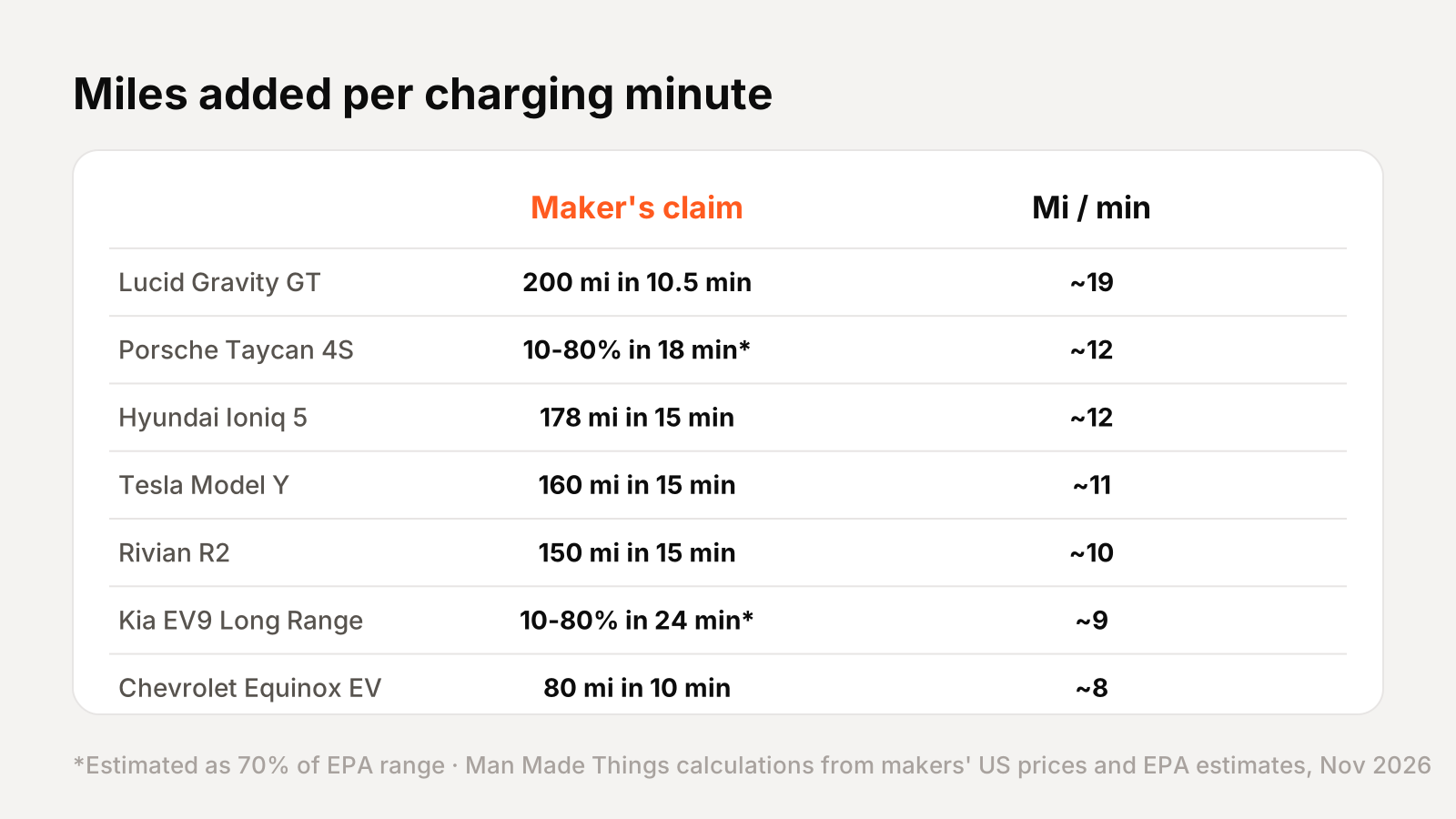
Makers love to quote a peak charging power, like 320 kW. But you don't drive kilowatts. What matters on a road trip is how many miles you get back for every minute you stand at the charger.
Makers describe charging in different ways, so we converted their claims into miles added per minute:
| Car | Maker's claim | Miles per minute |
|---|---|---|
| Lucid Gravity Grand Touring | 200 miles in 10.5 min (400 kW charger) | ~19 |
| Porsche Taycan 4S | 10–80% in 18 min* | ~12 |
| Hyundai Ioniq 5 (Long Range RWD) | Up to 178 miles in 15 min | ~12 |
| Tesla Model Y | Up to 160 miles in 15 min | ~11 |
| Rivian R2 | 150 miles in 15 min | ~10 |
| Kia EV9 (Long Range) | 10–80% in 24 min* | ~9 |
| Chevrolet Equinox EV | Up to 80 miles in 10 min | ~8 |
*For claims given as 10–80%, we applied 70% of the EPA-estimated range to the charging time. That's a paper estimate, since real-world miles depend on how you drive.
What this shows: a car with less range but faster charging can make a road trip just as quick. Two stops of 15 minutes in an Ioniq 5 may cost you less time than one long stop in a slower-charging car. And the charger matters: those best-case times need a charger fast enough to deliver them.
4. Every option costs you range. Here's how much
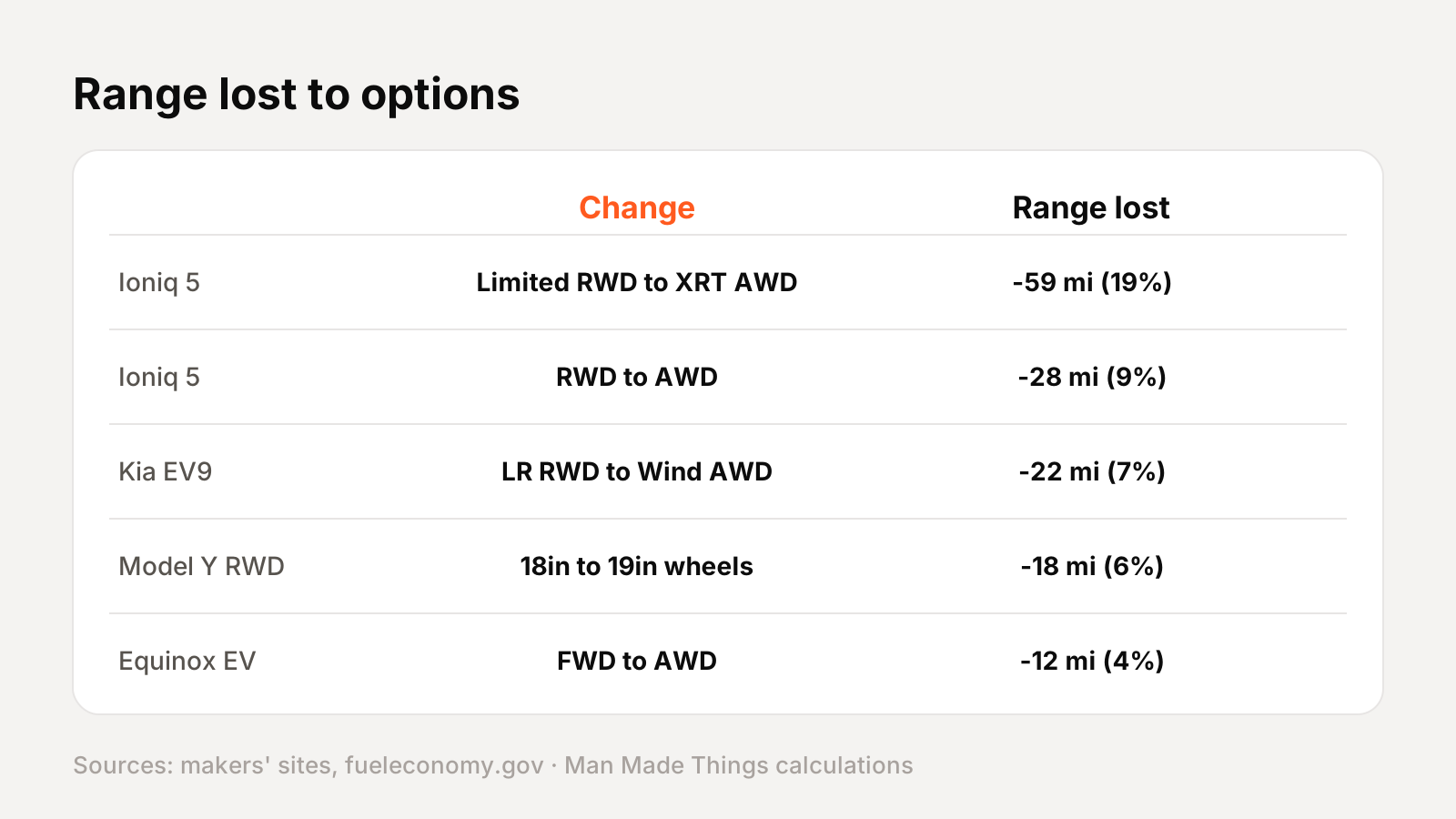
All-wheel drive, bigger wheels and rugged trims look great, but each one costs range. Using official EPA estimates:
| Change | Range lost | Share of range |
|---|---|---|
| Ioniq 5: Limited RWD (318 mi) to XRT AWD (259 mi) | −59 mi | −19% |
| Ioniq 5: RWD (318 mi) to AWD (290 mi) | −28 mi | −9% |
| Kia EV9: Long Range RWD (305 mi) to Wind AWD (283 mi) | −22 mi | −7% |
| Model Y RWD: 18-inch (321 mi) to 19-inch wheels (303 mi)† | −18 mi | −6% |
| Equinox EV: FWD (319 mi) to AWD (307 mi) | −12 mi | −4% |
†From fueleconomy.gov, the government's EPA data site.
The lesson: decide whether you really need AWD or the off-road look. If you live somewhere with mild winters and paved roads, the two-wheel-drive version usually gives you more range for less money.
5. Work out your charging from your commute, not the range
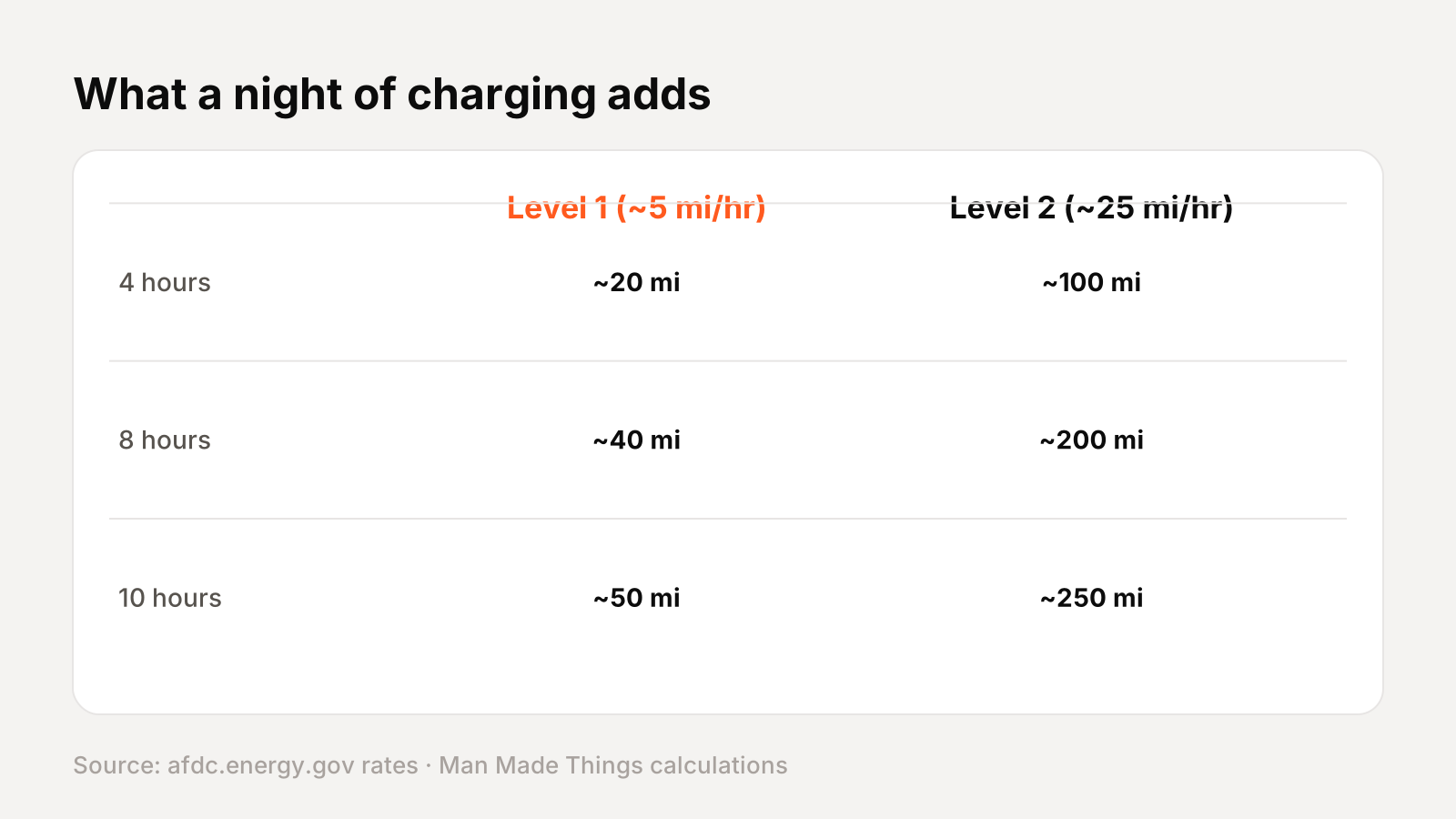
Most EV owners charge at home overnight, so the real question isn't "how far can it go?" but "can I put back what I used today while I sleep?"
The Department of Energy's AFDC says a Level 2 charger adds about 25 miles of range per hour, and Level 1, from a regular outlet, about 5 miles per hour. That means:
| Hours plugged in | Level 1 (~5 mi/hr) | Level 2 (~25 mi/hr) |
|---|---|---|
| 4 hours | ~20 miles | ~100 miles |
| 8 hours | ~40 miles | ~200 miles |
| 10 hours | ~50 miles | ~250 miles |
Our quick test: double your daily round trip. If a 10-hour night on Level 1 covers it, you may not need a Level 2 charger at all. If not, budget for one. Our best home EV chargers guide covers the options.
This also changes how much range you need. If you can fully recharge every night, you're buying range for your longest regular trip, not your average day.
6. Check your electrical panel before you buy the car
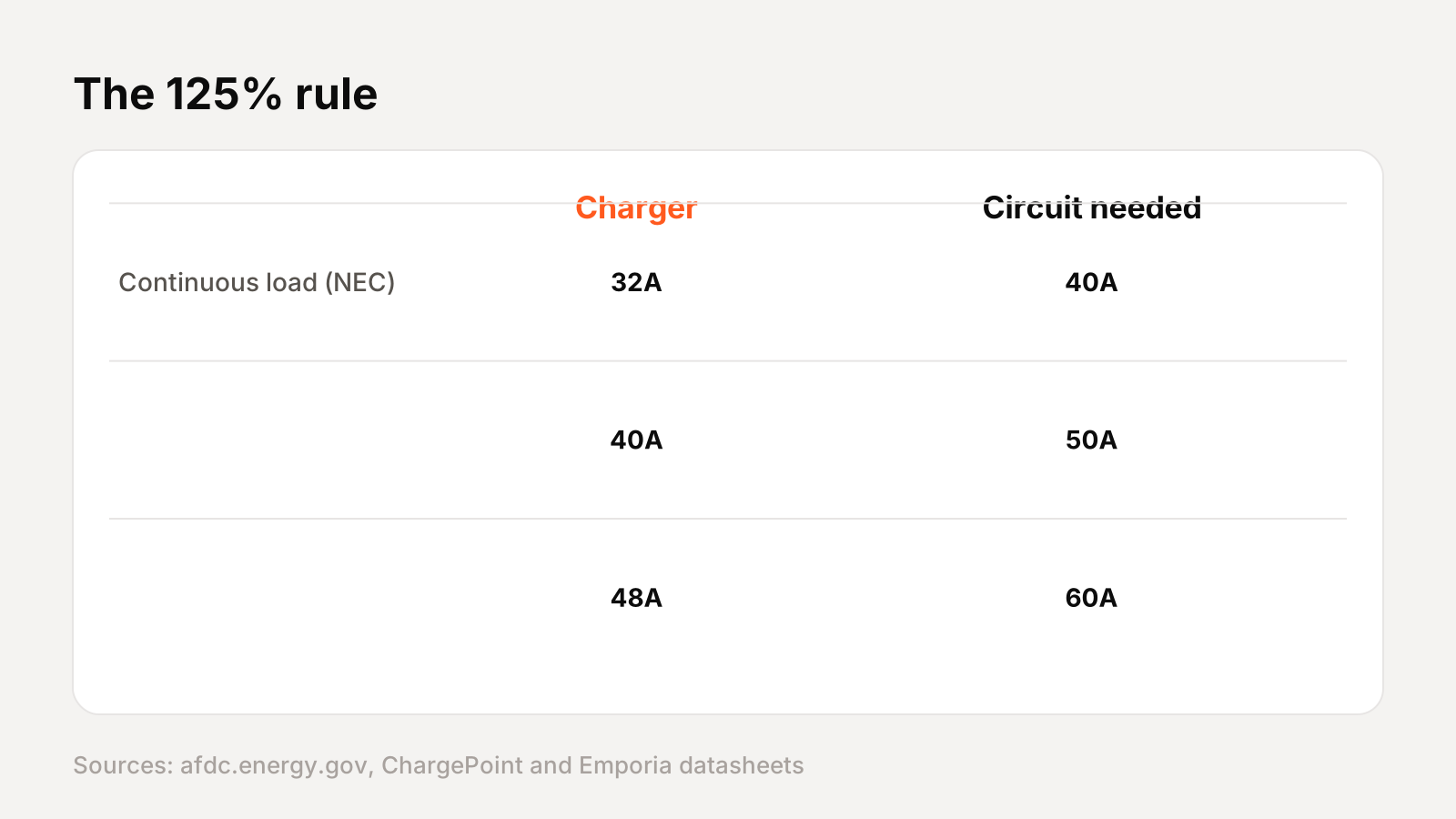
This is the hidden cost that catches people out. EV charging counts as a continuous load under the National Electrical Code, the AFDC says, so the circuit must be rated for 125% of the charger's current. A 40A charger needs a 50A circuit, and a 48A charger needs 60A.
If your home's panel doesn't have room for that, there are two routes: a panel upgrade, or a charger with load management, like the Emporia Pro, which Emporia says works even with older 60 or 100 amp service panels.
Our advice: get an electrician's quote for your home charger before you sign for the car, and add it to the car's price. The federal 30C credit for home charging equipment no longer applies to equipment placed in service after June 30, 2026, per the IRS, so check for state or utility rebates instead.
7. Read the warranty in miles, not just years
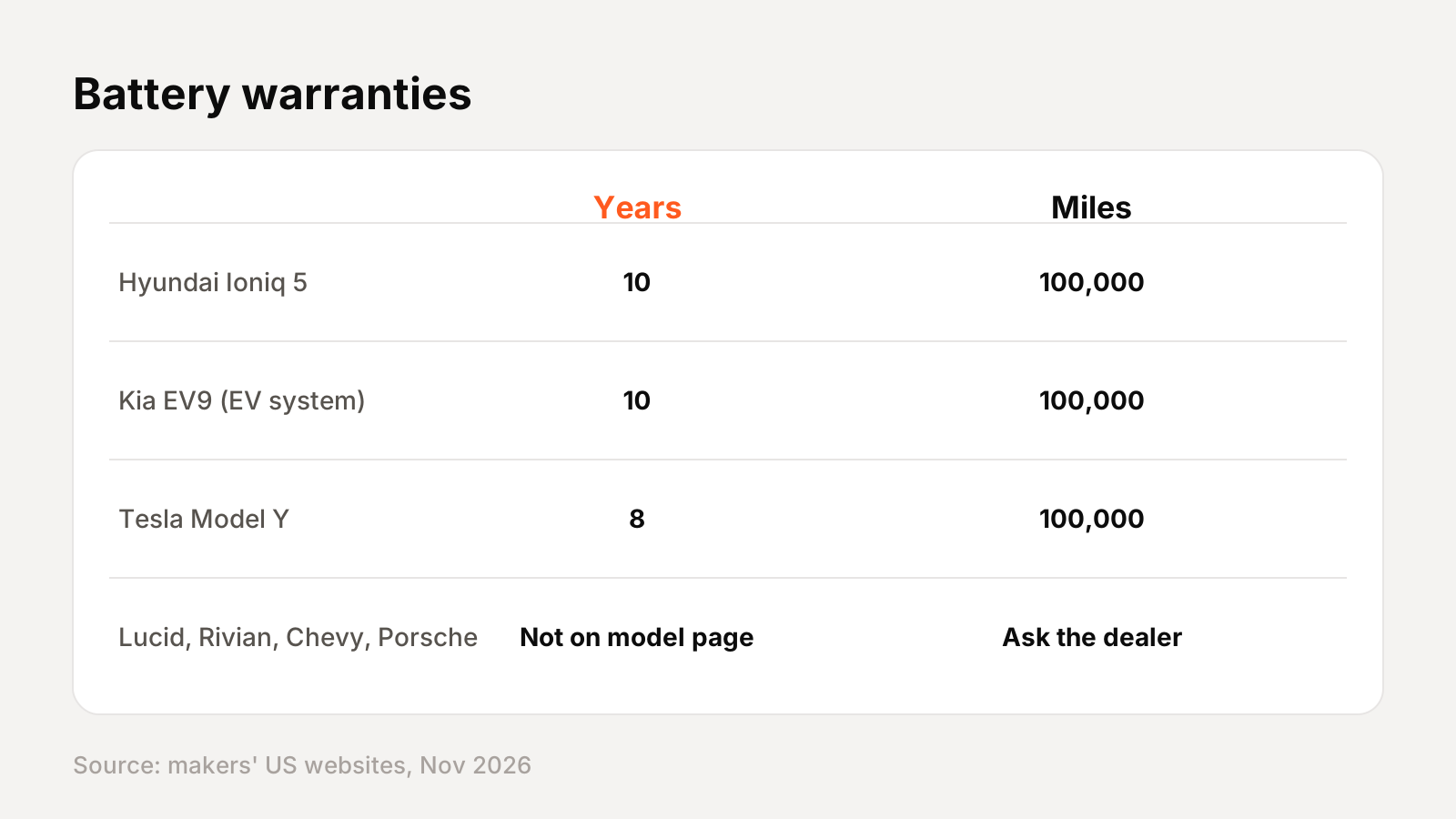
The battery is the most expensive part of an EV, so its warranty matters. From the makers' sites:
- Hyundai Ioniq 5: EV battery covered for 10 years or 100,000 miles.
- Kia EV9: EV system covered for 10 years or 100,000 miles.
- Tesla Model Y: battery and drive unit covered for 8 years or 100,000 miles.
Lucid, Rivian, Chevrolet and Porsche didn't state battery warranty terms on the model pages we checked, so ask the dealer for the written terms.
If you drive a lot, the mileage cap matters more than the years. At 15,000 miles a year, you'd hit 100,000 miles in under seven years, before the 8- or 10-year limit. Low-mileage drivers get the full term.
8. Our pre-purchase checklist

Before you sign, check these. None take long, and each one can save you money or hassle.
- Plug type. Most new EVs now have a NACS port. If the car uses CCS, ask whether a NACS adapter is included, and vice versa. Hyundai and Porsche include a CCS adapter with their NACS cars.
- Ask to fast-charge on the test drive. Plug in at a public charger and watch how quickly the miles climb. It's the best real-world check you can do.
- Get the destination fee in writing. Most makers don't show it on their main pages. Porsche lists $2,350 for the Taycan.
- Price the next trim up. As our math shows, it's often the better value.
- Get a home-charging quote before you sign, and add it to your budget.
- Check hands-free driving terms. Rivian's Universal Hands-Free costs $2,500 or $49.99 a month unless it's included, and Tesla's Full Self-Driving (Supervised) is $99 a month. Know what's included and what's a subscription.
- Get the battery warranty terms in writing.
- Look up state and utility incentives, since the federal credit is gone.
Frequently asked questions
What is a good price per mile of range for an EV?
+
Among the EVs we compared, mainstream models came in around $110 to $125 per mile of EPA range (Equinox EV, Ioniq 5, Model Y), while luxury and performance models cost $175 to over $400.
How do I compare EV charging speeds?
+
Convert each maker's claim into miles added per minute. Peak kW alone doesn't tell you how fast you'll get back on the road.
Is the long-range battery worth it?
+
Often, yes. On the Ioniq 5 and Kia EV9, the long-range upgrade costs roughly $34 to $40 per extra mile of range, cheaper per mile than the base cars.
How much range does AWD cost?
+
On the cars we checked, between about 4% (Equinox EV) and 9% (Ioniq 5), and up to 19% for the Ioniq 5 XRT.
Do I need a Level 2 charger?
+
If 10 hours on a regular outlet (about 50 miles, per the Department of Energy) covers twice your daily driving, you may not. Otherwise, a Level 2 charger adds about 25 miles per hour.
Sources
- Man Made Things: The 7 best electric cars of 2026 (source data)
- Hyundai: 2027 Ioniq 5
- Chevrolet: 2027 Equinox EV
- Tesla: Model Y
- Kia: 2026 EV9 specs
- Rivian: R2
- Lucid: Gravity
- Porsche: Taycan 4S
- Fueleconomy.gov
- AFDC: Charging stations
- AFDC: Charging at home
- IRS: Credits for new clean vehicles
- IRS: Alternative fuel vehicle refueling property credit
Editor-in-Chief
Rahul has been writing about gadgets and software since 2013, first at Thetechhacker and now at Man Made Things. He edits every review on the site and signs off on every verdict.
More from Rahul →