De/code: A Boot Spec Sheet. What Goodyear Welt, Full-Grain, Chromexcel and Vibram Really Mean
Every term on a boot or sneaker spec sheet, decoded with the FTC's Leather Guides and official sources from Tricker's, Thursday Boot Co., Red Wing, Horween, Vibram and Birkenstock: Goodyear welt, Blake stitch, cemented, leather claims, Chromexcel, Vibram soles, lasts, cork footbeds and heel-to-toe drop.
We may earn a commission when you buy through links on this page. Learn more
Quick answer
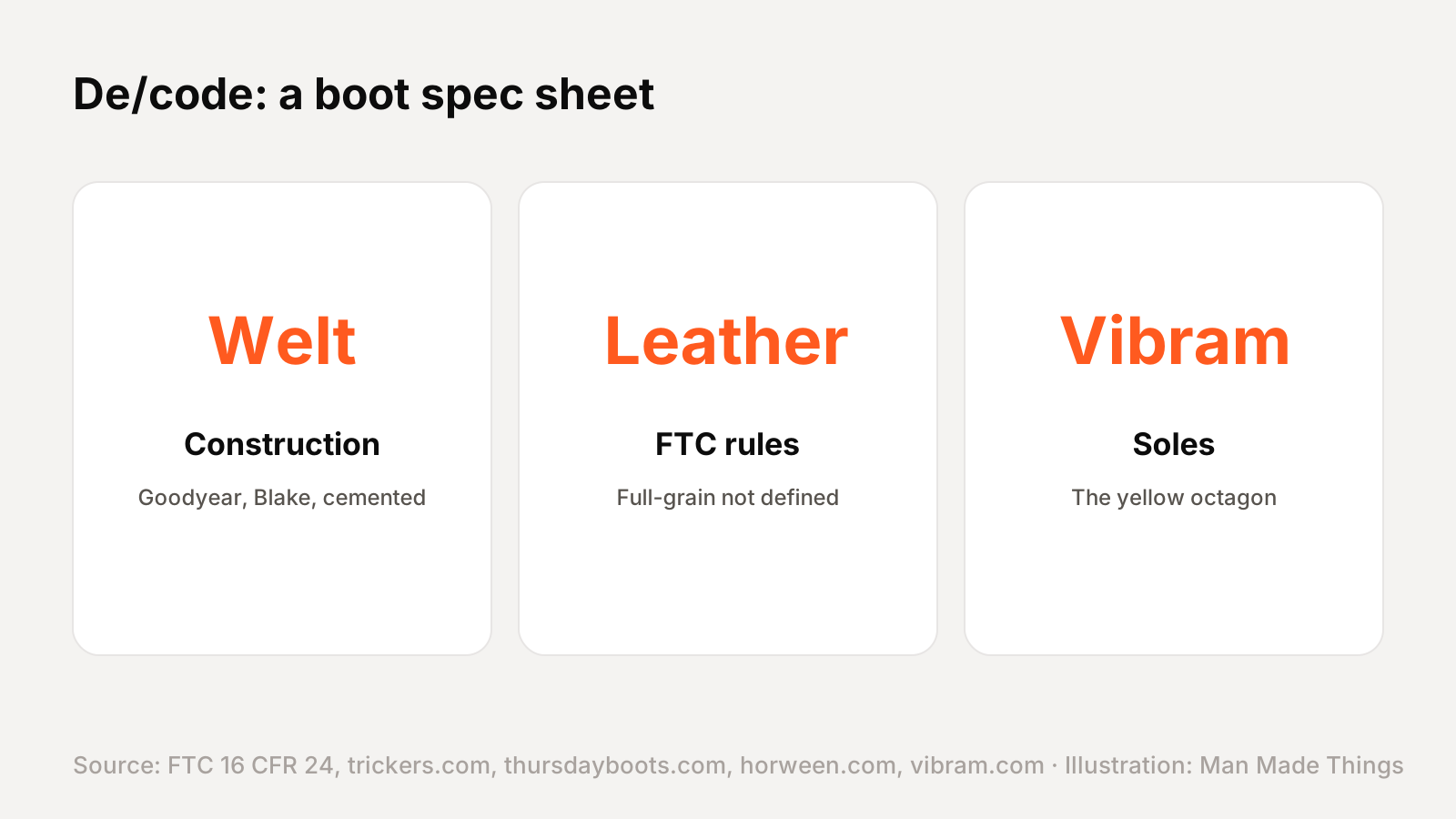
On a boot spec sheet: "Goodyear welt" means the sole is stitched to a leather strip (the welt), so it can be replaced without damaging the upper. "Blake stitch" is lighter and more flexible but stitched through the inside. "Cemented" means glued, as on nearly all sneakers, and hard to resole. Under FTC rules, unqualified "leather" must be leather in all substantial parts, and "bonded leather" can't be called leather. Horween Chromexcel takes 89 processes over 28 days, and Vibram's yellow octagon marks Vibram soles.
Good boots can last years, even decades, but only if they're built to. The spec sheet tells you how, if you know the language. "Goodyear welt," "full-grain," "Chromexcel," "Vibram" and "last" all matter, and some of them are protected by law.
This De/code explains each term using official sources: the US Federal Trade Commission's Leather Guides (16 CFR 24), and makers' own explanations from Tricker's, Thursday Boot Co., Alden, Red Wing, Crockett & Jones, Horween, Vibram, Birkenstock and Altra. Where something has no official definition, I say so.
Looking for boots? See our best Chelsea boots, best premium Chelsea boots and the older Goodyear welt vs Blake vs cemented explainer.
Construction: Goodyear welt, Blake stitch and cemented
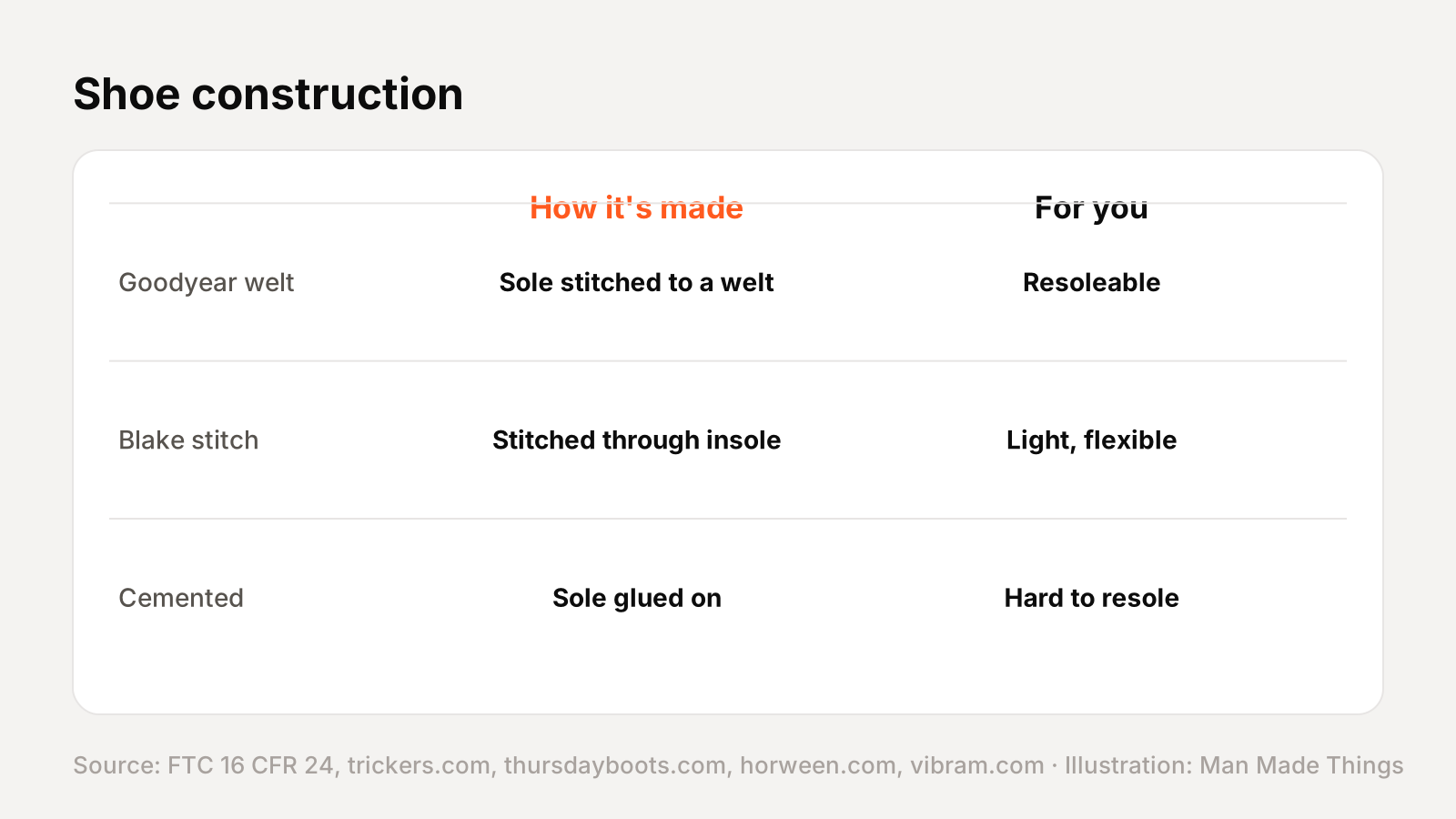
| Construction | How it's made | What it means for you |
|---|---|---|
| Goodyear welt | A leather strip (the welt) is stitched to the upper, lining and insole; the outsole is stitched to the welt | Can be resoled without damaging the upper |
| Blake stitch | The upper is folded under the insole and stitched straight through to the outsole | Lighter, more flexible, sleeker |
| Cemented | The upper is glued to the outsole | Light and cheap, but hard to resole |
Goodyear welt: Tricker's explains that the cavity under the insole is filled with cork, which molds to your foot. The machine takes its name from an 1875 patent backed by Charles Goodyear Jr. Thursday Boot Co. says Goodyear-welted shoes are less than 1% of shoe production, and Red Wing says its boots take more than 230 steps per pair. Alden offers factory restoration for $219.
Blake stitch: invented by Lyman Reed Blake in 1856, according to Beckett Simonon. It's lighter and more flexible than a Goodyear welt.
Cemented: Thursday notes nearly all sneakers are made this way.
Leather: what the law says
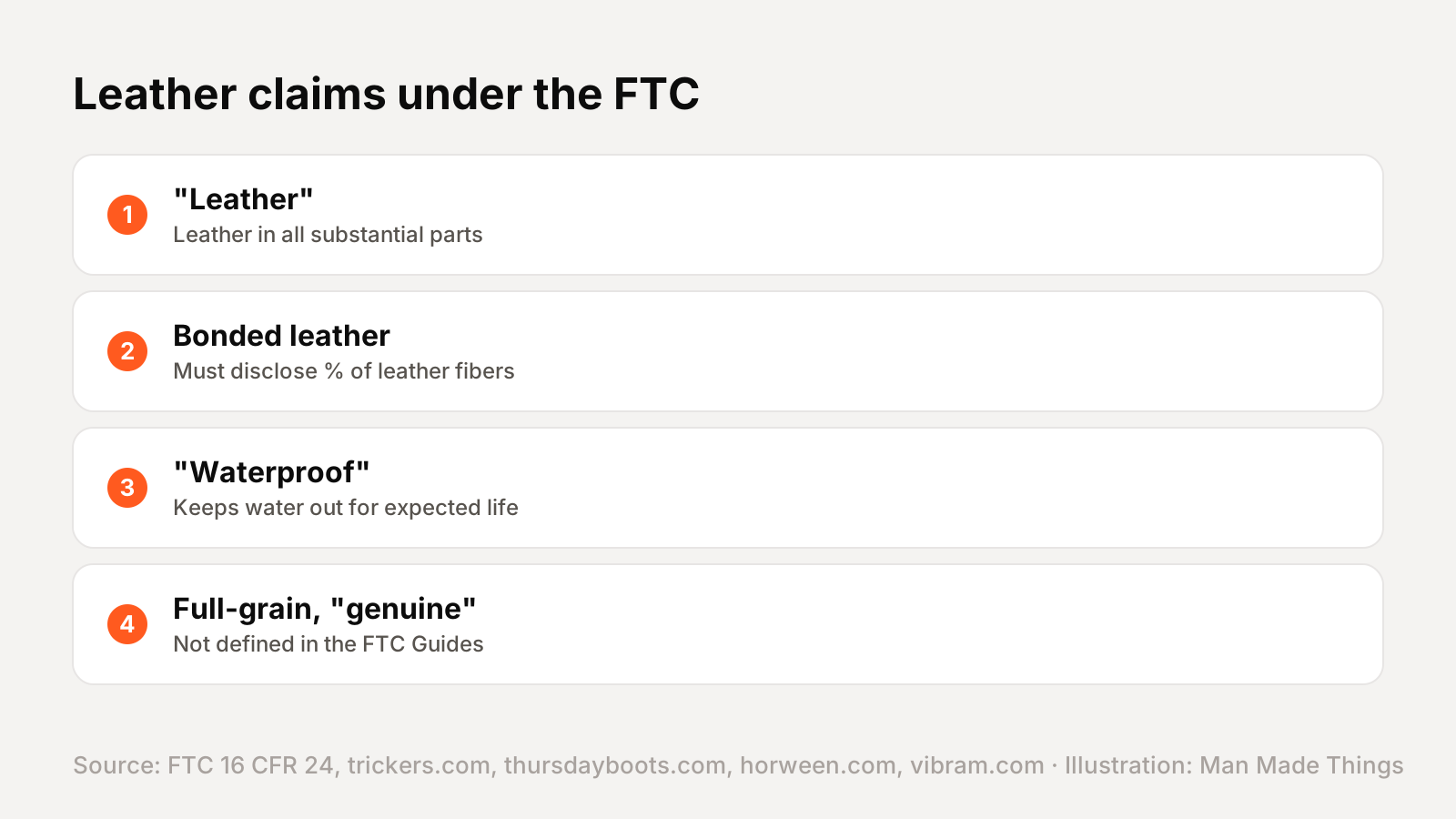
The FTC's Leather Guides set the rules for leather claims:
- "Leather" (unqualified) is allowed only if the product is leather in all substantial parts.
- Bonded or reconstituted leather can't simply be called leather. If it looks like leather, the percentage of leather fibers must be disclosed, like "60% Leather Fibers and 40% Non-leather Substances."
- Embossed leather processed to look like another kind must disclose the real kind.
- "Waterproof" may be used only if the product keeps water out under normal use for its expected life.
Full-grain, top-grain and "genuine leather": these common terms are not defined in the FTC's current Leather Guides. Red Wing describes full-grain as leather where "the top layer of the hide is left intact." There's no official definition of "genuine leather" as a grade, so treat it as a vague claim.
Horween Chromexcel
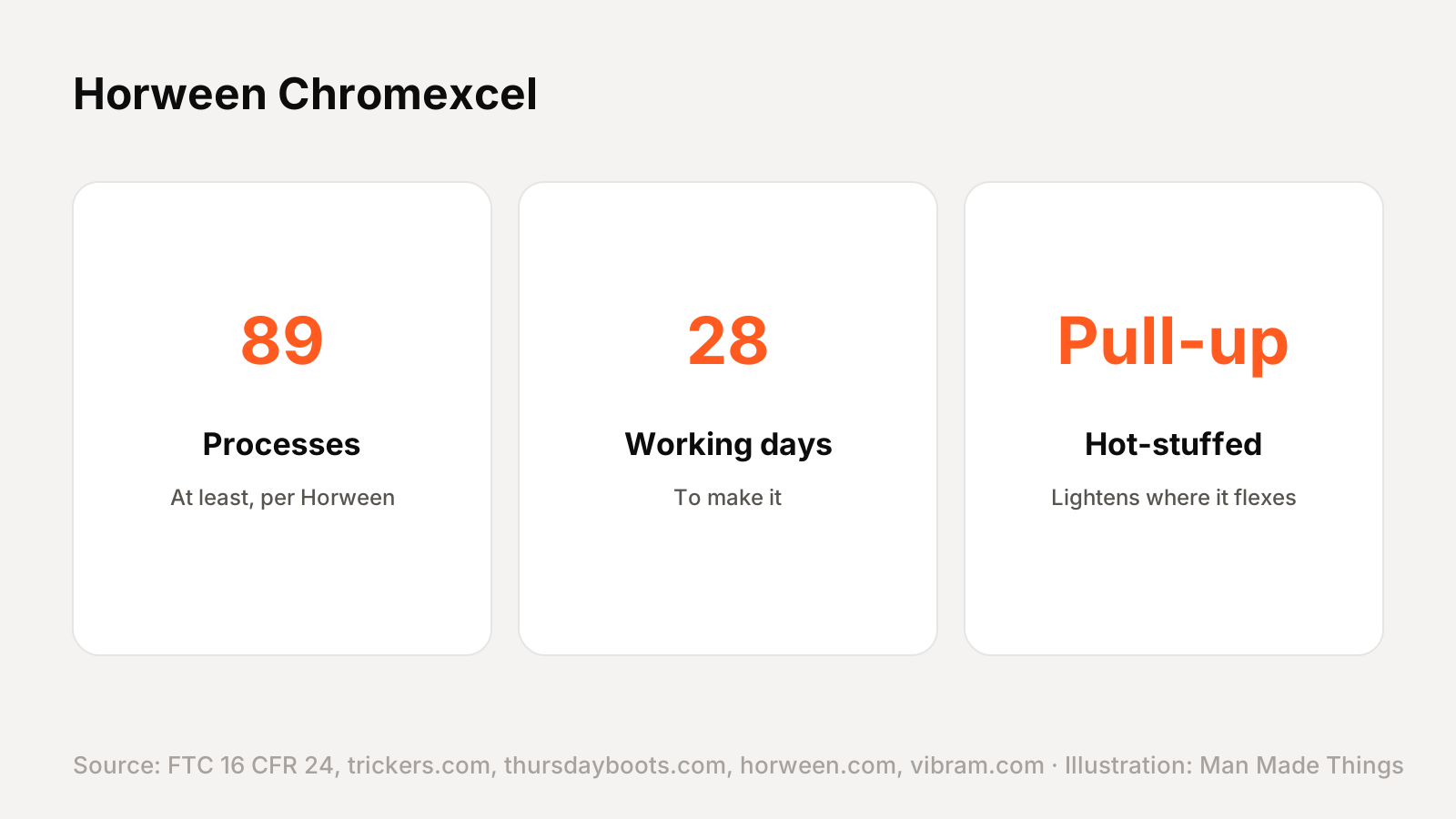
You'll see Horween Chromexcel on premium boots like the Grant Stone Chelsea in our premium Chelsea boots guide. Horween, a Chicago tannery, explains that Chromexcel is a combination tannage: a chrome base, then a heavy vegetable retan with bark extracts.
It takes at least 89 separate processes over 28 working days, Horween says. The leather is "hot stuffed" with oils, waxes and greases, including tallow and beeswax, which creates its signature pull-up: the leather lightens where it flexes. It's finished by hand with a non-pigmented aniline finish.
Vibram and soles
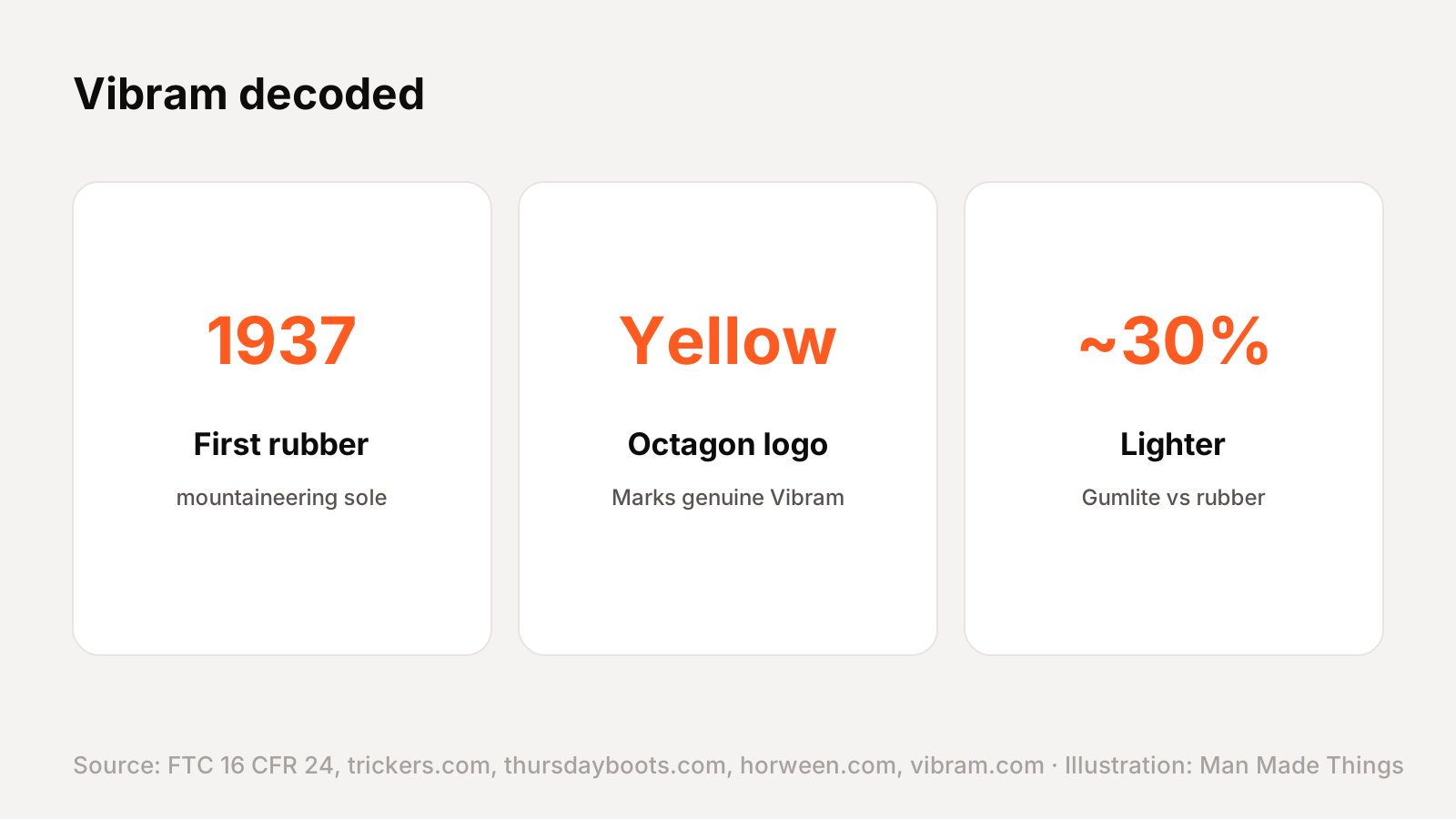
- The yellow octagon: Vibram's logo, introduced in 1947, became yellow-gold for its "Marca Oro" rubber compound in the late 1960s (Vibram's own pages give both 1967 and 1969). Vibram says it stands for quality, performance and safety.
- History: Vitale Bramani created the Carrarmato sole in 1937, the first rubber mountaineering sole.
- Lighter soles: Vibram's Gumlite is about 30% lighter than traditional rubber, and its Evaflex is an EVA sole.
- Specific soles: you'll see names like the "Vibram 430 Mini-Lug" on Red Wing's Iron Ranger, which Red Wing says offers reliable all-season traction.
Vibram warns that only soles from its official site and authorized sellers are guaranteed genuine.
Fit and comfort: lasts, cork and drop
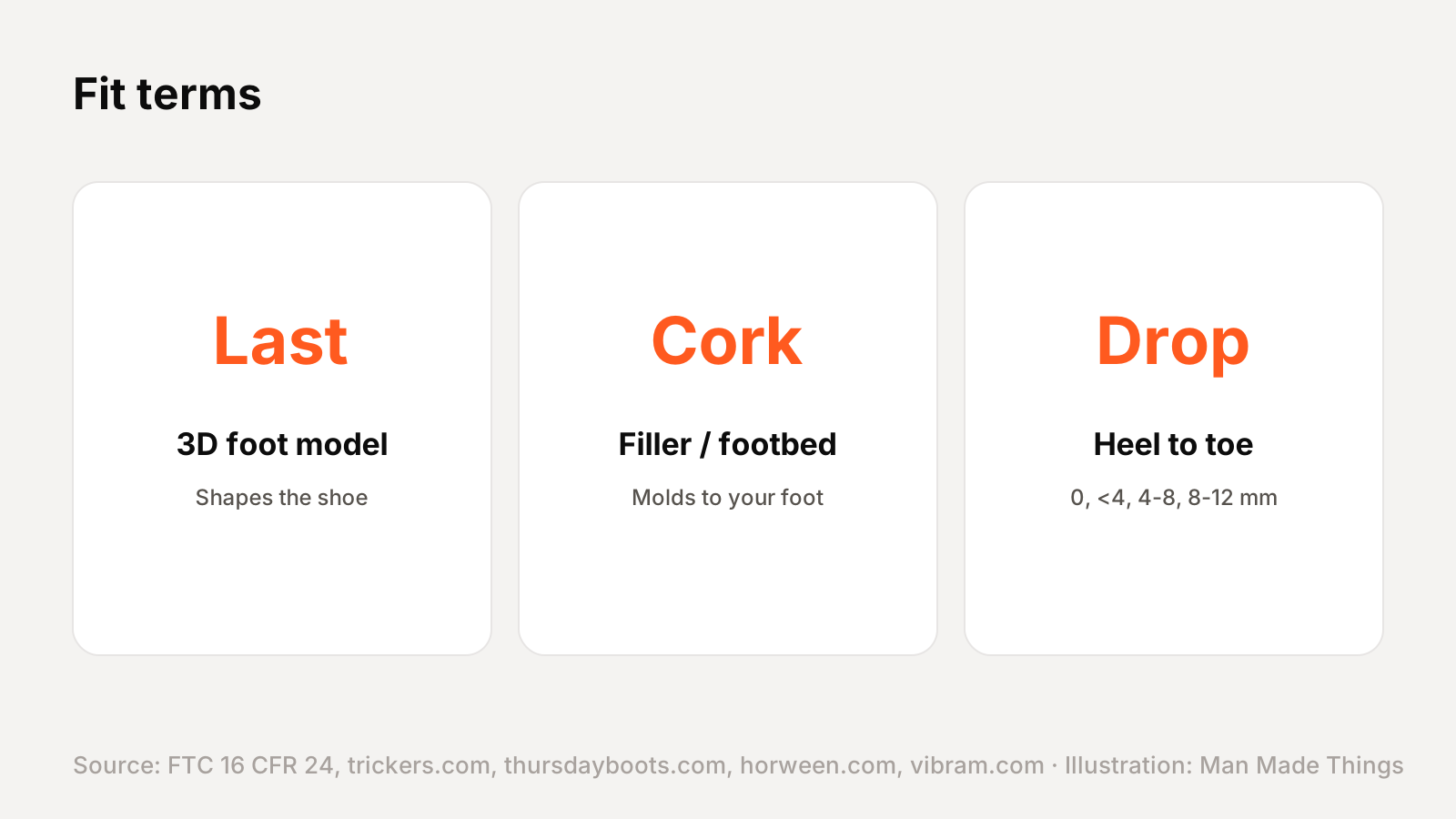
- Last: a three-dimensional model of a foot that a shoe is built around, identified by number. Crockett & Jones and Tricker's publish last guides; Red Wing's Iron Ranger uses its No. 8 last. Thursday says it tools its lasts to 0.1mm. Different lasts fit differently, even in the same size.
- Cork: in Goodyear-welted boots, cork filler under the insole molds to your foot over time. Birkenstock's footbed uses a cork-latex core between jute layers.
- Heel-to-toe drop: the height difference between heel and forefoot, in millimeters. Altra describes zero drop as 0mm, low as under 4mm, mid as 4–8mm and high as 8–12mm. It matters most in running shoes; see our running shoe value math.
The quick cheat sheet
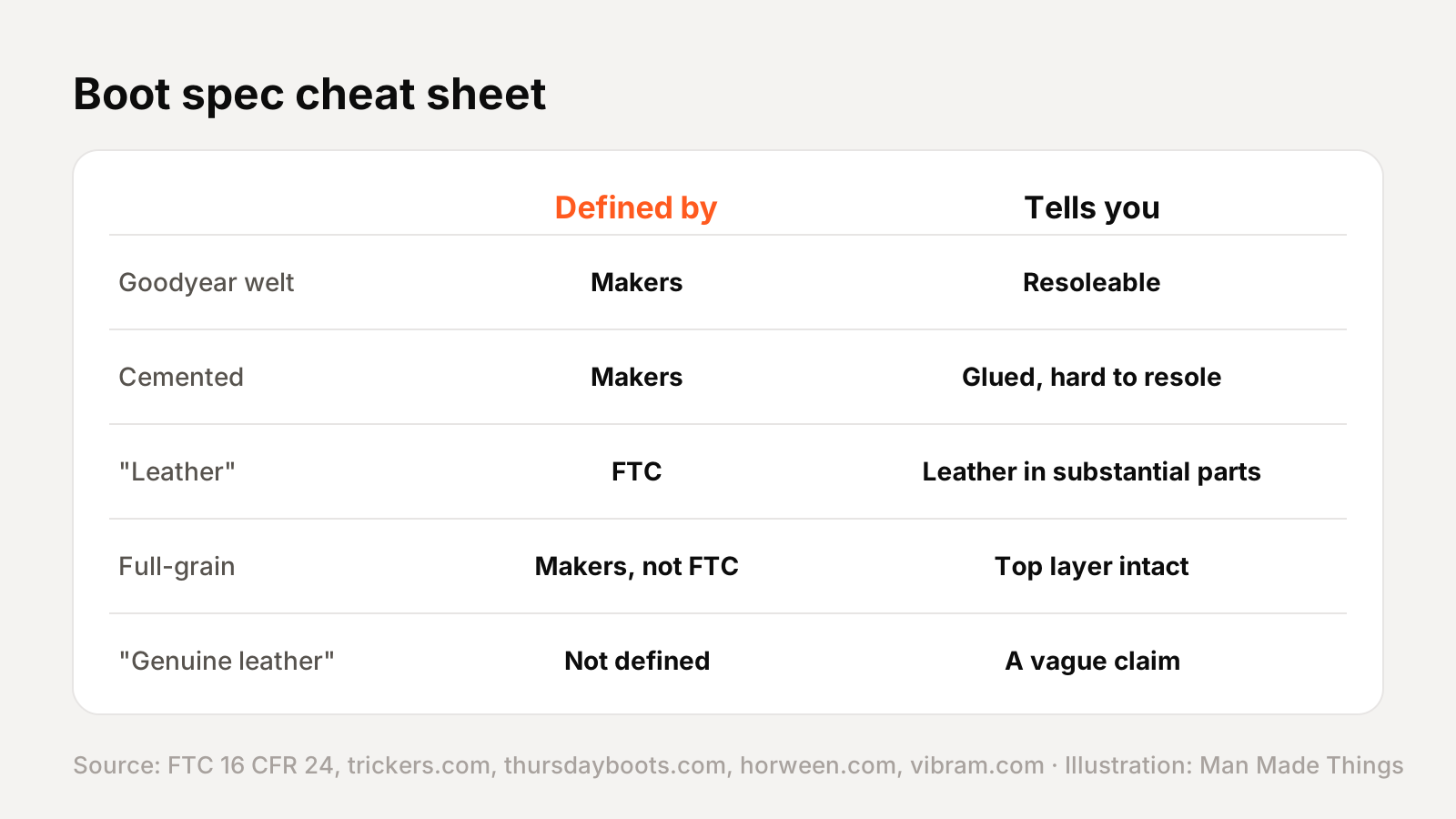
| Term | Defined by | What it tells you |
|---|---|---|
| Goodyear welt | Makers | Resoleable construction |
| Blake stitch | Makers | Light, flexible construction |
| Cemented | Makers | Glued; hard to resole |
| "Leather" | FTC Leather Guides | Leather in all substantial parts |
| Bonded leather | FTC Leather Guides | Must disclose leather-fiber percentage |
| Full-grain | Makers (not FTC) | Top layer of the hide intact |
| "Genuine leather" | Not defined | A vague claim |
| Chromexcel | Horween | Combination tannage, 89 processes |
| Vibram | Vibram | Branded soles, yellow octagon |
| Last | Makers | The shape the shoe is built on |
The takeaway: if you want boots that last, look for a Goodyear welt (so they can be resoled), full-grain leather from a maker that names its tannery, and a clear return policy so you can check the fit of the last.
Frequently asked questions
What is a Goodyear welt?
+
A construction where the sole is stitched to a leather strip (the welt) attached to the upper, so the sole can be replaced without damaging the upper.
Is full-grain leather legally defined?
+
Not in the FTC's current Leather Guides. Red Wing describes full-grain as leather where the top layer of the hide is left intact.
What is Horween Chromexcel?
+
A combination-tanned leather from Chicago's Horween tannery, made through at least 89 processes over 28 working days, known for its pull-up effect.
Can cemented shoes be resoled?
+
They're hard to resole, since the sole is glued to the upper. Nearly all sneakers are made this way.
Sources
- eCFR: 16 CFR 24 (FTC Leather Guides)
- Tricker's: Goodyear welting
- Thursday Boot Co.: Goodyear welt construction
- Thursday Boot Co.: Last guide
- Alden
- Red Wing: Iron Ranger
- Red Wing: Foot tanning company
- Beckett Simonon: Goodyear welting or Blake stitching
- Crockett & Jones: Last guide
- Horween: Chromexcel
- Vibram: History
- Vibram: Our icons
- Birkenstock: The footbed
- Altra: High-drop running shoes
Editor-in-Chief
Rahul has been writing about gadgets and software since 2013, first at Thetechhacker and now at Man Made Things. He edits every review on the site and signs off on every verdict.
More from Rahul →