Running Shoe Value Math: What Each Mile Really Costs
An original running shoe guide built on Nike's official 300–500 mile replacement guidance and makers' prices: cost per mile for the ASICS GEL-CONTEND 10, Nike Pegasus 42, Saucony Ride 19 and Brooks Ghost 18, how often to replace shoes at your weekly mileage, and what running really costs per year.
We may earn a commission when you buy through links on this page. Learn more
Quick answer
Nike says experts generally advise replacing running shoes every 300 to 500 miles. On that basis, a $145 Nike Pegasus 42 or Saucony Ride 19 costs about $0.29–$0.48 per mile, a $150 Brooks Ghost 18 about $0.30–$0.50, and an $80 ASICS GEL-CONTEND 10 about $0.16–$0.27. If you run 20 miles a week, you'll need a new pair every 15–25 weeks, or roughly two to three pairs a year.
Running is one of the cheapest ways to get fit, but shoes wear out, and most people never think about what each run actually costs, or when to replace their shoes.
Most shoe brands don't publish how long their shoes last. Nike is an exception: in its official guide to replacing running shoes, Nike says experts generally advise new running shoes every 300 to 500 miles. I used that guideline, plus official prices, to work out the real cost of running in some of the most popular shoes we've covered.
To be clear: these are my calculations, not durability tests. Real lifespan depends on your weight, stride, surfaces and the shoe itself. Treat the numbers as a planning tool. For picking a shoe, see our best running shoes for beginners.
1. Cost per mile
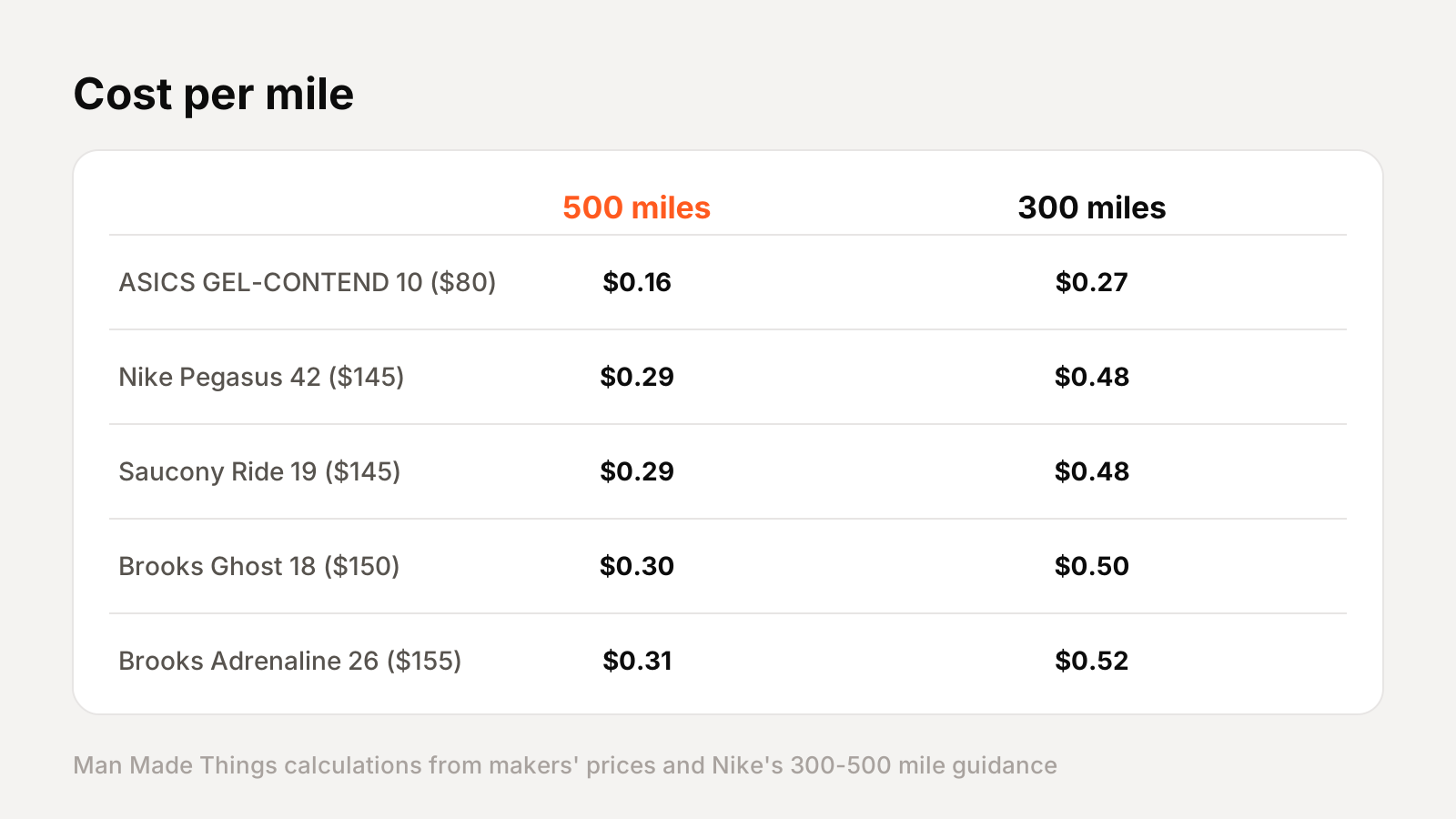
Dividing each shoe's official price by 300 and 500 miles:
| Shoe | Price | Cost per mile (500 mi) | Cost per mile (300 mi) |
|---|---|---|---|
| ASICS GEL-CONTEND 10 | $80 | $0.16 | $0.27 |
| Nike Pegasus 42 | $145 | $0.29 | $0.48 |
| Saucony Ride 19 | $145 | $0.29 | $0.48 |
| Brooks Ghost 18 | $150 | $0.30 | $0.50 |
| Brooks Adrenaline GTS 26 | $155 | $0.31 | $0.52 |
The takeaway: the difference between premium daily trainers is small, a few cents a mile. The budget ASICS costs about half as much per mile, though it's a simpler, heavier shoe. Pick the shoe that fits and feels right; the cost per mile barely changes between the $145–$155 options.
2. How often you'll replace them
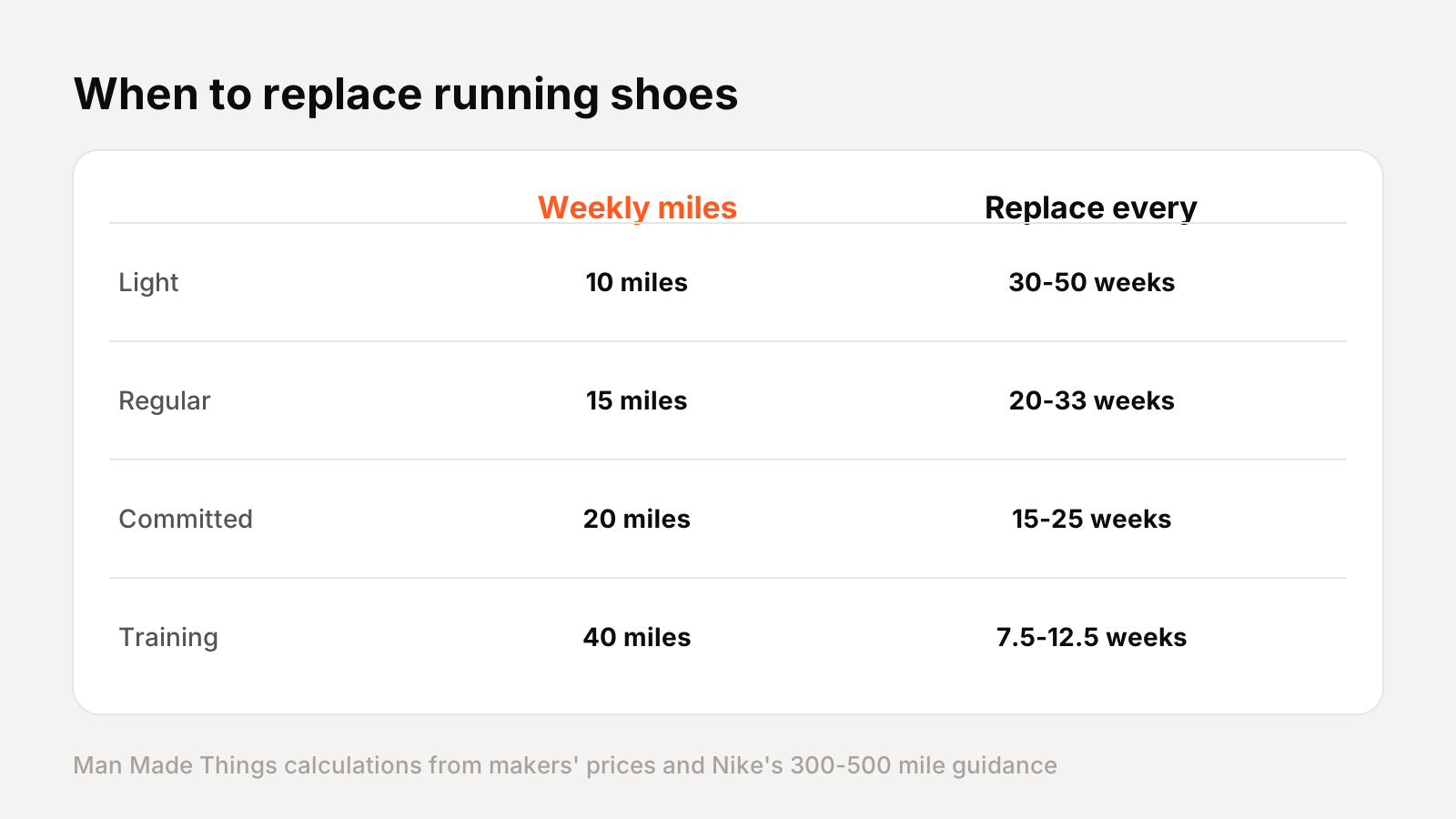
Nike also offers a simple table by weekly mileage. Using the 300–500 mile range:
| Weekly mileage | Replace roughly every |
|---|---|
| 10 miles | 30–50 weeks (about 7.5–12.5 months, per Nike) |
| 15 miles | 20–33 weeks |
| 20 miles | 15–25 weeks |
| 40 miles | 7.5–12.5 weeks (about 2–3 months, per Nike) |
Tip: write the date you start a new pair on the insole, or log your runs in an app or on a GPS watch so you know your mileage; see our New Year's fitness gear guide.
3. What running really costs per year
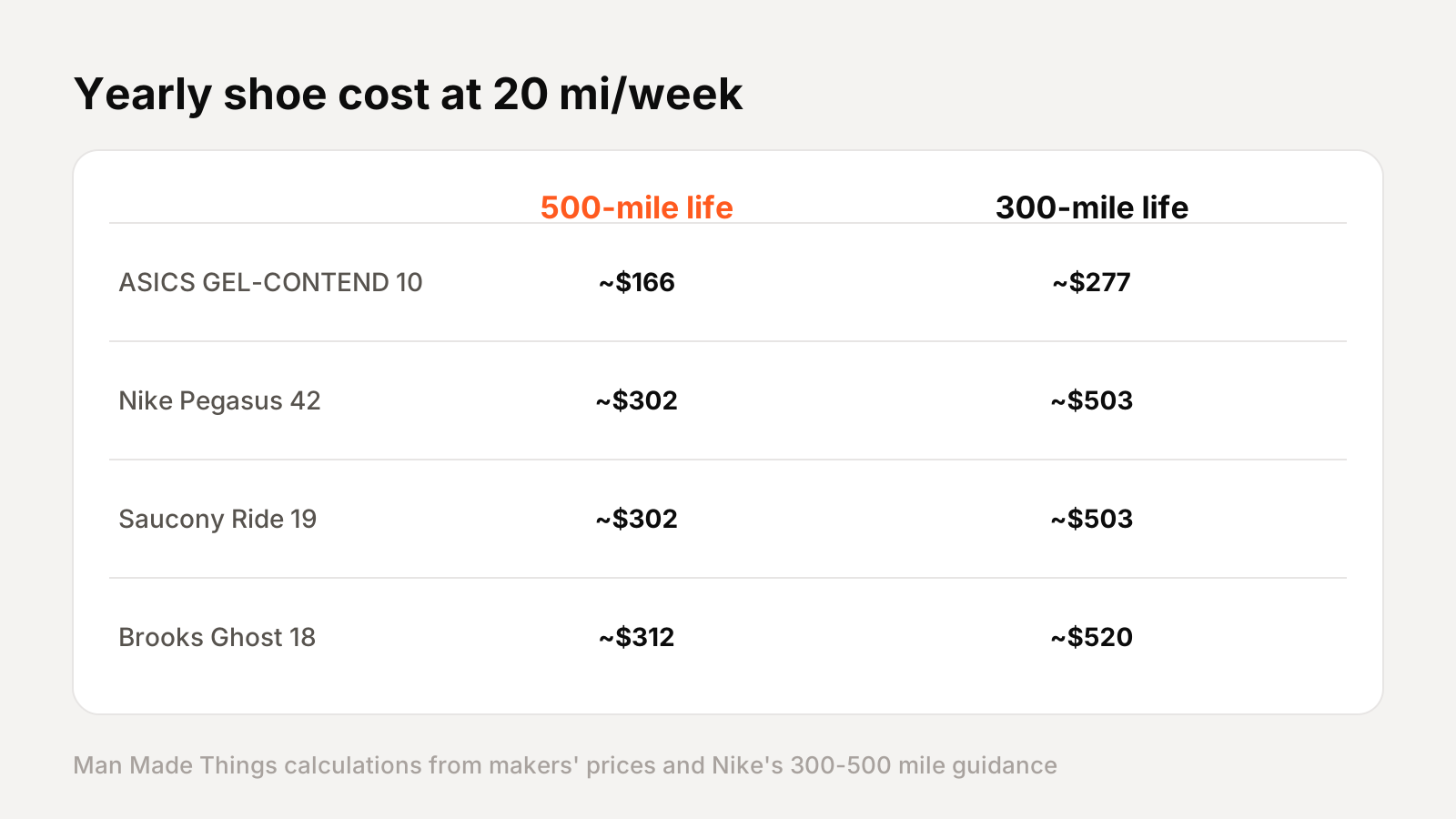
At 20 miles a week, you'll run about 1,040 miles a year. That means roughly 2 to 3.5 pairs of shoes a year, depending on whether they last 500 or 300 miles:
| Shoe | Yearly cost (500-mile life) | Yearly cost (300-mile life) |
|---|---|---|
| ASICS GEL-CONTEND 10 | ~$166 | ~$277 |
| Nike Pegasus 42 | ~$302 | ~$503 |
| Saucony Ride 19 | ~$302 | ~$503 |
| Brooks Ghost 18 | ~$312 | ~$520 |
If you run less, say 10 miles a week, halve those numbers.
4. The shoes, by the specs
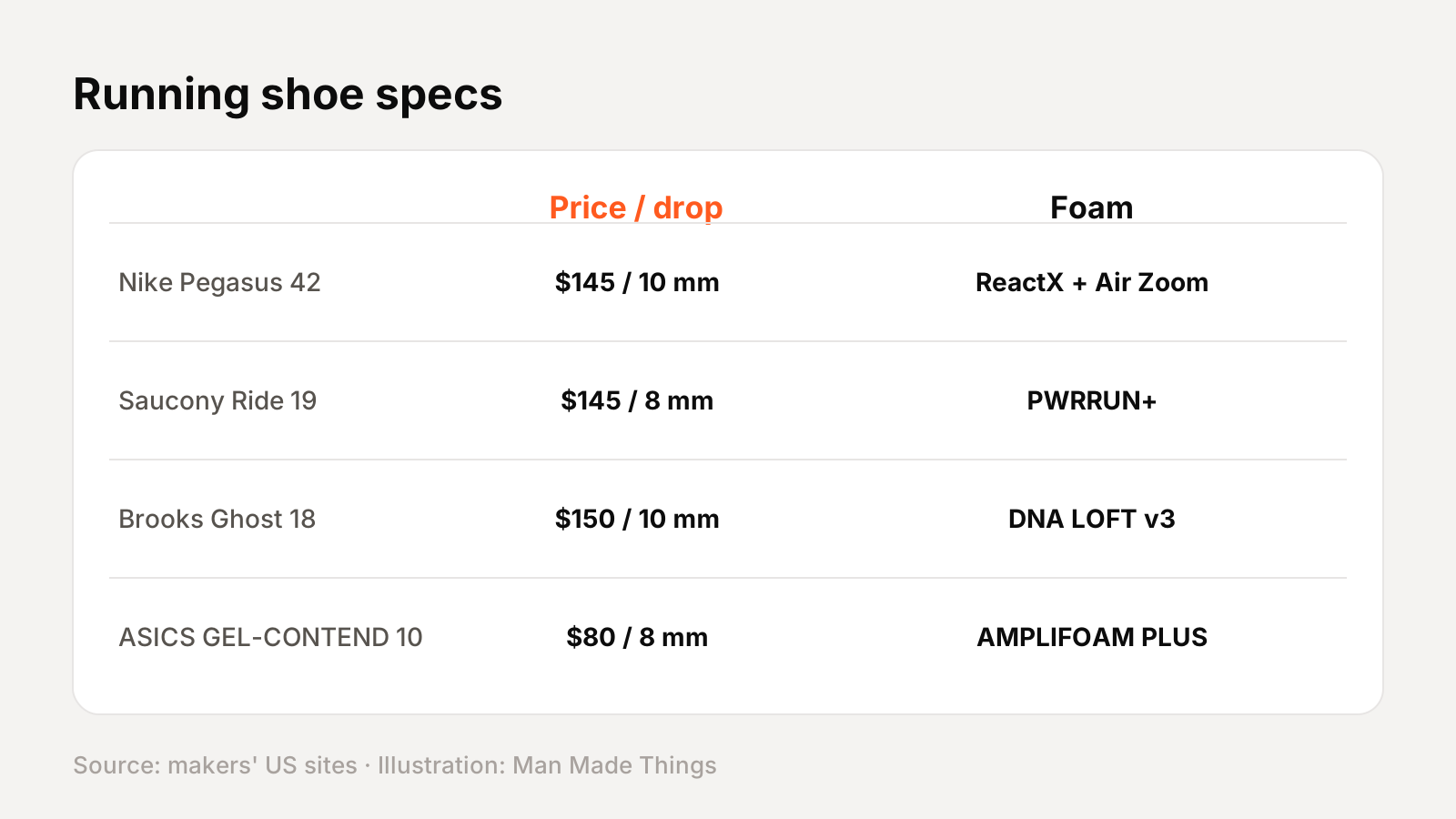
| Shoe | Price | Weight (men's) | Drop | Foam |
|---|---|---|---|---|
| Nike Pegasus 42 | $145 | about 300 g (10.59 oz, US 10) | 10 mm | ReactX with Air Zoom |
| Saucony Ride 19 | $145 | Not listed | 8 mm | PWRRUN+ |
| Brooks Ghost 18 | $150 | 289 g (10.2 oz) | 10 mm | DNA LOFT v3 |
| Brooks Adrenaline GTS 26 | $155 | Not listed | 10 mm | DNA LOFT v3 (nitrogen-infused) |
| ASICS GEL-CONTEND 10 | $80 | 317 g (11.2 oz) | 8 mm | AMPLIFOAM PLUS with GEL |
Drop is the height difference between heel and forefoot. Neither 8mm nor 10mm is "better"; if you're switching between shoes with different drops, ease in gradually.
Brooks, ASICS, HOKA and New Balance sites didn't load for us when updating this guide, so Brooks and ASICS figures come from our earlier beginner running shoes research.
5. Signs it's time for new shoes
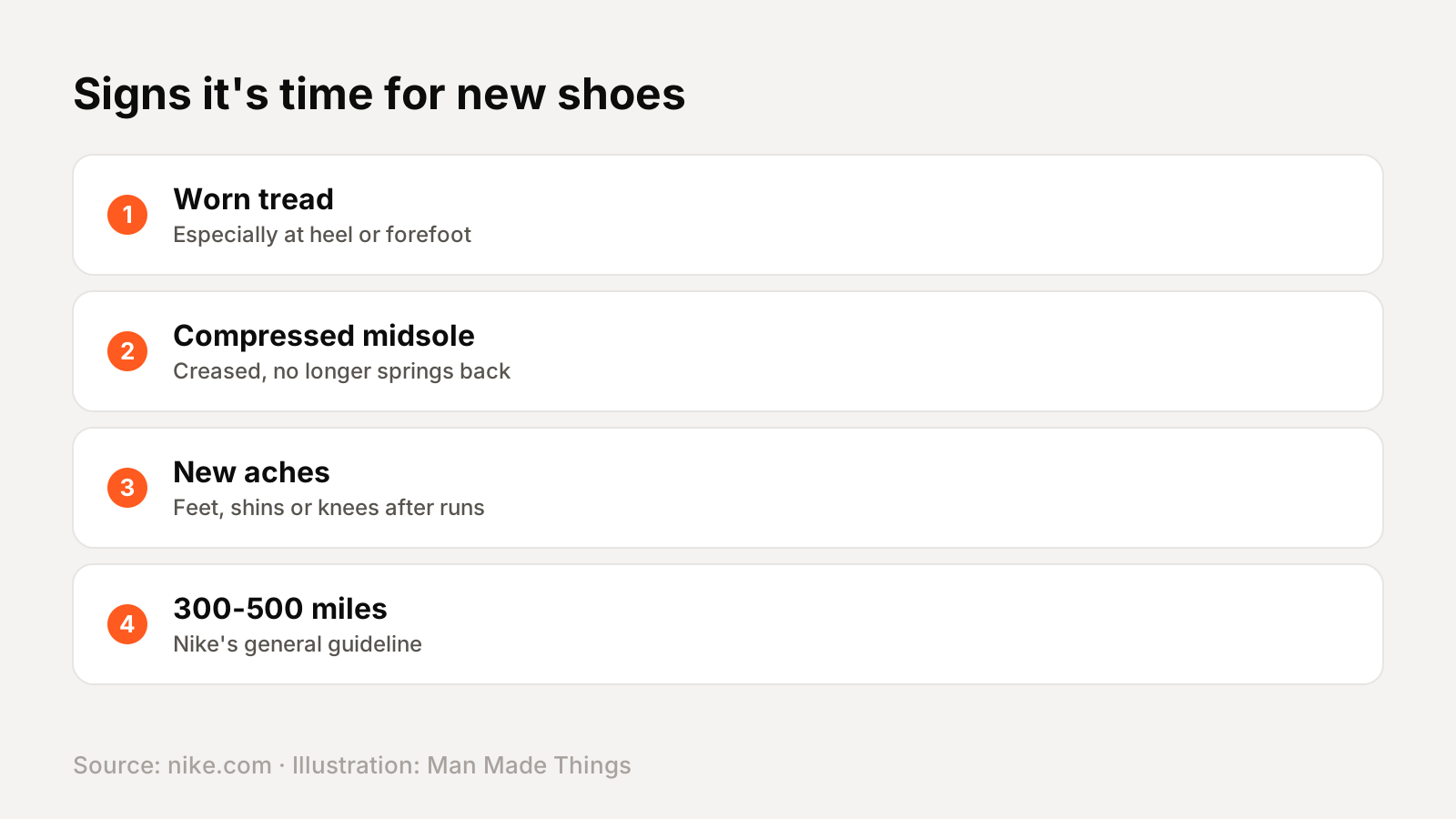
Mileage is a guide, not a rule. Nike's guide notes that research has found good shoes can last more than 600 miles. Watch for these signs:
- Worn-through tread on the outsole, especially at the heel or forefoot.
- A compressed or creased midsole that no longer springs back.
- New aches in your feet, shins or knees after runs that used to feel fine.
- Uneven wear that makes the shoe tilt when you set it on a flat surface.
If you notice these before 300 miles, replace them; if your shoes still feel good past 500 miles, there's no rule saying you must.
The bottom line: spend on the shoe that fits your feet best. Over a year of running, the price difference between good daily trainers is smaller than it looks.
6. What about pricier race shoes?
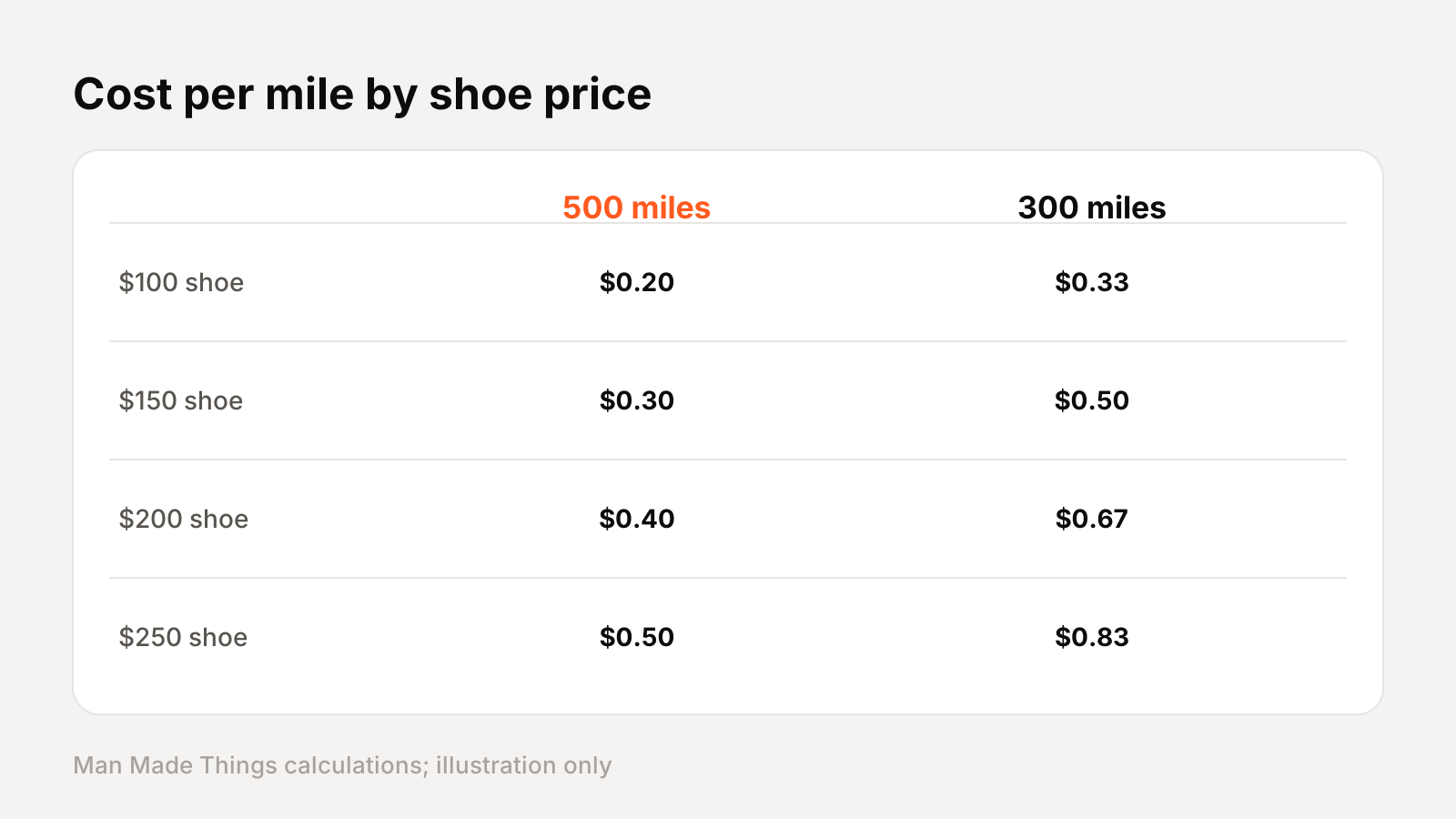
The same math works for any shoe. Here's what a few round price points would cost per mile if they lasted the same 300–500 miles:
| Shoe price | Cost per mile (500 mi) | Cost per mile (300 mi) |
|---|---|---|
| $100 | $0.20 | $0.33 |
| $150 | $0.30 | $0.50 |
| $200 | $0.40 | $0.67 |
| $250 | $0.50 | $0.83 |
These are illustrations, not durability claims: lighter racing shoes may not last as long as daily trainers, which would push their cost per mile higher still. If you buy a pricier pair for races or fast workouts, saving it for those days and doing easy miles in a daily trainer keeps your overall cost per mile down.
Ways to spend less: shop the brand's sale section when a new version of your shoe launches, and keep a log of your miles so you replace shoes when they're worn, not just when they look old.
Frequently asked questions
How many miles do running shoes last?
+
Nike says experts generally advise replacing running shoes every 300 to 500 miles, though research it cites found good shoes can last more than 600.
How much do running shoes cost per mile?
+
About $0.29–$0.48 per mile for a $145 shoe over 300–500 miles, and about $0.16–$0.27 for an $80 shoe.
How often should I replace running shoes if I run 20 miles a week?
+
Roughly every 15 to 25 weeks, based on the 300–500 mile guideline.
Sources
Editor-in-Chief
Rahul has been writing about gadgets and software since 2013, first at Thetechhacker and now at Man Made Things. He edits every review on the site and signs off on every verdict.
More from Rahul →