Wharfedale EVO 5.2 Review: Specs, Price and How It Compares
A research-based review of the Wharfedale EVO 5.2: Wharfedale's official specs, US price, technology explained and how it compares with the rest of Wharfedale's bookshelf speakers.
We may earn a commission when you buy through links on this page. Learn more
Quick answer
The Wharfedale EVO 5.2 is a passive bookshelf speaker (you'll need an amplifier) with a three-way bass reflex design, listed at $1,299 a pair ($1,799 with matching stands) on Wharfedale's US store. It's best for listeners who want big, full-range sound from a bookshelf speaker for under $1,500.
Wharfedale's bookshelf speakers run from the $399 Diamond 12.0i to the $8,495 Elysian 2 R, with classic Heritage models in between. The EVO 5.2 is a passive bookshelf speaker (you'll need an amplifier), listed at $1,299 a pair ($1,799 with matching stands) on Wharfedale's US store.
A note on how we review: I haven't completed a hands-on listening test of the EVO 5.2, so there's no star rating on this page. Everything below comes from Wharfedale's official US store and spec sheet, with plain-English explanations and a comparison with the rest of Wharfedale's bookshelf range. See every model in our Wharfedale bookshelf speakers guide, and for other brands, our best bookshelf speakers under $500.
Image: Wharfedale
Wharfedale
Wharfedale EVO 5.2
The EVO 5.2 is a strong pick for listeners who want big, full-range sound from a bookshelf speaker for under $1,500.
Best for: Listeners who want big, full-range sound from a bookshelf speaker for under $1,500
Pros
- 01Three-way with a dome midrange
- 02Bass to 38 Hz
- 03105 dB max output
- 04AMT tweeter
Cons
- 01Large and heavy at 15 kg each
- 024-ohm load
- 03Stands add $500
What the EVO 5.2 is
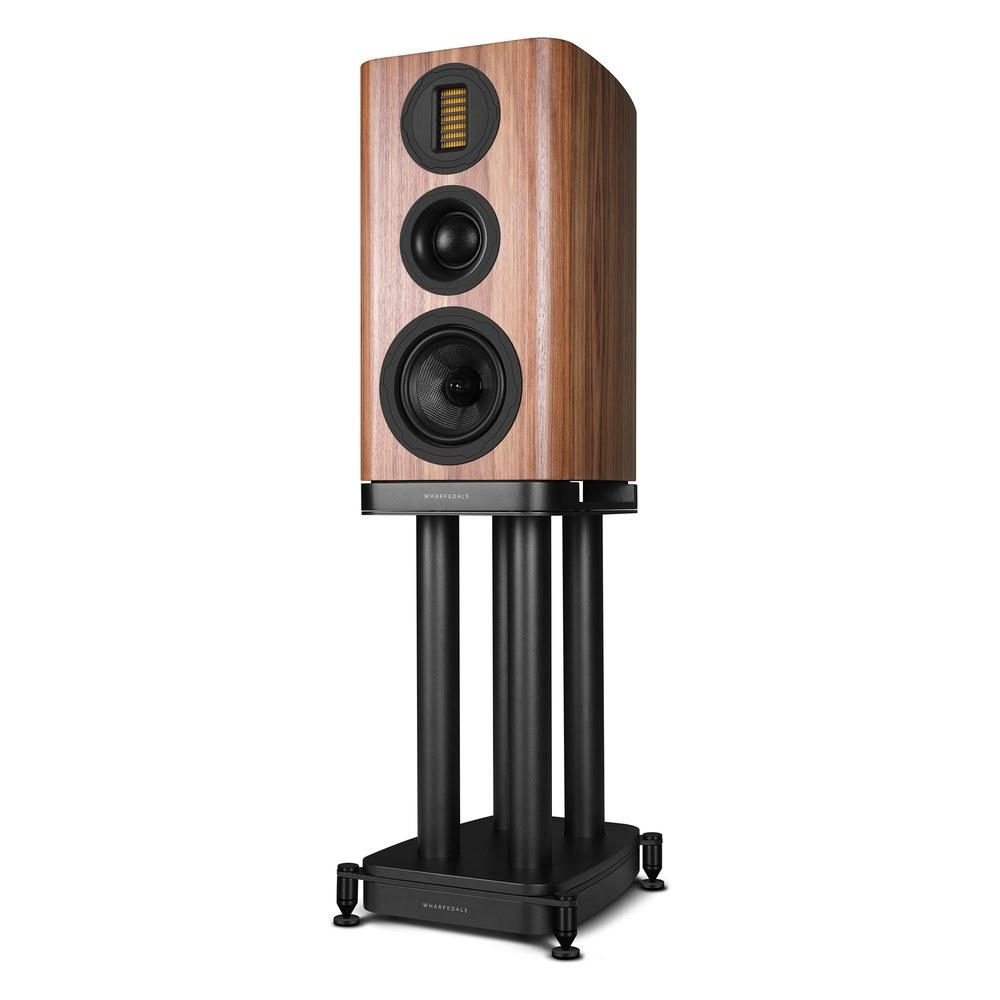
The Wharfedale EVO 5.2 is the three-way bookshelf speaker in the EVO 5 range, at $1,299 a pair. It adds a 2-inch soft dome midrange between the AMT tweeter and a larger 6.5-inch woven Kevlar bass driver.
Wharfedale's spec sheet shows bass extension to 38 Hz and a maximum output of 105 dB, well beyond the EVO 5.1's 46 Hz and 98 dB. Wharfedale says EVO 5 was "co-developed with our flagship Elysian series" and keeps a "natural, musical British signature."
The EVO 5 range brings AMT tweeters and Kevlar woofers to the $999-$1,299 price point.
EVO 5.2 specs
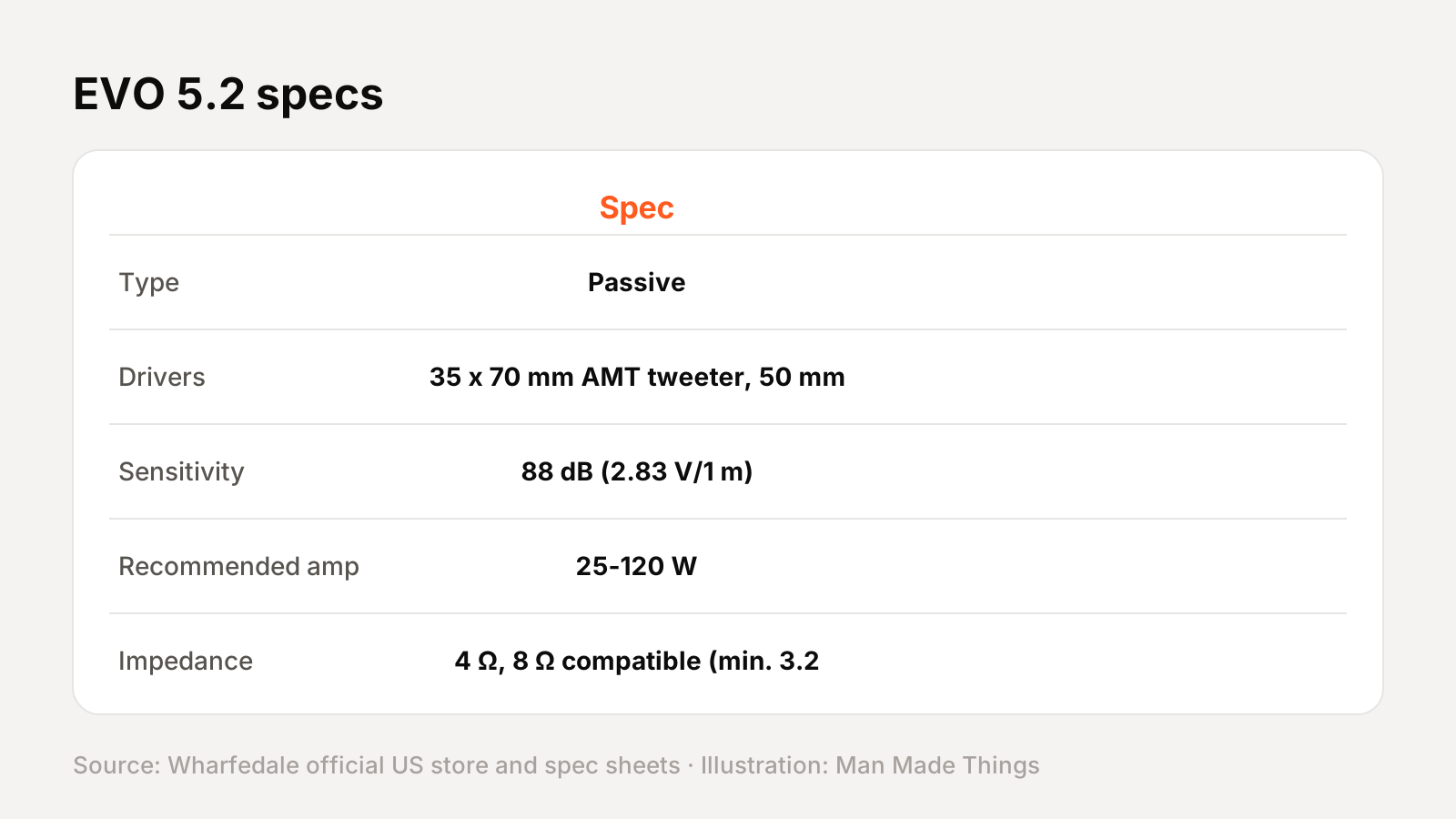
From Wharfedale's official US store and spec sheet (measurements are per speaker unless noted):
| Spec | EVO 5.2 |
|---|---|
| Type | Passive |
| Drivers | 35 x 70 mm AMT tweeter, 50 mm soft dome mid, 165 mm woven Kevlar bass |
| Sensitivity | 88 dB (2.83 V/1 m) |
| Recommended amp power | 25-120 W |
| Impedance | 4 Ω, 8 Ω compatible (min. 3.2 Ω) |
| Frequency response (±3 dB) | 44 Hz - 24 kHz |
| Bass extension (-6 dB) | 38 Hz |
| Crossover | 800 Hz, 4.3 kHz |
| Dimensions (H x W x D) | 497 x 260 x 390 mm |
| Weight | 15.0 kg each |
| Max SPL | 105 dB |
| Finishes | Walnut, Lunar Grey, Black, White |
Prices and versions
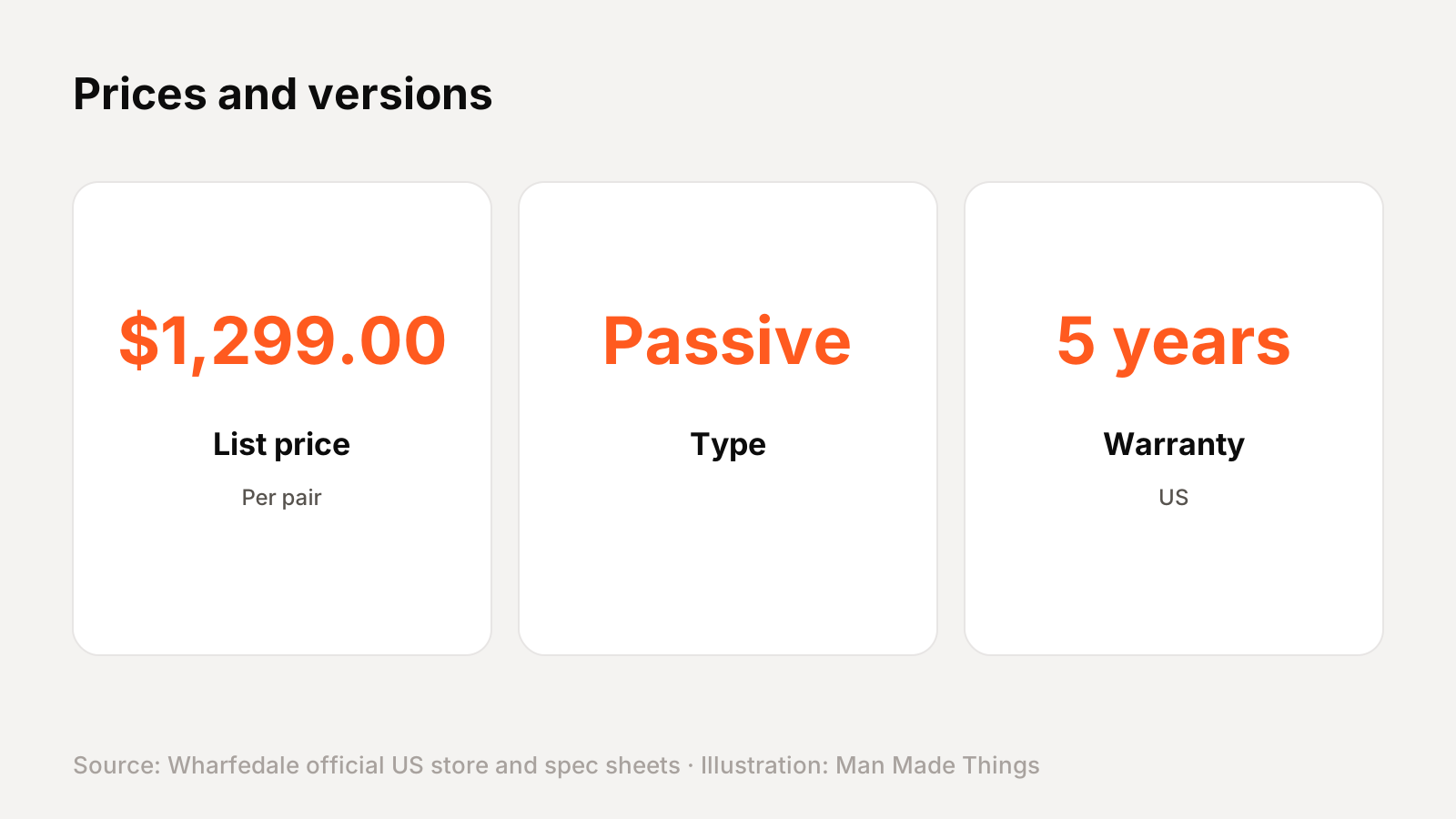
Wharfedale's US store lists the EVO 5.2 in Walnut, Lunar Grey, Black and White at $1,299 a pair, or $1,799 with matching EVO 5.2 stands. All four were available when we checked.
Key technologies, explained
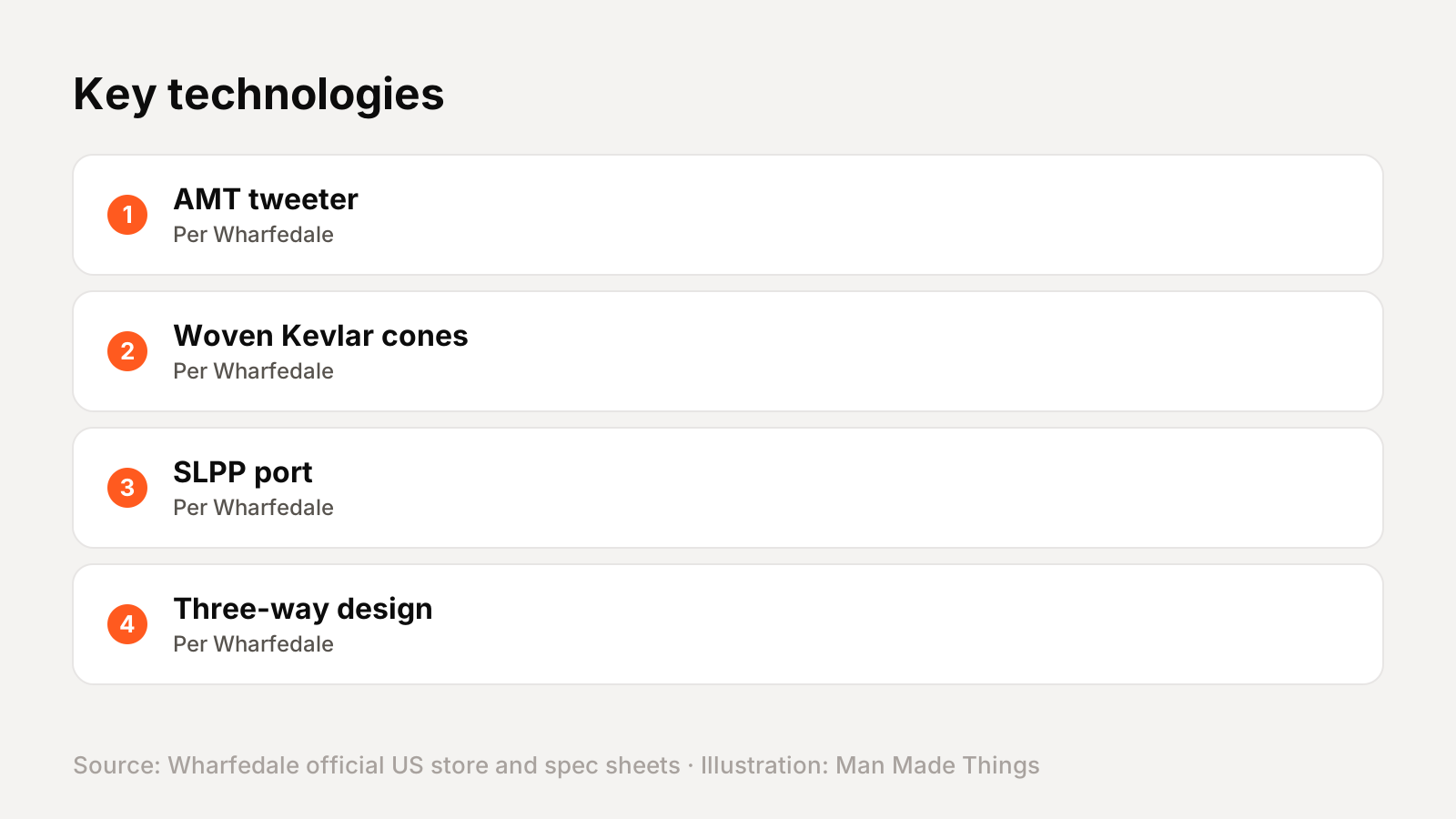
Here's what the main features Wharfedale lists actually do:
- AMT tweeter: Wharfedale's Air Motion Transformer uses a folded, pleated diaphragm. On EVO 5, Wharfedale says the larger AMT gives "faster transients, wider dispersion, and ultra-low distortion."
- Woven Kevlar cones: Wharfedale uses woven Kevlar for bass and midrange drivers, which it says gives stiff, well-damped cones with low distortion.
- SLPP port: Wharfedale's Slot Loaded Profiled Port vents bass from the cabinet base. On EVO 5 it's "tri-directional," which Wharfedale says makes the speaker "far less sensitive to" placement near walls.
- Three-way design: a separate midrange driver handles vocals and instruments, so the bass driver and tweeter each cover less of the spectrum.
- Multi-layer cabinet: Wharfedale lists stiff, braced multi-layer cabinets to reduce resonance.
What you need to use it
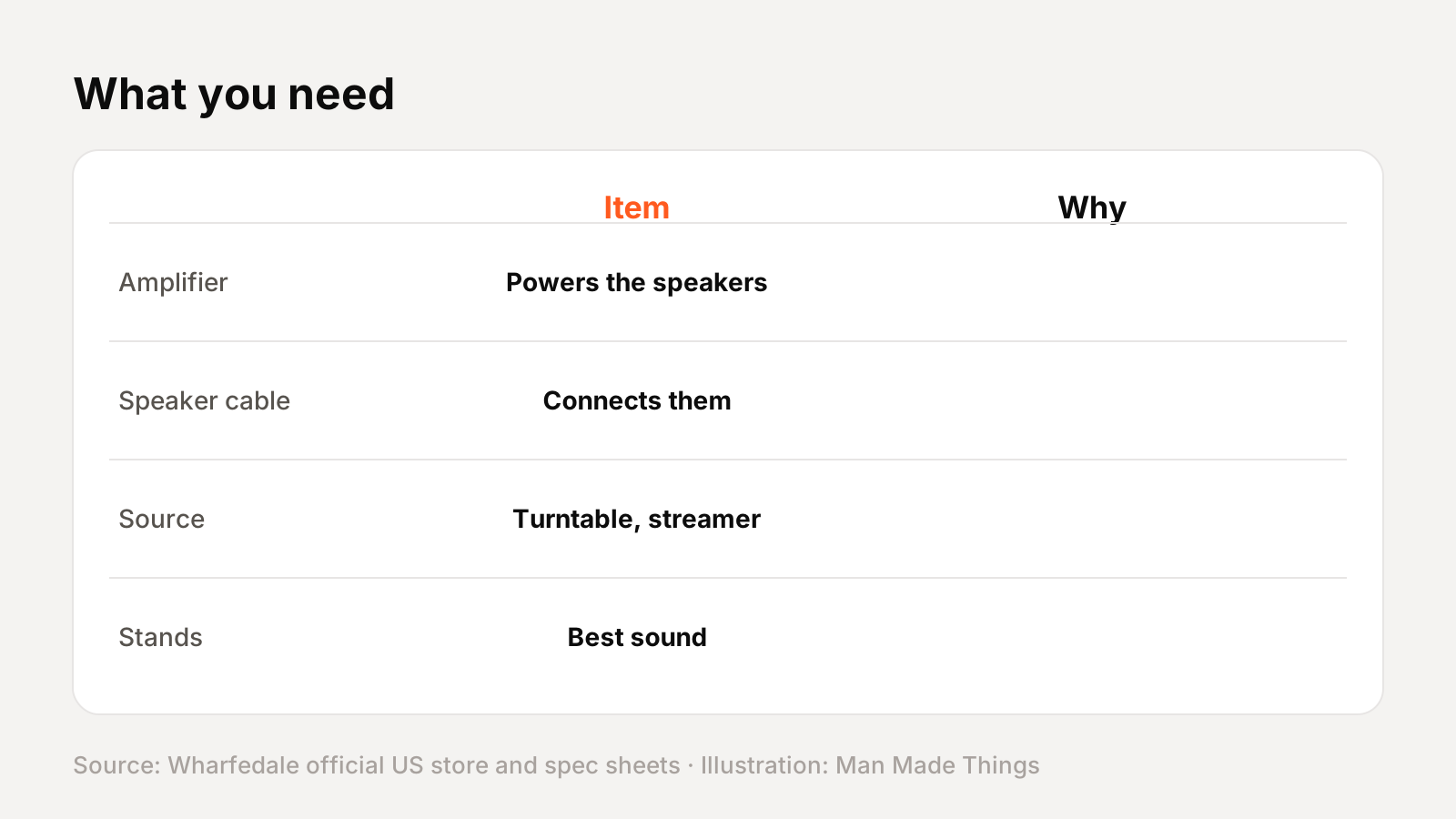
The EVO 5.2 is a passive speaker, so it has no built-in amplifier. To use it you'll need:
- An amplifier or AV receiver. Wharfedale recommends 25 to 120 W. A stereo integrated amp or a streaming amp both work.
- Speaker cable to connect each speaker to the amp.
- A source, such as a turntable (with a phono stage), CD player or streamer, if your amp doesn't stream.
Wharfedale lists a nominal impedance of 4 Ω, 8 Ω compatible (min. 3.2 Ω), so choose an amplifier rated for that load.
How it compares with other Wharfedale bookshelf speakers
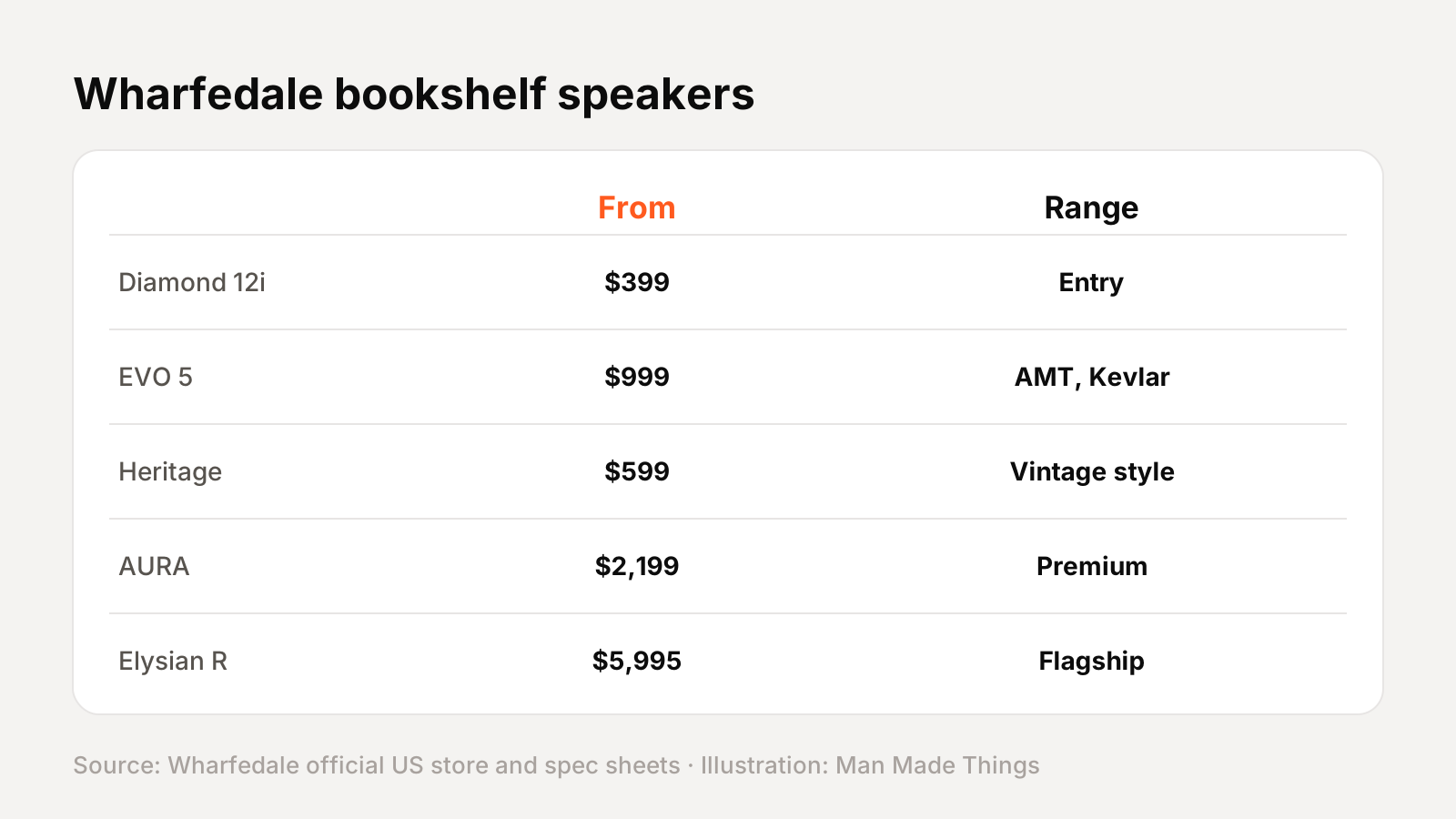
Wharfedale's current US bookshelf lineup, with list prices per pair from Wharfedale's US store (several were on sale when we checked):
| Model | US list price (pair) | Design | Bass driver | Bass extension |
|---|---|---|---|---|
| Diamond 12.0i | $399 | Two-way bass reflex | 100 mm (4 in) polypropylene bass cone | 65 Hz |
| Diamond 12.1i | $499 | Two-way bass reflex | 130 mm (5 in) polypropylene bass cone | 60 Hz |
| Diamond 12.2i | $649 | Two-way bass reflex | 150 mm (6.5 in) polypropylene bass cone | 43 Hz |
| EVO 5.1 | $999 | Two-way bass reflex | 130 mm (5 in) woven Kevlar bass cone | 46 Hz |
| EVO 5.2 | $1,299 | Three-way bass reflex | 165 mm (6.5 in) woven Kevlar bass cone | 38 Hz |
| AURA 1 | $2,199 | Two-way bass reflex | 130 mm (5 in) glass fibre matrix bass cone | 44 Hz |
| AURA 2 | $2,799 | Three-way bass reflex | 150 mm (6.5 in) glass fibre matrix bass | 33 Hz |
| Elysian 1 R | $5,995 | Two-way bass reflex | 180 mm (7 in) coated glass fibre matrix bass cone | 44 Hz |
| Elysian 2 R | $8,495 | Three-way bass reflex | 220 mm (8.5 in) coated glass fibre matrix bass | 28 Hz |
| Linton | $1,699 | Three-way bass reflex | 200 mm (8 in) woven Kevlar bass | 35 Hz |
| Super Linton | $2,699 | Three-way bass reflex | 200 mm (8 in) woven Kevlar bass | 32 Hz |
| Denton 85 | $1,199 | Two-way bass reflex | 165 mm (6.5 in) woven Kevlar bass cone | 40 Hz |
| Denton 80 | $599 | Two-way bass reflex | 125 mm (5 in) woven Kevlar bass cone | Not listed |
| Super Denton | $1,499 | Three-way bass reflex | 165 mm (6.5 in) woven Kevlar bass | 40 Hz |
| Denton 1S | $999 | Two-way coaxial bass reflex | Coaxial: 25 mm (1 in) silk dome tweeter in a 165 mm (6.5 in) polypropylene cone | 45 Hz |
| Aston | $2,695 | Two-way bass reflex | 150 mm (6 in) carbon fibre bass cone | 44 Hz |
| Dovedale | $7,495 | Three-way bass reflex | 250 mm (10 in) woven Kevlar bass | 25 Hz |
How to choose within Wharfedale's EVO 5 range
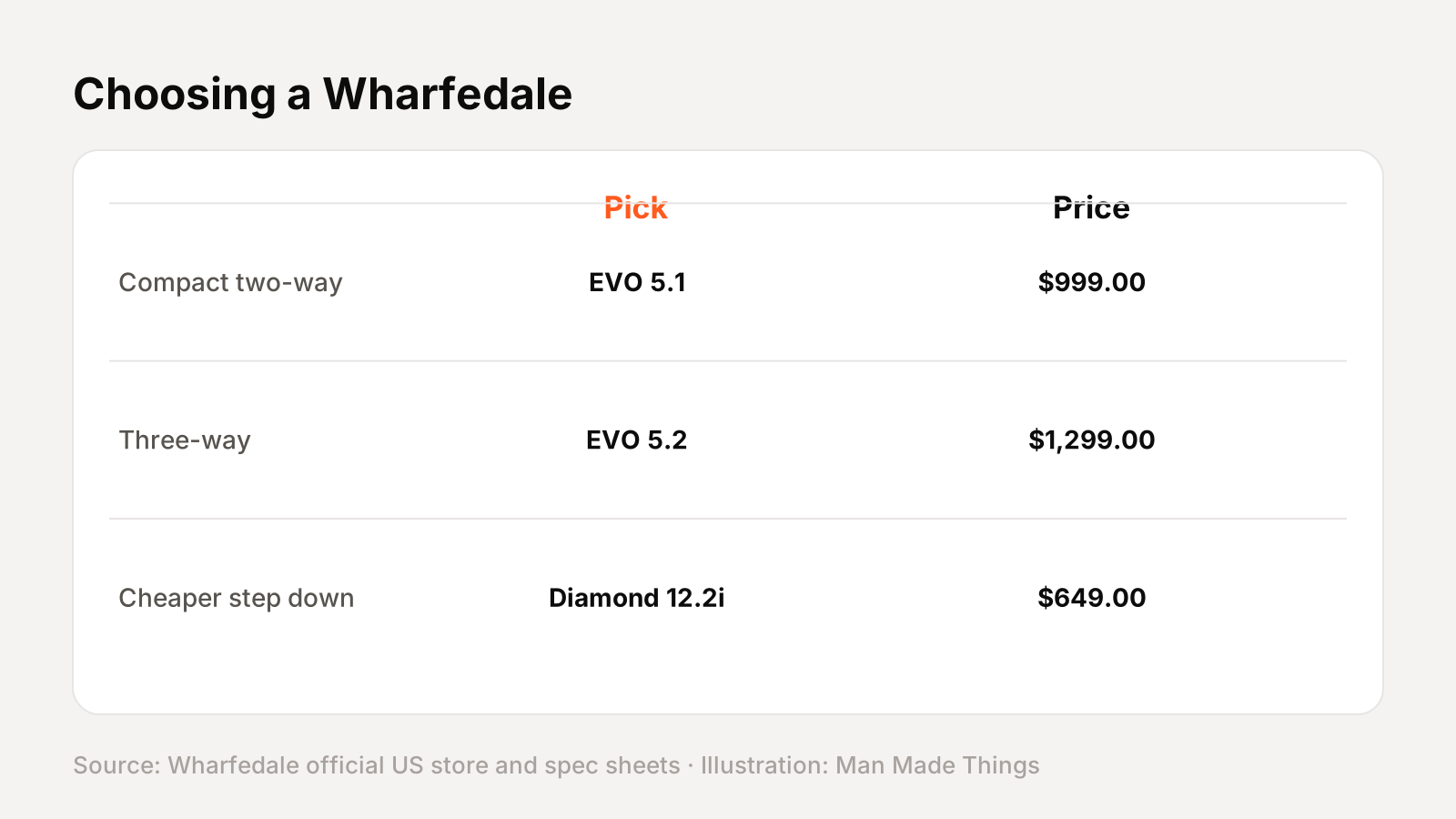
| If you want... | Consider |
|---|---|
| Compact two-way | EVO 5.1 ($999.00 a pair) |
| Three-way | EVO 5.2 ($1,299.00 a pair) |
| Cheaper step down | Diamond 12.2i ($649.00 a pair) |
Speaker terms, explained
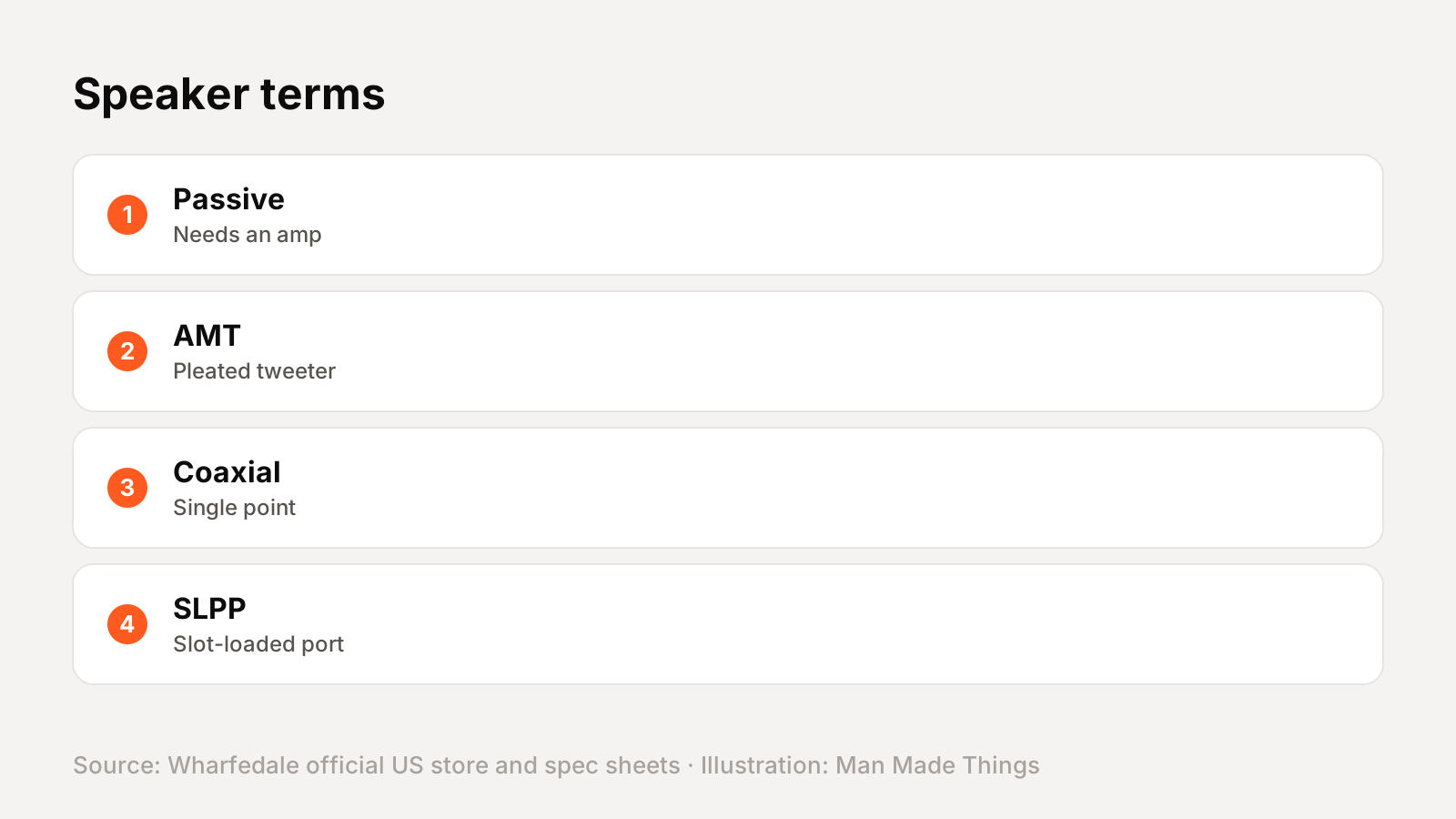
| Term | What it means |
|---|---|
| Passive | A speaker without a built-in amplifier |
| Two-way / three-way | How many frequency bands the sound is split into across different drivers |
| AMT | Air Motion Transformer, a pleated-diaphragm tweeter |
| Coaxial | The tweeter is mounted in the center of the bass cone |
| Bass reflex / SLPP | A port that boosts bass; SLPP is Wharfedale's slot-loaded design |
| Sensitivity | How loud a speaker plays from a given input; higher numbers need less amp power |
| Impedance | The electrical load the speaker presents to an amplifier, in ohms |
| Bass extension (-6 dB) | Roughly how deep the bass goes before it drops off |
Setting up the EVO 5.2
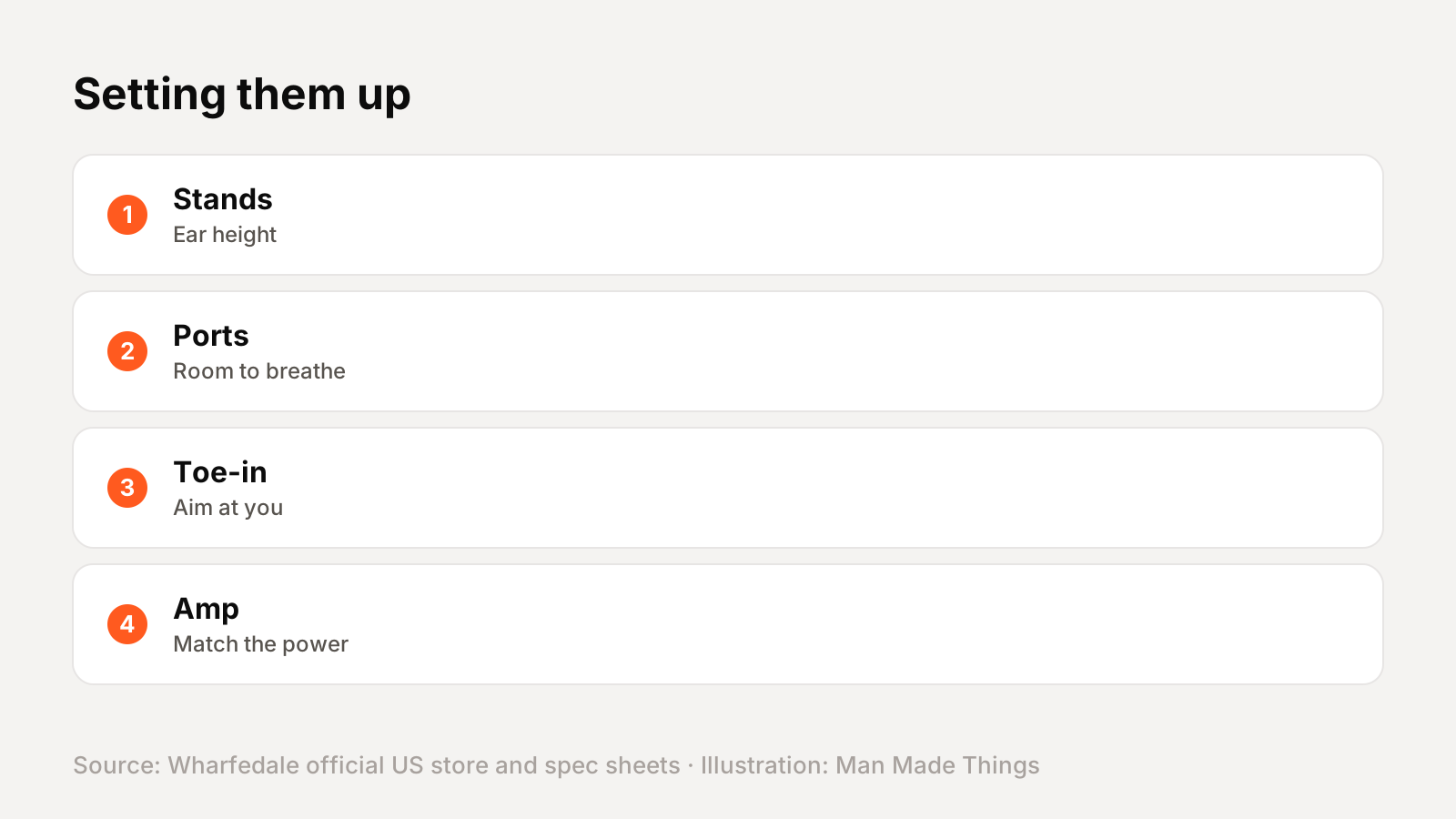
- Use stands at ear height; Wharfedale sells matching stands for most models.
- Give the ports room to work, especially rear- or bottom-ported models.
- Toe the speakers in slightly toward your listening position.
- Match your amplifier to Wharfedale's recommended power range and the speaker's impedance.
- Let them run in; new drivers often loosen up over the first hours of use.
Buying and warranty
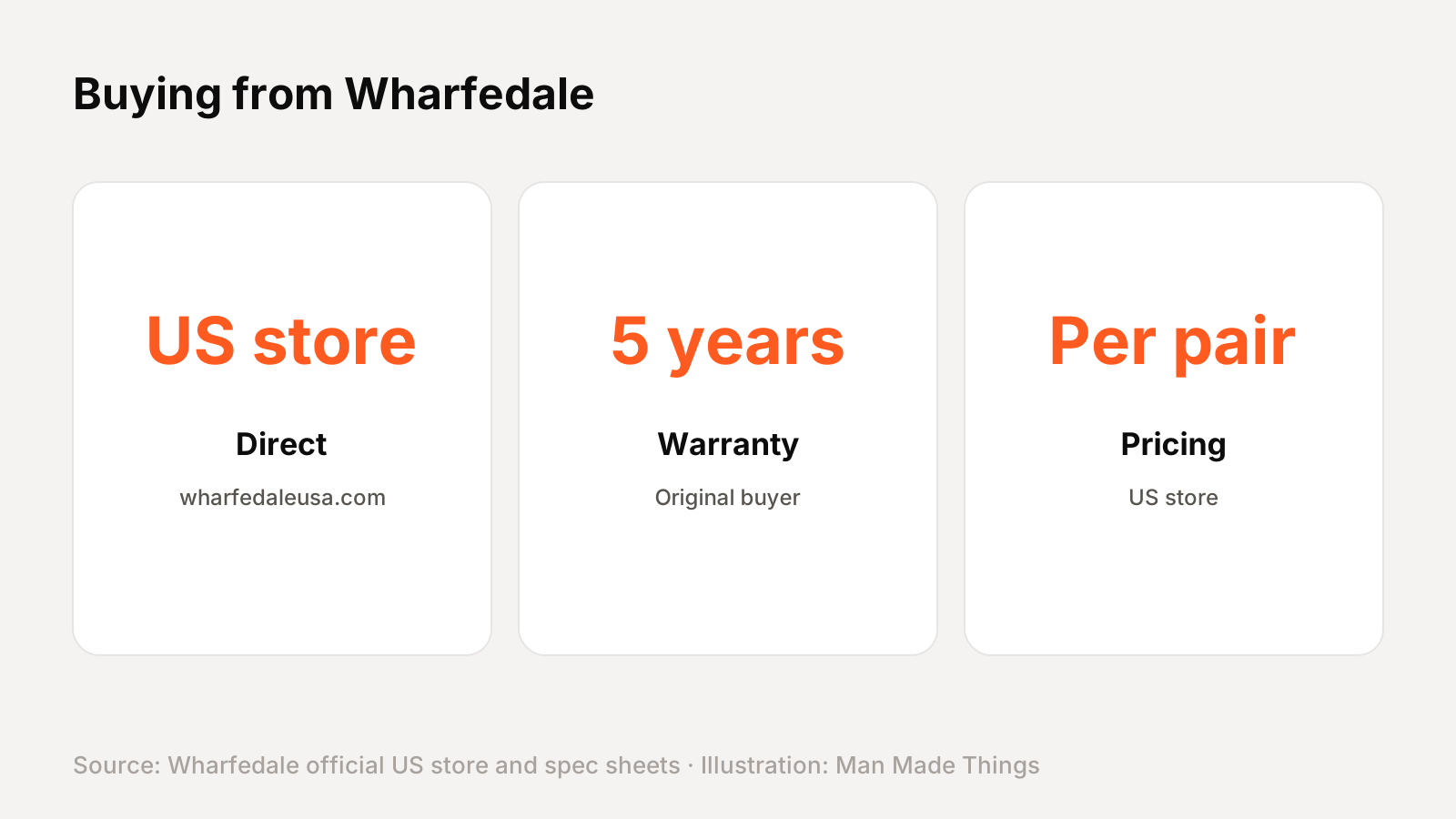
Wharfedale sells the EVO 5.2 direct from wharfedaleusa.com, and it's also sold by US dealers. Wharfedale's US store lists a 5-year warranty for the original purchaser, covering defects in materials and workmanship.
Wharfedale's US prices are per pair. Prices on this page are from Wharfedale's US store in November 2026, and several models were on sale.
Should you buy the EVO 5.2?
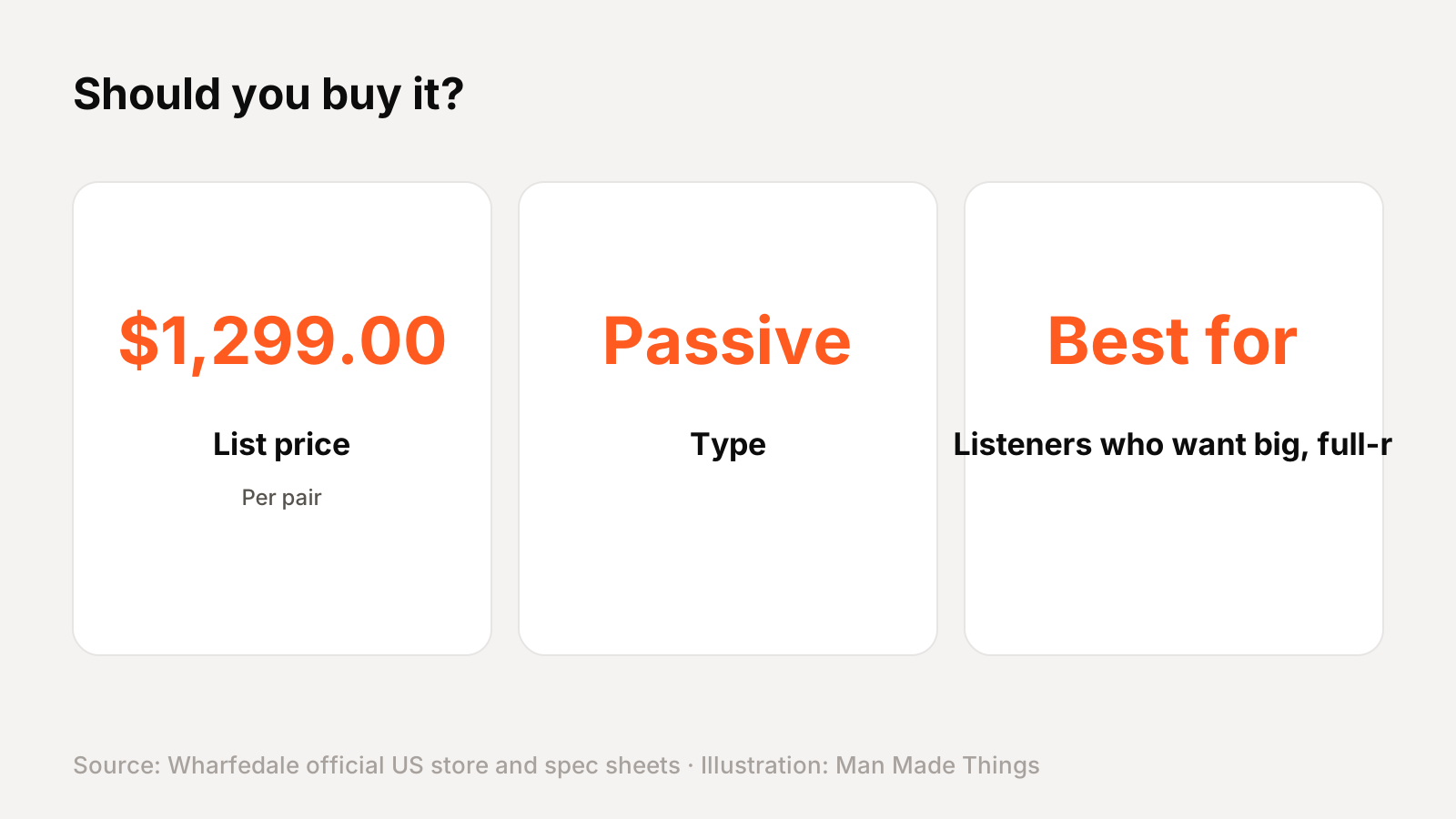
Who it's for: Listeners who want big, full-range sound from a bookshelf speaker for under $1,500.
What we like:
- Three-way with a dome midrange
- Bass to 38 Hz
- 105 dB max output
- AMT tweeter
What to consider:
- Large and heavy at 15 kg each
- 4-ohm load
- Stands add $500
Who should skip it: The AURA 1 is a step up with glass fiber drivers and gloss finishes.
The bottom line: The EVO 5.2 is a strong pick for listeners who want big, full-range sound from a bookshelf speaker for under $1,500.
Wharfedale EVO 5.2 specs
| Type | Passive |
|---|---|
| Drivers | 35 x 70 mm AMT tweeter, 50 mm soft dome mid, 165 mm woven Ke |
| Sensitivity | 88 dB (2.83 V/1 m) |
| Recommended amp power | 25-120 W |
| Impedance | 4 Ω, 8 Ω compatible (min. 3.2 Ω) |
| Frequency response (±3 dB) | 44 Hz - 24 kHz |
| Bass extension (-6 dB) | 38 Hz |
| Crossover | 800 Hz, 4.3 kHz |
Test report
Hands-on test report: in progress
We don't publish scores or test results until a real unit has gone through our routine: battery rundown at 50% volume, call quality outdoors, noise cancellation on a commute, fit over a full workday, and connection stability across devices. This review will be updated with measured results and a star rating once testing is complete.
Frequently asked questions
How much is the Wharfedale EVO 5.2?
+
$1,299 a pair ($1,799 with matching stands) on Wharfedale's US store when we checked in November 2026. Wharfedale's US prices are per pair.
Does the EVO 5.2 need an amplifier?
+
Yes. It's a passive speaker, and Wharfedale recommends 25-120 W of amplifier power.
What drivers does the EVO 5.2 use?
+
35 x 70 mm AMT tweeter, 50 mm (2 in) soft dome midrange, 165 mm (6.5 in) woven Kevlar bass cone.
What warranty does the EVO 5.2 have?
+
Wharfedale's US store lists a 5-year warranty for the original purchaser, covering defects in materials and workmanship.
Sources
Editor-in-Chief
Rahul has been writing about gadgets and software since 2013, first at Thetechhacker and now at Man Made Things. He edits every review on the site and signs off on every verdict.
More from Rahul →