The Best Bookshelf Speakers Under $500: Fluance, Polk and KEF
Three pairs of bookshelf speakers for a first hi-fi setup: the powered Fluance Ri71 with HDMI ARC, the $299 Polk Signature Elite ES15 and the KEF Q1 Meta when it's on sale, plus placement tips.
We may earn a commission when you buy through links on this page. Learn more
Quick answer
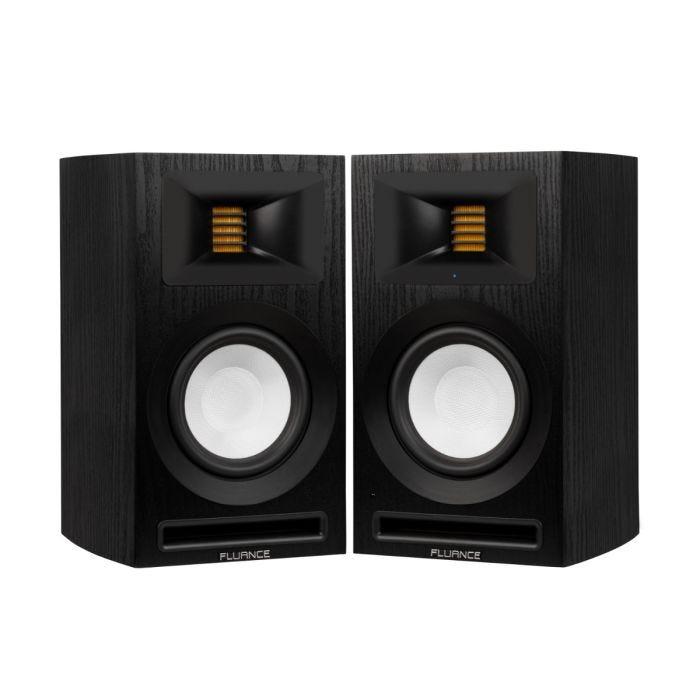
The Fluance Ri71 ($499.99 a pair) is the best bookshelf speaker under $500 for most people: powered, with Bluetooth aptX HD, HDMI ARC for your TV and a subwoofer output. The Polk Signature Elite ES15 ($299 a pair) is the best passive pick if you already own an amplifier. The KEF Q1 Meta lists at $699.99 a pair, but it's worth grabbing when it's on sale under $500.
A good pair of bookshelf speakers is the single biggest upgrade most people can make to how music sounds at home. They fill a room in a way a smart speaker or soundbar can't, with real stereo separation, and they're small enough to sit on a shelf, a desk or a pair of stands.
The first decision is whether you want powered or passive speakers. Powered speakers have the amplifier built in, so you just plug them in. Passive speakers need a separate amplifier or receiver, but give you more freedom to upgrade later.
I picked one powered pair, one passive pair and one premium pick worth watching for deals, and checked every spec and price on the brand's own US site. All prices are per pair. Pairing these with a record player? See our best turntables for beginners guide. These are research-based picks with no star scores. Let's get into it.
Our picks at a glance
1. Best overall (powered)
Fluance Ri71 Powered Bookshelf Speakers
The Ri71 is the most complete package here. Each pair has 120 watts of built-in amplification, so all you need is a power outlet. Then you can connect almost anything: your TV through HDMI ARC, your phone through Bluetooth with aptX HD, or a turntable or CD player through the RCA inputs.
That HDMI ARC input makes it a great alternative to a soundbar. You get proper stereo speakers for movies and music, controlled with your TV remote. There's a subwoofer output if you want more bass later, and a remote is included.
The sound hardware is good for the price, with an Air Motion Transformer tweeter for crisp detail and a 5.25-inch glass fiber woofer. The catches: there's no phono preamp, so most turntables need one added, there's no optical or USB input, and the warranty is two years. At $499.99, it's right at the limit.
Pros
- 01HDMI ARC replaces a soundbar
- 02Bluetooth with aptX HD
- 03Built-in amp, just plug in
- 04Subwoofer output
Cons
- 01No phono preamp for turntables
- 02No optical or USB input
- 032-year warranty
| Type | Powered, 2 × 60W RMS Class D with DSP |
|---|---|
| Drivers | AMT tweeter, 5.25 in woven glass fiber woofer |
| Frequency response | 46 Hz–30 kHz |
| Inputs | HDMI ARC, RCA, Bluetooth 5.0 (aptX HD, AAC) |
| Outputs | Subwoofer out (80 Hz) |
| Phono preamp | No |
| Warranty | 2 years |
2. Best passive
Polk Signature Elite ES15
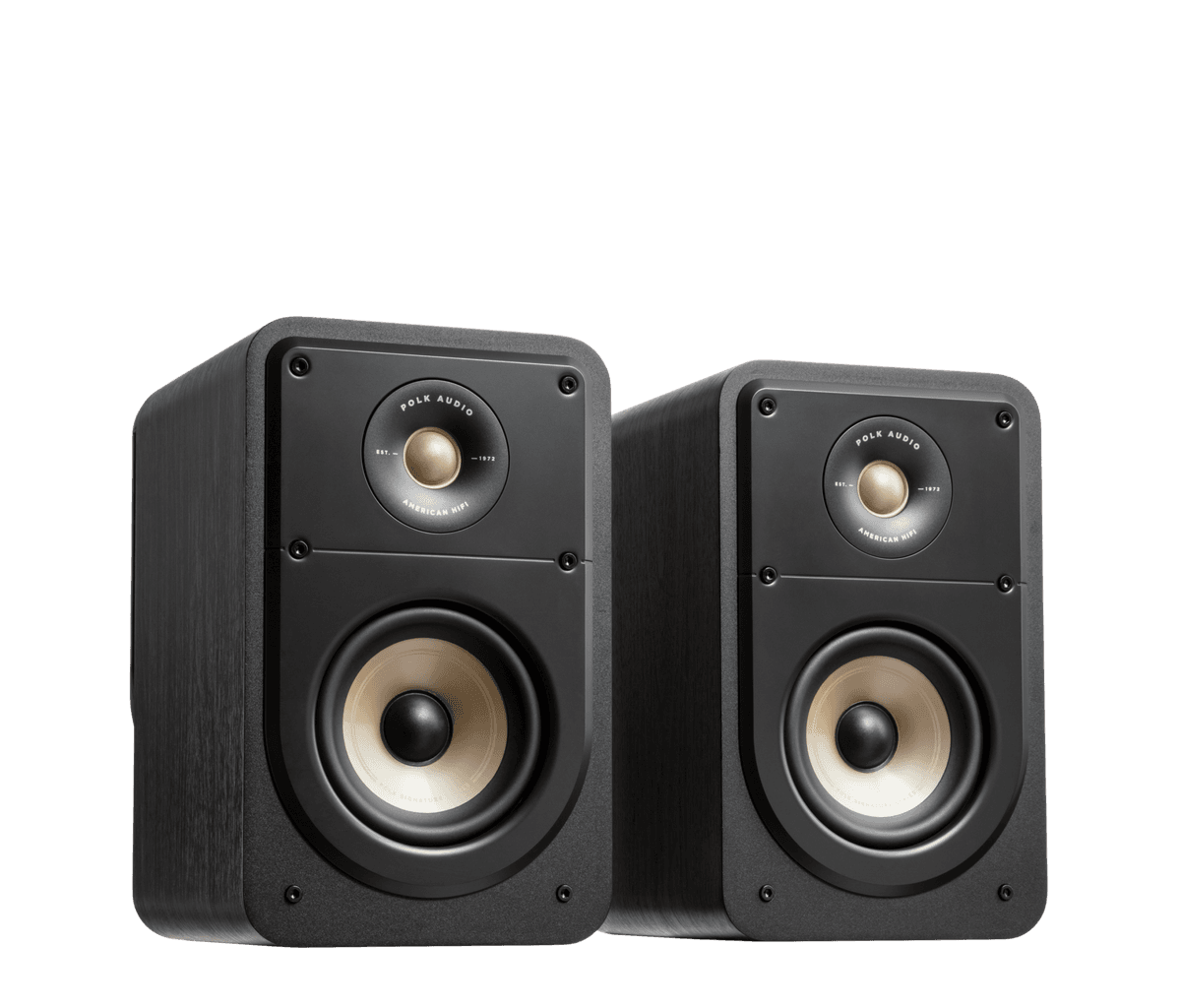
If you already have an amplifier or AV receiver, the ES15 is great value. For $299 a pair, you get a 1-inch tweeter that's Hi-Res Audio certified, a 5.25-inch woofer and Polk's Power Port, a bass port design that helps these compact speakers sound fuller.
They're flexible to place. Put them on a shelf or stands, or hang them on a wall with the built-in keyhole slots, which makes them a good choice for rear surround speakers in a home theater too. Polk backs them with a five-year limited warranty, the longest here.
As passive speakers, they need an amplifier, which adds cost if you don't already own one. Their 85 dB sensitivity is the lowest of the three, so they need a decent amp to get loud, and there's no bi-wiring support.
Pros
- 01Great value at $299 a pair
- 02Shelf, stand or wall mounting
- 03Hi-Res certified tweeter
- 045-year warranty
Cons
- 01Needs a separate amplifier
- 02Lower sensitivity needs more power
- 03No bi-wiring
| Type | Passive, Power Port |
|---|---|
| Drivers | 1 in Terylene tweeter, 5.25 in polypropylene woofer |
| Frequency response | 44 Hz–40 kHz |
| Sensitivity | 85 dB |
| Amp power | 20–100W per channel, 8 ohm compatible |
| Mounting | Shelf, stand or wall (keyhole) |
| Warranty | 5 years |
3. Best on sale
KEF Q1 Meta
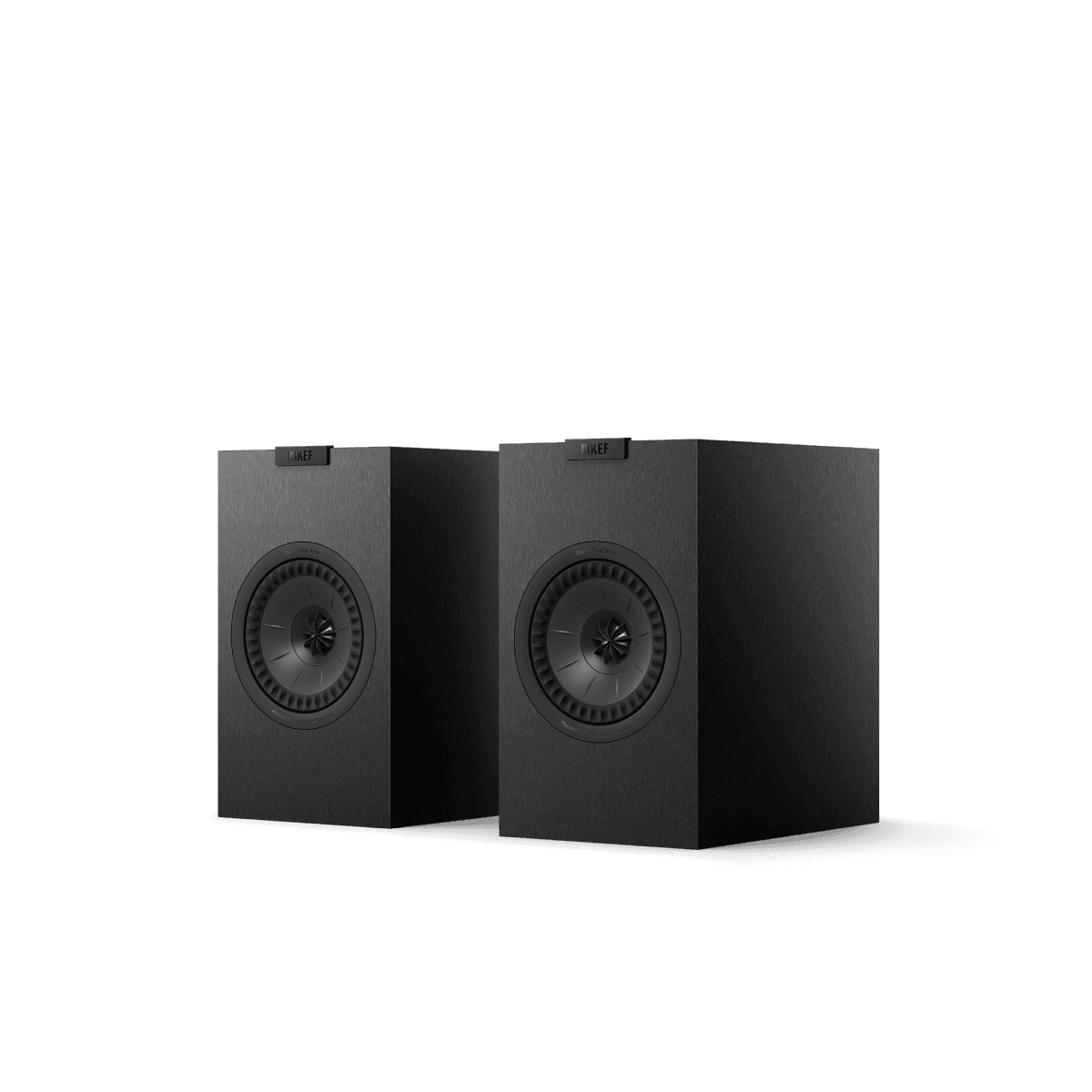
I'm being upfront about this one. The Q1 Meta lists at $699.99 a pair, over our budget. But KEF had it on sale for $399.99 when I checked, and at that price, it's the most sophisticated speaker here. If you see it under $500, it's worth grabbing.
What makes it special is KEF's Uni-Q driver, which puts the tweeter right in the center of the woofer. The sound comes from a single point, so it spreads more evenly around the room and you don't have to sit in one exact spot. KEF's Metamaterial Absorption Technology, or MAT, is designed to absorb unwanted sound from the back of the tweeter, which KEF says cleans up the treble.
It's passive, so you need an amplifier. Its 4-ohm rating is also a harder load than the Polk's, so check that your amp is comfortable driving 4-ohm speakers.
Pros
- 01Uni-Q driver for even, wide sound
- 02MAT for cleaner treble
- 03Wide 10–150W amp range
- 04Three finishes including walnut
Cons
- 01$699.99 list, only under $500 on sale
- 02Needs an amplifier
- 034-ohm load is harder on budget amps
| Type | Passive, two-way bass reflex |
|---|---|
| Driver | Uni-Q: 1 in tweeter inside 5.25 in cone, with MAT |
| Frequency response | 51 Hz–20 kHz (±3 dB) |
| Sensitivity | 86 dB |
| Impedance | 4 ohms (min 3.2) |
| Amp power | 10–150W |
| Weight | 13.4 lb each |
Powered vs passive speakers
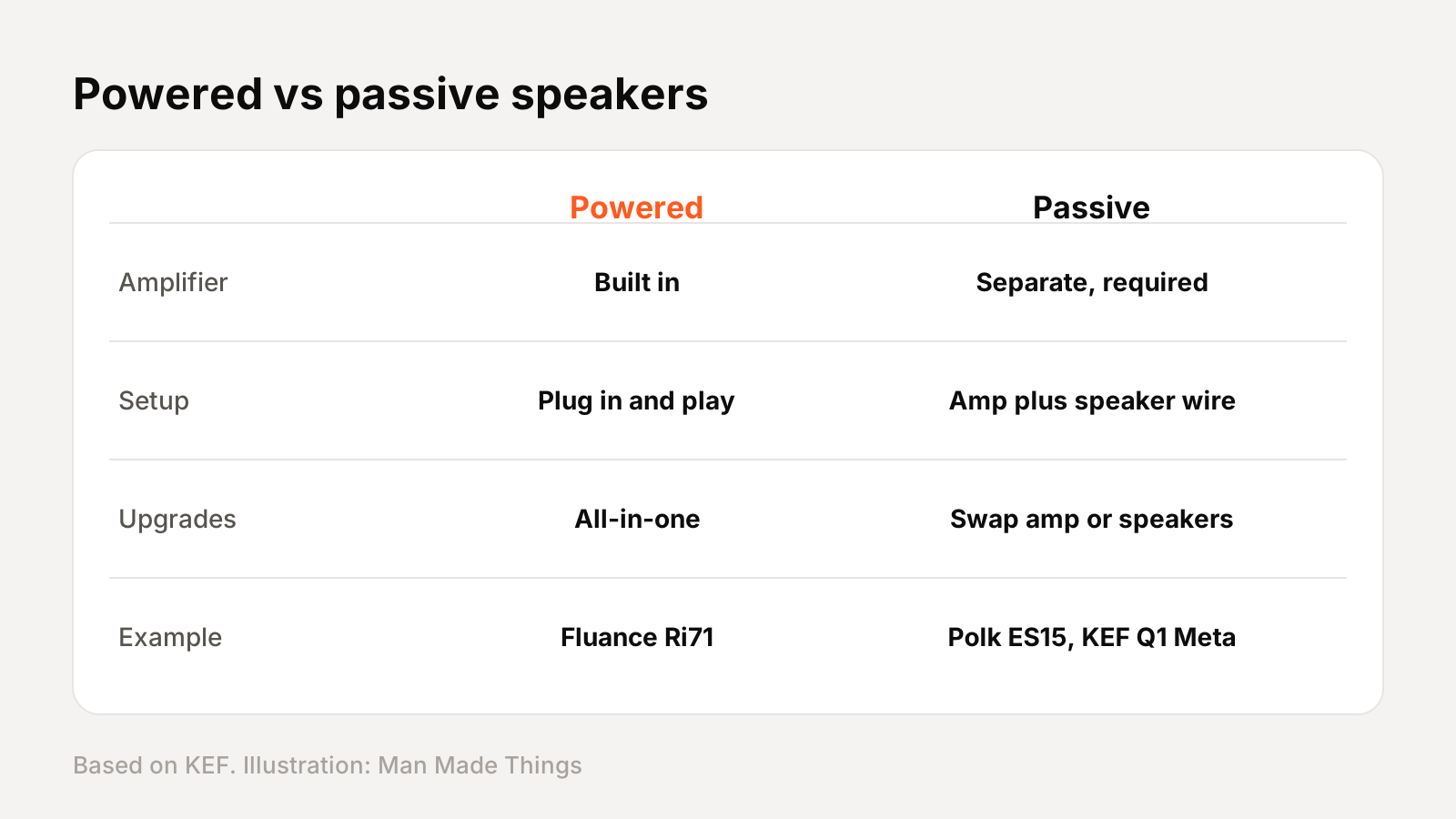
KEF's explainer sums up the difference well.
- Powered (active) speakers have amplifiers built in, often with their own digital-to-analog converter and digital signal processing. They only need power and a source. No amp to match, fewer boxes and simpler wiring. The Fluance Ri71 is powered.
- Passive speakers rely on an external amplifier, which takes the signal, boosts it and sends it to the speakers over speaker wire. The advantage is freedom: you choose your amplifier and can upgrade either part later. The Polk and KEF are passive.
KEF says the question of which sounds better is subjective and depends on the quality of the parts and design, not just the type. For a simple TV or desk setup, powered is easier. If you enjoy building a system, passive gives you more room to grow.
Where to put your speakers
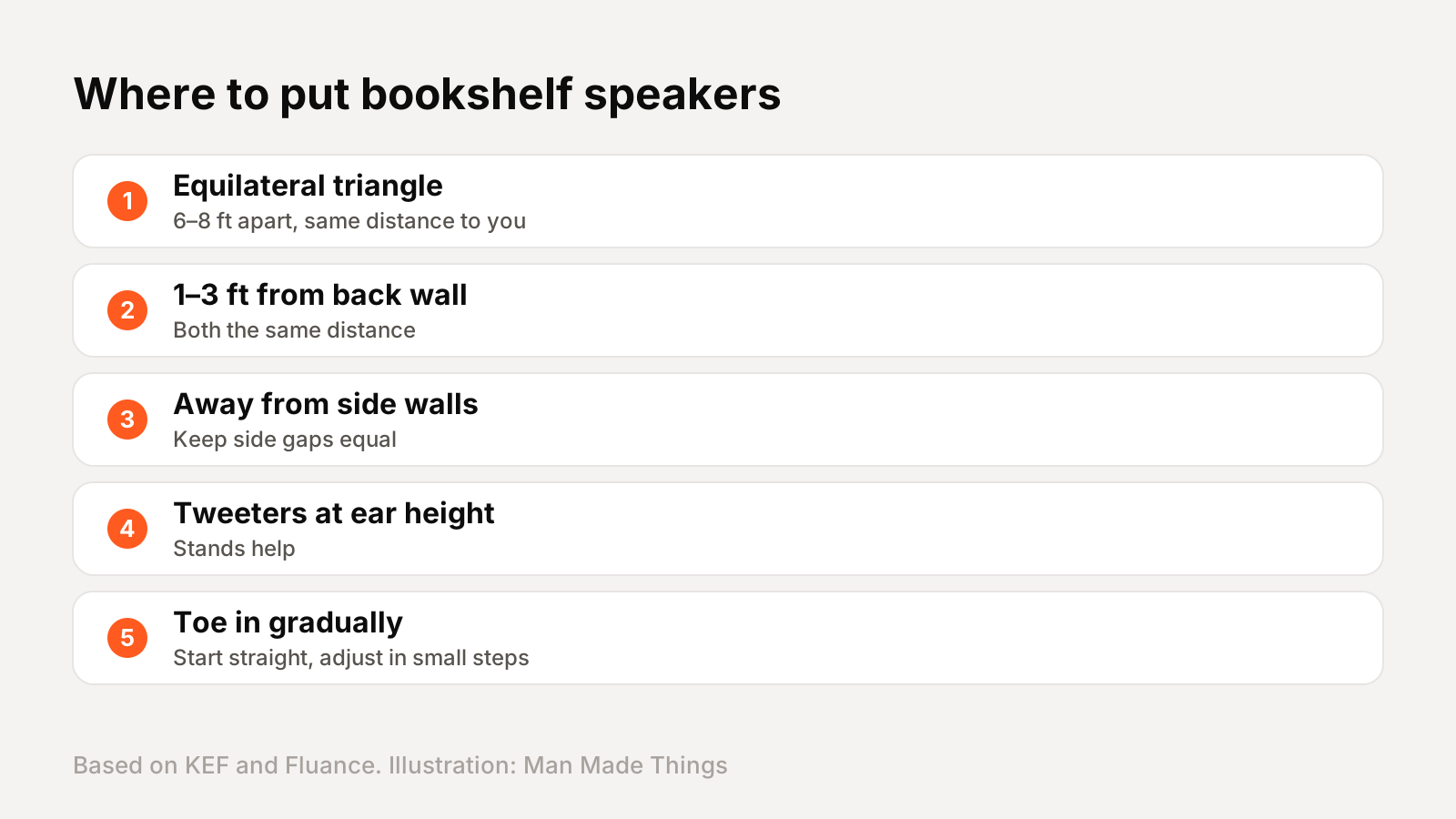
Where you place your speakers can change the sound as much as which ones you buy. KEF's placement tips are a great starting point:
- Make a triangle. Put the speakers about 6 to 8 feet apart, and sit the same distance from each one.
- Pull them off the back wall, about 1 to 3 feet, and keep both the same distance from it. Speakers too close to a wall sound boomy, especially rear-ported ones.
- Keep away from side walls, and keep the side distances equal.
- Start pointing straight ahead, then angle them toward you in small steps until the sound locks into the center.
Fluance adds that the tweeters should be at ear height when you're seated, which is why stands help so much. Stands also separate the speakers from your furniture, which reduces vibration. Use spikes on carpet and rubber pads on hardwood.
Frequently asked questions
What are the best bookshelf speakers under $500?
+
The Fluance Ri71 at $499.99 a pair. They're powered, with Bluetooth aptX HD, HDMI ARC and a subwoofer output.
Should I buy powered or passive speakers?
+
Powered speakers are simpler because the amplifier is built in. Passive speakers need a separate amplifier but are easier to upgrade over time.
Can I connect a turntable to the Fluance Ri71?
+
Yes, through the RCA inputs, but it has no phono preamp, so you'll need a turntable with a built-in preamp or a separate one.
How far from the wall should bookshelf speakers be?
+
KEF suggests about 1 to 3 feet from the wall behind them, with both speakers the same distance away.
Sources
Editor-in-Chief
Rahul has been writing about gadgets and software since 2013, first at Thetechhacker and now at Man Made Things. He edits every review on the site and signs off on every verdict.
More from Rahul →