Watch Water Resistance Ratings Explained: What 30m, 50m, 100m and 200m Really Mean
What the water resistance rating on your watch actually allows, according to Seiko, Casio, Citizen, Tissot, Omega and Rolex, plus the ISO standards behind the numbers and how often to have the seals checked.
We may earn a commission when you buy through links on this page. Learn more
Quick answer
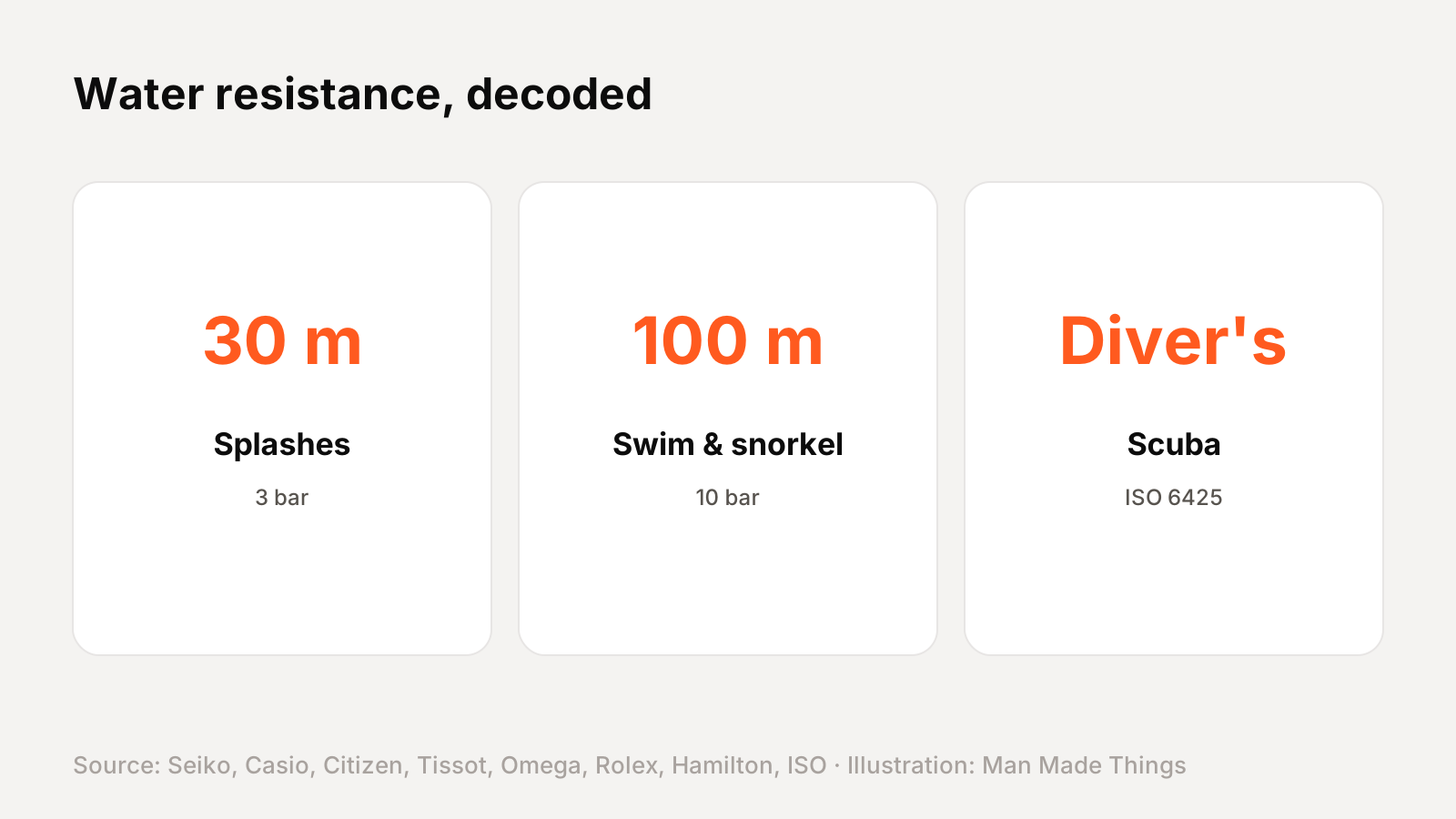
A water resistance rating is a pressure test result, not a safe diving depth. Most brands say 30m (3 bar) means splashes and hand washing only, 50m (5 bar) is fine for swimming, 100m (10 bar) suits snorkeling and skin diving, and 200m (20 bar) or a proper ISO 6425 diver's watch is what you want for scuba. Seals age, so Omega, Tissot and Hamilton recommend a water resistance check once a year.
Almost every watch has a depth printed on the dial or caseback: 30m, 50m, 100m, 200m. It's natural to read that as "safe to this depth." It isn't. The number describes a pressure the watch was designed and tested to resist, not how deep you can take it.
That's why a watch marked 30m can be ruined by a swim, and why brands publish their own guidance on what each rating actually allows. I've gone through the official guidance from Seiko, Casio, Citizen, Tissot, Omega and Rolex, and the ISO standards behind the numbers, so you can see where brands agree and where they don't.
If you're shopping for something you can swim and dive with, see our best dive watches under $1,000 and learn how to use a dive watch bezel.
The rating is a pressure, not a depth
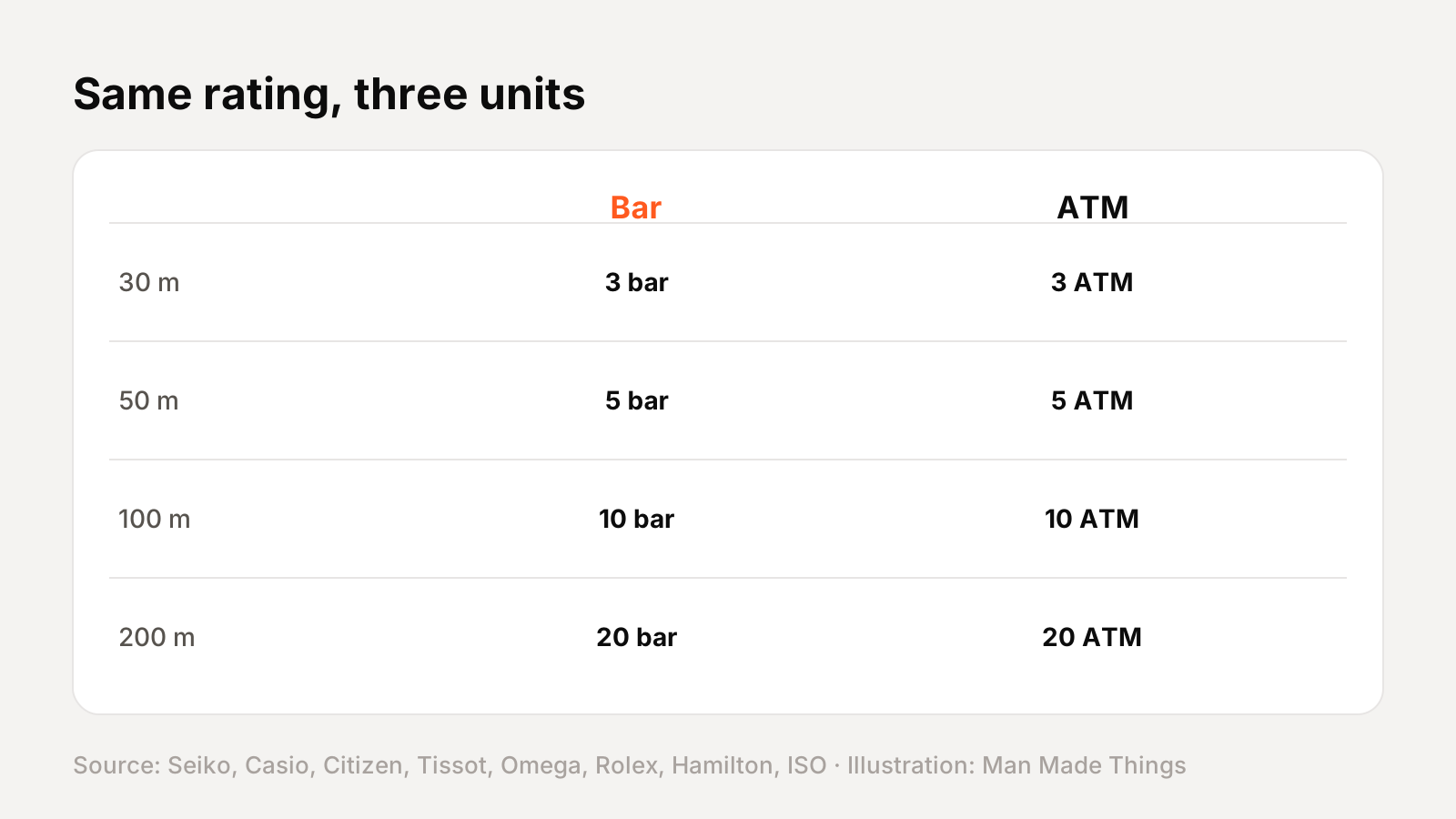
Water resistance is expressed three ways that mean the same thing:
| Marking | Same as | Same as |
|---|---|---|
| 30 m | 3 bar | 3 ATM |
| 50 m | 5 bar | 5 ATM |
| 100 m | 10 bar | 10 ATM |
| 200 m | 20 bar | 20 ATM |
The figure describes static pressure in a test, with the watch sitting still. Real life adds movement: diving into a pool, a wave, or a jet of water from a shower head all create pressure spikes, and temperature changes make gaskets expand and contract. That's why brands give much more conservative advice than the number suggests.
Some watches are only marked "Water Resistant" with no number. Seiko treats that the same as its lowest category.
What each rating allows, according to the brands
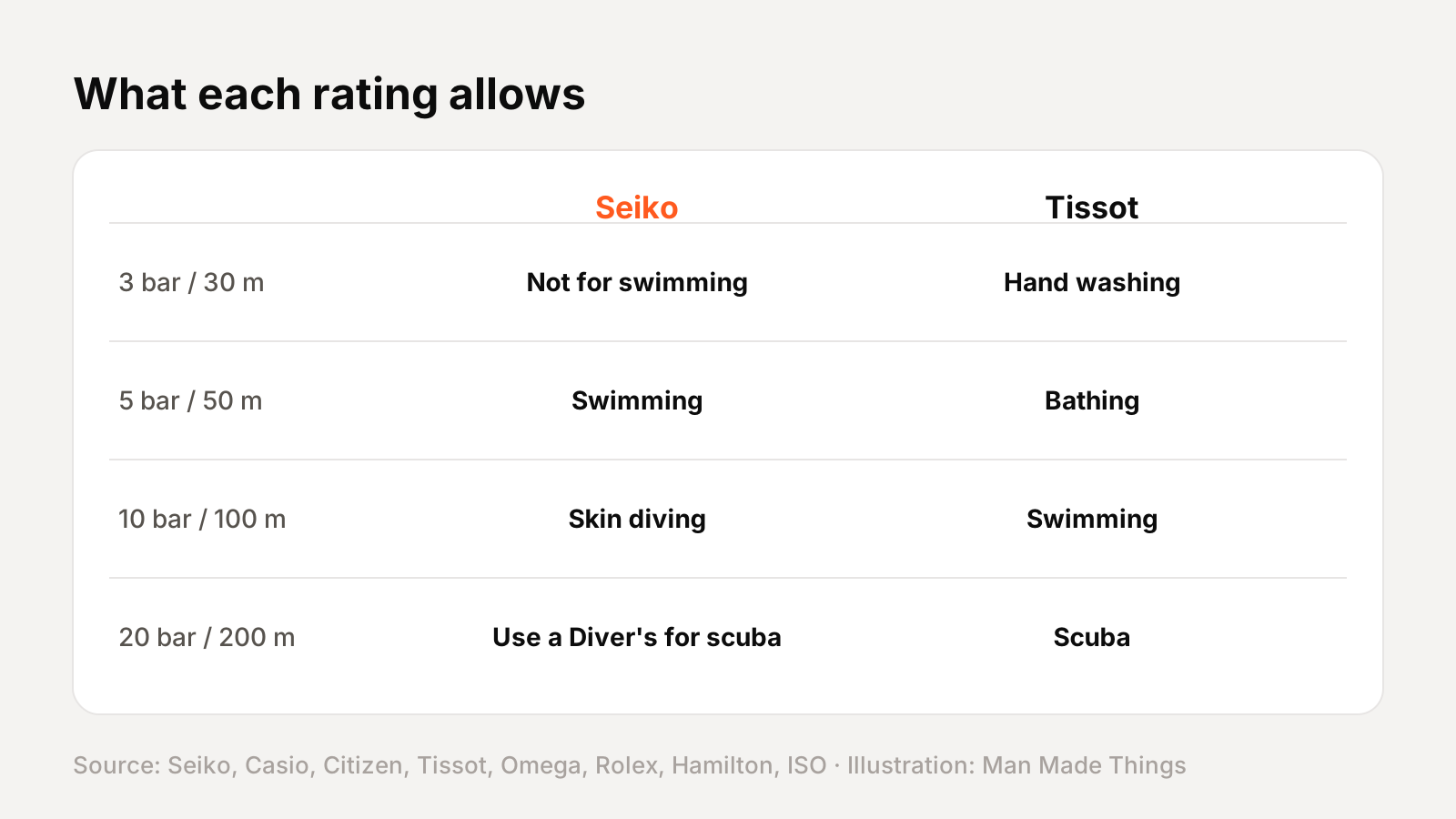
Here's how four major brands describe each level in their official manuals and FAQs:
| Rating | Seiko | Casio | Citizen | Tissot |
|---|---|---|---|---|
| 3 bar / 30 m | Accidental contact with water in everyday life; "do not use it for swimming" | Hand washing and rain | Rain and hand washing; no underwater use | "Suitable for hand washing" |
| 5 bar / 50 m | "Suitable for sports such as swimming" | Adds swimming and water-related work | Swimming, but not skin diving | Hand washing and bathing |
| 10 bar / 100 m | Diving without an air cylinder | Adds windsurfing and skin diving | Skin diving, not scuba | Showering and swimming |
| 20 bar / 200 m | Same as 10 bar; Seiko recommends a Diver's watch for scuba | Same; no scuba or air-tank diving | Skin diving, not scuba | Snorkeling and scuba diving |
The takeaway: treat 30m as splash-proof, 50m as the minimum for swimming, and 100m as the comfortable choice for regular swimming and snorkeling. For scuba, most of these brands point you to a dedicated diver's watch.
Where brands disagree: Omega reads the number more literally. Its FAQ says a watch rated to 30m "can be worn for swimming at depths of up to 30 metres underwater." Tissot is more cautious, recommending a 10 bar watch for swimming. When in doubt, follow the guidance from the brand that made your watch.
The ISO standards behind the numbers
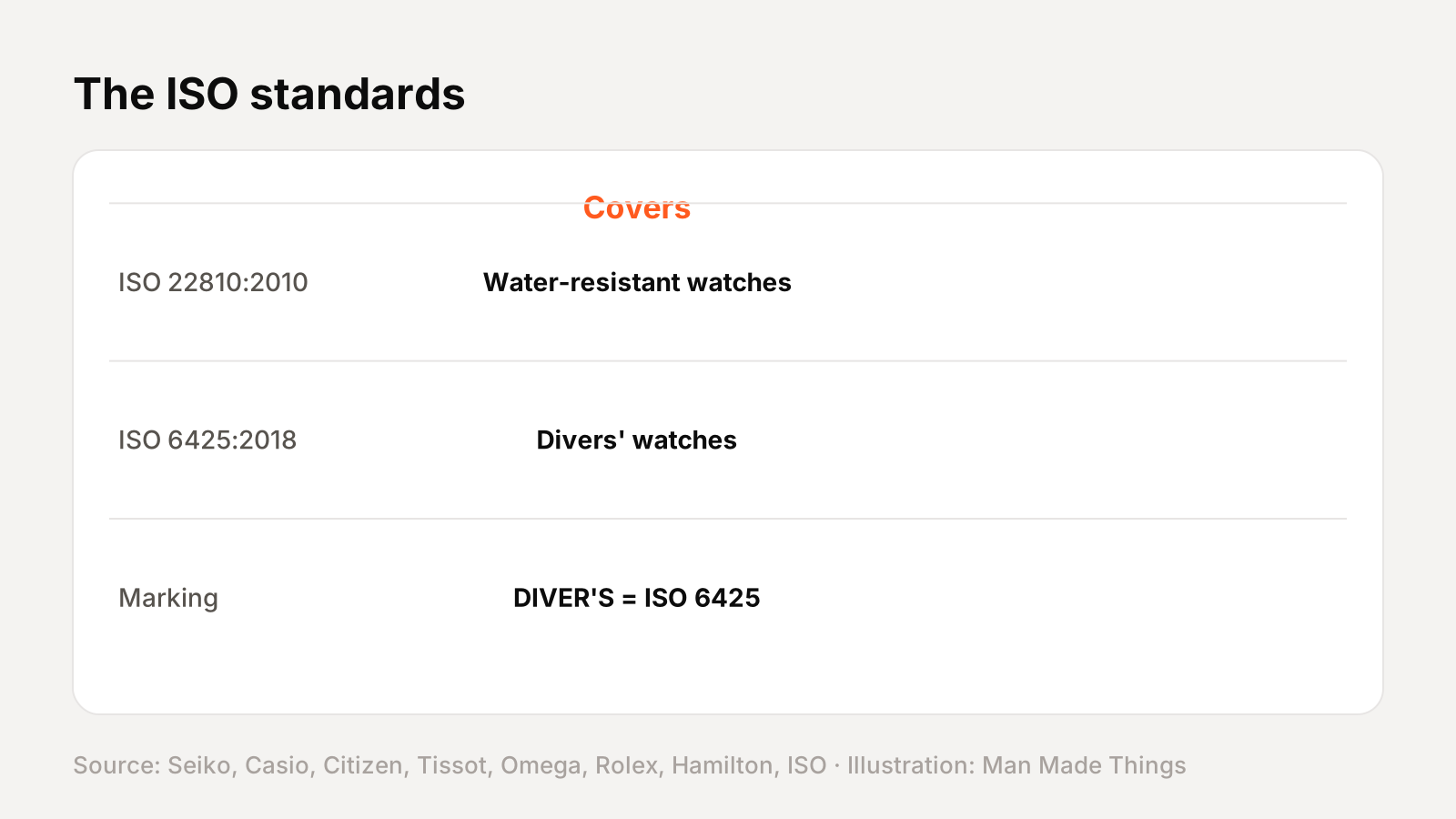
Two international standards apply:
| Standard | Title | What it covers |
|---|---|---|
| ISO 22810:2010 | Horology: Water-resistant watches | Requirements and test methods for everyday water-resistant watches, including swimming; it replaced ISO 2281 |
| ISO 6425:2018 | Horology: Divers' watches | Requirements and test methods for divers' watches and saturation divers' watches, and the markings makers may use |
A watch marked "DIVER'S" (often with a depth like "DIVER'S 200m") is claiming the stricter ISO 6425 standard, which covers more than water resistance. That's why Seiko and Casio recommend a diver's watch, rather than just a higher number, for scuba.
The ISO texts themselves are sold by ISO, and brands don't always say which standard they test to. If it matters for how you use your watch, check your manual.
Rolex and Omega: what the luxury brands say
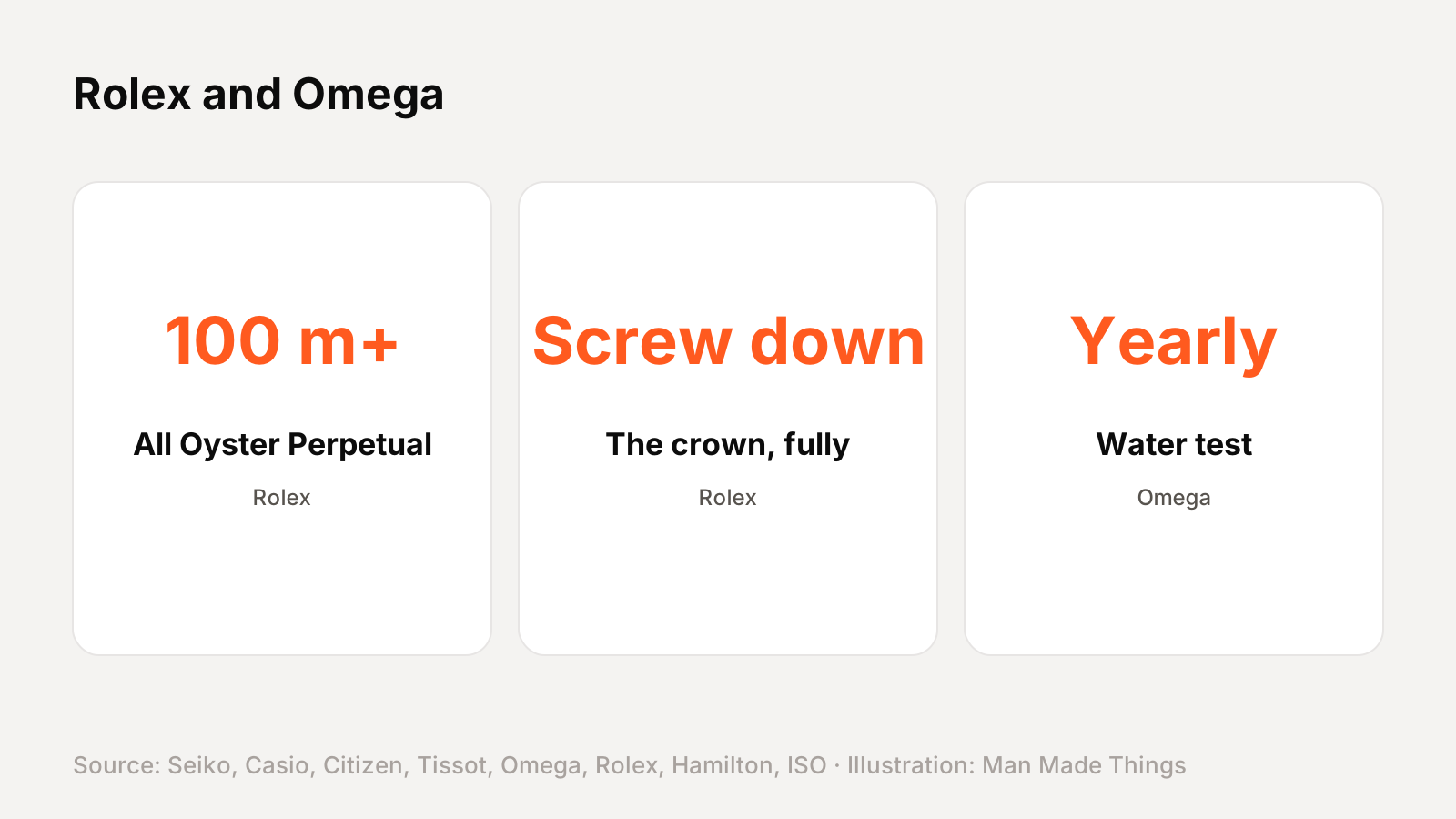
Rolex says on its official FAQ that "all Rolex Oyster Perpetual wristwatches are waterproof to depths of at least 100 metres," that the Perpetual 1908 is rated to 50 metres, and that some Oyster models withstand 1,220 or even 3,900 metres. Its advice for keeping a watch waterproof is about the crown: it "has to be screwed down tightly to create a hermetic seal," and after setting the time or winding, you should screw it down "until it cannot turn any further." Rolex also says to rinse the watch with fresh water after wearing it in the sea.
Omega says to avoid operating chronograph pushers underwater, except on the Seamaster 300M and 600M chronographs, and to always screw the crown back in after using it.
The rules every brand agrees on
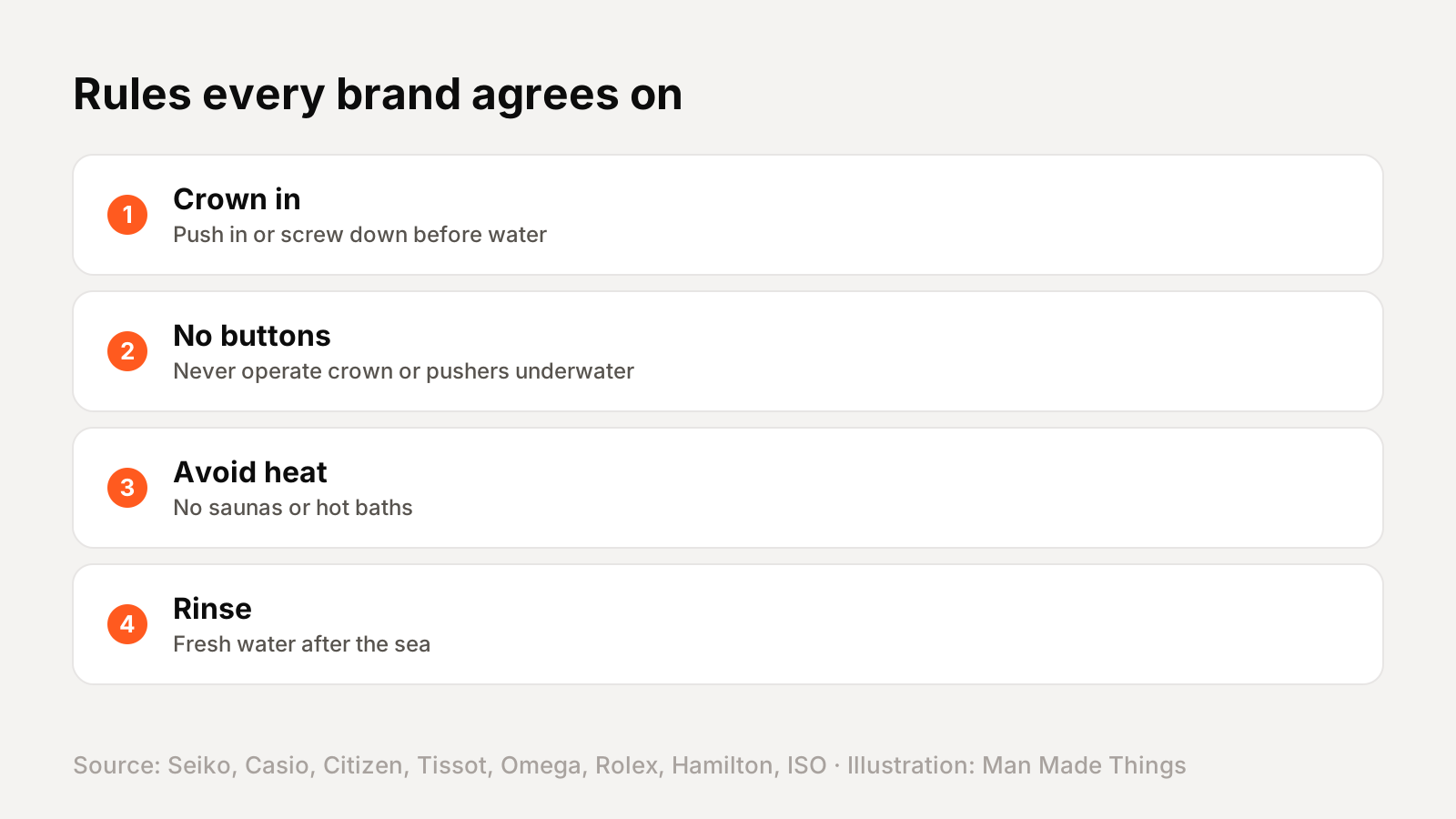
Different brands word it differently, but the core advice is consistent:
- Never operate the crown or buttons underwater. Casio says not to use them while the watch "is submersed in water or wet." Hamilton says the same for crowns and pushers.
- Make sure the crown is pushed in or screwed down before the watch gets wet. A screw-down crown left unscrewed loses most of its protection.
- Avoid heat. Casio warns against wearing its watches in "a heated swimming pool, sauna, or any other high temperature/high humidity environment." Hamilton says to avoid temperatures over 60°C (140°F), and Omega says its watches run best between 0°C and 60°C and should avoid wide temperature changes.
- Rinse after salt water, as Rolex recommends after wearing a watch in the sea.
- Remember the strap. The case may be water resistant, but check the care instructions for your strap before swimming with it.
Water resistance wears out: how often to check it
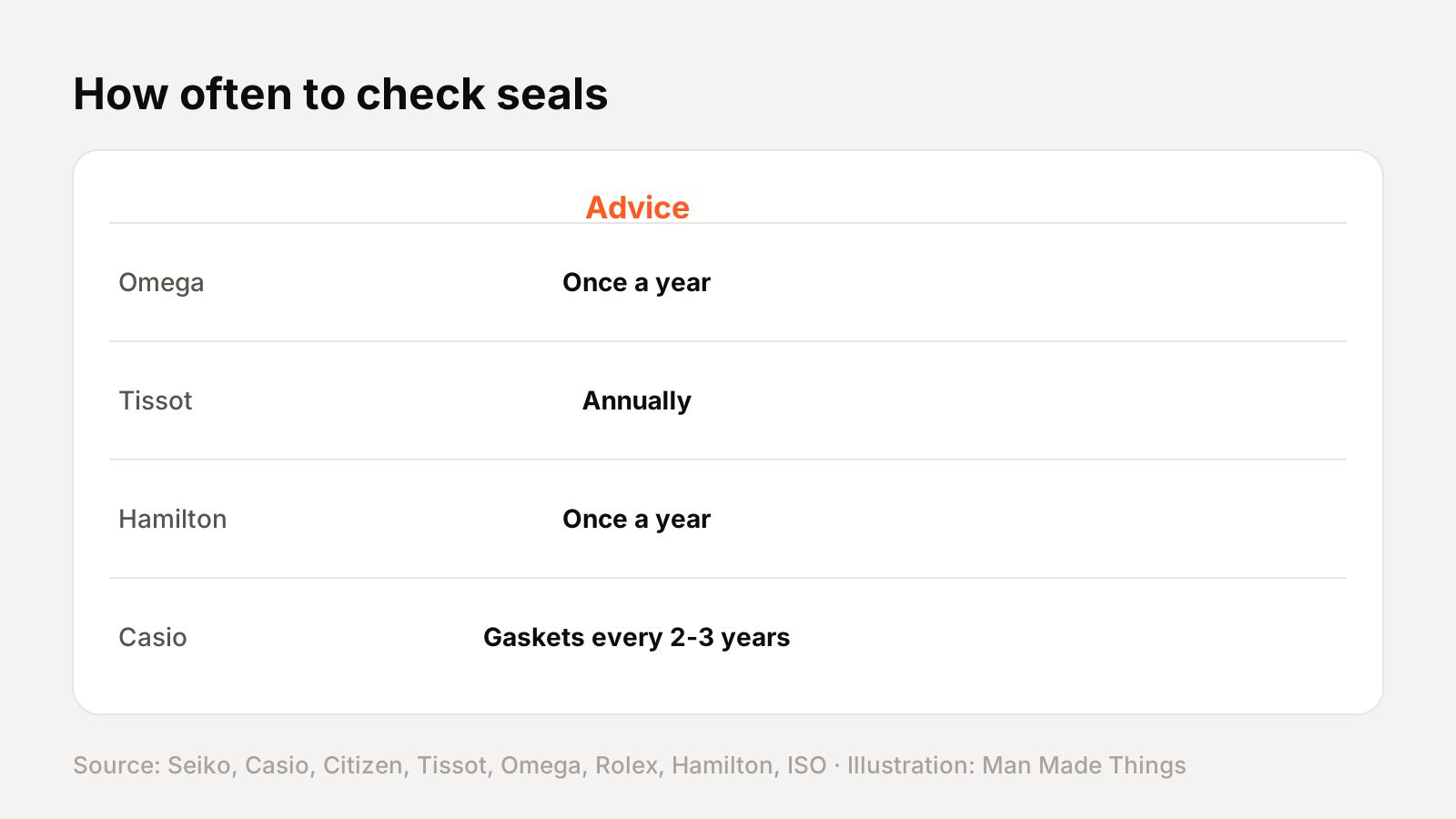
The rubber gaskets that seal a watch age over time. Hamilton states it plainly: water resistance "is not permanent." Here's what brands recommend:
| Brand | Recommendation |
|---|---|
| Omega | "Have the water resistance checked once a year" |
| Tissot | Check annually with an authorized service partner |
| Hamilton | A water resistance check once per year |
| Casio | Replace gaskets about every two to three years; water resistance is inspected at battery changes |
| Seiko | Replace the gasket at battery changes |
A pressure test is usually quick and inexpensive at a watchmaker or authorized service center. It's well worth doing before a beach vacation, and after any battery change or repair that opens the case.
Which rating do you actually need?
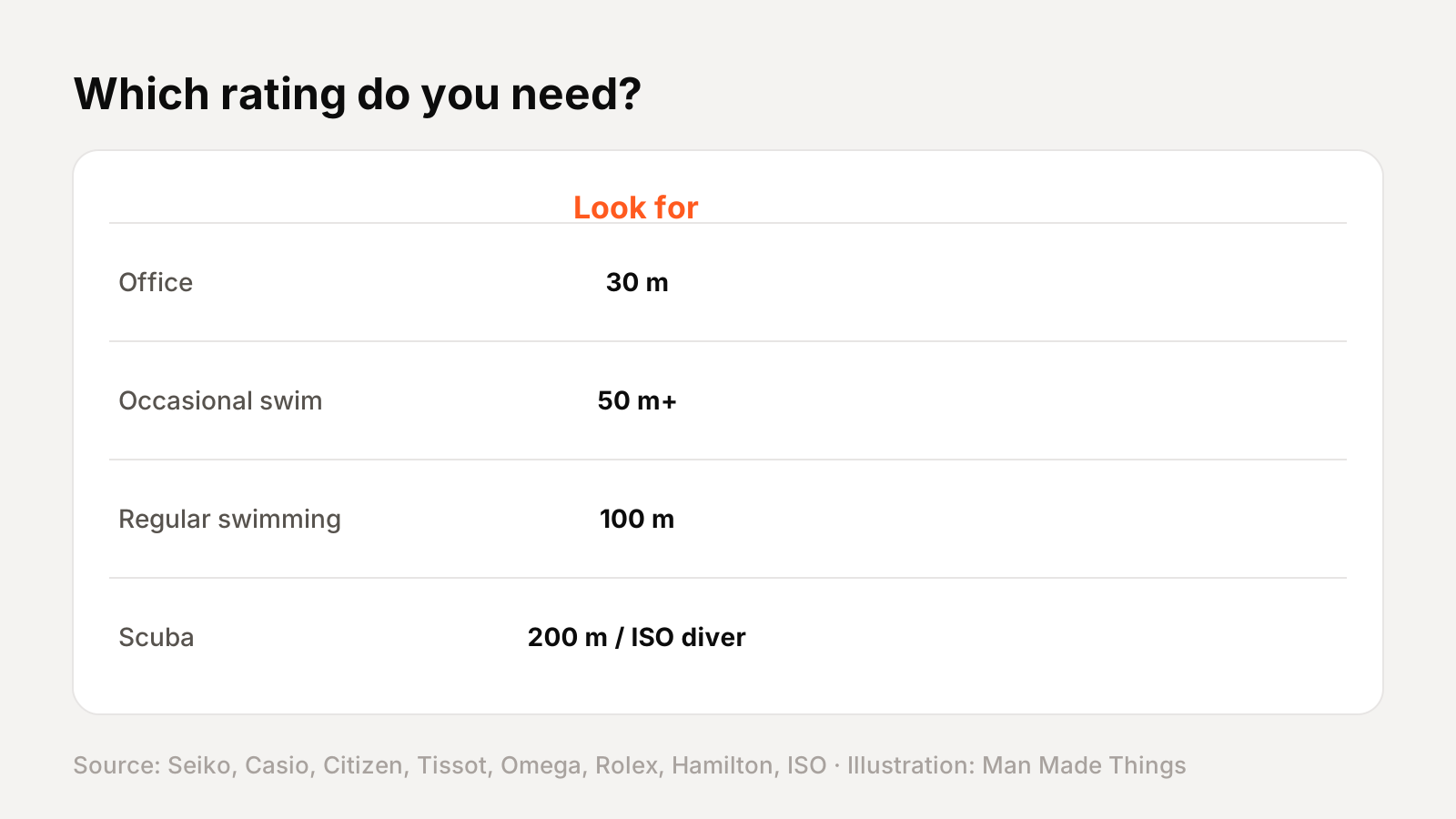
| If you... | Look for |
|---|---|
| Wear a dress watch to the office | 30 m is fine; keep it dry |
| Want to wash dishes and get caught in rain without worry | 30 m to 50 m |
| Swim occasionally | 50 m minimum (100 m per Tissot) |
| Swim laps or snorkel regularly | 100 m |
| Scuba dive | 200 m and, ideally, an ISO 6425 "DIVER'S" watch |
For most people, 100m is the sweet spot: it covers everything short of scuba with a comfortable margin. Many affordable field watches and automatic watches now offer it.
Frequently asked questions
Can I swim with a 30m water resistant watch?
+
Most brands say no. Seiko, Casio, Citizen and Tissot describe 30m (3 bar) as suitable for splashes, rain and hand washing only. Omega is an exception and says its 30m watches can be worn swimming.
Can I shower with my watch?
+
Tissot lists showering at 10 bar (100m). Hot water is the bigger risk: Casio and Hamilton warn against high temperatures, so avoid hot showers, baths and saunas.
How often should water resistance be tested?
+
Omega, Tissot and Hamilton recommend once a year. Casio suggests replacing gaskets every two to three years.
What does ISO 6425 mean on a watch?
+
It's the international standard for divers' watches. A watch marked 'DIVER'S' claims compliance with it.
Sources

Watches & Coffee Writer
Aditya is a passionate coffee lover who loves watches. He covers watches and coffee for Man Made Things.
More from Aditya →