USB-C Charging Explained: Watts, Power Delivery and Fast Charging
What watts, USB Power Delivery and PPS mean, which cable you need above 60W, and what charger fast-charges an iPhone, Pixel, Galaxy phone or MacBook, according to USB-IF, Apple, Google and Samsung.
We may earn a commission when you buy through links on this page. Learn more
Quick answer
USB-C is the plug; USB Power Delivery (PD) is the charging standard that negotiates how much power to send, up to 240W. Watts equal volts times amps. Above 60W you need a 5A e-marked cable. Most phones fast-charge with a USB-C PD charger: Apple recommends 20W to 40W or more depending on the iPhone, Pixel uses PD PPS chargers of 30W or 45W, and Samsung's Super Fast Charging needs a 25W or 45W charger.
USB-C was supposed to make charging simple: one plug for everything. And it mostly has. But the plug looking the same doesn't mean every charger and cable works the same. A 20W phone charger and a 140W laptop charger both have USB-C ports, and a cheap cable can quietly limit how fast your laptop charges.
The good news is that it's not complicated once you know three things: what watts are, what USB Power Delivery does, and when your cable matters.
Everything below comes from USB-IF, the group that maintains the USB standards, plus Apple, Google and Samsung's own support pages. Looking for a portable charger? See our best power banks guide.
Watts, volts and amps in plain English
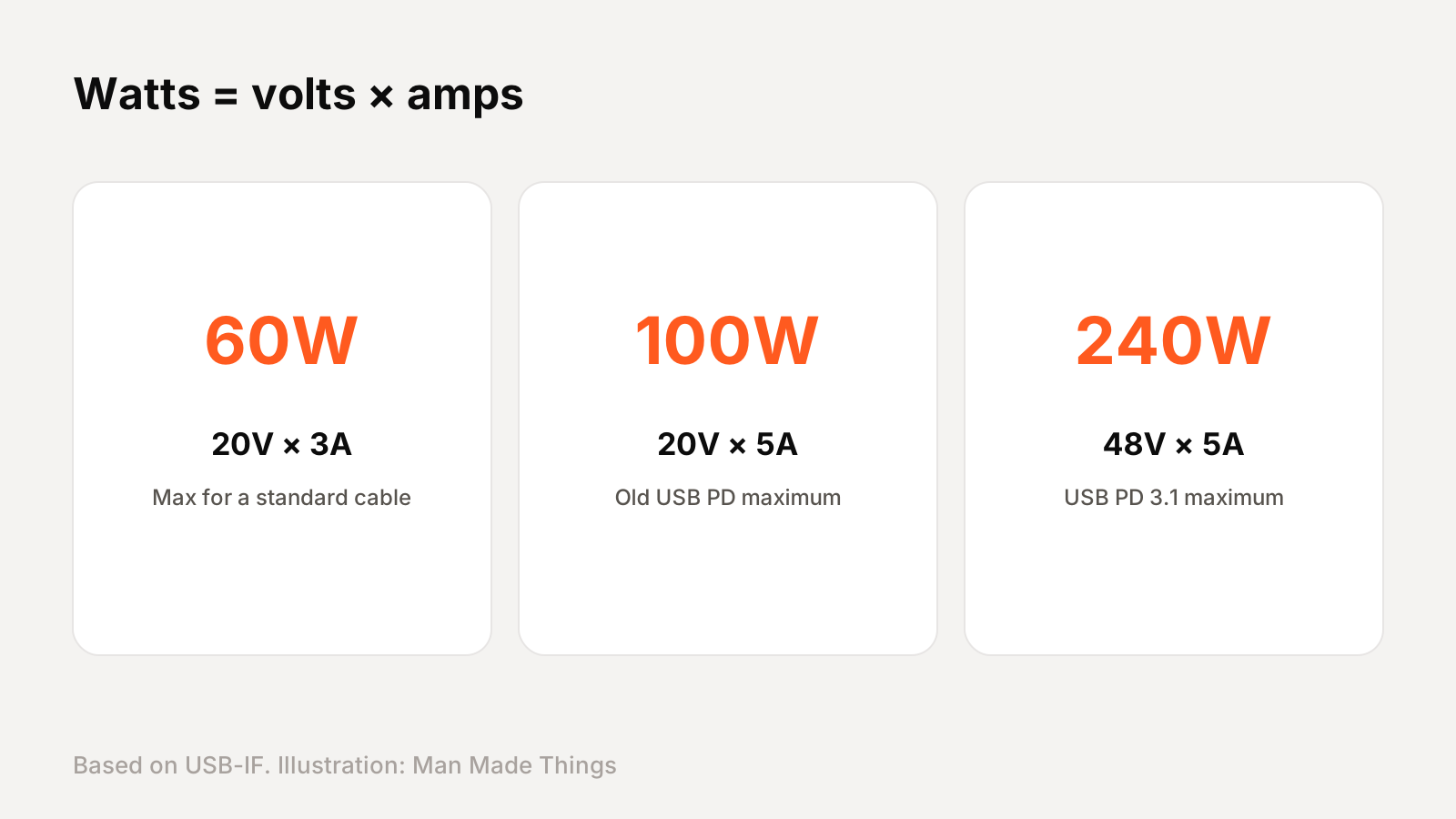
Charging speed is measured in watts (W), and watts are simply volts multiplied by amps.
USB-IF's numbers show how this works:
- 20 volts at 5 amps = 100W, the old maximum for USB Power Delivery.
- 28V gives up to 140W, 36V up to 180W and 48V up to 240W, the new maximum.
Think of volts as the water pressure in a pipe and amps as the width of the pipe. To push more power, you can raise the pressure, widen the pipe, or both.
A charger's wattage is the most it can deliver, not what it forces into your device. That's important, and we'll come back to it. A 100W charger plugged into a phone that only takes 25W will deliver about 25W.
USB-C vs USB Power Delivery
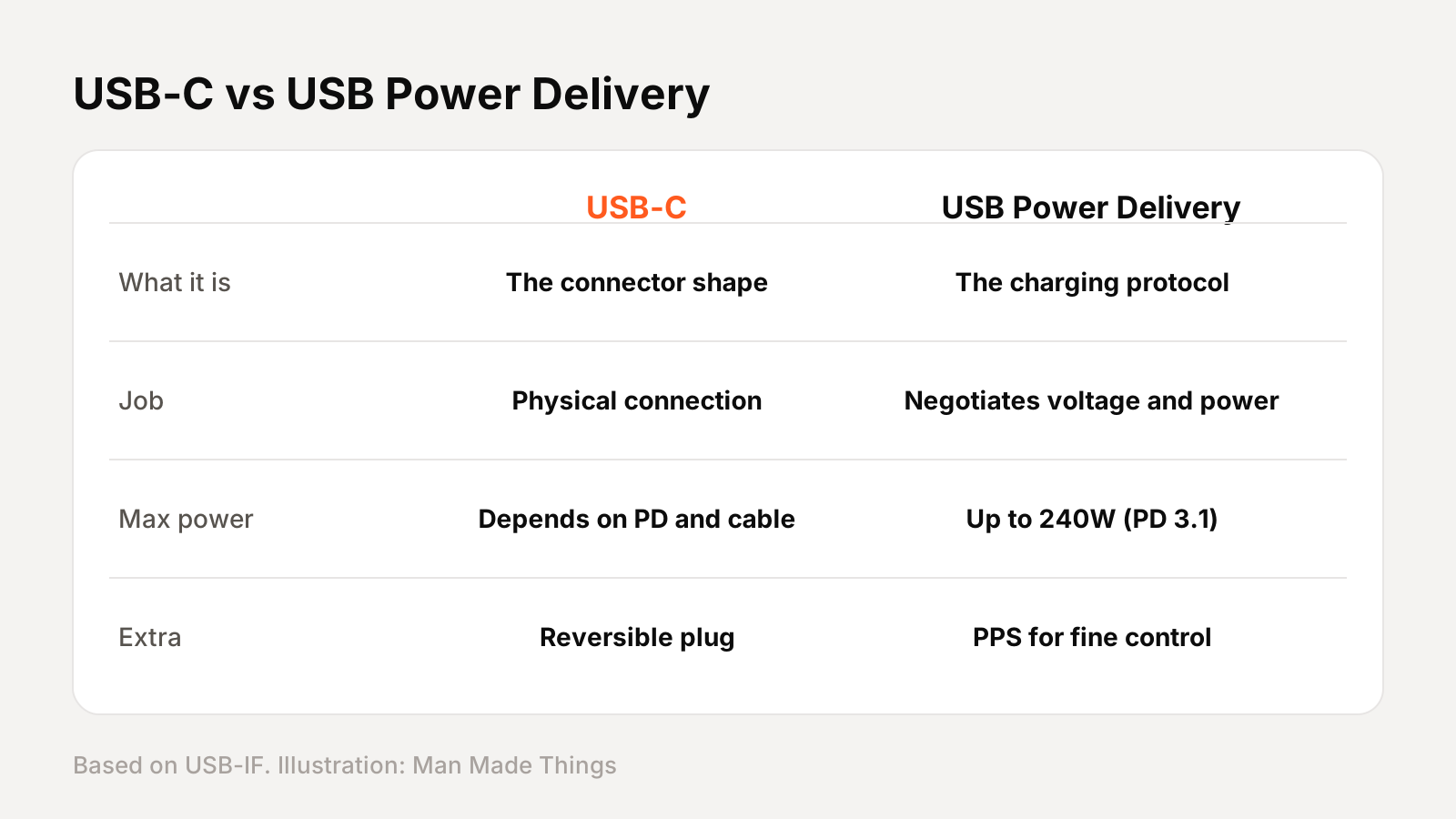
USB-IF makes a point of this in its own guidelines: USB Type-C is not USB Power Delivery. USB-C is the shape of the plug. USB Power Delivery (PD) is the protocol that lets a charger and device talk to each other and agree on how much power to send.
Here's what that conversation does. When you plug in, your device tells the charger what it can take, and the charger offers voltages it supports. USB-IF says PD allows each device to take only the power it requires, and get more when it needs it.
USB PD started with a maximum of 100W. USB-IF says the 2021 update, PD 3.1, raised that to 240W using new 28V, 36V and 48V levels, which USB-IF's logo rules call the Extended Power Range.
There's also PPS, short for Programmable Power Supply, part of the PD standard. Samsung says PPS adjusts voltage and current in real time based on charging status. Many Android phones, including Pixel and Galaxy models, use PPS for their fastest charging.
Why your cable matters above 60W
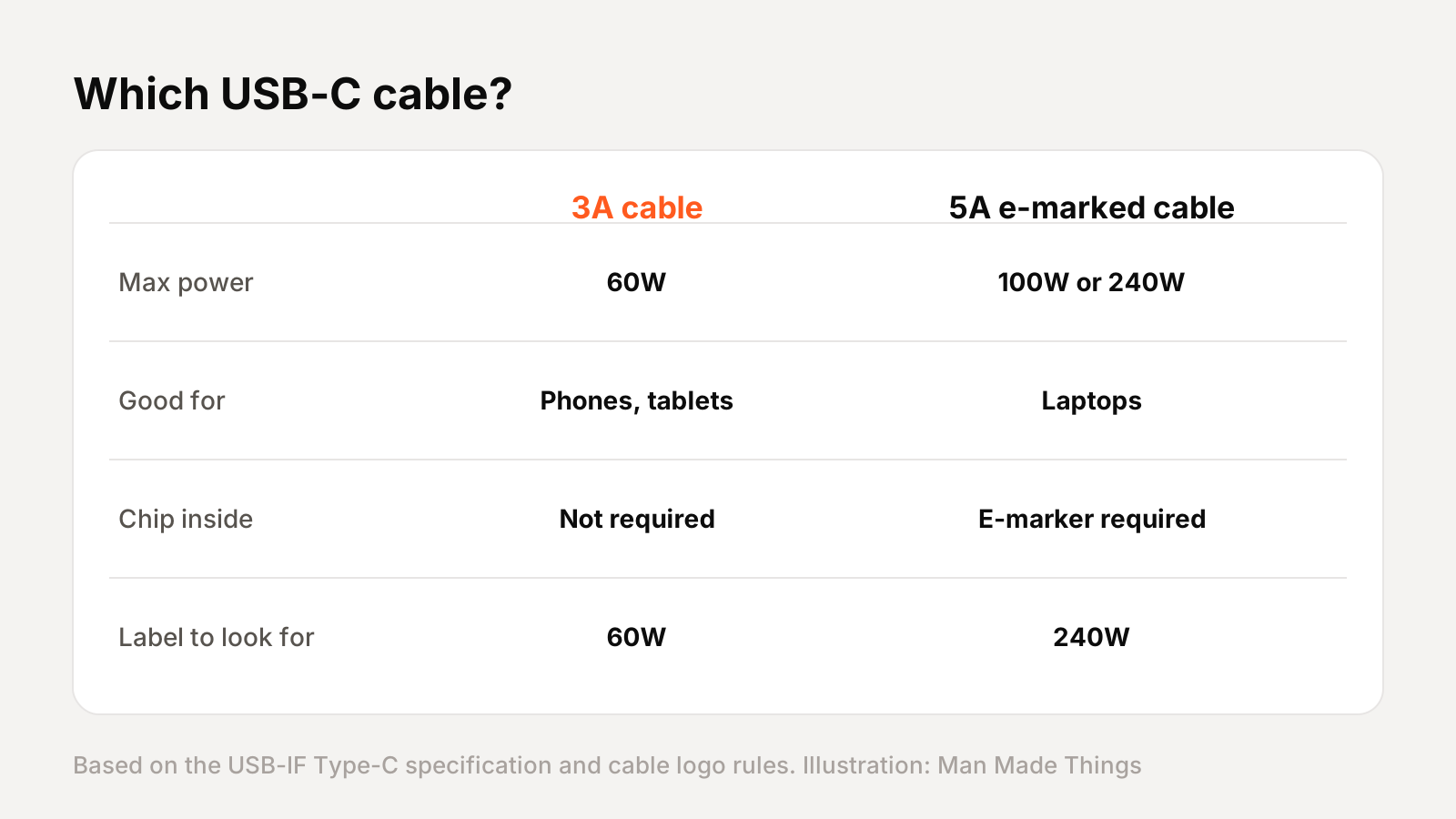
This is the part people miss. Not all USB-C cables can carry the same power.
USB-IF's specification says standard cables are rated for 3 amps, and any cable rated above 3 amps must be an electronically marked, or e-marked, cable. The e-marker is a tiny chip that tells the charger what the cable can safely handle.
What that means in practice:
- A 3A cable tops out at 60W (20V × 3A). Fine for phones and most tablets.
- For more than 60W, like a big laptop, you need a 5A e-marked cable, rated up to 100W or 240W.
USB-IF now requires certified USB-C cables to be labeled with their power rating, such as 60W or 240W, along with their data speed. If you're buying a cable for a laptop, look for the 240W label from a certified brand.
Which charger fast-charges your phone
iPhone: Apple's fast-charge requirements now vary by model. Apple says the iPhone 17 and 17 Pro can charge to 50 percent in about 20 minutes with a 40W adapter or higher, while the iPhone 17e and iPhone Air reach 50 percent in about 30 minutes with a 20W adapter or higher. For older iPhones, Apple says to use its 18W or greater USB-C adapter or a comparable third-party USB-C PD adapter. Apple also warns that a charger of 7.5W or less will charge slowly.
Google Pixel: Google lists fast charging with a USB-C PPS charger. For example, it says the Pixel 10 reaches up to 55 percent in about 30 minutes with a 30W PPS charger, and the Pixel 10 Pro XL up to 70 percent with a 45W charger.
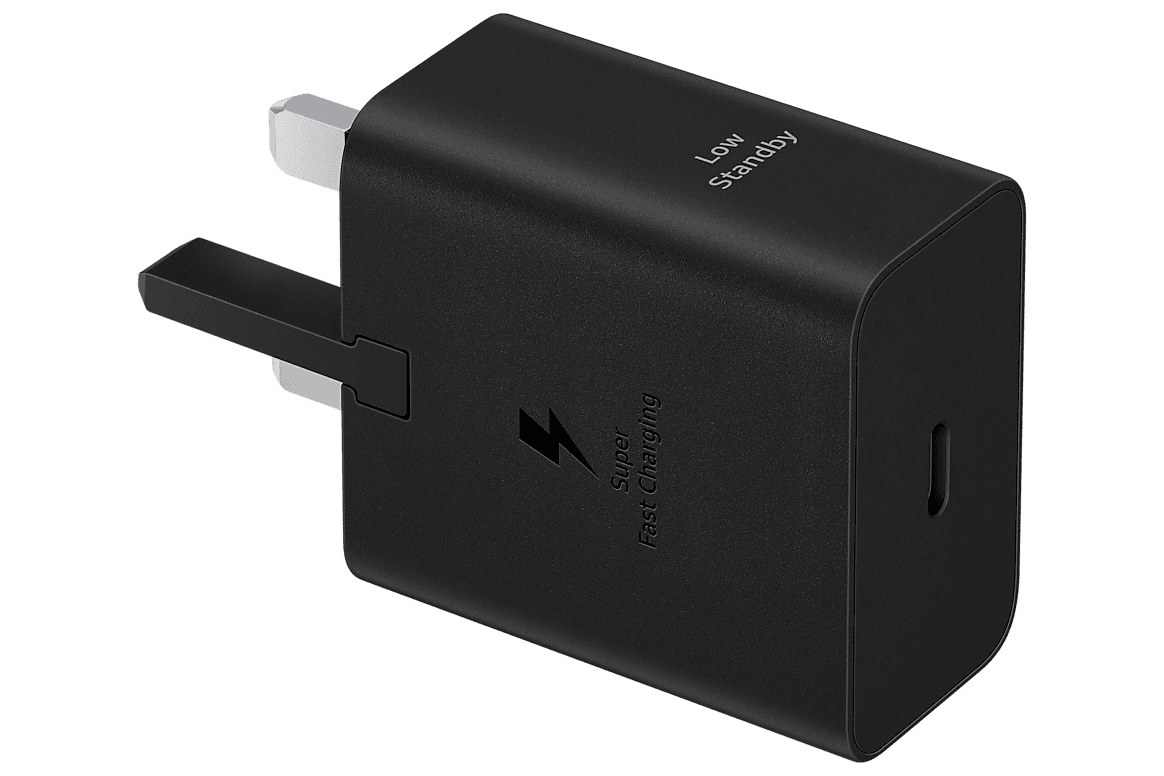
Samsung Galaxy: Samsung says Super Fast Charging needs a 25W or 45W Samsung-approved adapter, and its UK support page adds that 45W charging needs a 5A e-marked cable.
In every case, the charger must support USB PD. An old USB-A cube won't fast-charge a modern phone.
Laptops, and is a bigger charger safe?
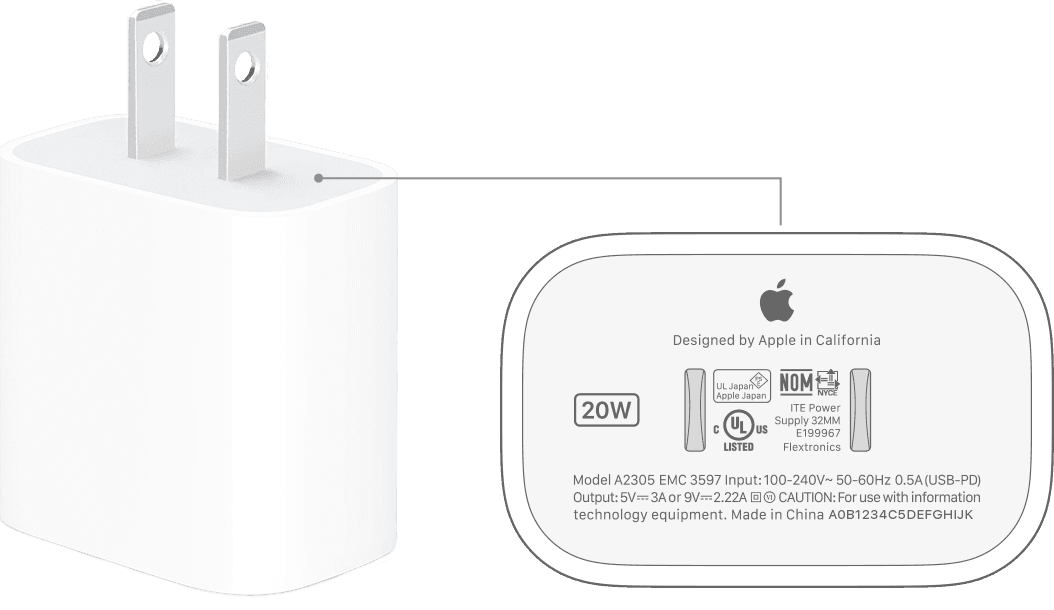
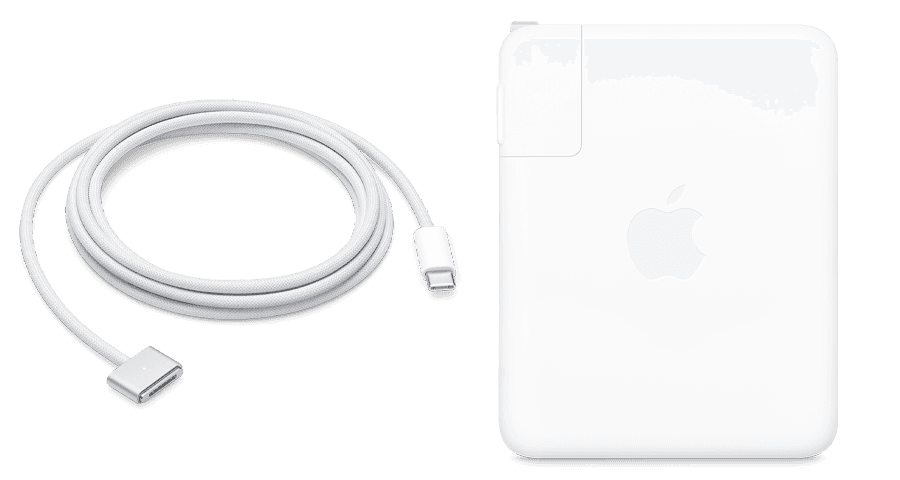
MacBooks: Apple says you can charge a Mac laptop with any USB-C power adapter or display that supports USB PD, even if it provides more or less wattage than the one recommended for your Mac. For the best experience, use at least the recommended wattage. Apple's recommendations range from 30W or 35W for a 13-inch MacBook Air up to 140W for the 16-inch MacBook Pro. You can check what's being delivered by holding Option, clicking the Apple menu, choosing System Information, then Power.
Is a higher-watt charger safe for my phone? Yes, with a certified charger. Samsung says its phones automatically choose the best supported charging speed when plugged into a higher-rated charger, and USB-IF says PD lets each device take only the power it needs. So one good 65W or 100W charger can safely top up your phone, tablet and laptop.
The bigger risk is cheap, uncertified chargers. Apple warns that adapters that don't meet safety standards could pose a risk of injury. Buy from reputable brands, and look for USB-IF certification where it's listed.
Frequently asked questions
What is USB Power Delivery?
+
A charging standard that lets a charger and device agree on how much power to send over USB-C, up to 240W under PD 3.1.
Do I need a special cable for fast charging?
+
For phones, a standard 3A USB-C cable (up to 60W) is usually fine. Above 60W, you need a 5A e-marked cable.
Can I charge my phone with a laptop charger?
+
Yes, with a USB PD charger. Samsung says phones automatically choose the best supported speed from a higher-rated charger.
What is PPS charging?
+
Programmable Power Supply, part of USB PD. Samsung says it adjusts voltage and current in real time. Pixel and Galaxy phones use it for fast charging.
Sources
- USB-IF: USB Charger (USB Power Delivery)
- USB-IF: USB Type-C cable logo guidelines (PDF)
- USB-IF: USB Type-C specification R2.0 (PDF)
- Apple: Fast charge your iPhone
- Apple: If your iPhone charges slowly
- Apple: Power adapters for Mac laptops
- Apple: About Apple USB power adapters
- Google: Pixel tech specs
- Samsung: Super fast charging
Editor-in-Chief
Rahul has been writing about gadgets and software since 2013, first at Thetechhacker and now at Man Made Things. He edits every review on the site and signs off on every verdict.
More from Rahul →