The Best Portable Chargers and Power Banks: For Phones, Laptops and iPhone
Three Anker power banks for everyday carry, charging a laptop and snapping onto an iPhone, plus the FAA rules for flying with one.
We may earn a commission when you buy through links on this page. Learn more
Quick answer
The Anker Nano Power Bank (10,000mAh, 30W, $49.99) is the best power bank for most people because it has a built-in USB-C cable and fits in a pocket. For laptops, the Anker Prime 26K (300W, $229.99) can charge two at once and is just under the FAA's 100Wh carry-on limit. For iPhone, the Anker MagGo 2 Pro ($109.99) snaps on magnetically and charges at up to 25W.
A dead phone at the airport gate, the battery icon going red halfway through a concert, a laptop dying ten minutes before a deadline. We've all been there, and a decent power bank fixes all of it.
The problem is that power banks are a mess of numbers. mAh, watts, PD, Qi2, Wh. Most people buy the biggest number they can find and end up carrying a brick that charges slowly anyway.
So I picked three for three different jobs: an everyday pocket charger, a laptop charger and a magnetic one for iPhone. All three happen to be from Anker, which simply has the strongest lineup in each category right now. I checked every spec and price on Anker's US site, and checked each model against Anker's and the CPSC's recall lists. None of the three were listed. These are research-based picks, so no star scores yet. Let's get into it.
Our picks at a glance
1. Best everyday power bank
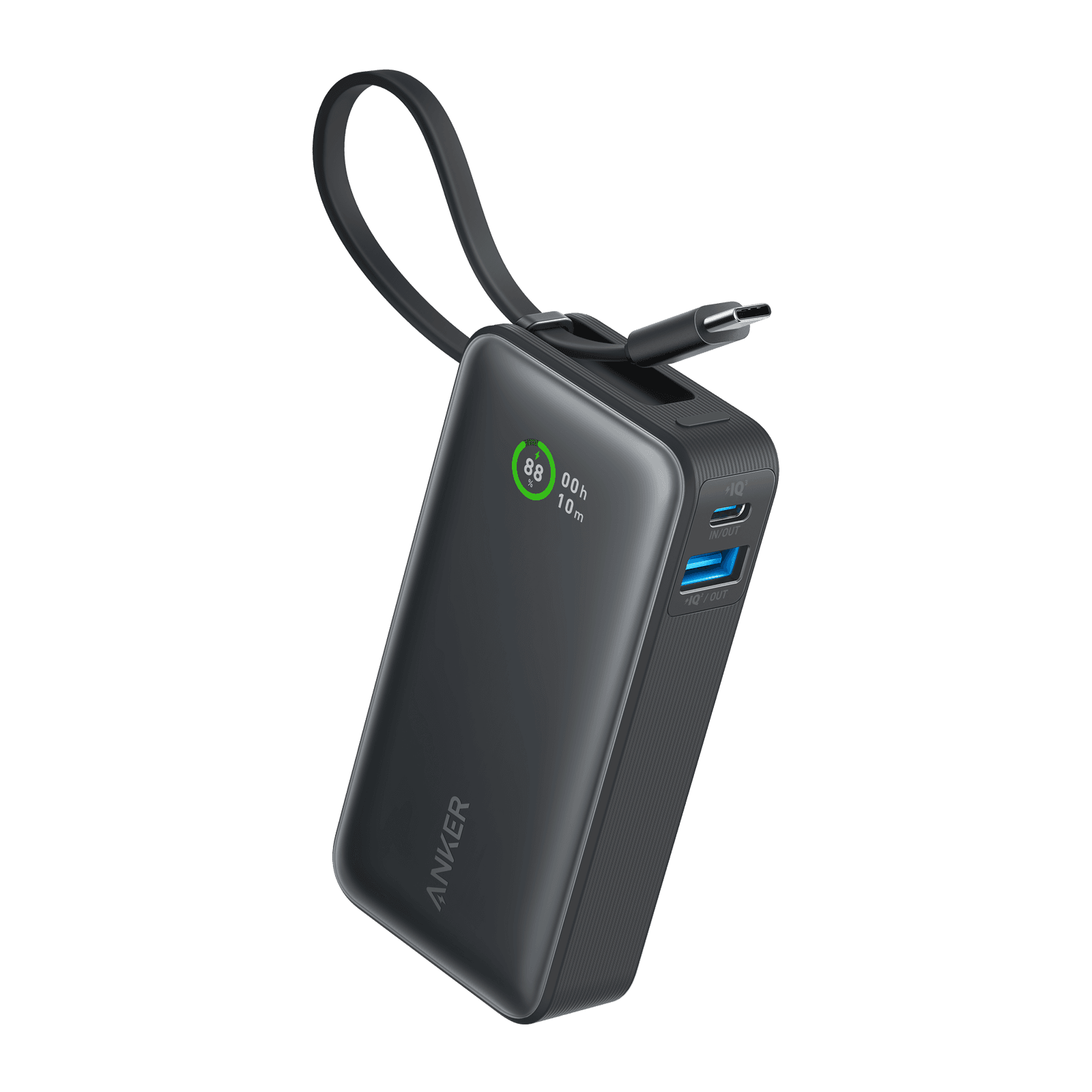
Anker Nano Power Bank (10K, 30W, Built-In USB-C Cable)
The best thing about this power bank is the cable you can't forget. A USB-C cable is built right into the body and loops back as a carry strap, so it's always there when you need it.
At 10,000mAh, it's enough for one to two full phone charges depending on your phone's battery, and it fits in a jacket pocket at about 7.6 ounces. The built-in cable and the USB-C port each deliver up to 30W, which fast-charges a phone and can even top up a small laptop or tablet. There's also a USB-A port for older cables.
The catch: when you use several ports at once, total output drops to about 24W. And it's been around since about 2023, so it's not the newest model. It's still the one I'd carry every day.
Pros
- 01Built-in USB-C cable that's always with you
- 02Up to 30 W fast charging
- 03Pocket-sized at about 7.6 oz
- 04Display shows exact battery level
Cons
- 01Total output drops to about 24 W across multiple ports
- 02Not enough for a full laptop charge
| Capacity | 10,000 mAh |
|---|---|
| Ports | Built-in USB-C cable, 1 USB-C, 1 USB-A |
| Max output | 30 W from one port; about 24 W total when sharing |
| USB-A output | Up to 22.5 W |
| Recharge | 30 W input, about 50% in 45 min |
| Weight | 7.58 oz (215 g) |
| Size | 4.09 × 2.06 × 1.02 in |
| Extras | Color display, cable doubles as a carry handle |
2. Best for laptops
Anker Prime Power Bank (26K, 300W)
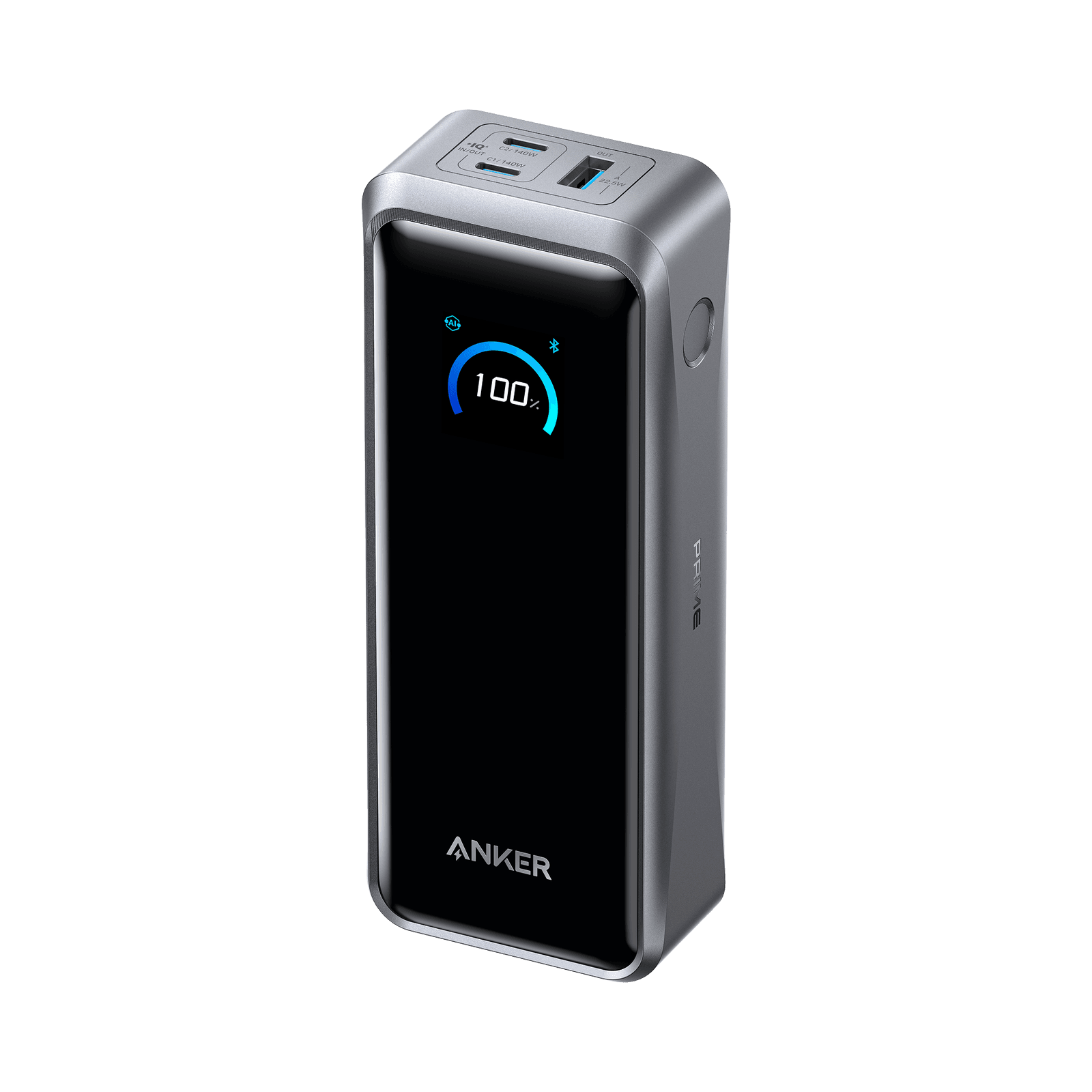
If you need to charge a laptop away from an outlet, this is the one. Each USB-C port puts out up to 140W, with 300W total, so it can charge two laptops at full speed at the same time. Anker says it charges a MacBook Pro with an M4 Pro chip to 50% in about 27 minutes, with a 5A cable.
The capacity is chosen carefully. At 99.75Wh, it sits just under the FAA's 100Wh limit for carry-on batteries, so you can fly with it without asking the airline. That's not an accident, and it matters if you travel for work.
It's big and heavy at 600g, and it's not cheap. Anker also notes that usable output is lower than the 26,250mAh on the label, because some energy is lost converting voltage, which is true of every power bank. But for working from airports and coffee shops, nothing else here comes close.
Pros
- 01Up to 140 W per port, 300 W total
- 02Charges two laptops at once
- 0399.75 Wh, under the FAA carry-on limit
- 04Recharges very quickly with two chargers
Cons
- 01Heavy at 600 g
- 02Expensive at $229.99
- 03Fastest recharge needs two 140 W chargers and 5 A cables
| Capacity | 26,250 mAh (99.75 Wh) |
|---|---|
| Ports | 2 USB-C, 1 USB-A |
| Max output | 300 W total, 140 W per USB-C port |
| Recharge | Up to 250 W with two 140 W chargers; 50% in about 13 min |
| Weight | 1.32 lb (600 g) |
| Size | 6.3 × 1.5 × 2.5 in |
| Extras | Smart display, app control over Bluetooth |
3. Best for iPhone
Anker MagGo 2 Pro Magnetic Power Bank (10K, Qi2 25W)
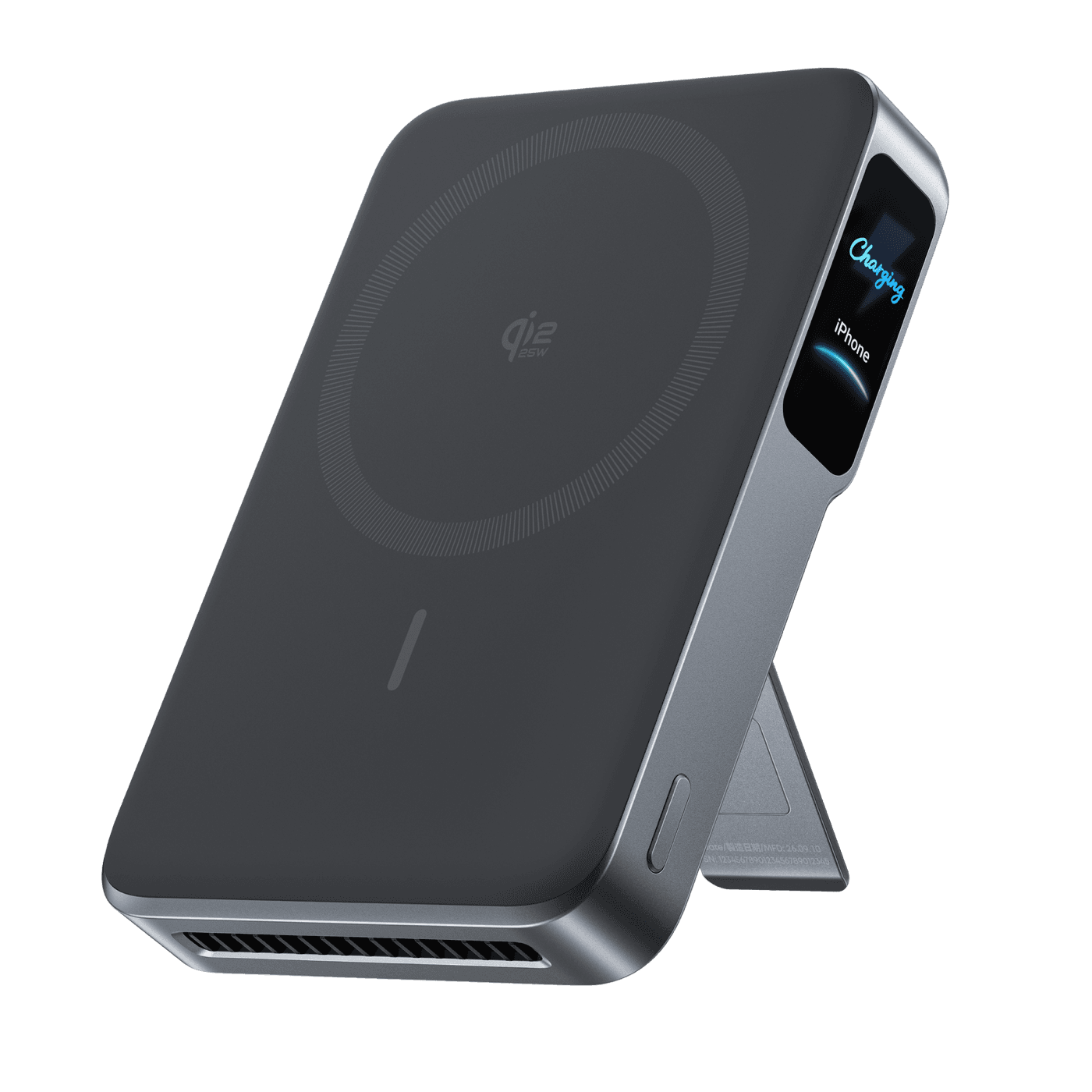
This one snaps onto the back of an iPhone with MagSafe-compatible magnets, so there's no cable at all. It uses the newer Qi2.2 standard to charge at up to 25W on iPhone 16, 17 and 18 models. Anker says it gets an iPhone 17 Pro to 50% in about 25 minutes.
Wireless charging makes heat, and heat slows charging down. Anker's fix is a small built-in fan to keep things cool. There's a Silent Mode that turns the fan off if the noise bugs you. A fold-out stand turns your phone into a little screen for video calls or movies.
It's pricier than plain power banks, and the 25W speed only works on recent iPhones. If you want something cheaper and slimmer, Anker's 15W MagGo models cost less.
Pros
- 01Snaps on magnetically, no cable needed
- 02Up to 25 W wireless on recent iPhones
- 03Built-in stand
- 04Fan keeps charging fast and cool
Cons
- 0125 W only works on iPhone 16 and newer
- 02Fan adds some noise unless you use Silent Mode
- 03More expensive than wired power banks
| Capacity | 10,000 mAh |
|---|---|
| Wireless | Qi2.2 up to 25 W on iPhone 16, 17 and 18; 15 W on Android Qi2 phones |
| Wired | 1 USB-C, 45 W in and out |
| Recharge | About 80% in 52 min with a 45 W cable |
| Weight | 7.7 oz |
| Size | 2.79 × 4.14 × 0.7 in |
| Extras | Built-in stand, display, cooling fan with silent mode |
mAh vs Wh: how much power do you actually get?
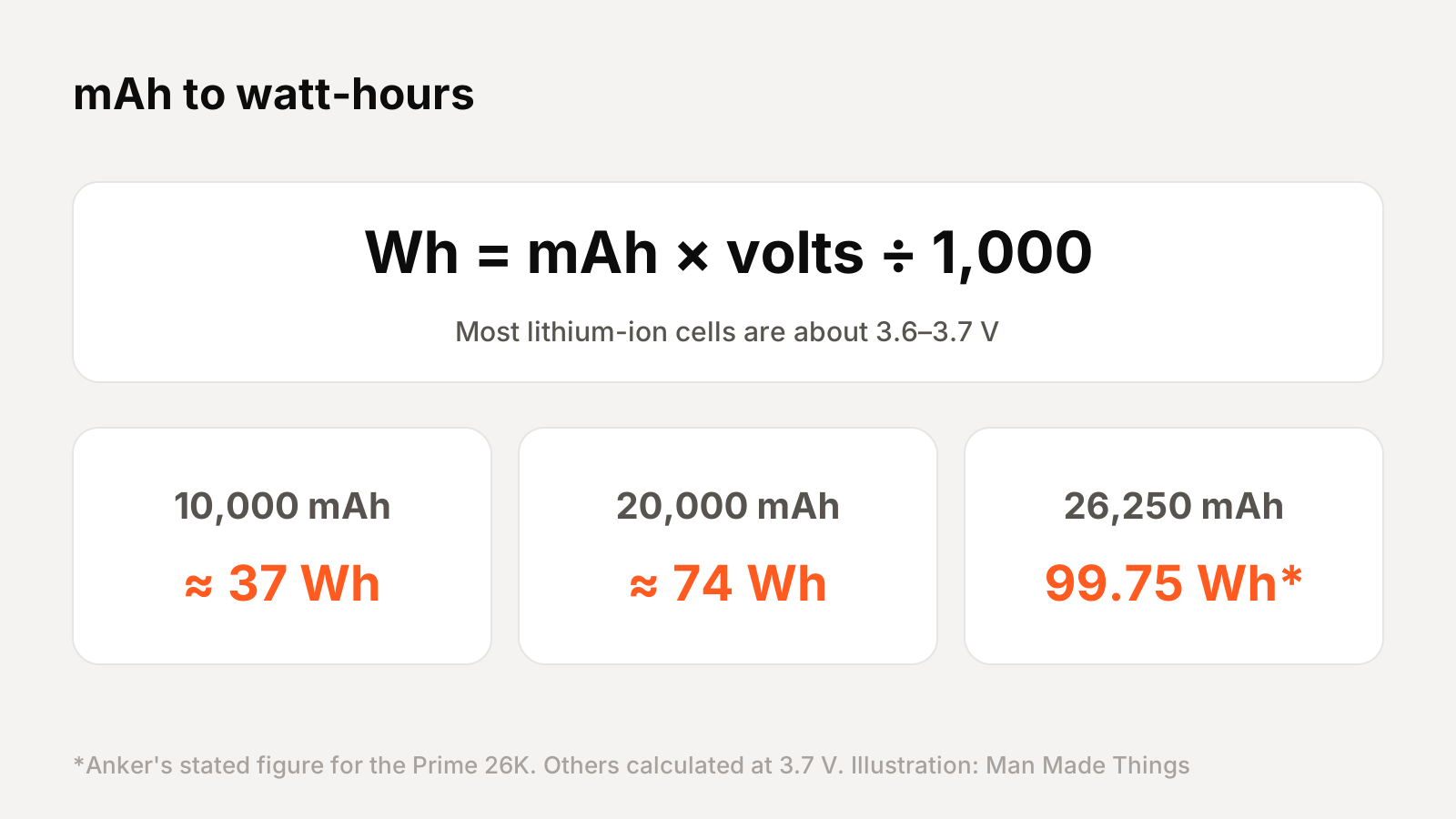
Power banks are usually sold by mAh (milliamp-hours), but that number alone is misleading because it ignores voltage. The more useful number is Wh (watt-hours).
The formula is simple: Wh = mAh × voltage ÷ 1,000. Most lithium-ion cells run at about 3.6 to 3.7 volts. So a 10,000mAh power bank is roughly 36 to 37Wh.
You'll never get the full label capacity into your phone, because some energy is lost converting the battery's voltage to the voltage your phone needs. Anker, for example, says its 26,250mAh Prime delivers closer to 15,200mAh of usable output. That's normal for every brand.
Flying with a power bank: the FAA rules
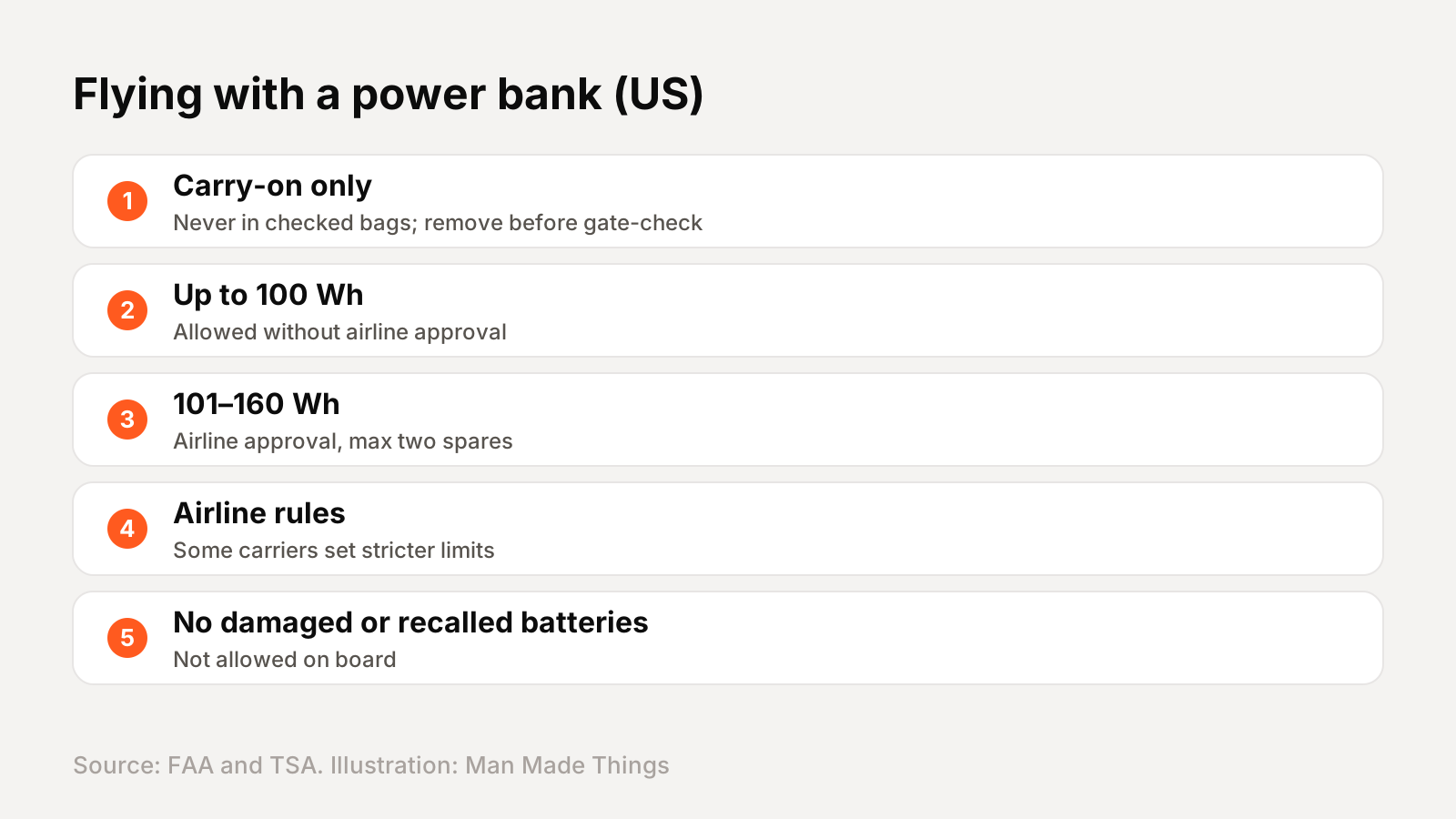
Power banks have strict rules on US flights, and getting them wrong can mean losing your charger at security.
- Carry-on only. The FAA and TSA say power banks must go in your carry-on bag, never in checked luggage. If your bag gets gate-checked, take the power bank out first.
- 100Wh limit. Lithium-ion batteries up to 100Wh are allowed without approval.
- 101–160Wh needs airline approval, and you can carry no more than two of those spare batteries.
- Airlines can be stricter. Some limit how many power banks you bring or ban using them in flight. Check with your airline.
- No damaged or recalled batteries. The FAA says these must not be carried on board.
All three picks here are under 100Wh, so they're fine for carry-on.
Not sure about your own power bank? Look for the Wh rating printed on the case or in the manual. If you only see mAh, use the formula above. And if a power bank is swollen, cracked or gets unusually hot, stop using it and recycle it properly. Don't take it on a plane.
Frequently asked questions
What is the best power bank for most people?
+
The Anker Nano Power Bank (10K, 30W) with a built-in USB-C cable. It costs $49.99, charges at up to 30W and fits in a pocket.
Can I take a power bank on a plane?
+
Yes, in your carry-on only. The FAA allows lithium-ion batteries up to 100Wh without approval, and up to two spares of 101–160Wh with airline approval.
How do I convert mAh to Wh?
+
Multiply mAh by the battery voltage and divide by 1,000. At a typical 3.7V, 10,000mAh is about 37Wh.
Can a power bank charge a laptop?
+
Yes, if it supports USB-C Power Delivery at enough wattage. The Anker Prime 26K delivers up to 140W per USB-C port, enough for most laptops.
Sources
Editor-in-Chief
Rahul has been writing about gadgets and software since 2013, first at Thetechhacker and now at Man Made Things. He edits every review on the site and signs off on every verdict.
More from Rahul →