IPA Styles Explained: English, American, Hazy, Double and Everything in Between
The differences between English IPA, American IPA, Hazy IPA, Double IPA and specialty IPAs like Black, Rye, White and Brut, with official alcohol, bitterness and color ranges from the BJCP 2021 Style Guidelines.
We may earn a commission when you buy through links on this page. Learn more
Quick answer
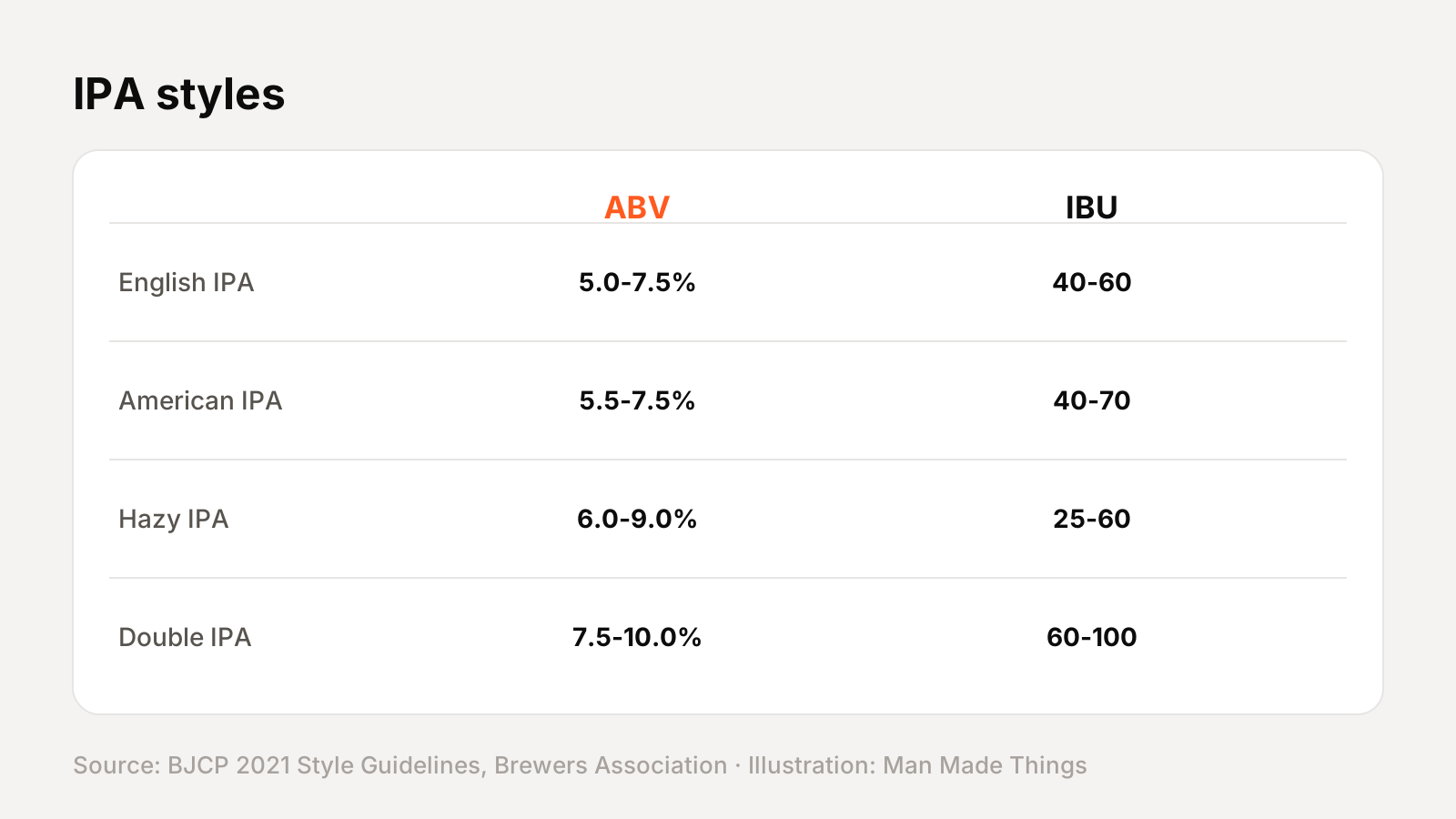
IPA (India Pale Ale) is a family of hop-forward beers. The BJCP 2021 guidelines define English IPA (5.0–7.5% ABV, 40–60 IBU), American IPA (5.5–7.5%, 40–70 IBU, the classic bitter 'West Coast' style), Hazy IPA (6.0–9.0%, 25–60 IBU, fruity, soft and cloudy) and Double IPA (7.5–10.0%, 60–100 IBU), plus specialty IPAs such as Black, Brown, Red, Rye, White, Belgian and Brut.
Walk into any bottle shop and the IPA shelf is the biggest one: West Coast, hazy, juicy, double, triple, session, black, brut. It's easy to assume these are marketing labels, but most of them map to defined styles.
The most widely used definitions come from the Beer Judge Certification Program (BJCP), whose 2021 Style Guidelines are used to judge homebrew and many commercial competitions. Each style comes with "vital statistics": gravity, bitterness (IBU), color (SRM) and alcohol (ABV).
Below is a plain-English guide to every IPA style in the BJCP 2021 guidelines, with the official numbers. New to beer styles? Start with ale vs lager.
How to read the numbers
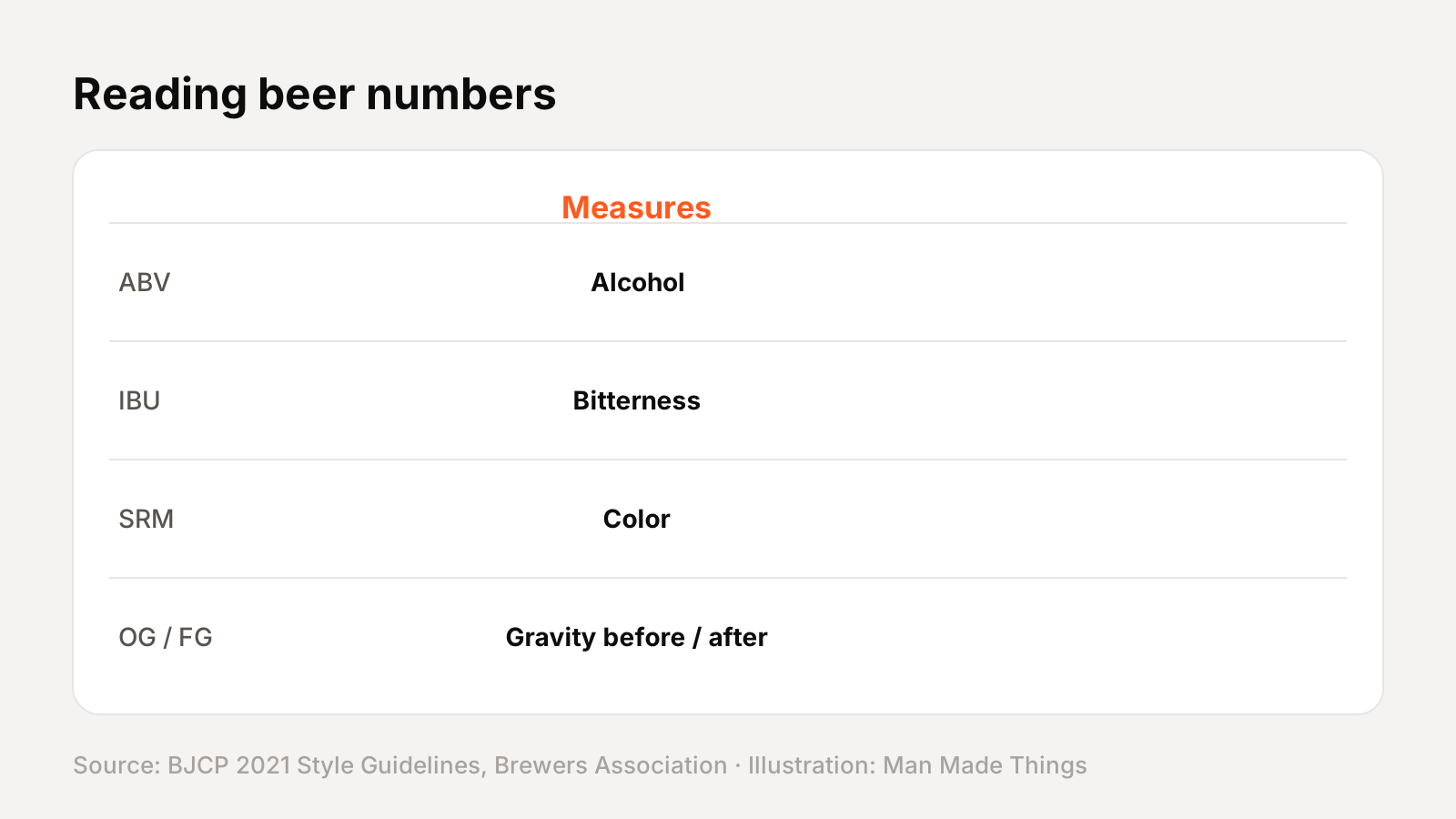
| Measure | What it means |
|---|---|
| ABV | Alcohol by volume |
| IBU | International Bitterness Units, a measure of bitterness from hops; higher means more bitter |
| SRM | Standard Reference Method, a color scale; lower is paler, higher is darker |
| OG | Original gravity, the sugar content before fermentation |
| FG | Final gravity, what's left after fermentation; lower usually means drier |
IBU is a lab measurement, not a taste score: a sweeter, fuller beer can taste less bitter than a dry one with the same IBU.
English IPA: where it started
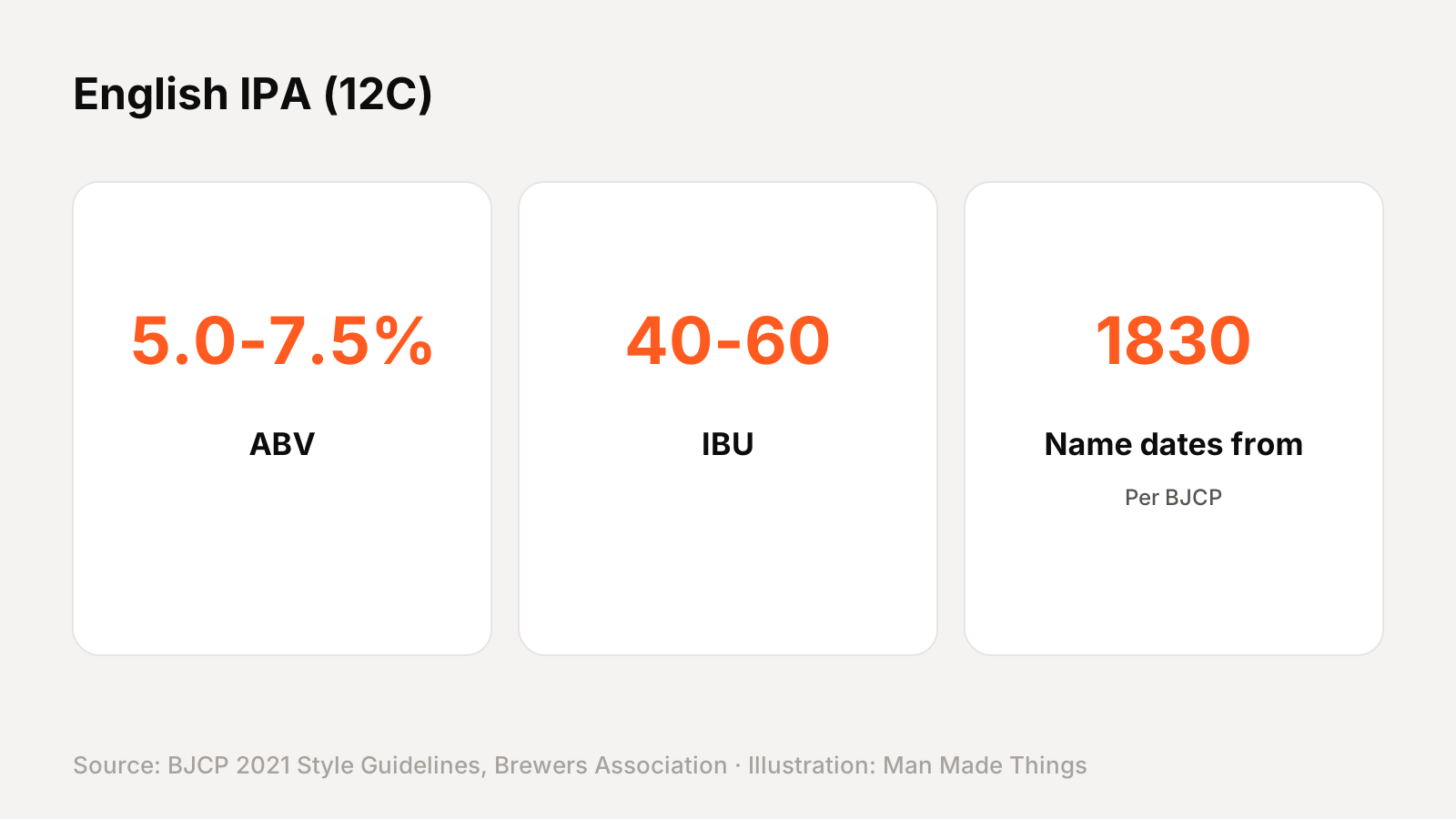
The BJCP describes English IPA (style 12C) as "a bitter, moderately-strong, very well-attenuated pale British ale with a dry finish and a hoppy aroma and flavor."
Vital statistics: OG 1.050–1.070, FG 1.010–1.015, IBU 40–60, SRM 6–14, ABV 5.0–7.5%.
History, per the BJCP: the style began as a London pale stock ale shipped to India in the late 1700s. George Hodgson of the Bow Brewery was an early dominant seller but "did not invent" it. Allsopp reformulated it in Burton in 1823, and the name "India Pale Ale" dates from around 1830.
American IPA: the classic, bitter 'West Coast' style
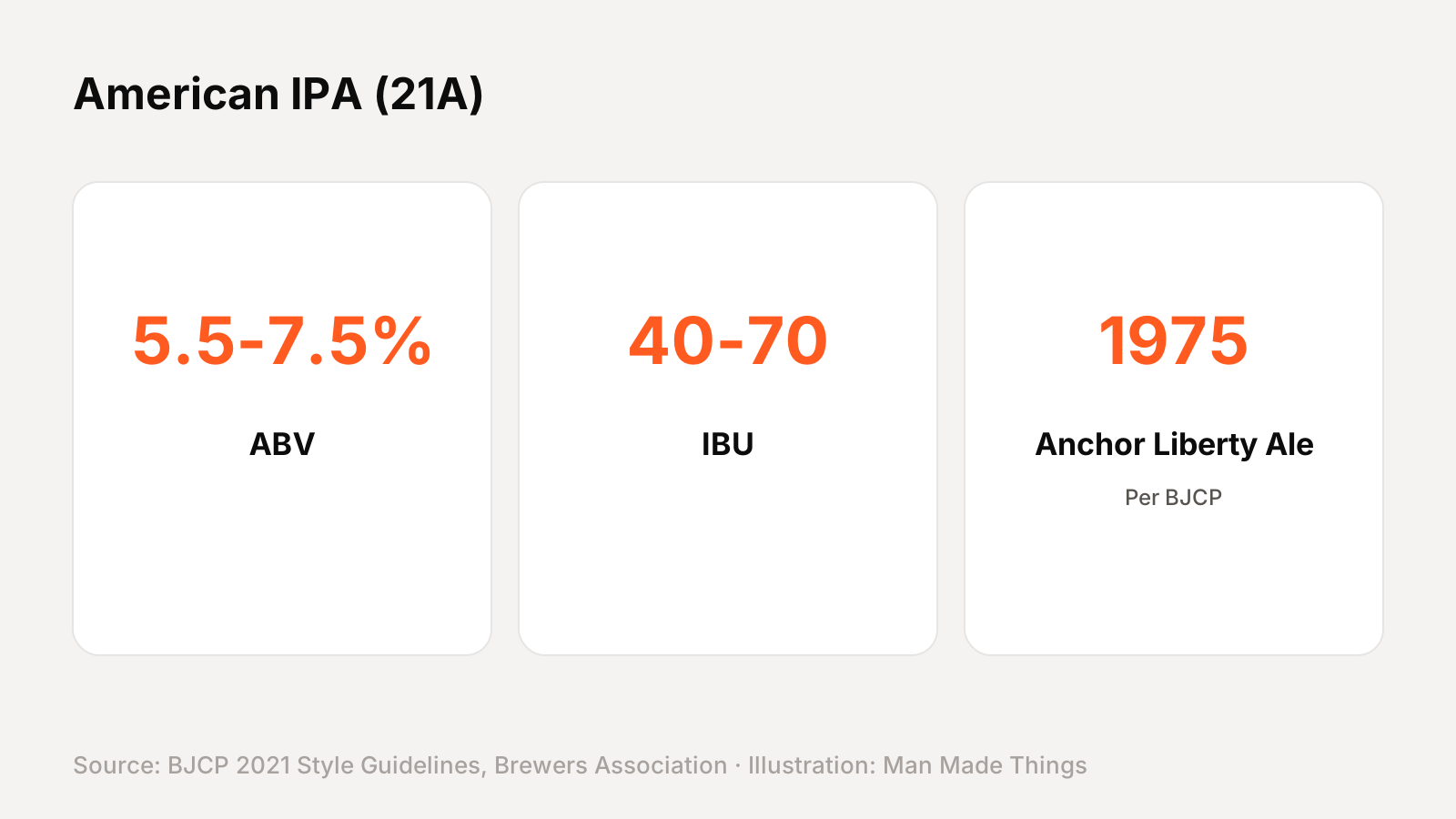
The BJCP calls American IPA (21A) "a decidedly hoppy and bitter, moderately strong, pale American ale." It's what many brewers and drinkers call a "West Coast IPA," though that name isn't a separate BJCP category.
Vital statistics: OG 1.056–1.070, FG 1.008–1.014, IBU 40–70, SRM 6–14, ABV 5.5–7.5%.
History: the BJCP says the first modern American craft version "is generally believed to be Anchor Liberty Ale, first brewed in 1975."
An example: Stone IPA, first released on August 16, 1997, is listed by Stone at 6.9% ABV and 71 IBU.
Hazy IPA: soft, fruity and cloudy
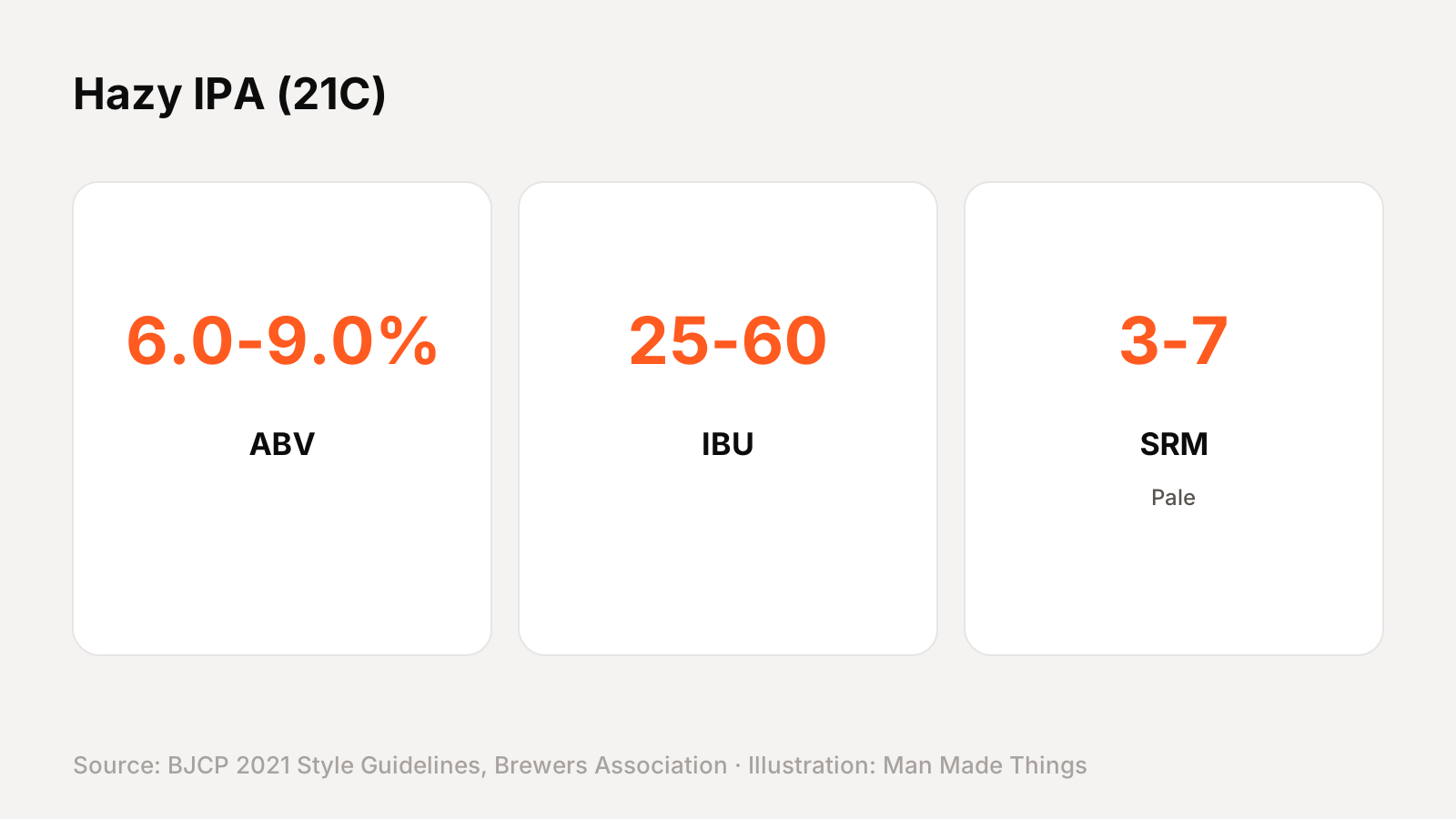
The BJCP describes Hazy IPA (21C) as "an American IPA with intense fruit flavors and aromas, a soft body, smooth mouthfeel, and often opaque with substantial haze." It says the style originated "in the New England region of the United States," which is why it's often called a New England IPA (NEIPA).
Vital statistics: OG 1.060–1.085, FG 1.010–1.015, IBU 25–60, SRM 3–7, ABV 6.0–9.0%.
Notice the lower bitterness floor than American IPA: hazy IPAs lean on hop aroma and fruit rather than bitterness. The Brewers Association guidelines, which call it "Juicy or Hazy India Pale Ale," describe "high to very high hop aroma and flavor" with bitterness that is "low to medium" and "soft and well-integrated," and note that grists may include oats or wheat. They also say "a juicy character is not required," and that haze can vary from very low to very high.
Double IPA: stronger and more bitter
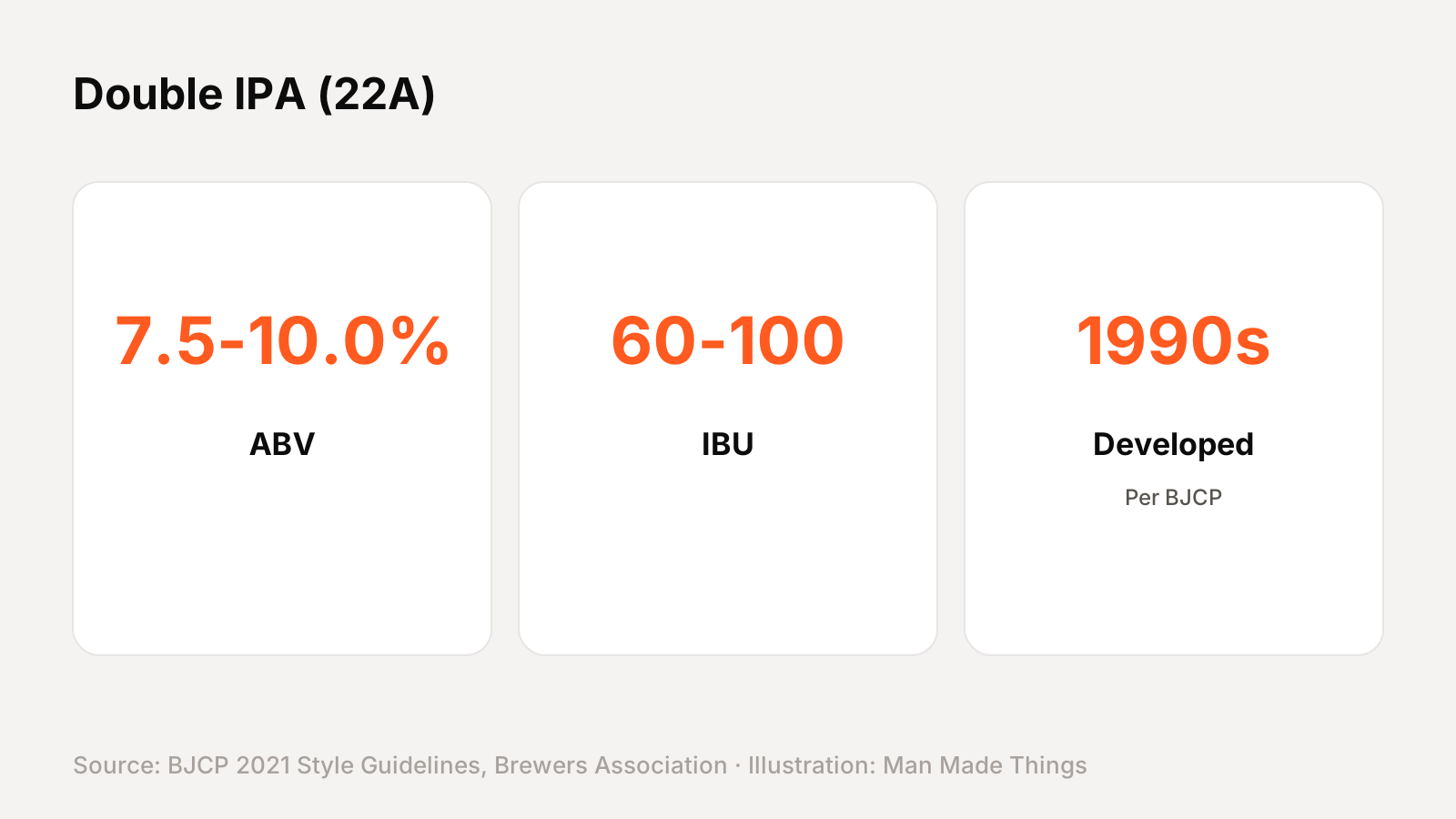
The BJCP describes Double IPA (22A) as "an intensely hoppy, fairly strong, bitter pale ale without the big, rich, complex maltiness" of an American barleywine. It says the style was "first developed in the mid-late 1990s."
Vital statistics: OG 1.065–1.085, FG 1.008–1.018, IBU 60–100, SRM 6–14, ABV 7.5–10.0%.
An example: Russian River's Pliny the Elder, listed by the BJCP as a classic Double IPA, is 8.0% ABV according to the brewery, which says the recipe came out of a Double IPA festival in 2000.
Specialty IPAs: Black, Brown, Red, Rye, White, Belgian and Brut
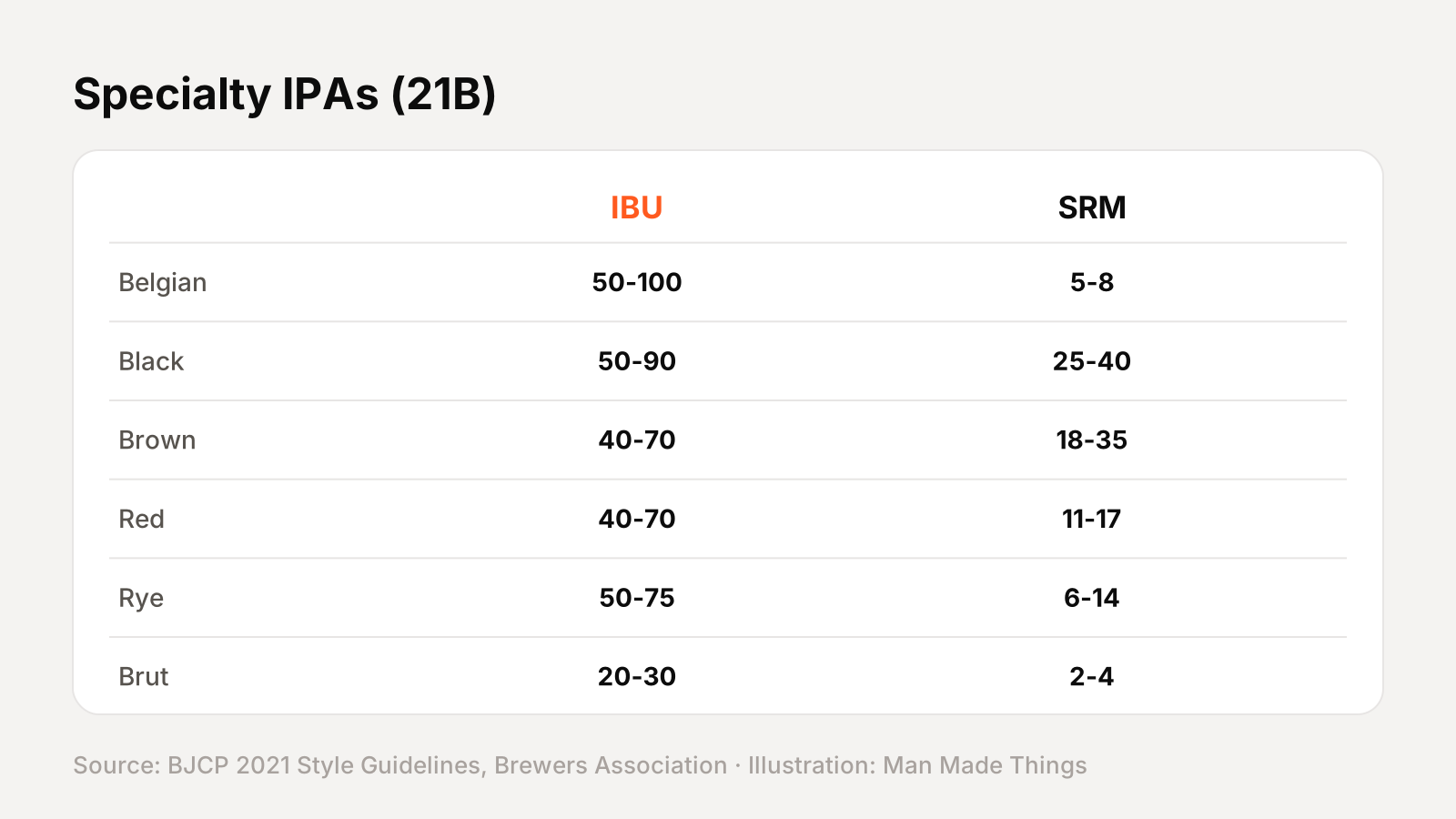
The BJCP's Specialty IPA (21B) covers beers "recognizable as an IPA by balance – a hop-forward, bitter, dryish beer – with something else present." They can be brewed at session (3.0–5.0%), standard (5.0–7.5%) or double (7.5–10.0%) strength.
| Type | IBU | SRM (color) | ABV | What's different |
|---|---|---|---|---|
| Belgian IPA | 50–100 | 5–8 | 6.2–9.5% | Fruity, spicy Belgian yeast |
| Black IPA | 50–90 | 25–40 | 5.5–9.0% | Dark, but "not a strongly roasted or burnt character" |
| Brown IPA | 40–70 | 18–35 | 5.5–7.5% | Caramel, chocolate, toffee or dark fruit |
| Red IPA | 40–70 | 11–17 | 5.5–7.5% | Caramel, toffee or fruit, like an American Amber |
| Rye IPA | 50–75 | 6–14 | 5.5–8.0% | "Spicy, grainy rye malt" |
| White IPA | 40–70 | 5–6 | 5.5–7.0% | Witbier-style yeast or spices |
| Brut IPA | 20–30 | 2–4 | 6.0–7.5% | "Bone-dry finish, very high carbonation," like sparkling white wine |
All IPA styles at a glance
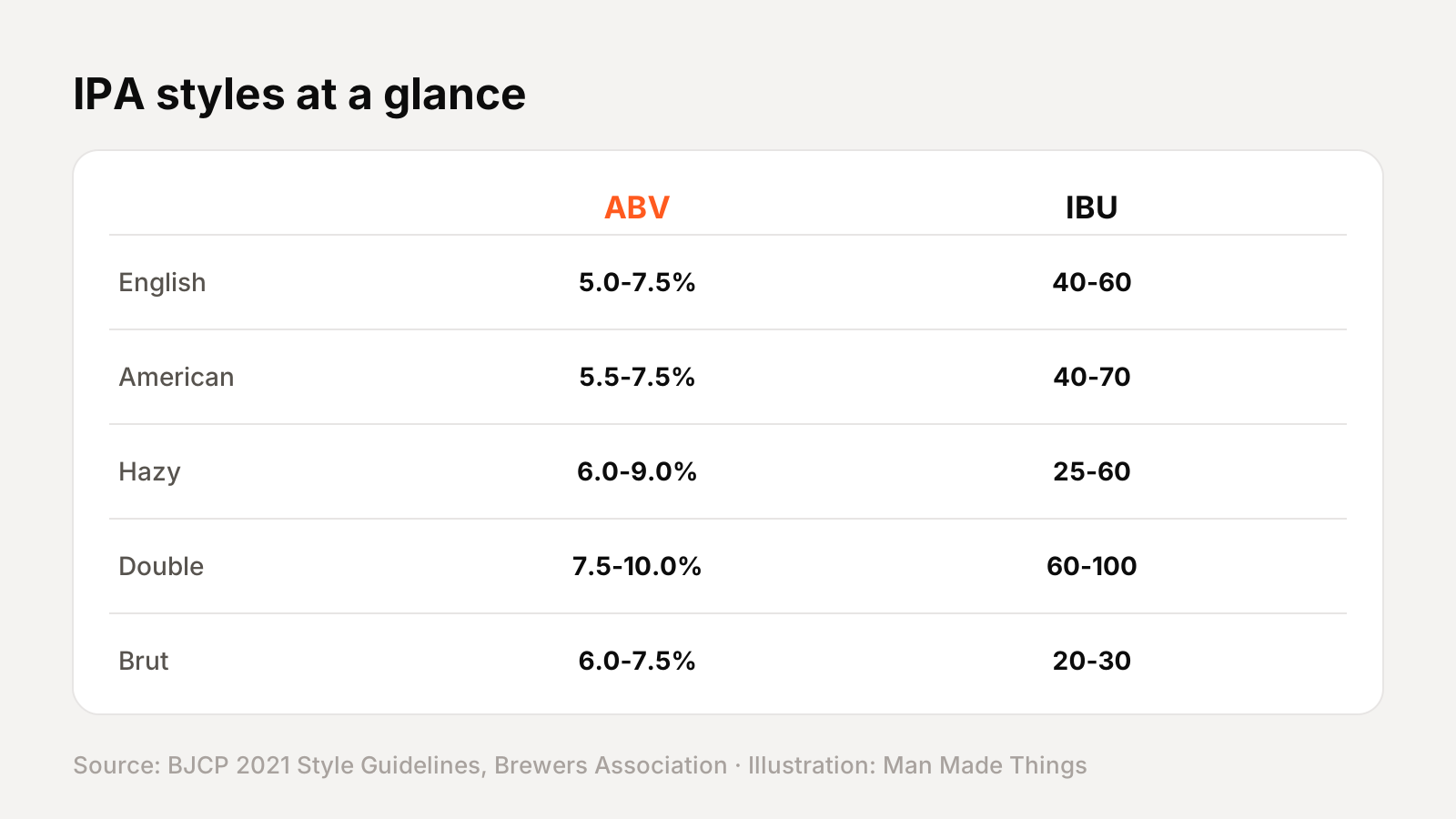
| Style | ABV | IBU | Color (SRM) | In one line |
|---|---|---|---|---|
| English IPA | 5.0–7.5% | 40–60 | 6–14 | Bitter, dry, British |
| American IPA | 5.5–7.5% | 40–70 | 6–14 | Hoppy and bitter |
| Hazy IPA | 6.0–9.0% | 25–60 | 3–7 | Fruity, soft, cloudy |
| Double IPA | 7.5–10.0% | 60–100 | 6–14 | Stronger and hoppier |
| Brut IPA | 6.0–7.5% | 20–30 | 2–4 | Bone-dry, champagne-like |
All figures from the BJCP 2021 Style Guidelines. Serving IPAs? Our best beer glasses guide covers IPA-specific glassware.
Frequently asked questions
What's the difference between a West Coast IPA and a hazy IPA?
+
West Coast usually refers to the BJCP's American IPA: clear, bitter (40–70 IBU) and hoppy. Hazy IPA is fruitier, softer, often cloudy and usually less bitter (25–60 IBU).
How strong is a double IPA?
+
The BJCP range is 7.5–10.0% ABV with 60–100 IBU.
Where did the IPA come from?
+
According to the BJCP, it began as a London pale stock ale shipped to India in the late 1700s; the name India Pale Ale dates from around 1830.
Sources
Editor-in-Chief
Rahul has been writing about gadgets and software since 2013, first at Thetechhacker and now at Man Made Things. He edits every review on the site and signs off on every verdict.
More from Rahul →