2026 Hyundai Ioniq 9: Every Trim's Price, Range, Charging and Specs
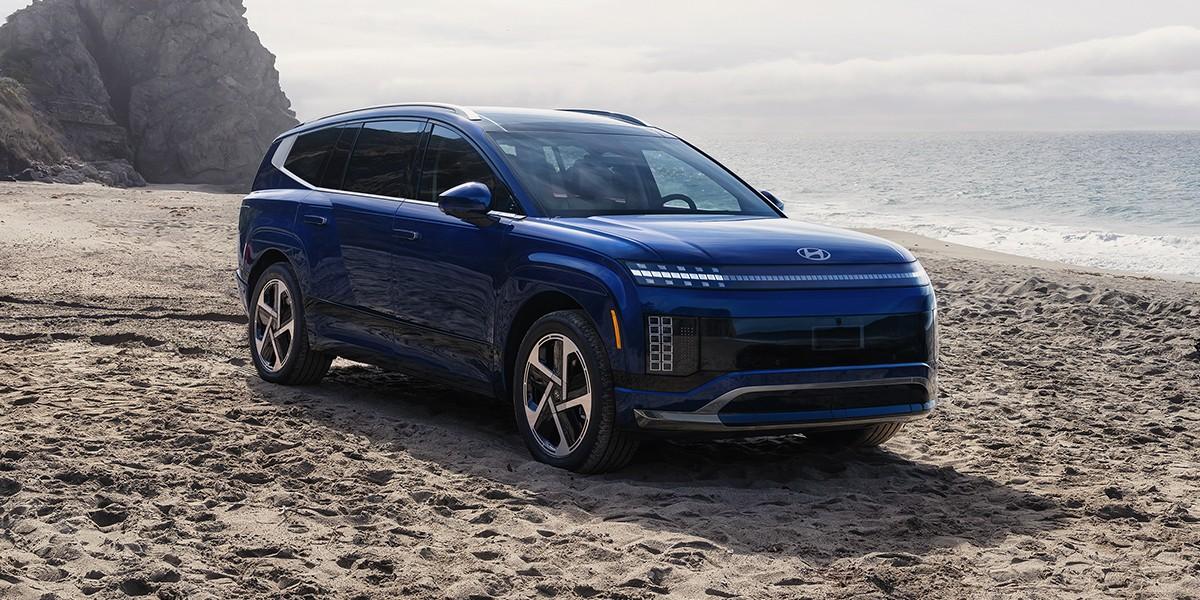
The 2026 Hyundai Ioniq 9 three-row electric SUV explained from Hyundai's official specs and EPA data: six trims from $58,955 to $76,490, up to 335 miles of range, a 110.3 kWh battery, native NACS, 10–80% in 24 minutes, 5,000 lb towing and 86.9 cu ft of cargo.
We may earn a commission when you buy through links on this page. Learn more
Quick answer
The 2026 Hyundai Ioniq 9 is a three-row electric SUV from $58,955 (S, before freight) to $76,490 (Calligraphy Design). Every trim uses a 110.3 kWh battery. EPA range is 335 miles for the RWD S, 320 miles for the 303 hp AWD SE and SEL, and 311 miles for the 422 hp AWD Limited and Calligraphy. It has a native NACS port, charges 10–80% in 24 minutes at 350 kW, tows up to 5,000 lb and offers up to 86.9 cu ft of cargo.
The Ioniq 9 is Hyundai's biggest electric vehicle: a three-row SUV with a huge 110.3 kWh battery, the largest in its class we've covered, and up to 335 miles of EPA-rated range. It shares much of its engineering with the Kia EV9, but the two differ in price, range and space.
Every number here comes from Hyundai's official US specs and pricing, with efficiency from the EPA's fueleconomy.gov. Prices exclude freight. For a comparison with its Kia cousin, see our Kia EV9 specs.
Below you'll find every trim's price, power and range, Hyundai's official charging times, cargo and towing figures, the warranty, and a simple price-per-mile comparison that shows which trim gives you the most range for your money.
Trims and prices
| Trim | Price | Drive | Power / torque | EPA range | Seats |
|---|---|---|---|---|---|
| S | $58,955 | RWD | 215 hp / 258 lb-ft | 335 mi | 7 |
| SE | $62,765 | AWD | 303 hp / 446 lb-ft | 320 mi | 7 |
| SEL | $66,320 | AWD | 303 hp / 446 lb-ft | 320 mi | 7 |
| Limited | $71,250 | AWD | 422 hp / 516 lb-ft | 311 mi | 6 |
| Calligraphy | $74,990 | AWD | 422 hp / 516 lb-ft | 311 mi | 6 |
| Calligraphy Design | $76,490 | AWD | 422 hp / 516 lb-ft | 311 mi | 6 |
All trims share the same 110.3 kWh battery. Hyundai doesn't publish 0–60 times.
The sweet spots: the S gives you the most range for the least money. The SE adds AWD and 5,000 lb towing for about $3,800 more, losing just 15 miles of range.
Range and efficiency
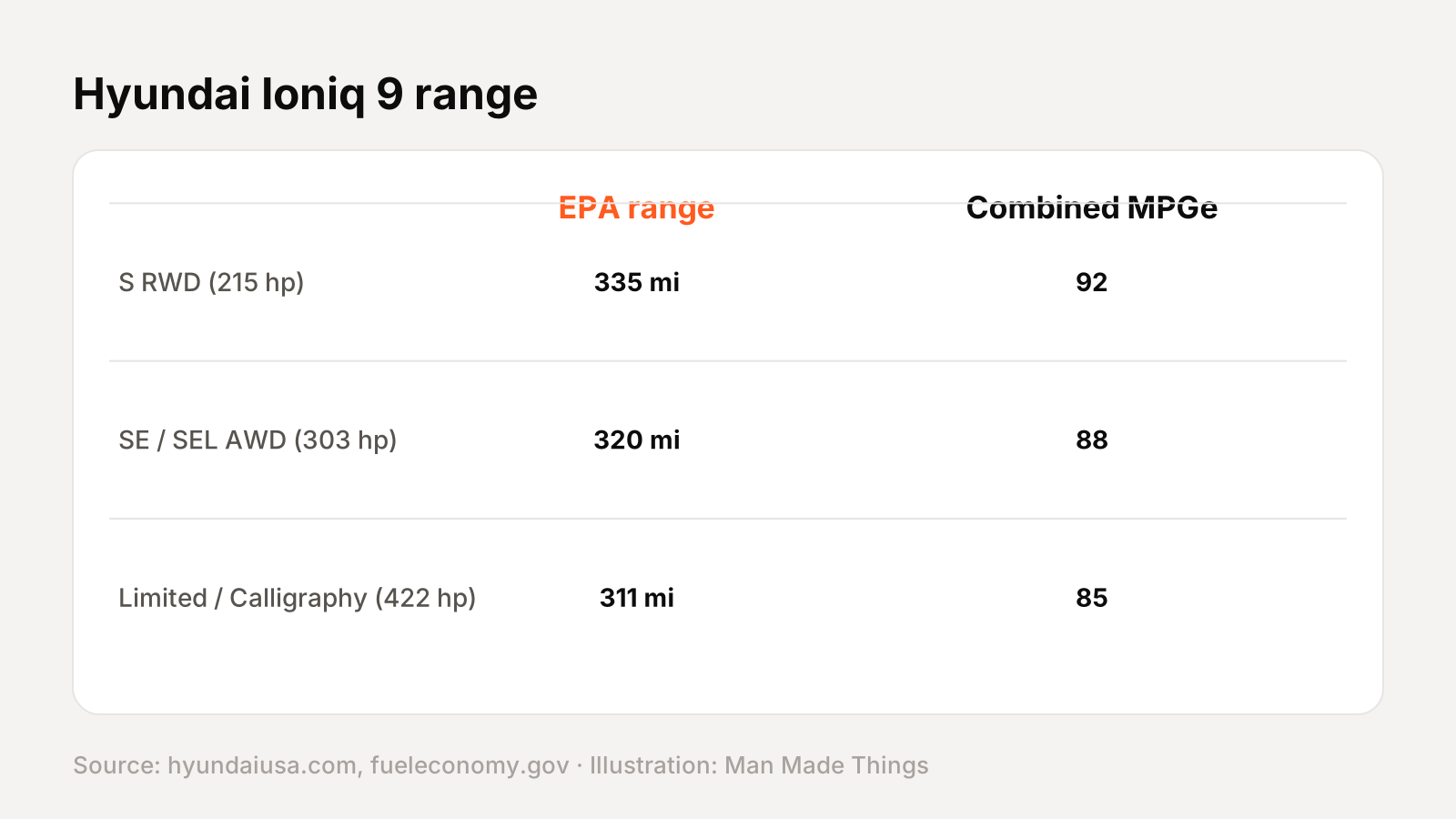
| Version | EPA range | MPGe (city/hwy/combined) | kWh per 100 miles |
|---|---|---|---|
| RWD (S) | 335 mi | 103 / 81 / 92 | 37 |
| AWD (SE, SEL) | 320 mi | 98 / 78 / 88 | 38 |
| AWD Performance (Limited, Calligraphy) | 311 mi | 91 / 79 / 85 | 40 |
Compared with the Kia EV9: every Ioniq 9 version beats every EV9 trim on EPA range (the EV9 tops out at 305 miles), thanks largely to its bigger battery. Hyundai also lists a slippery drag coefficient of 0.269.
Charging
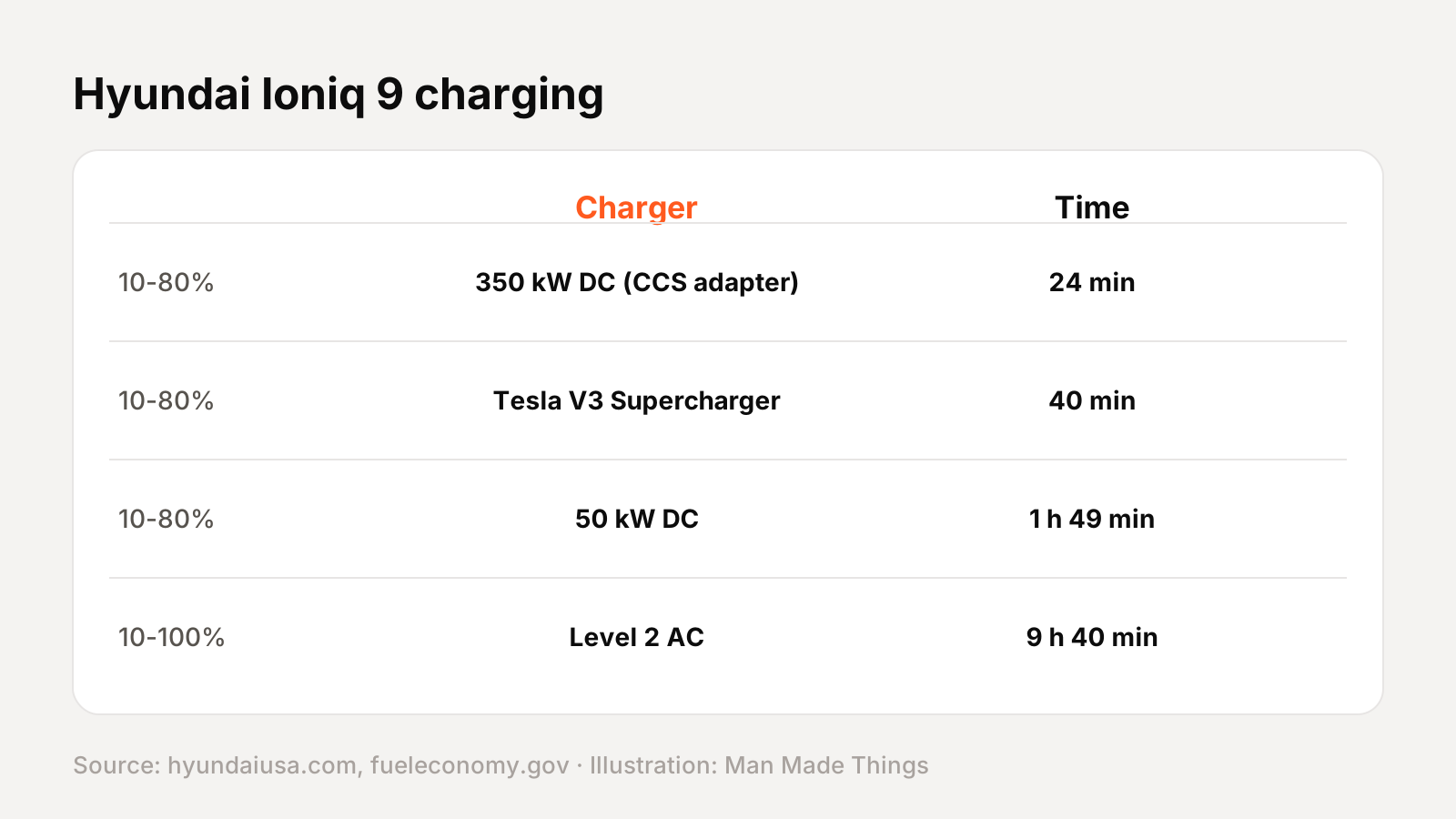
The Ioniq 9 has a native NACS port. Hyundai says that gives access to over 20,000 Tesla Superchargers with no adapter, and it includes a CCS adapter for other fast chargers.
Hyundai's official charging times:
| Charger | Time |
|---|---|
| 350 kW DC (800V), 10–80%, via CCS adapter | 24 min |
| Tesla V3 Supercharger (NACS), 10–80% | 40 min |
| 50 kW DC, 10–80% | 1 h 49 min |
| Level 2 (AC), 10–100% | 9 h 40 min |
Note the gap: the fastest time needs a 350 kW 800-volt CCS charger. On a Supercharger it takes 40 minutes, still reasonable on a road trip. At home, a Level 2 charger refills it overnight; see our best home EV chargers.
Limited and higher trims include V2L, so you can power devices from the battery.
Space and towing
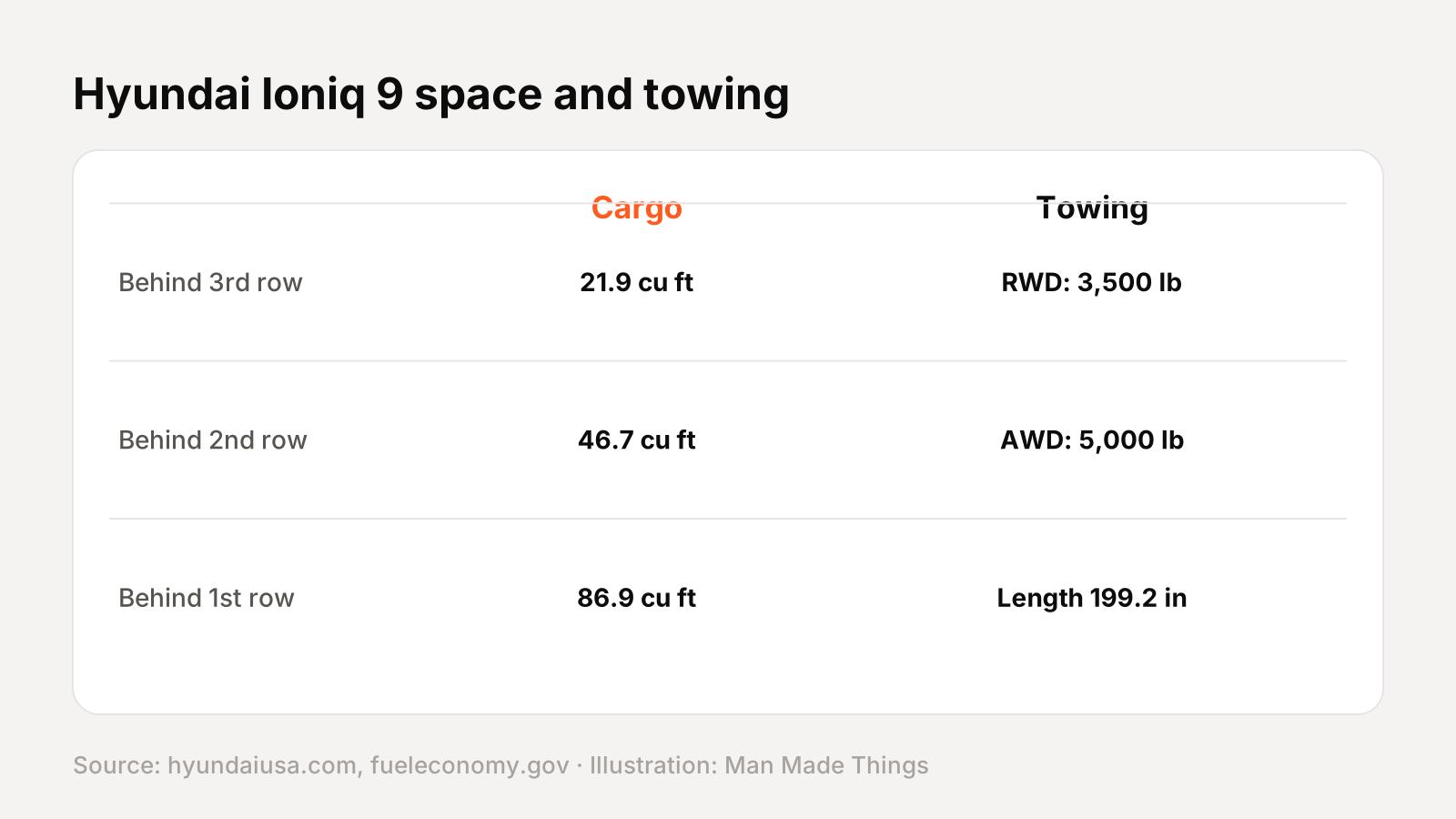
- Length: 199.2 inches, on a 123.2-inch wheelbase.
- Cargo: 21.9 cu ft behind the third row, 46.7 cu ft behind the second, 86.9 cu ft behind the first.
- Seats: 7 on S, SE and SEL; 6 (with second-row captain's chairs) on Limited and Calligraphy trims.
- Towing: 3,500 lb on the RWD S; 5,000 lb on all AWD trims.
Versus the EV9: the Ioniq 9 is 2 inches longer and has more cargo space at every row (86.9 vs 81.7 cu ft maximum). It also tows 5,000 lb on its cheaper AWD trims, where the EV9 needs Land or GT-Line to reach that.
Tech, warranty and which to buy
- Driver assistance: Highway Driving Assist 2. Calligraphy trims add a head-up display and Remote Smart Parking Assist 2.
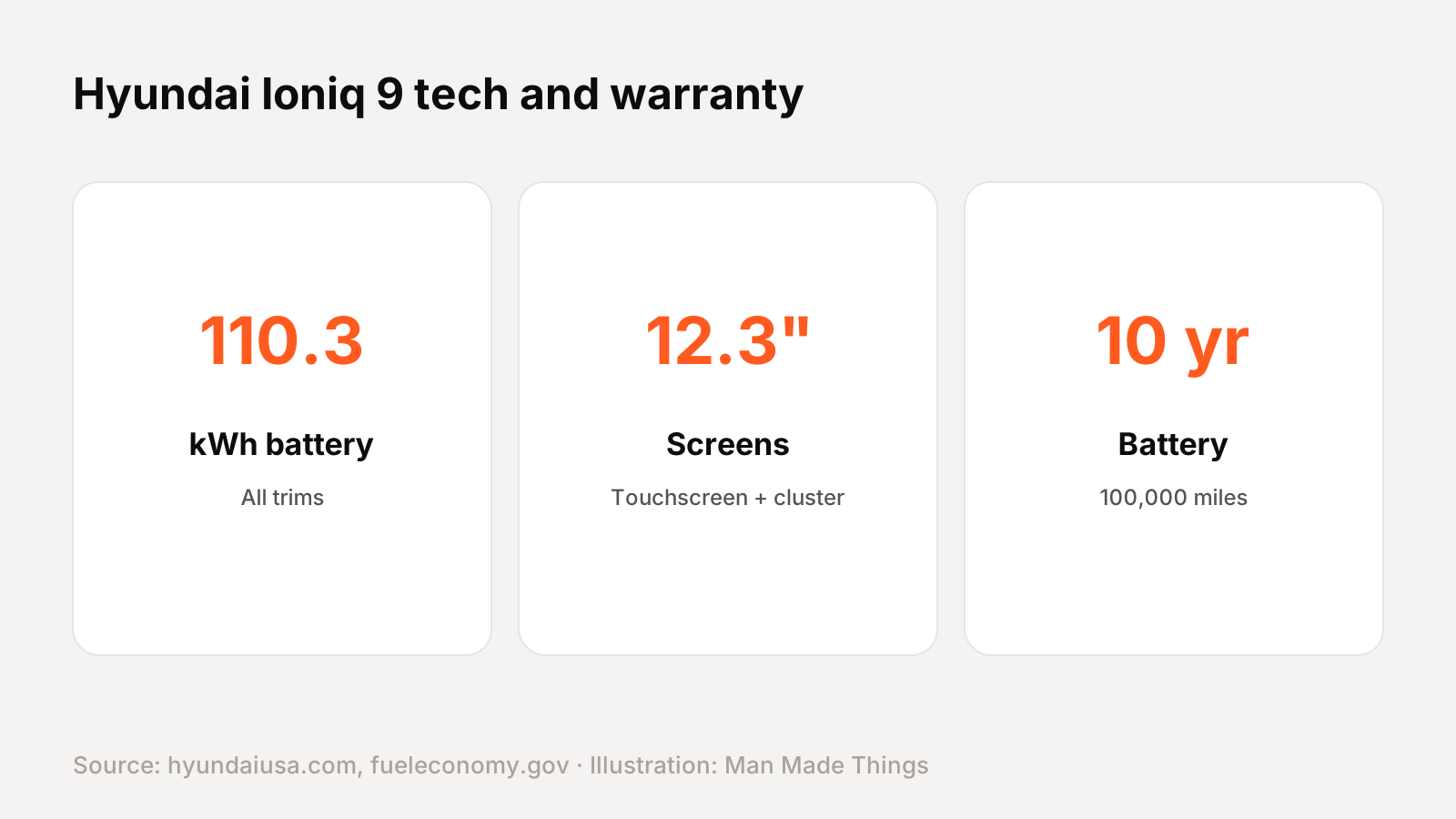
- Screens: a 12.3-inch touchscreen and 12.3-inch digital cluster.
- Warranty: 5 years/60,000 miles basic, 10 years/100,000 miles powertrain and 10 years/100,000 miles on the battery.
Which trim?
- Most range for the money: the S ($58,955, 335 miles), if you don't need AWD.
- Best all-rounder: the SE ($62,765): AWD, 320 miles, 5,000 lb towing, seven seats.
- Most power: Limited and up, with 422 hp and captain's chairs.
For more three-row and family EV options, see our best electric cars of 2026.
Price per mile of range
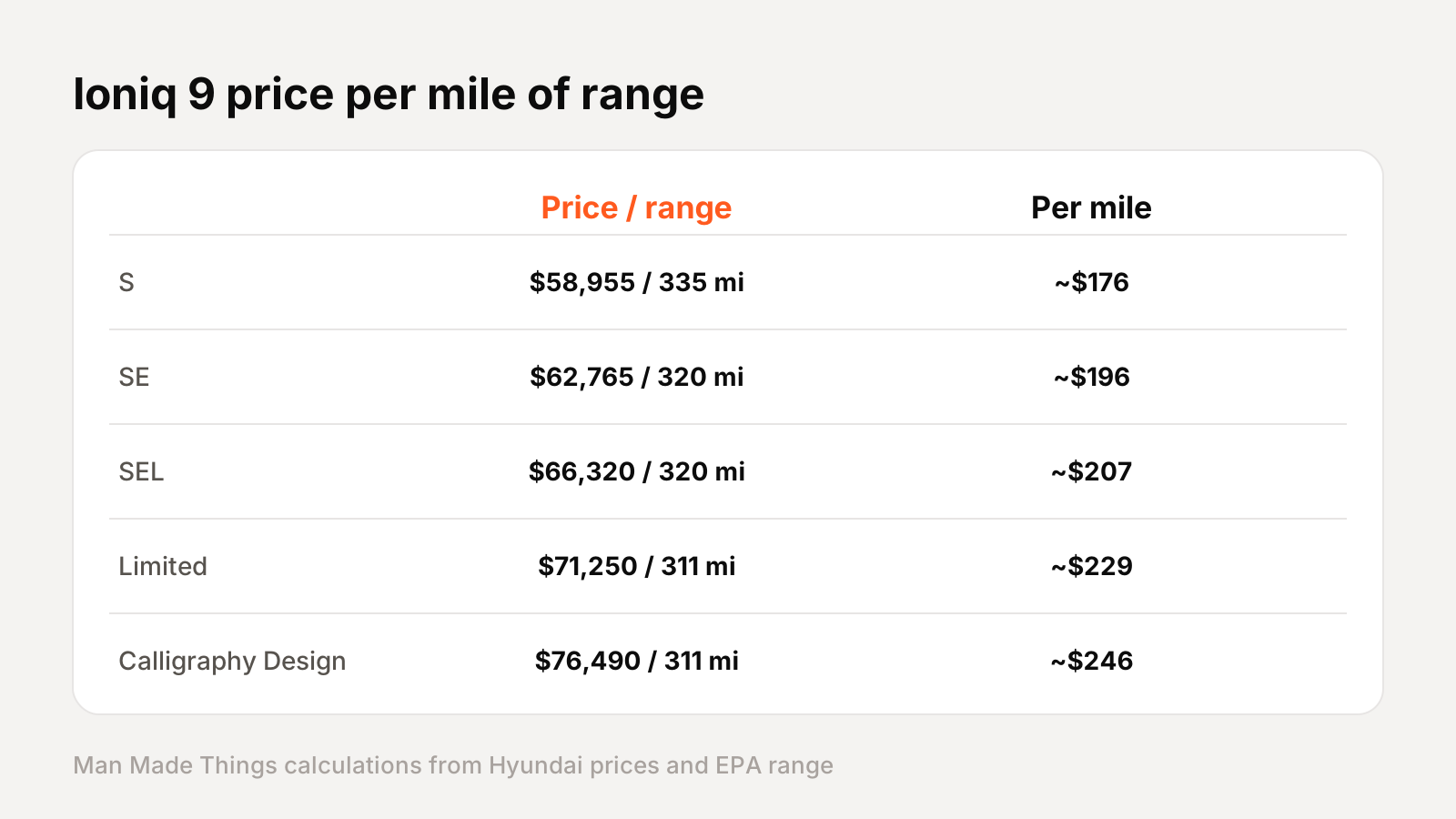
A simple way to compare trims is to divide each one's price by its EPA range (my calculation, using Hyundai's prices before freight):
| Trim | Price | Range | Price per mile of range |
|---|---|---|---|
| S | $58,955 | 335 mi | ~$176 |
| SE | $62,765 | 320 mi | ~$196 |
| SEL | $66,320 | 320 mi | ~$207 |
| Limited | $71,250 | 311 mi | ~$229 |
| Calligraphy | $74,990 | 311 mi | ~$241 |
| Calligraphy Design | $76,490 | 311 mi | ~$246 |
What it shows: the base S is the best value by a wide margin, because it's both the cheapest and the longest-range trim. Moving up the range buys power, AWD, captain's chairs and luxury features, not more range. If you live somewhere with snow or plan to tow more than 3,500 lb, the SE is the sensible step up. For the same idea applied to other EVs, see our Model Y vs EV6 vs Ioniq 5.
Frequently asked questions
How much is the Hyundai Ioniq 9?
+
From $58,955 for the S to $76,490 for the Calligraphy Design, before freight, per Hyundai.
What is the Ioniq 9's range?
+
335 miles (RWD S), 320 miles (AWD SE and SEL) and 311 miles (Limited and Calligraphy), EPA estimates.
How fast does the Ioniq 9 charge?
+
10–80% in 24 minutes on a 350 kW charger (with the included CCS adapter), or 40 minutes on a Tesla V3 Supercharger, per Hyundai.
Ioniq 9 or Kia EV9?
+
The Ioniq 9 has a bigger 110.3 kWh battery, more range (311–335 vs 230–305 miles) and more cargo space; the EV9 starts lower at $54,900.
Sources
Editor-in-Chief
Rahul has been writing about gadgets and software since 2013, first at Thetechhacker and now at Man Made Things. He edits every review on the site and signs off on every verdict.
More from Rahul →