How Often Should You Service an Automatic Watch? What Rolex, Omega, Seiko and Others Recommend
Official service intervals for automatic watches from Rolex, Omega, Longines, Tissot, Hamilton, Grand Seiko, Seiko and Citizen, what a full service includes, warning signs and how warranties fit in.
We may earn a commission when you buy through links on this page. Learn more
Quick answer
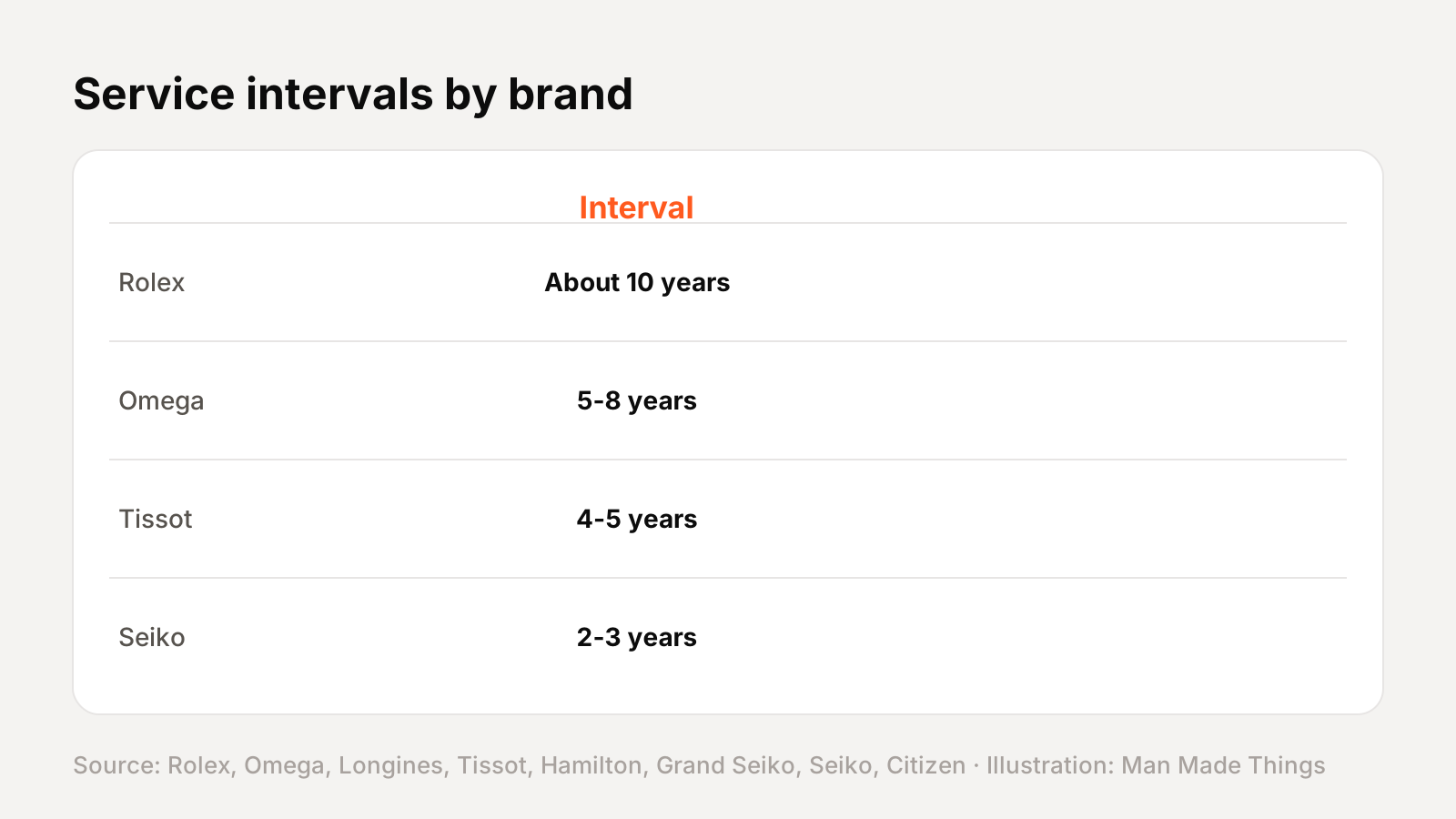
It depends on the brand. Rolex recommends a service approximately every 10 years, Omega every 5 to 8 years, Longines every 6 to 8 years, Tissot every 4 to 5 years, Grand Seiko every 3 to 4 years, and Seiko and Citizen about every 2 to 3 years for their mechanical calibers. Service sooner if the watch starts running noticeably fast or slow, stops, or after a knock or water exposure.
An automatic watch is a small machine with dozens of moving parts running on tiny amounts of oil. Over years, that oil dries and degrades, and parts wear. A service resets the clock: the movement is taken apart, cleaned, re-oiled and adjusted, and the seals are replaced.
But how often? Ask online and you'll hear everything from "every three years" to "when it stops." The better answer is to check what the brand that made your watch says, because recommendations vary a lot, from 2 to 3 years for some Seiko and Citizen calibers to about 10 years for Rolex.
I've collected the official recommendations from the major brands, along with what a service actually involves and the signs your watch needs one sooner. New to automatics? See our best automatic watches under $500.
Official service intervals by brand
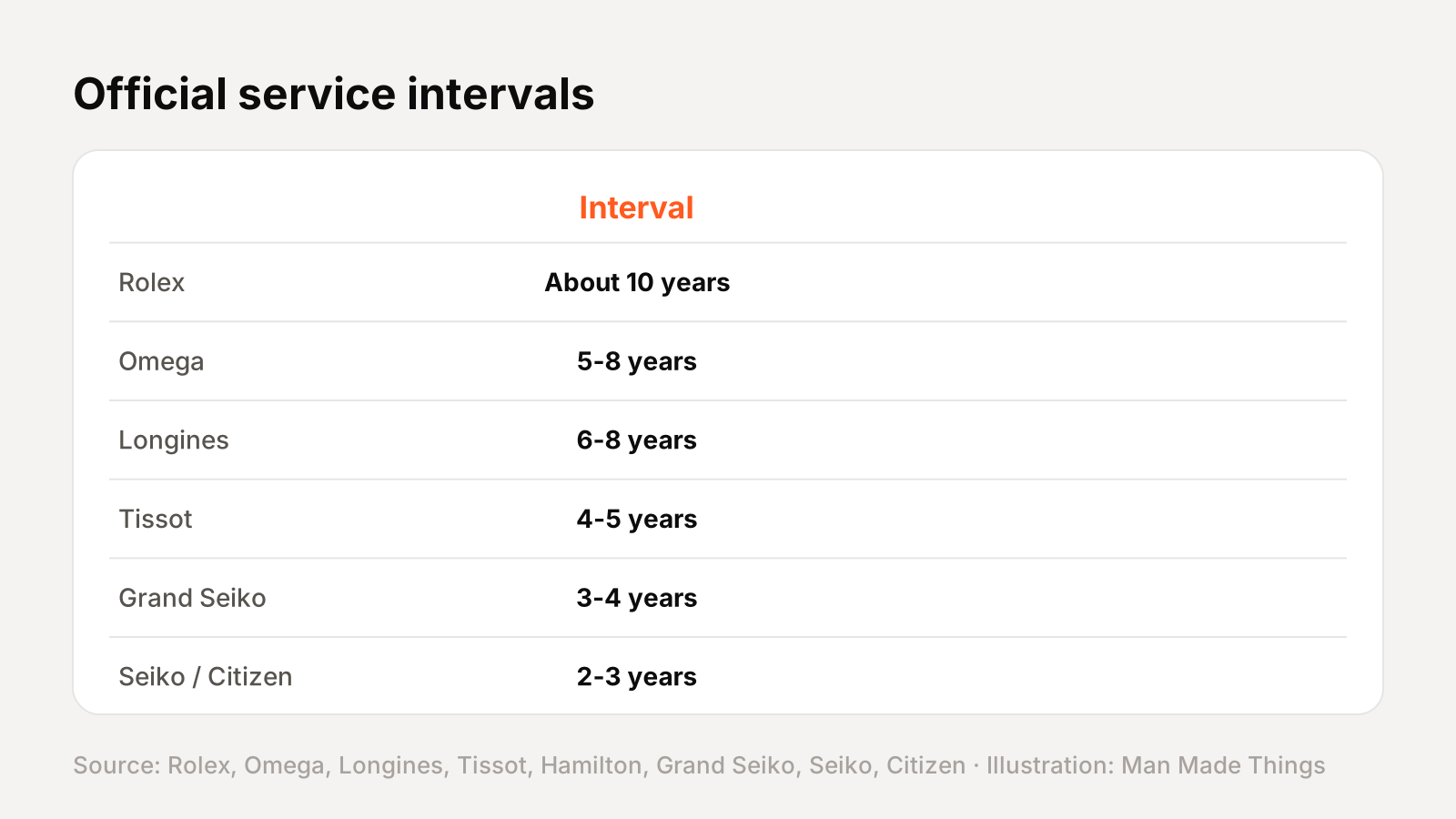
| Brand | Recommended interval | What the brand says |
|---|---|---|
| Rolex | About 10 years | "Approximately every 10 years depending on the model and real-life usage" |
| Omega | 5 to 8 years | A complete service "every 5 to 8 years" |
| Longines | 6 to 8 years | "A full service is recommended every six to eight years" |
| Tissot | 4 to 5 years | Service "every 4 to 5 years" |
| Grand Seiko | 3 to 4 years | "Once every three to four years" |
| Seiko (6R35 automatic) | 2 to 3 years | "Approximately once every 2 to 3 years" |
| Citizen (mechanical) | 2 to 3 years | "Every 2-3 years" |
| Hamilton | No fixed interval | Its site says "a precise interval for servicing cannot be determined" |
Sources: each brand's official care, FAQ or instruction pages, November 2026.
Why the big range? Brands differ in lubricants, materials and how conservative they want to be. Seiko and Citizen give the shortest figures in their manuals, while Rolex gives the longest. None of these are hard deadlines; they're the makers' recommendations for keeping a watch accurate and reliable.
What happens during a full service
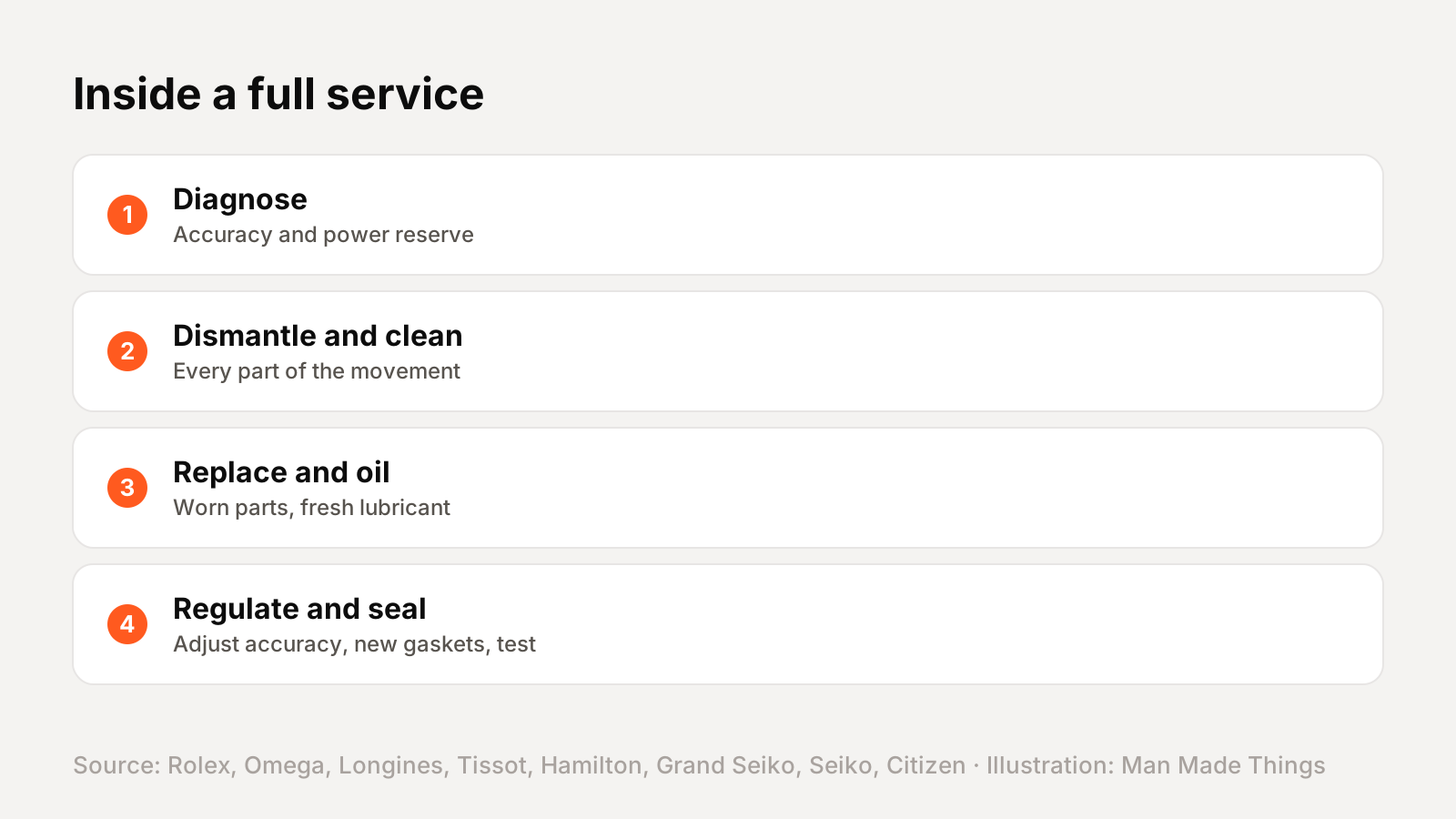
A full service is far more than a clean. Brands describe broadly the same steps:
- Diagnosis. The watchmaker checks the watch's condition, accuracy and power reserve.
- Movement dismantled. Longines describes taking apart both the case and the movement; Seiko's description covers "washing parts, changing oil, adjusting accuracy, checking functions and replacing consumable parts."
- Cleaning. Every part is cleaned. Grand Seiko describes "examining and cleaning every part."
- Worn parts replaced and the movement reassembled and lubricated.
- Regulation. The movement is adjusted for accuracy.
- Case work. The case and bracelet are cleaned and, at many brands, refinished on request.
- New seals and a water resistance test. Longines lists final checks of "precision, power reserve, water resistance."
Seiko also suggests asking for the gasket and spring bars to be replaced during a service, since both wear over time.
Signs your watch needs service sooner
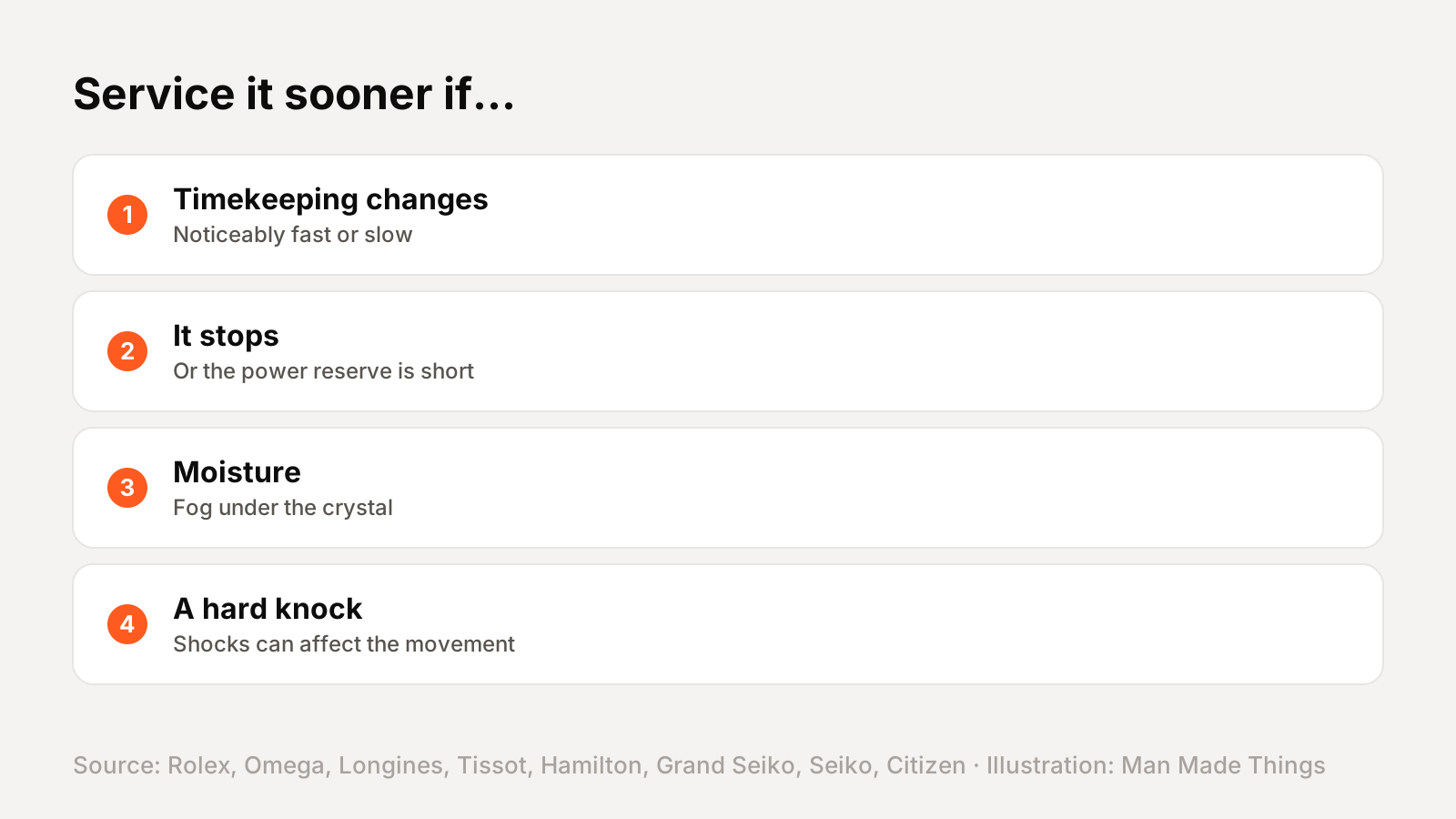
The intervals above assume normal wear. Don't wait if you notice any of these:
- It runs noticeably fast or slow. Seiko says degraded oil can make a watch gain or lose time or stop, and Citizen says mechanical watches "may become inaccurate due to insufficient lubrication or worn parts."
- It stops, or the power reserve seems short. Grand Seiko notes that "oil may dry or be insufficient" and "parts may wear" over time.
- Moisture or fog under the crystal. Get it checked promptly by a watchmaker.
- After a hard knock or a drop. Shocks can affect accuracy or damage parts.
- The crown or winding feels rough or different.
A note on quartz: if a second hand jumps in 4-second steps, that's a low-battery warning on many quartz watches (Omega and Hamilton both describe it). It doesn't apply to automatics.
Water resistance checks between services
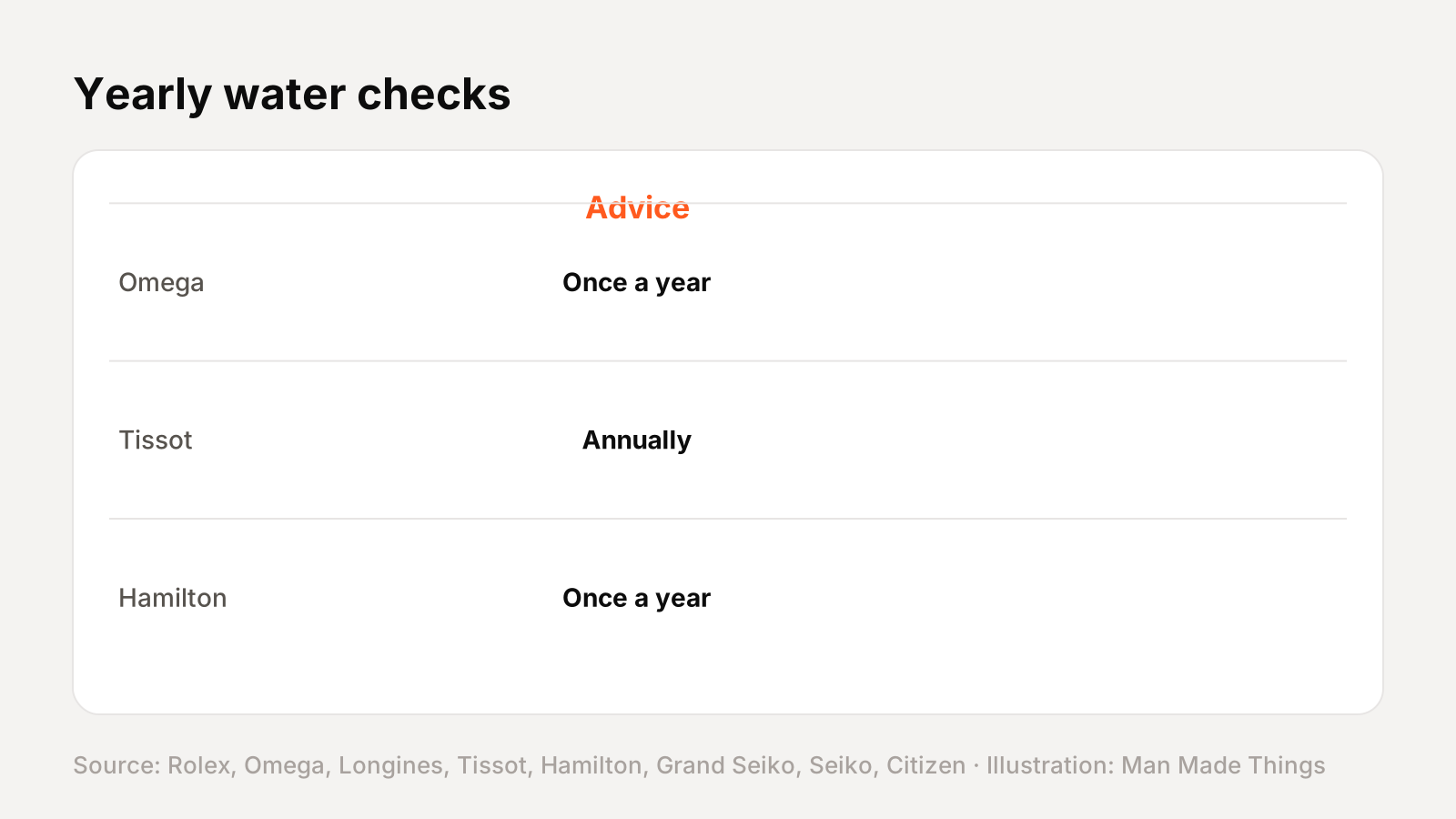
A full movement service isn't the only maintenance a watch needs. Gaskets age faster than movements, so several brands recommend a yearly water resistance check regardless of the service interval:
| Brand | Water resistance check |
|---|---|
| Omega | "Have the water resistance checked once a year" |
| Tissot | Annually, by an authorized service partner |
| Hamilton | Once per year; water resistance "is not permanent" |
A pressure test is quick and inexpensive compared with a full service, and it's worth doing if you swim with your watch. For more on ratings, read watch water resistance explained.
Warranties and service guarantees
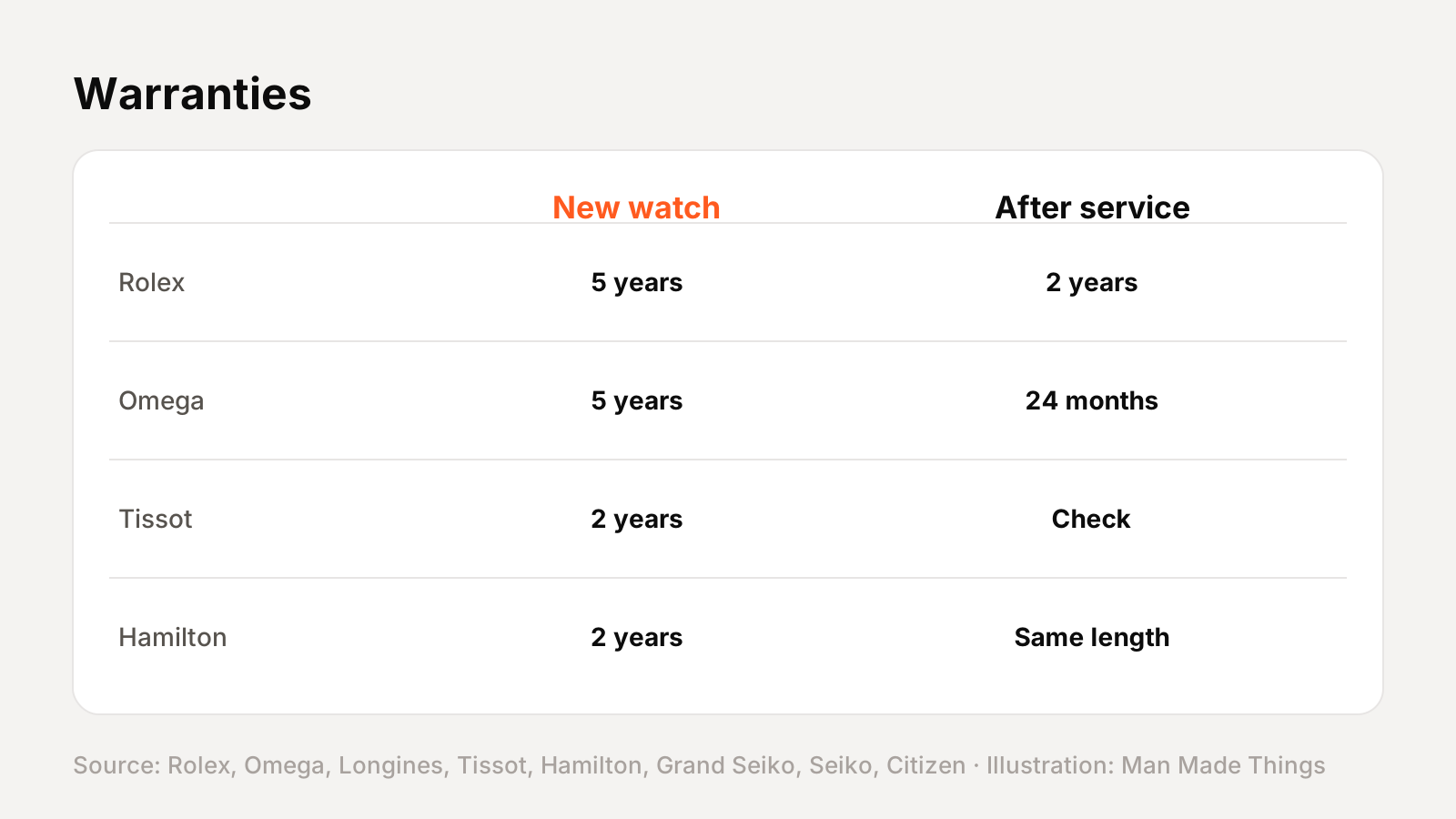
A new watch's warranty doesn't replace servicing, but it's worth knowing what's covered:
| Brand | New-watch warranty | After a service |
|---|---|---|
| Rolex | International five-year guarantee | 2-year service guarantee |
| Omega | 5 years | 24 months |
| Tissot | 2 years (3 years for some models) | Check with Tissot |
| Hamilton | 2 years | Same length as the new-watch warranty |
Warranties usually cover manufacturing defects, not wear, accidents or water damage from misuse. Buying from an authorized dealer matters: Rolex says its Official Rolex Jewelers ensure the five-year guarantee.
Brand service center or independent watchmaker?
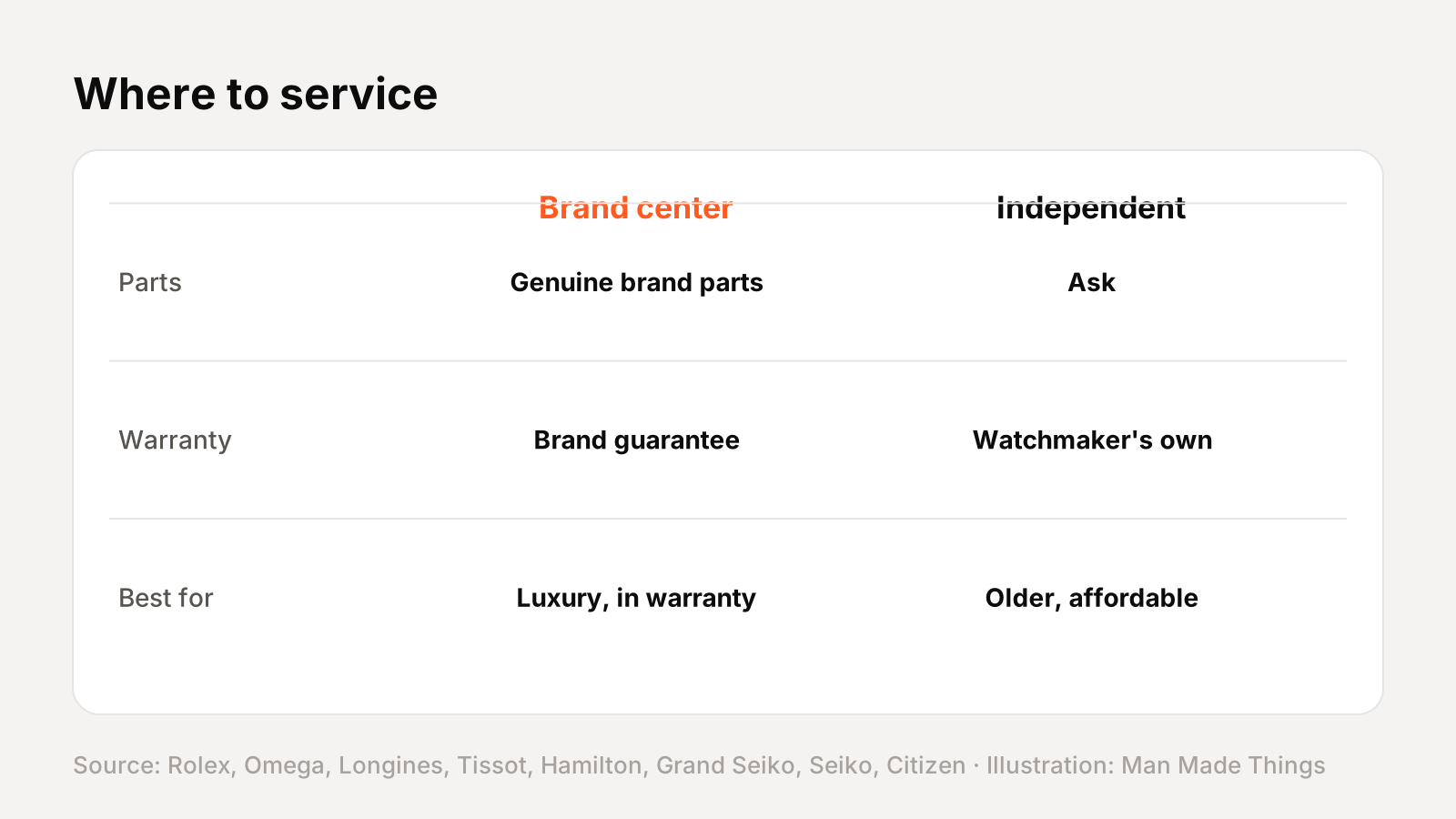
| Brand service center | Independent watchmaker | |
|---|---|---|
| Parts | Genuine brand parts | Ask what parts they use |
| Service warranty | Brand warranty (Rolex gives an international two-year service guarantee covering parts and labour) | The watchmaker's own warranty |
| Best for | Watches under warranty, luxury watches, resale value | Older, simpler or affordable watches |
For a watch still under warranty, use the brand or an authorized service center so the warranty stays valid. For an older Seiko or an inexpensive automatic, a reputable independent watchmaker is often the practical choice.
How to make the time between services count
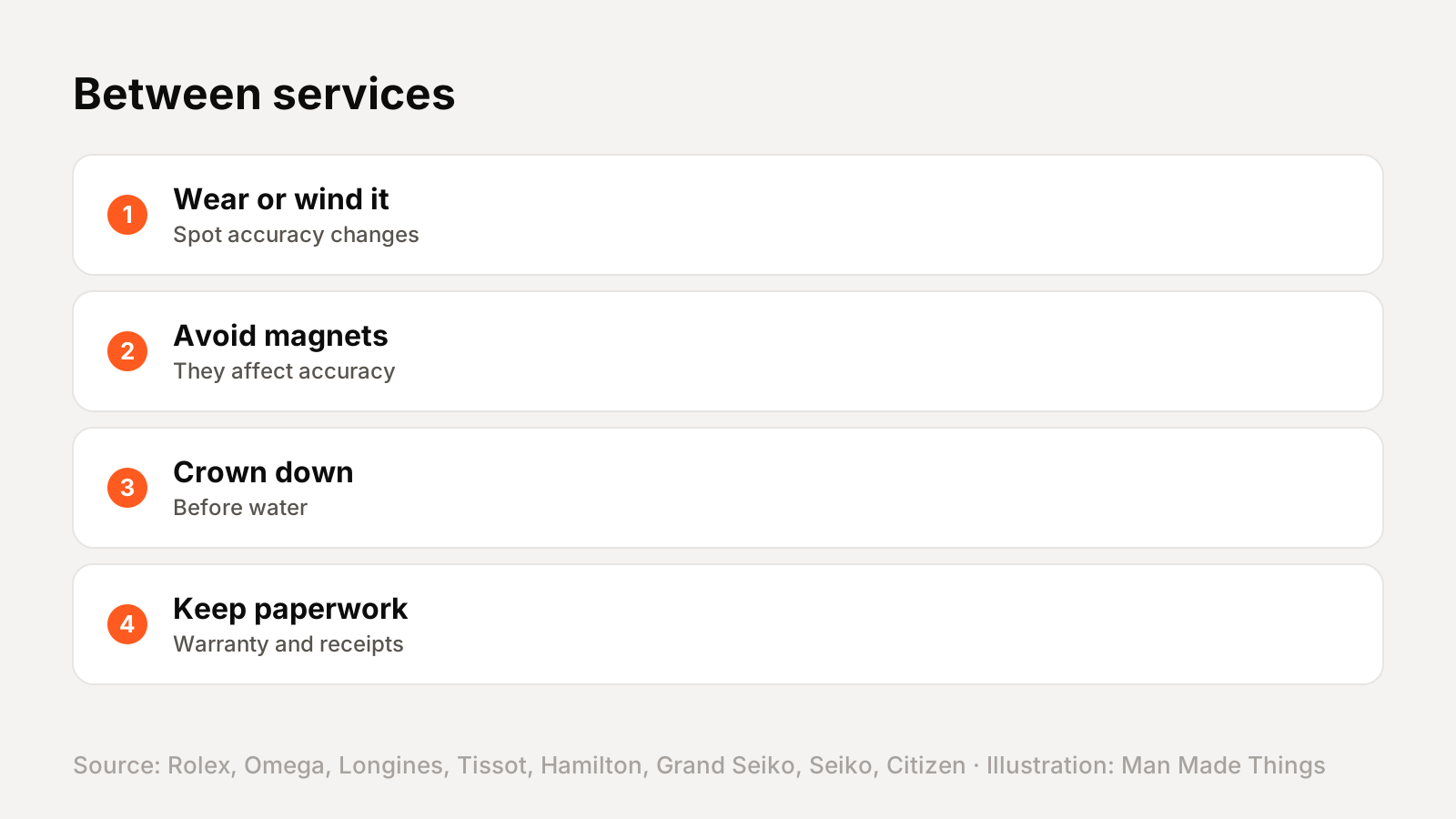
- Wear or wind it regularly, which also makes it easier to notice changes in accuracy.
- Keep it away from strong magnets, which can affect a mechanical watch's accuracy.
- Avoid hard knocks, especially during sports.
- Screw down or push in the crown before any contact with water, as Rolex and others stress.
- Rinse after the sea or pool.
- Keep the paperwork, including warranty cards and service receipts. They help with future servicing and resale.
Frequently asked questions
How often should I service a Rolex?
+
Rolex recommends approximately every 10 years, depending on the model and real-life usage.
How often should I service an Omega?
+
Omega recommends a complete service every 5 to 8 years and a water resistance check once a year.
How often should I service a Seiko automatic?
+
Seiko's instructions for its 6R35 automatic recommend approximately once every 2 to 3 years; Grand Seiko recommends every 3 to 4 years.
What does a watch service include?
+
Brands describe dismantling and cleaning the movement, replacing worn parts, re-lubricating and regulating it, replacing seals and testing water resistance.
Sources

Watches & Coffee Writer
Aditya is a passionate coffee lover who loves watches. He covers watches and coffee for Man Made Things.
More from Aditya →