Down Fill Power Explained: What 650, 800 and 1000-Fill Really Mean
What down fill power measures, how labs like IDFL test it, why fill weight matters just as much, what 90/10 down means, and what the Responsible Down Standard certifies, with real examples from Rab, Mountain Hardwear, Arc'teryx, Patagonia, Uniqlo and Canada Goose.
We may earn a commission when you buy through links on this page. Learn more
Quick answer
Fill power measures how much space one ounce (or 30 g) of down fills in a test cylinder, in cubic inches. Higher fill power means loftier, higher-quality down that gives more warmth for its weight. But warmth also depends on fill weight, how much down is in the jacket: a jacket with more 650-fill down can be warmer than one with a little 850-fill. IDFL treats 700+ as extremely high quality.
Down jackets are sold on numbers: 650-fill, 800-fill, even 1000-fill. Most people assume a bigger number means a warmer jacket. Sometimes it does. But fill power measures the quality of the down, not how much of it is in the jacket, and that second number, fill weight, is often missing from the label.
Here's what fill power actually measures, according to IDFL (one of the main down and feather testing labs), why fill weight matters just as much, what the "90/10" on a label means, and what certifications like the Responsible Down Standard guarantee. Shopping now? See our best down jackets.
What fill power measures
IDFL defines it simply: "Fill Power measures the loft or insulation properties of down products."
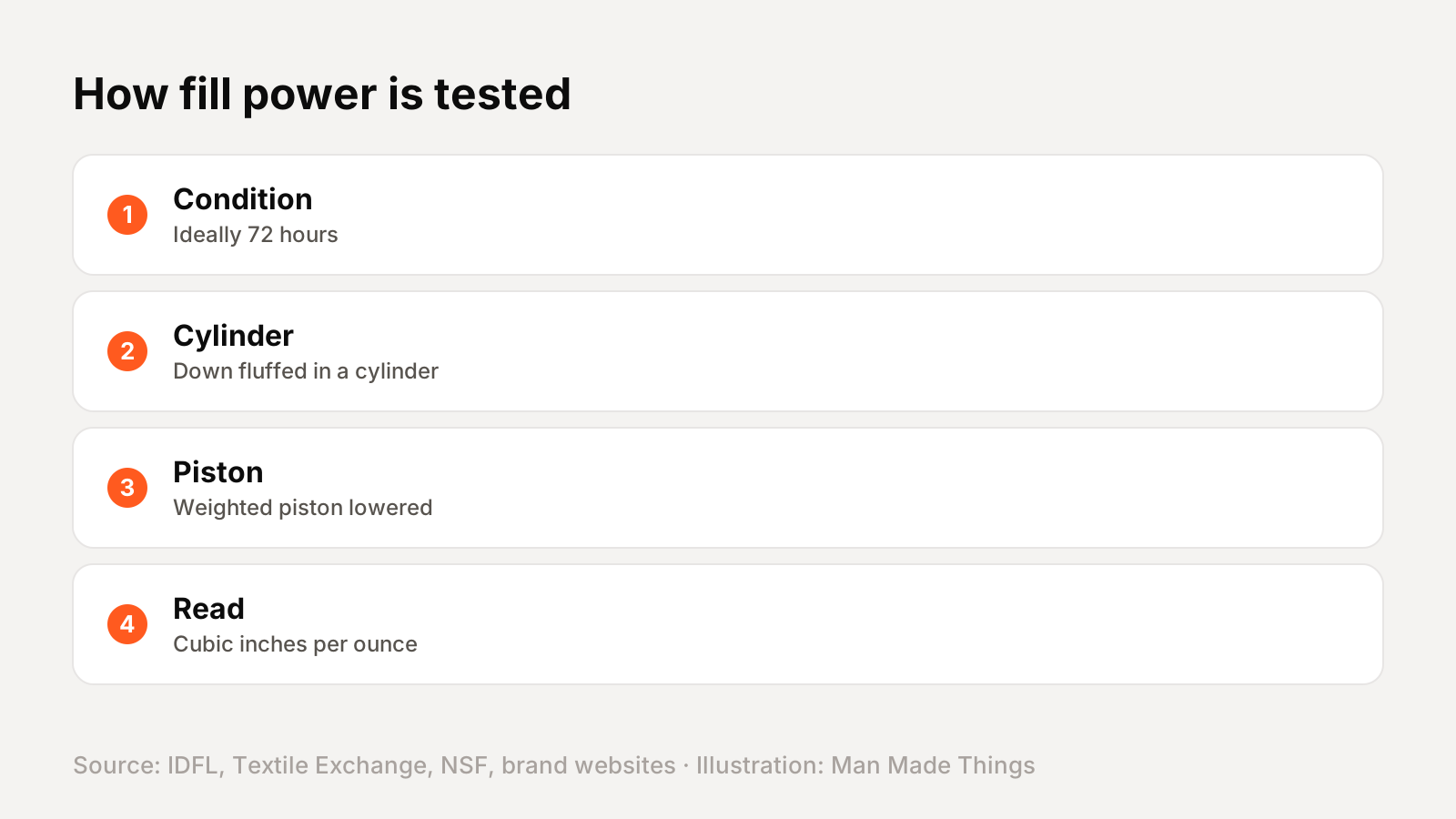
The test works like this:
- A sample is conditioned, ideally for 72 hours. IDFL says steam conditioning is the official IDFB (International Down and Feather Bureau) method, and tumble drying is the European method.
- The down goes into a cylinder, is fluffed with air or stirred, and a weighted piston is lowered onto it.
- The height where the piston stops gives the volume the down fills.
The test measures the volume of fill "per one ounce (USA) or 30g (Europe/Japan/IDFB)." So 800 fill power means one ounce of that down lofts to about 800 cubic inches.
Different standards (IDFB, EN 12130, JIS) use different cylinder sizes, piston weights and units, so results aren't always directly comparable. Uniqlo, for example, specifies that its 750+ figure is "measured by the IDFB method."
What the numbers mean
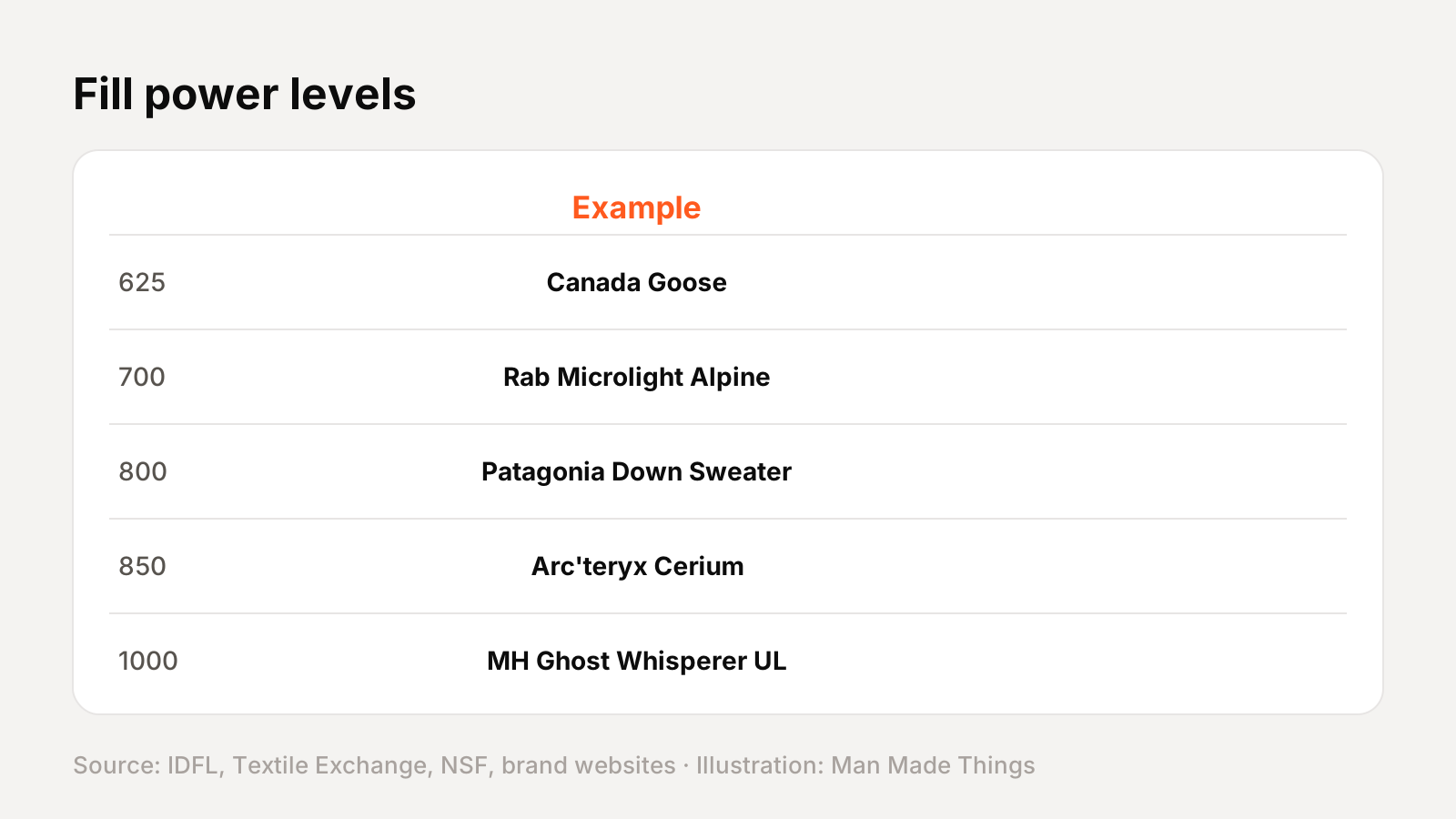
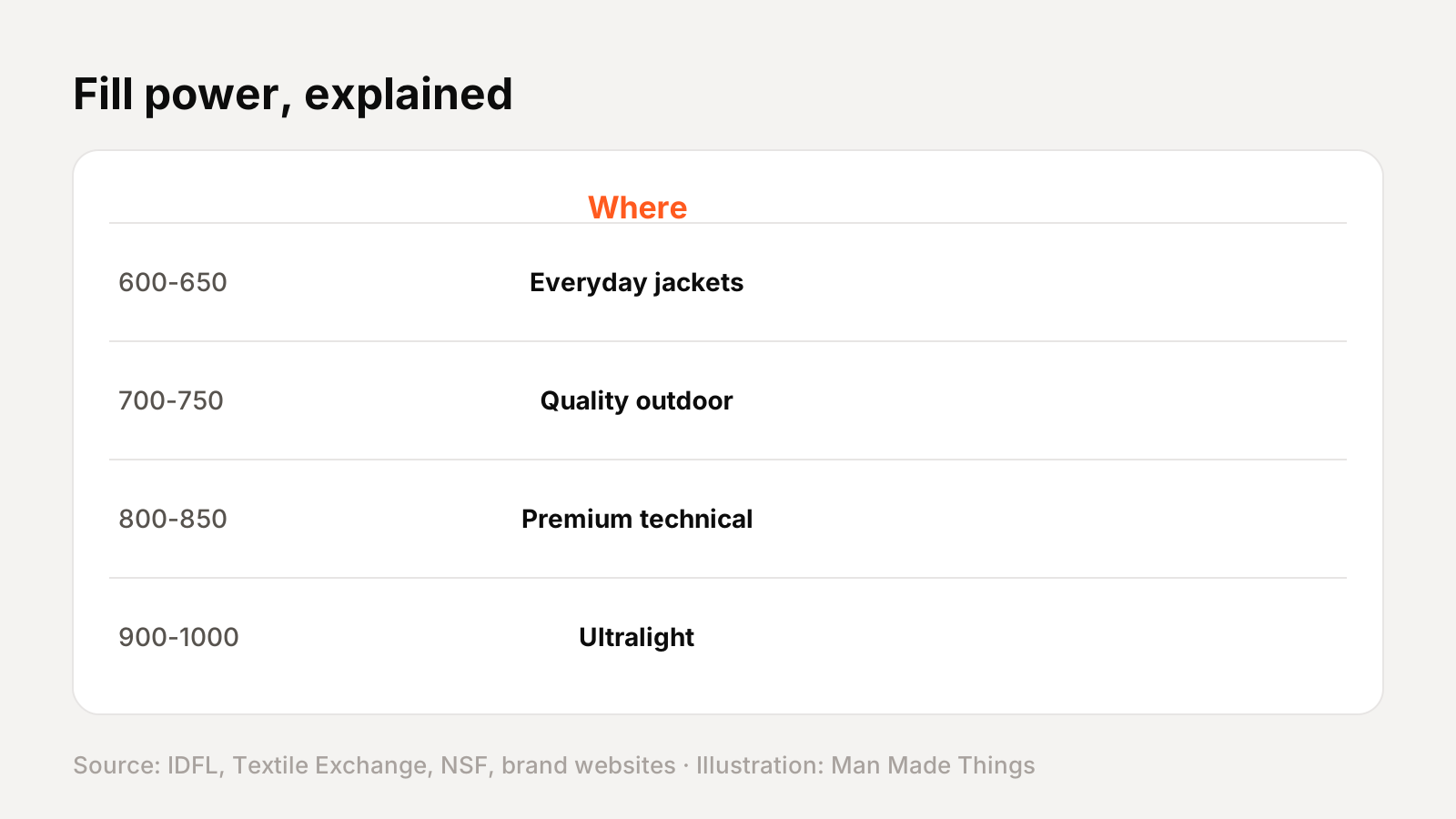
| Fill power | Where you'll see it | Examples |
|---|---|---|
| 600–650 | Everyday and city jackets | Canada Goose's 625-fill pieces |
| 700–750 | Quality everyday and outdoor jackets | Rab Microlight Alpine (700), Uniqlo Ultra Light Down (750+), Canada Goose 750-fill |
| 800–850 | Premium technical jackets | Patagonia Down Sweater (800), Arc'teryx Cerium (850) |
| 900–1000 | Ultralight specialist gear | Mountain Hardwear Ghost Whisperer UL (1000) |
IDFL describes 700+ as extremely high quality. Higher fill power means each ounce traps more air, so a jacket can be just as warm with less down, which makes it lighter and more compressible.
A note on accuracy: IDFL says its results could be ±5% of the actual fill power, and that "a 1-2% difference can be 8-16 FP points." It also notes that down in finished jackets and sleeping bags often struggles to reach its original fill power.
Fill power vs fill weight: the number that's often missing
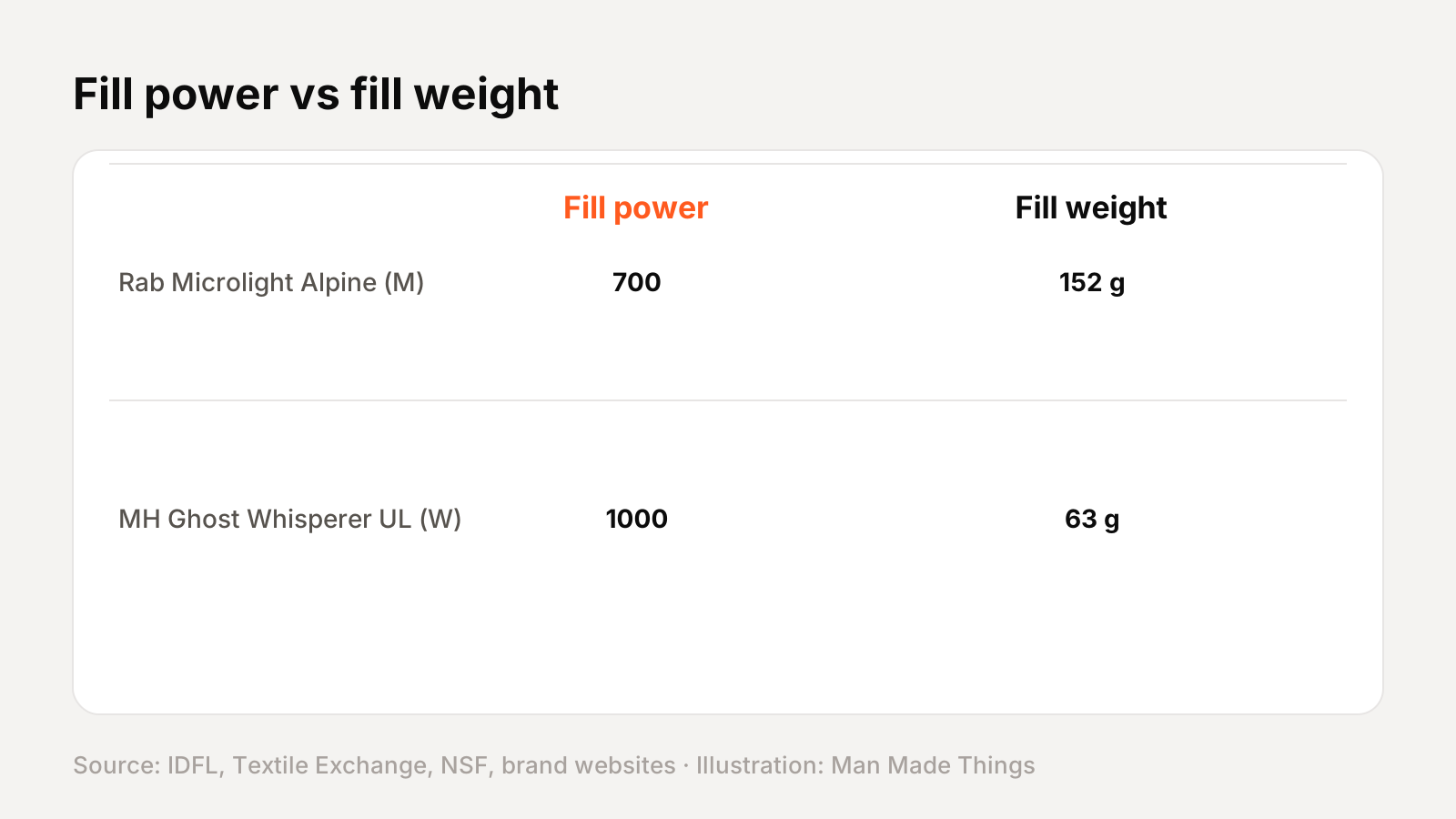
Fill power tells you the quality of the down. Fill weight tells you how much down is in the garment. Warmth depends on both.
Some brands publish fill weight. Rab lists the Microlight Alpine's insulation as "700FP recycled down with Grangers hydrophobic finish (5.3oz/152g, Size M)" in a jacket that weighs 15.09 oz (428 g) in total. Mountain Hardwear lists 2.2 oz (63 g) of 1000-fill down in a women's Ghost Whisperer UL Hoody that weighs 6.2 oz (175 g).
Those two listings (a men's medium and a women's jacket, so not a perfect comparison) show how much fill weight varies: the Rab uses lower fill power but more than twice as much down by weight, while the Ghost Whisperer UL uses a small amount of very high fill power down to stay ultralight.
Takeaway: when you compare jackets, look for fill weight. If a brand doesn't publish it, the jacket's total weight and intended use are the next best clues.
What '90/10' means: down vs feathers
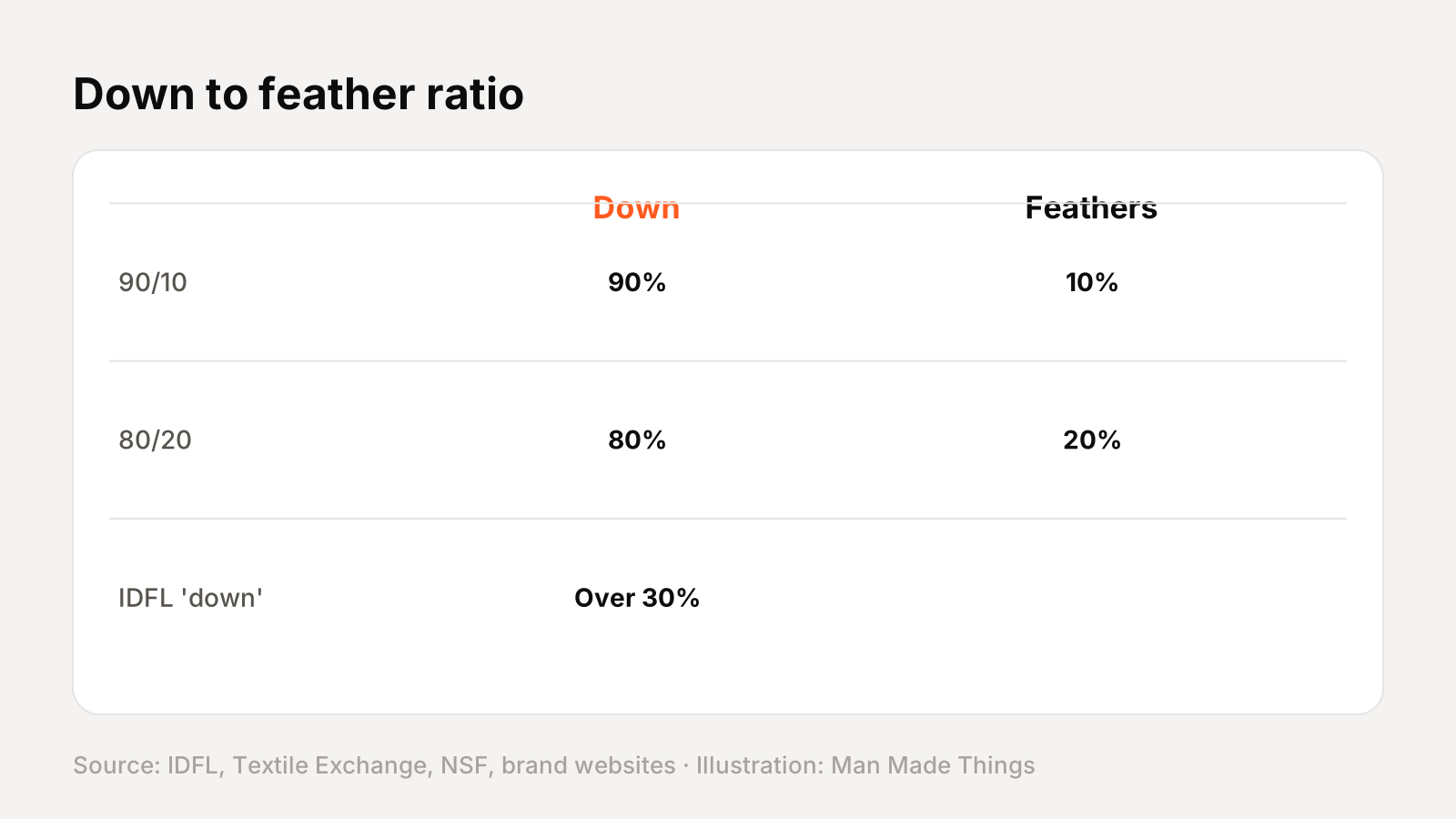
Down is the fluffy cluster under a bird's feathers; feathers have a quill. Down products contain a mix, stated as a ratio:
| Label | Down | Feathers | Example |
|---|---|---|---|
| 90/10 | 90% | 10% | Canada Goose 750-fill pieces; Uniqlo Ultra Light Down |
| 80/20 | 80% | 20% | Canada Goose 625-fill Langford Parka |
IDFL's lab definition is broad: a sample with a declared down content "of over 30%" counts as down; up to 30% is a feather sample. Brands selling premium jackets typically state much higher figures; Arc'teryx, for example, specifies a minimum of 90% down in the Cerium.
Canada Goose also rates warmth separately on its own TEI scale, a reminder that fill power is only one part of the picture.
Hydrophobic down
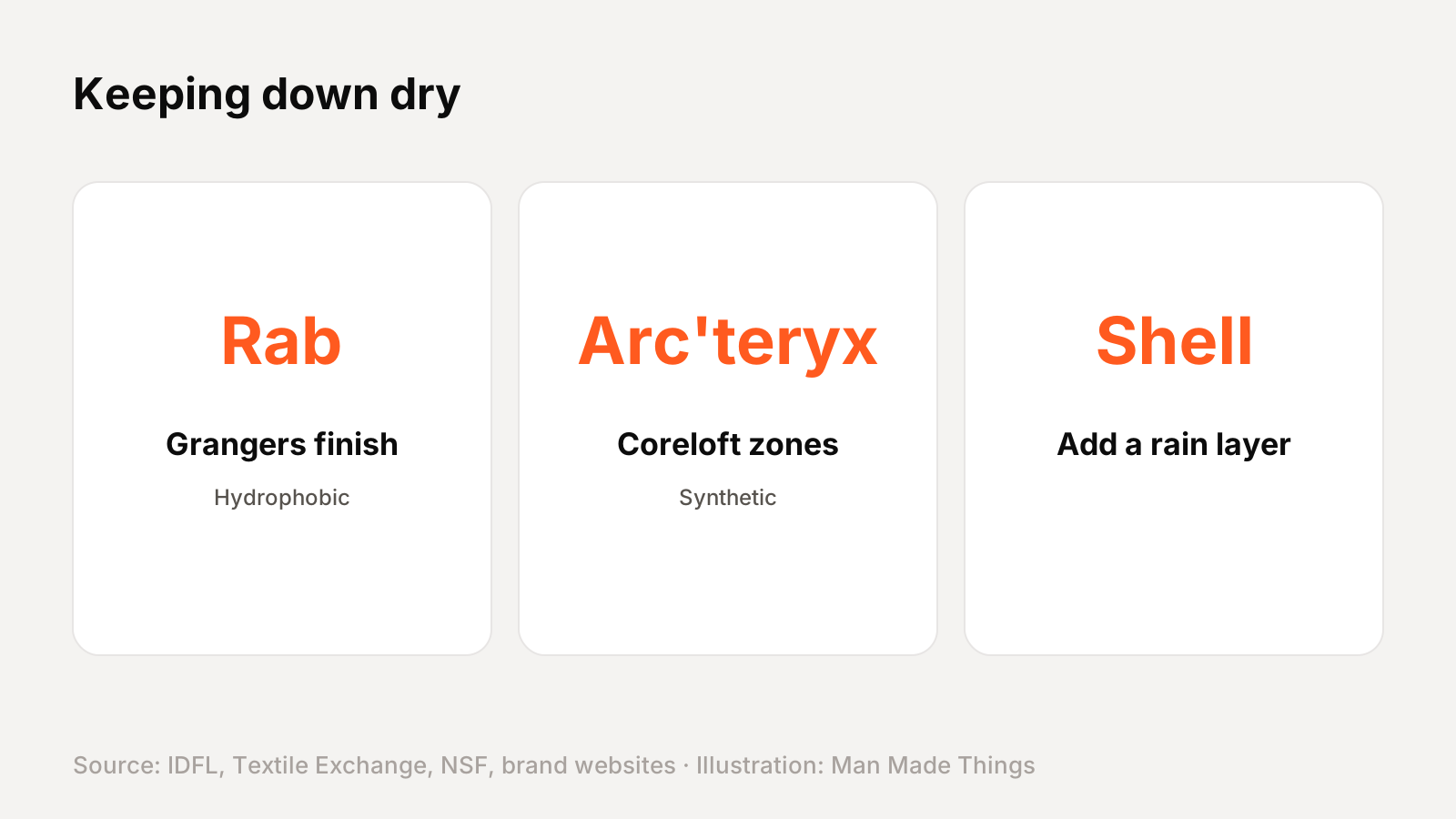
Down loses loft when it gets wet. Brands tackle this in different ways:
- Water-resistant treatments: Rab uses down with a "Grangers hydrophobic finish" in the Microlight Alpine.
- Hybrid insulation: Arc'teryx puts synthetic Coreloft insulation "in areas prone to moisture" on the Cerium, keeping 850-fill down elsewhere.
For wet climates, also look at the shell fabric and consider a rain jacket over your down layer.
Responsible down: RDS and Global TDS
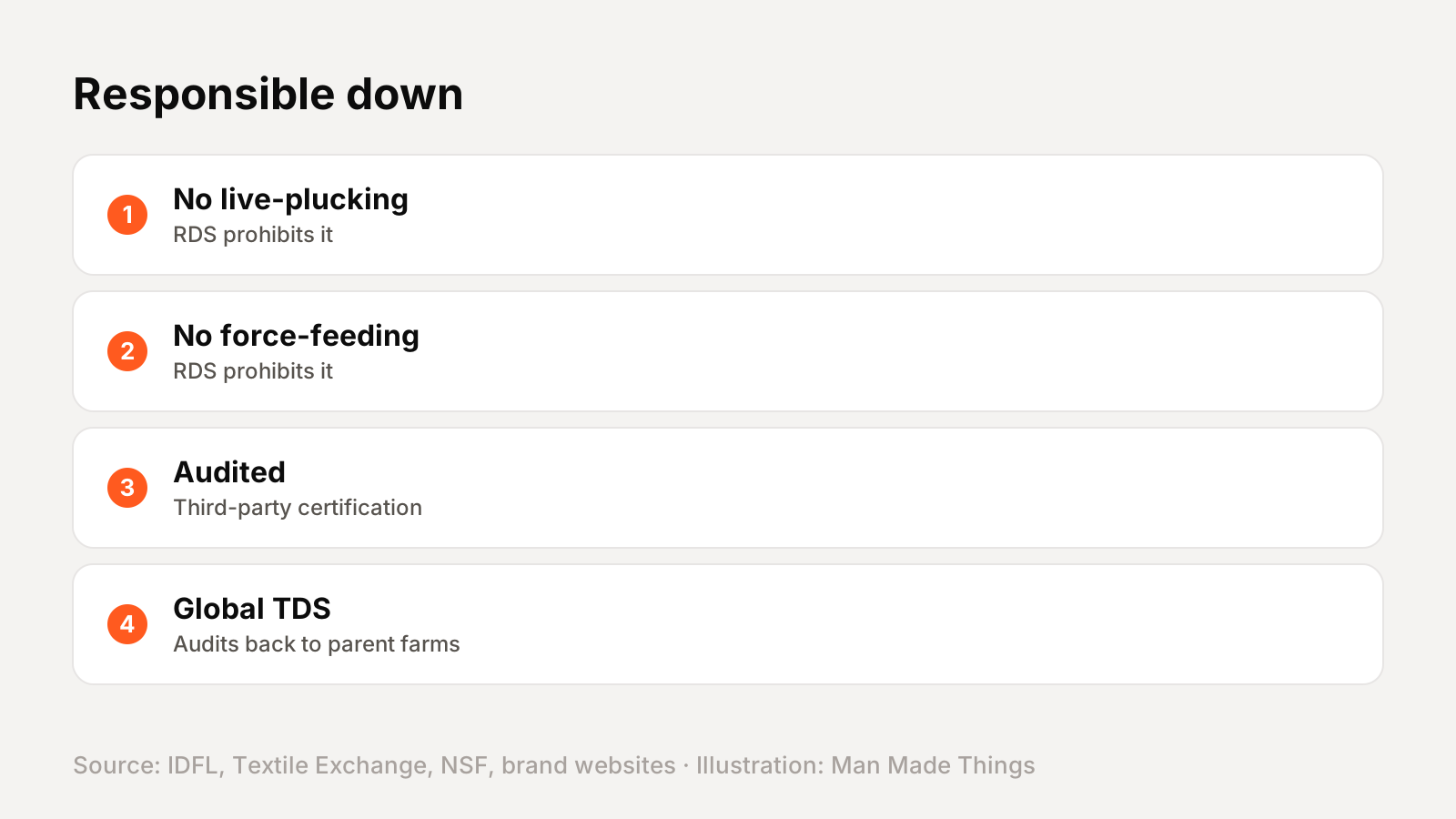
Two certifications show up on many down jackets:
Responsible Down Standard (RDS), from Textile Exchange, aims "to ensure that down and feathers come from animals that have not been subjected to an unnecessary harm." Its rules include:
- "Any removal of down and feathers from live birds (live-plucking or molt-harvesting) is prohibited; force-feeding is also prohibited."
- Third-party certification bodies audit each stage of the supply chain.
- "Only products with 100% certified down and feathers may carry the RDS logo."
Global Traceable Down Standard (Global TDS), owned by NSF and based on Patagonia's original Traceable Down Standard, also forbids force-feeding and live-plucking and audits back to parent farms.
Mountain Hardwear and Patagonia both list RDS-certified down on the jackets mentioned above.
How to choose
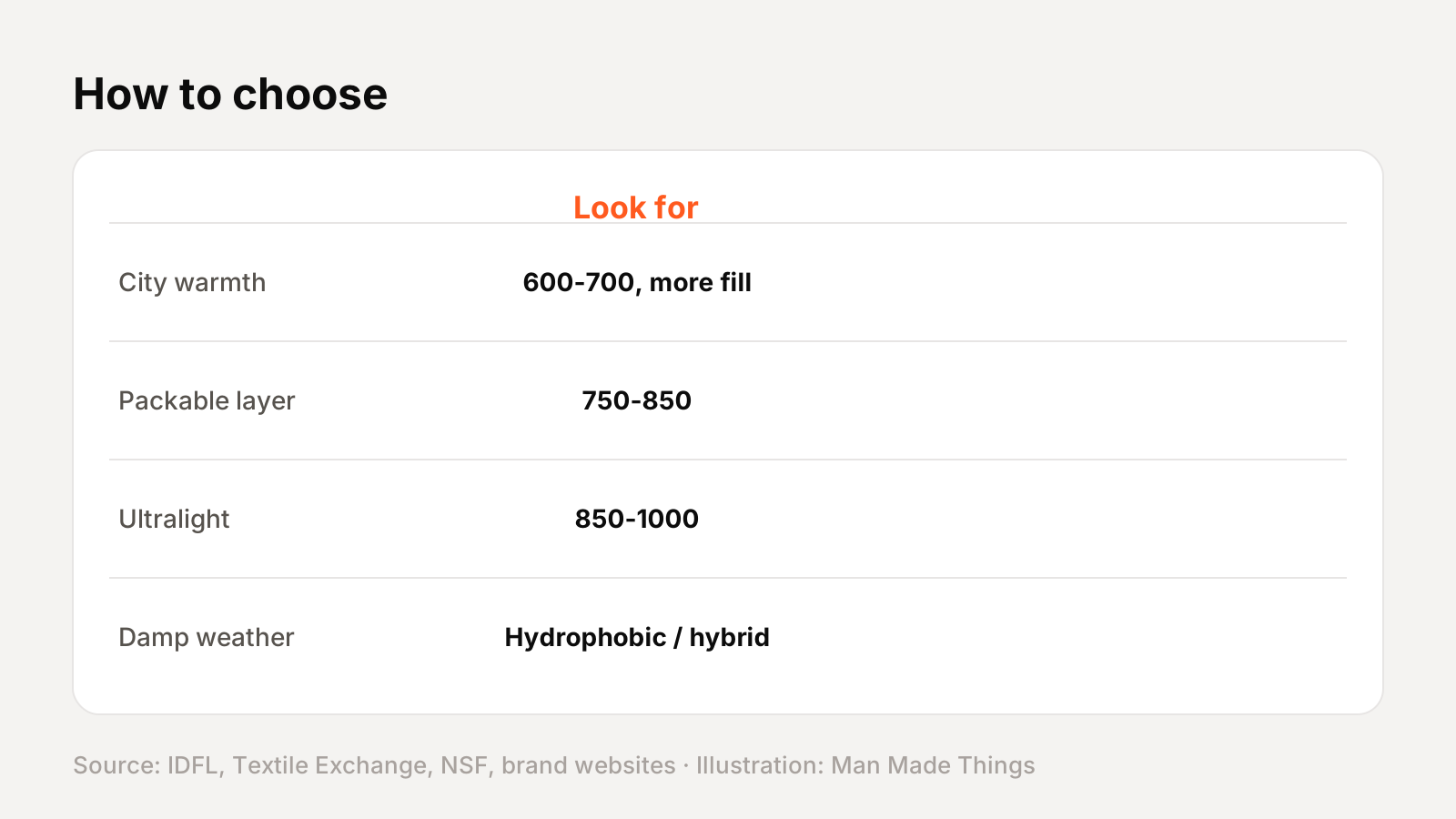
| You want... | Look for |
|---|---|
| A warm city jacket on a budget | 600–700 fill with plenty of fill weight |
| A light, packable everyday layer | 750–850 fill |
| An ultralight layer for hiking and travel | 850–1000 fill, low fill weight |
| Warmth in damp weather | Hydrophobic down or hybrid synthetic insulation |
| Animal-welfare assurance | RDS or Global TDS certification |
Always compare fill weight when you can find it, and remember the shell, baffle design and fit matter too.
Frequently asked questions
Is 800 fill power warmer than 650?
+
Ounce for ounce, yes: 800-fill down lofts more. But a jacket with more 650-fill down can be warmer overall, so compare fill weight too.
What is fill weight?
+
The amount of down in a garment, usually in ounces or grams. Rab, for example, lists 5.3 oz (152 g) in its Microlight Alpine, size M.
What does RDS mean on a down jacket?
+
The Responsible Down Standard from Textile Exchange, which prohibits live-plucking and force-feeding and requires third-party audits.
Sources
- IDFL: Fill power and down testing
- IDFL: Fill power tolerance and variances (PDF)
- IDFL: Fill testing options
- Textile Exchange: Quick Guide to the RDS (PDF)
- NSF: Global Traceable Down Standard
- Rab: Microlight Alpine
- Mountain Hardwear: Ghost Whisperer UL Hoody
- Arc'teryx: Cerium Hoody
- Patagonia: Men's Down Sweater
- Uniqlo: Ultra Light Down
- Canada Goose: FAQ
Editor-in-Chief
Rahul has been writing about gadgets and software since 2013, first at Thetechhacker and now at Man Made Things. He edits every review on the site and signs off on every verdict.
More from Rahul →