De/code: A Coffee Bag. What Single Origin, Washed, Natural, Altitude and Roast Date Really Mean
Every term on a specialty coffee bag, decoded with definitions from the Specialty Coffee Association, World Coffee Research, USDA, Fairtrade and leading roasters: single origin vs blend, variety, altitude, washed, natural and honey processing, roast date, tasting notes, certifications and decaf.
We may earn a commission when you buy through links on this page. Learn more
Quick answer
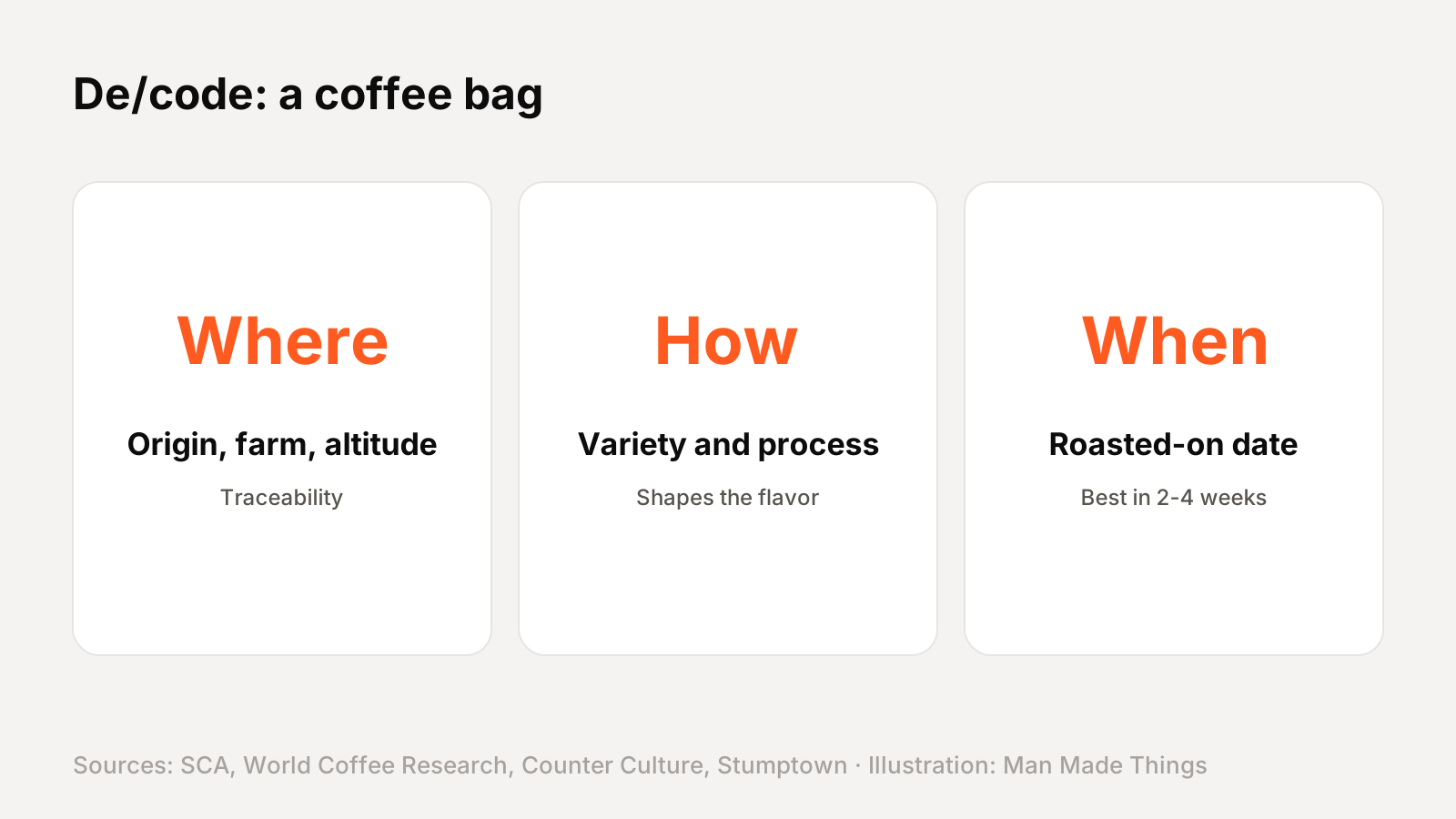
On a coffee bag: "single origin" means it comes from one place, which can be a country, a region or a single farm. "Washed" coffees tend to taste brighter and cleaner; "natural" (dry-processed) coffees taste fruitier with more body; "honey" sits in between. Higher altitude generally means more complex coffee, according to Counter Culture. Look for a "roasted on" date, not just "best by": Counter Culture says coffee is best 2–4 weeks after roasting. Tasting notes describe natural flavors, not added flavorings.
Specialty coffee bags are packed with information: a farm name, a variety you've never heard of, an altitude in meters, a process, three tasting notes and a date. It can feel like you need a course to buy a bag of beans.
You don't. Every one of those words tells you something about how the coffee will taste, and once you know what they mean, you'll pick better coffee.
As a coffee lover, this is one of my favorite things to explain. Every definition below comes from an authoritative source: the Specialty Coffee Association (SCA), World Coffee Research (WCR), the USDA, certification bodies, and roasters' own guides from Counter Culture, Stumptown and Intelligentsia. Where something isn't officially defined, I say so.
Single origin vs blend
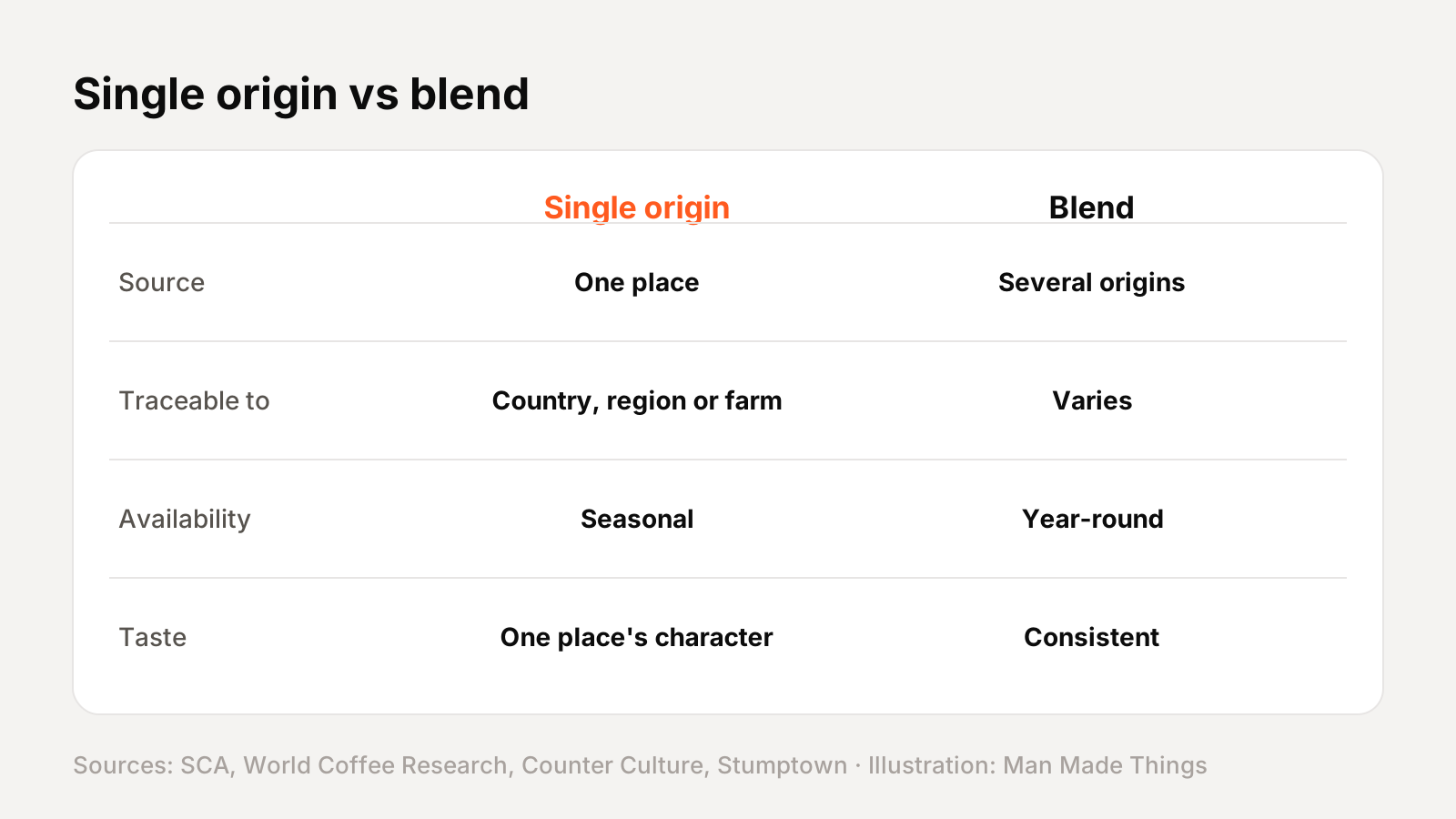
Single origin means the coffee comes from one place, but "place" can mean a lot. Counter Culture admits the term depends "a LOT on the context": a bag labeled "Ethiopian Coffee" is single origin at the country level, while Counter Culture's own single origins can be traced to a region, a cooperative and even an individual farm. Single origins are seasonal, so they come and go.
A blend mixes coffees from different places for a consistent taste. Stumptown explains that its Hair Bender blend combines washed Central and South American coffees for sweetness, East African coffees for floral notes and Indonesian coffees for syrupy body. The recipe changes with the seasons to keep the flavor the same.
Which to choose: single origins show off one place's character; blends are made to taste consistent year-round, and are often a great choice for espresso and milk drinks.
Country, region, farm and producer
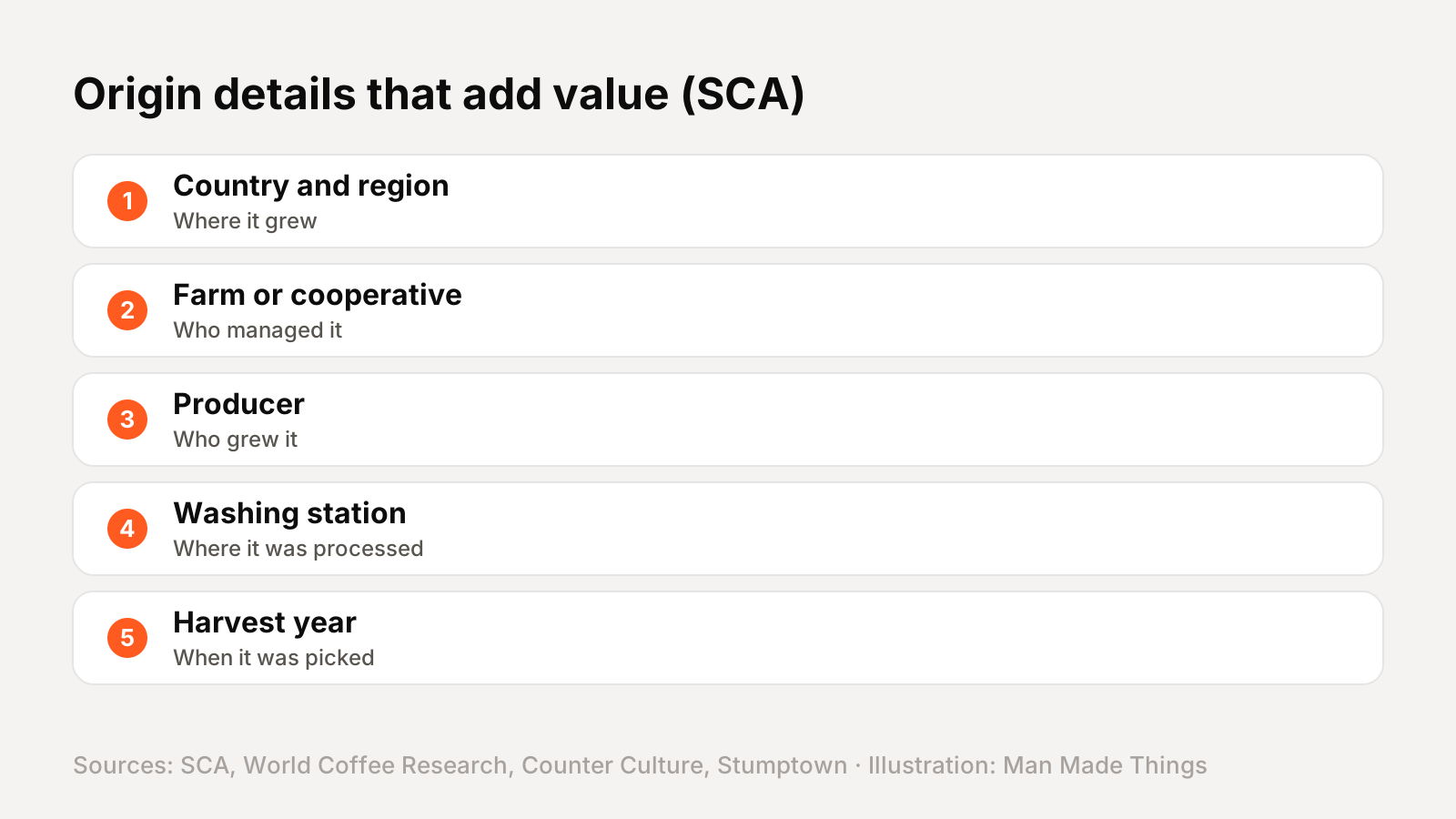
The more detail on the bag, the more traceable the coffee. The SCA's Coffee Value Assessment lists the kinds of origin information that add value to a coffee, including:
- Country and region
- Farm or cooperative name
- Producer(s): the people who grew it
- Washing station or wet mill: where the cherries were processed
- Harvest year
The SCA counts these as "extrinsic" attributes: things you can't taste directly but that add value, like traceability and how the coffee was grown. A bag that names a farm and producer is usually from a roaster that knows exactly where its coffee came from.
Variety: Geisha, Bourbon, Caturra and more
Just as wine has grape varieties, coffee has plant varieties. Most specialty coffee is arabica. World Coffee Research explains that two old lines, Typica and Bourbon, form the basis of most modern arabica. Robusta is a different species, with about double arabica's caffeine, according to Counter Culture.
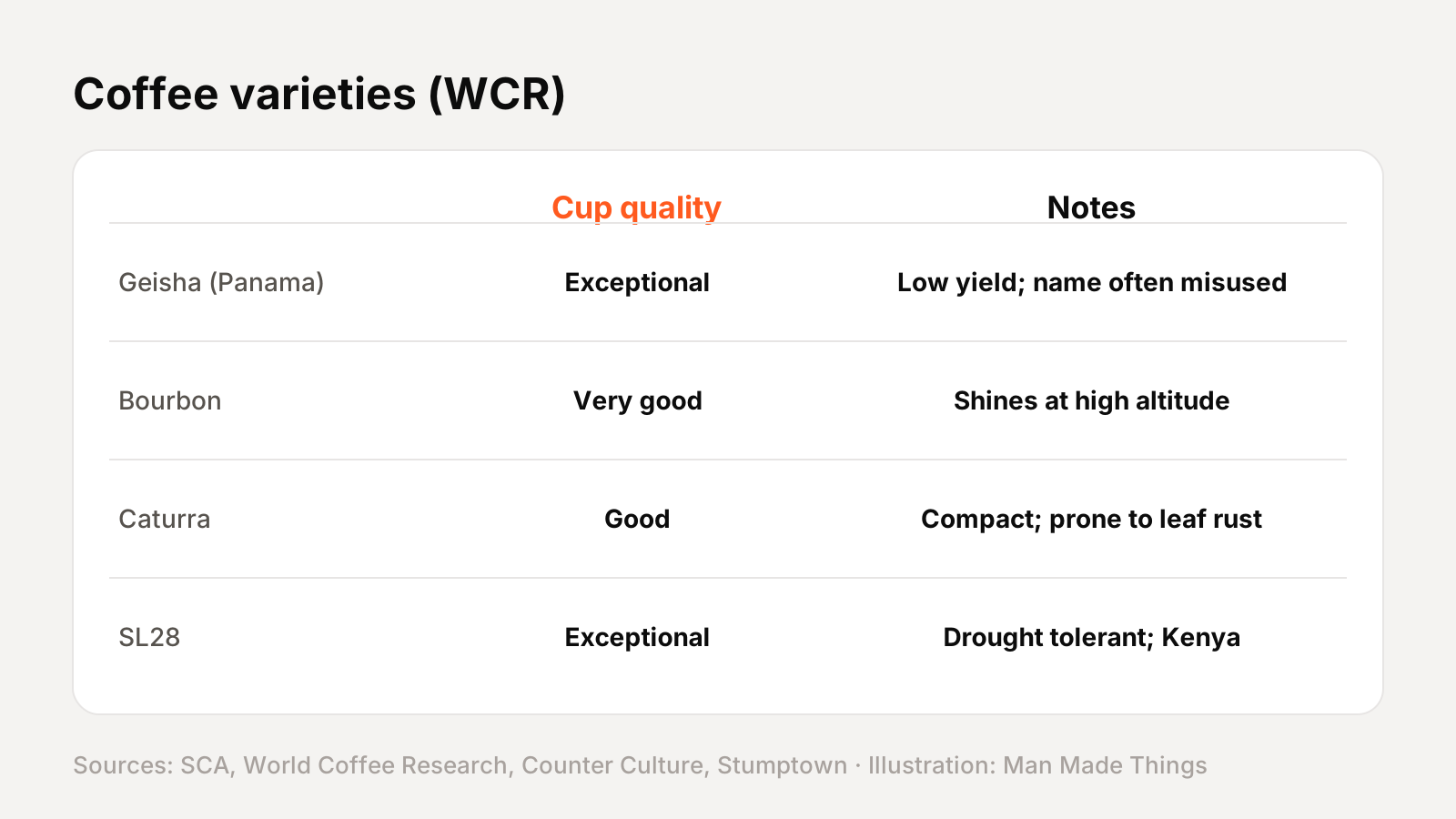
A few varieties you'll see, with WCR's ratings for cup quality at high altitude:
| Variety | Cup quality (high altitude) | Notes from WCR |
|---|---|---|
| Geisha (Panama) | Exceptional | Low yield; WCR notes the name is often used for coffees without true Panama Geisha genetics |
| Bourbon | Very good | Excellent cup quality at the highest altitudes |
| Caturra | Good | Compact plant, very susceptible to leaf rust |
| SL28 | Exceptional | Drought tolerant; common in Kenya |
You'll sometimes see "varietal" used instead of "variety" on bags; World Coffee Research and Counter Culture both use "variety."
Altitude (MASL)
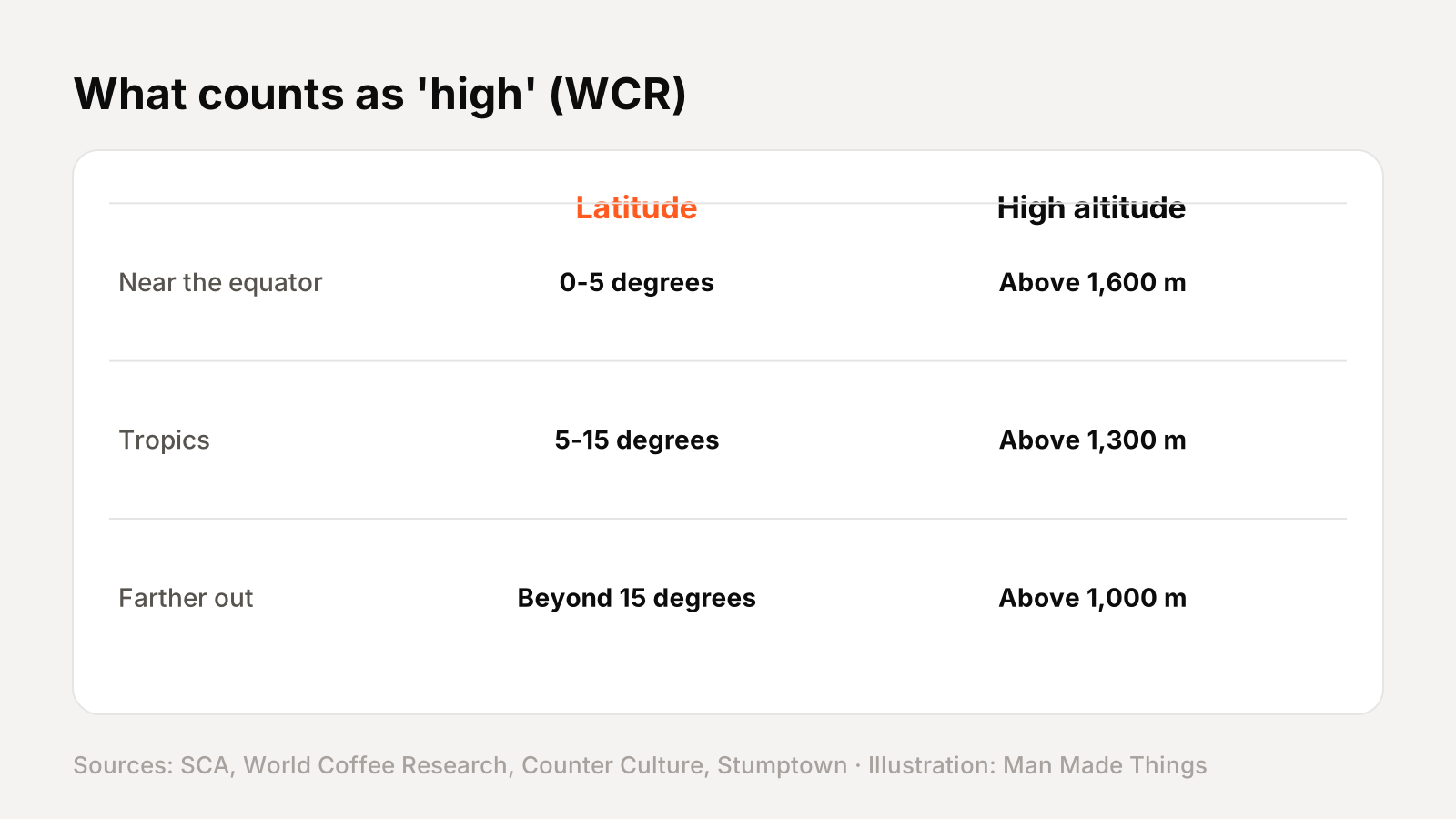
Altitude is usually printed in MASL (meters above sea level). Counter Culture explains that day-to-night temperature swings at higher altitudes slow the coffee's growth and make it more complex: "with all other variables fixed, the higher a coffee is grown, the higher the cup quality."
But "high" depends on where in the world the coffee grows. World Coffee Research defines high altitude as:
- above 1,600 m within 5° of the equator;
- above 1,300 m between 5° and 15°; and
- above 1,000 m beyond 15°.
So 1,200 meters counts as high far from the equator, but not within 15° of it.
Process: washed, natural, honey and anaerobic
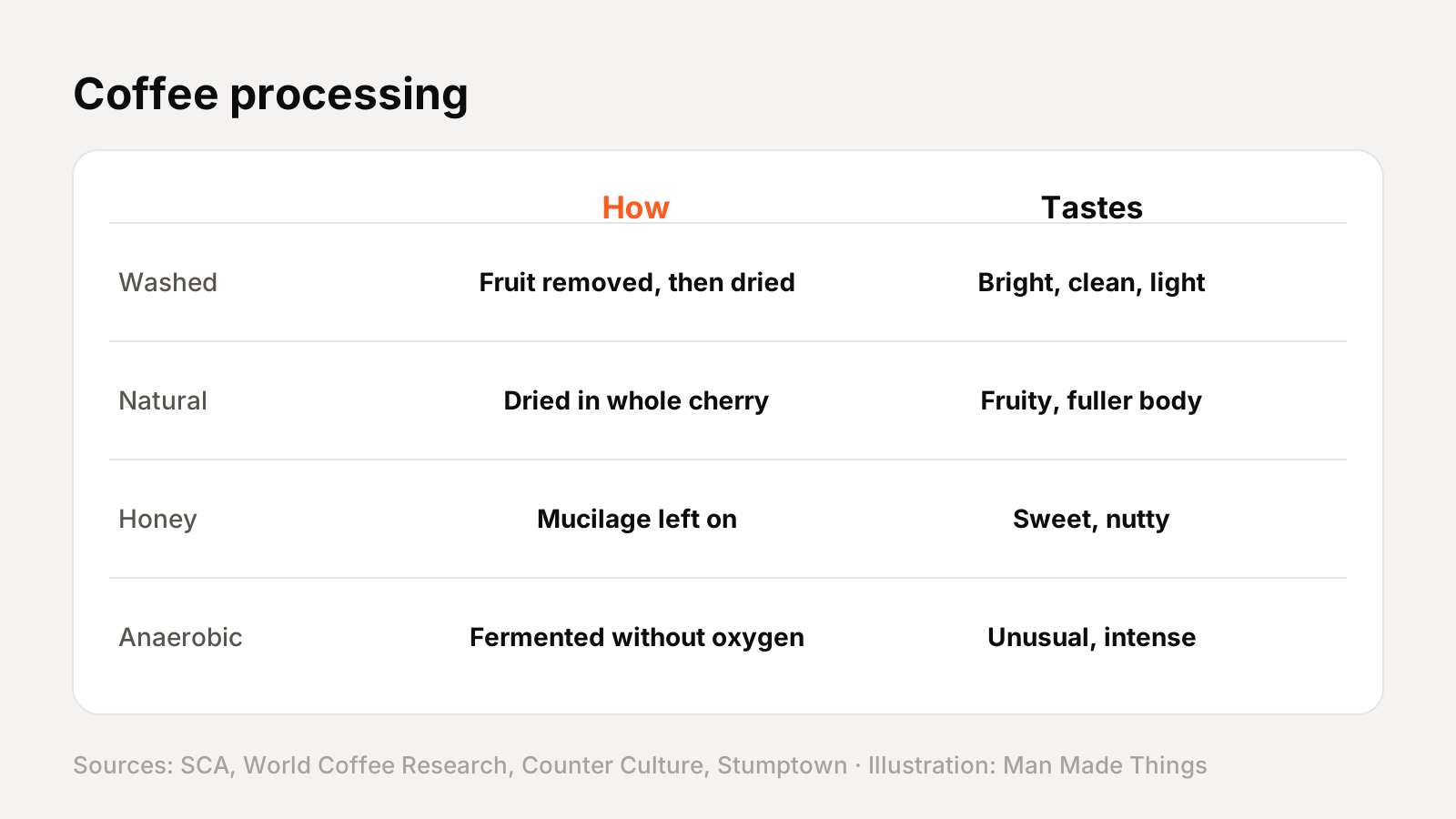
Process is how the coffee seed is separated from the cherry around it, and it has a big effect on flavor. From Counter Culture's explanations:
| Process | How it's done | How it tends to taste |
|---|---|---|
| Washed (wet) | Fruit is removed, the seeds ferment to break down the sticky layer, then they're washed and dried | Brighter acidity, cleaner, lighter body |
| Natural (dry) | Whole cherries dry in the sun for three to six weeks before the fruit is removed | Fruitier, fuller body, often berry-like |
| Honey (pulped natural) | Fruit is removed but the sticky mucilage stays on while drying | Milder fruit than a natural; sweeter, nuttier |
Counter Culture adds that neither washed nor natural is "cleaner" or safer; they're just different.
Anaerobic processing, explained by Intelligentsia, ferments coffee in an oxygen-free environment, which can create unusual, intense flavors. Taken too far, Intelligentsia says, it can taste over-fermented or "boozy."
Tip: if you like bright, tea-like coffee, try washed. If you like fruity, jammy coffee, try natural.
Roast level and roast date
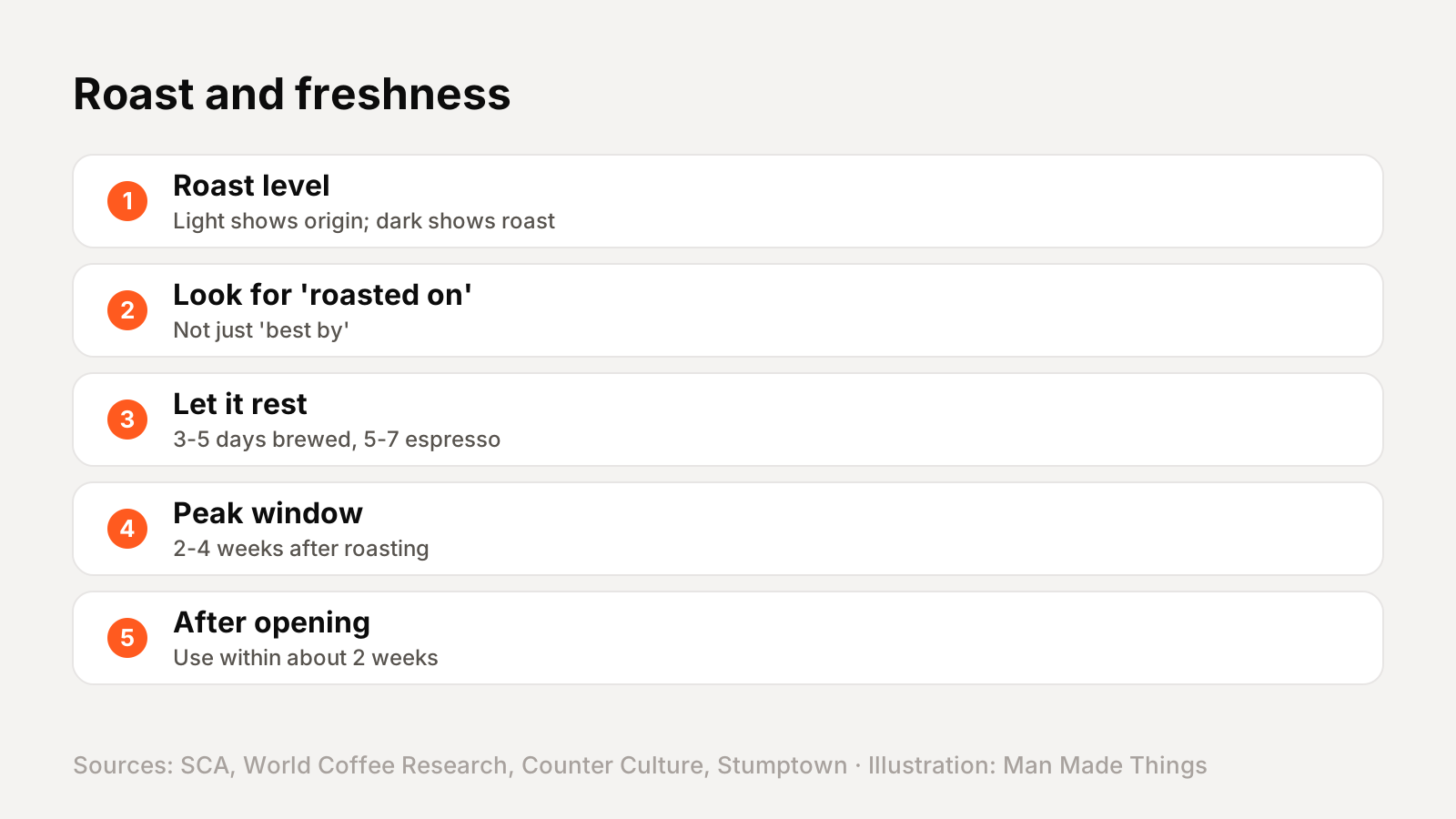
Roast level: Counter Culture explains that lighter roasts emphasize the coffee's own character, while darker roasts emphasize roast flavors. Stumptown adds that lighter roasts have the highest acidity, and dark roasts the lowest. The SCA is still developing an official roast-level standard, so "light" and "medium" vary between roasters. Our roast levels explainer has more.
Roast date: this is the most important date on the bag.
- Look for "roasted on," not just "best by," says Counter Culture.
- Coffee needs to rest: Counter Culture suggests 3–5 days after roasting for brewed coffee, and 5–7 days for espresso.
- Peak window: Counter Culture says coffee is best within 2–4 weeks of roasting; Stumptown says within two weeks, with quality dropping after 30 days.
- After opening: use it within about two weeks, and don't store it in the fridge or freezer, says Counter Culture.
Tasting notes and specialty scores
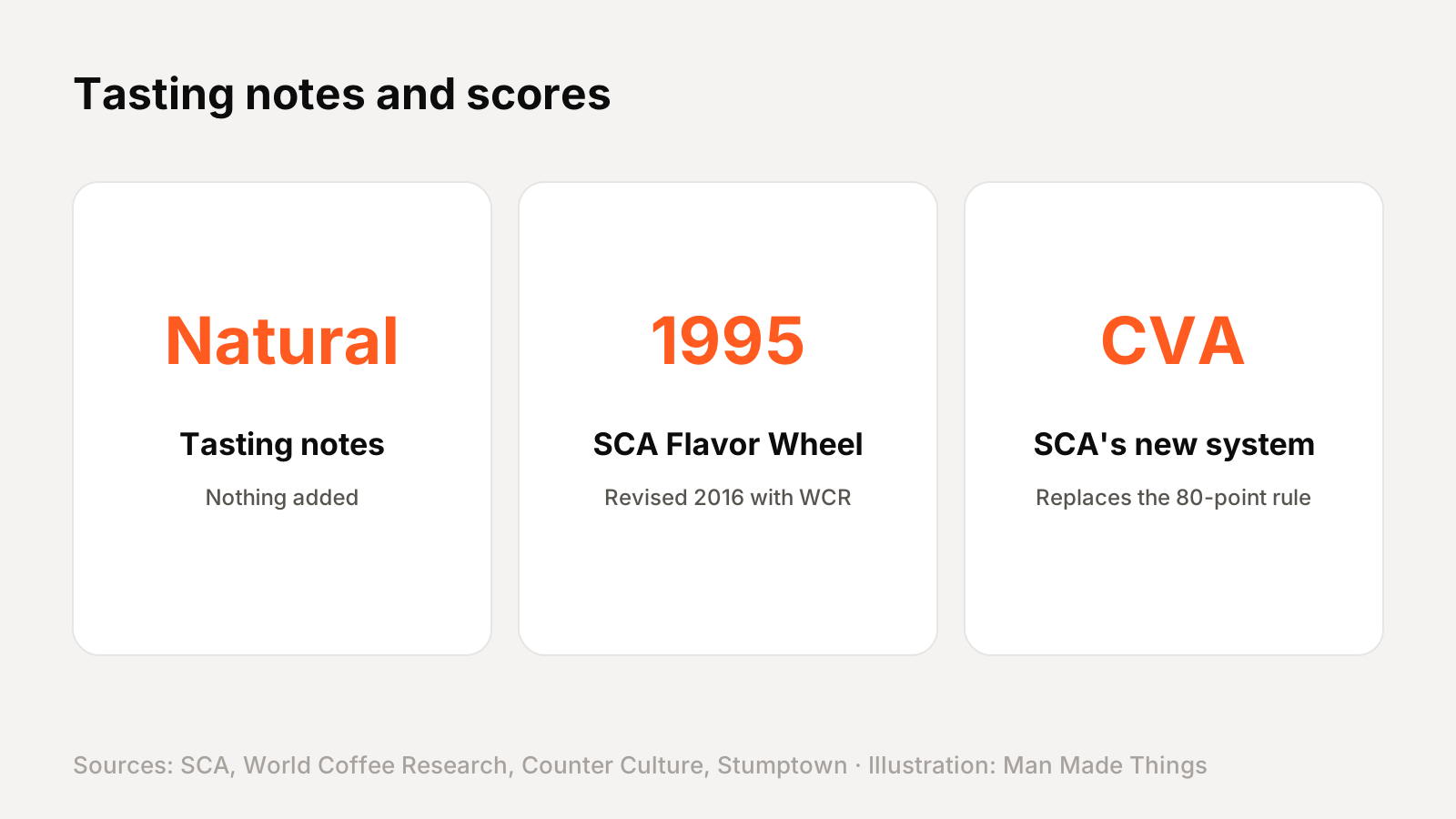
Tasting notes like "milk chocolate, cherry, caramel" don't mean anything was added. Counter Culture is emphatic: "we do not flavor our coffees!" The notes describe flavors that occur naturally in the coffee. Counter Culture picks the three words its team uses most when tasting.
Many roasters use the SCA Coffee Taster's Flavor Wheel, first published in 1995 and revised in 2016 with World Coffee Research. Counter Culture suggests reading it from the center (broad categories, like "fruity") outward to specific flavors.
Scores and "specialty": you may see a score like "86 points" on a bag. That comes from cupping, a standardized tasting. Note that the SCA has moved away from defining specialty coffee as anything scoring over 80 points. It now defines specialty coffee by its distinctive attributes and extra value in the market, and uses a newer system called the Coffee Value Assessment. Professional tasters can be licensed as Q Graders through the SCA.
Certifications and decaf
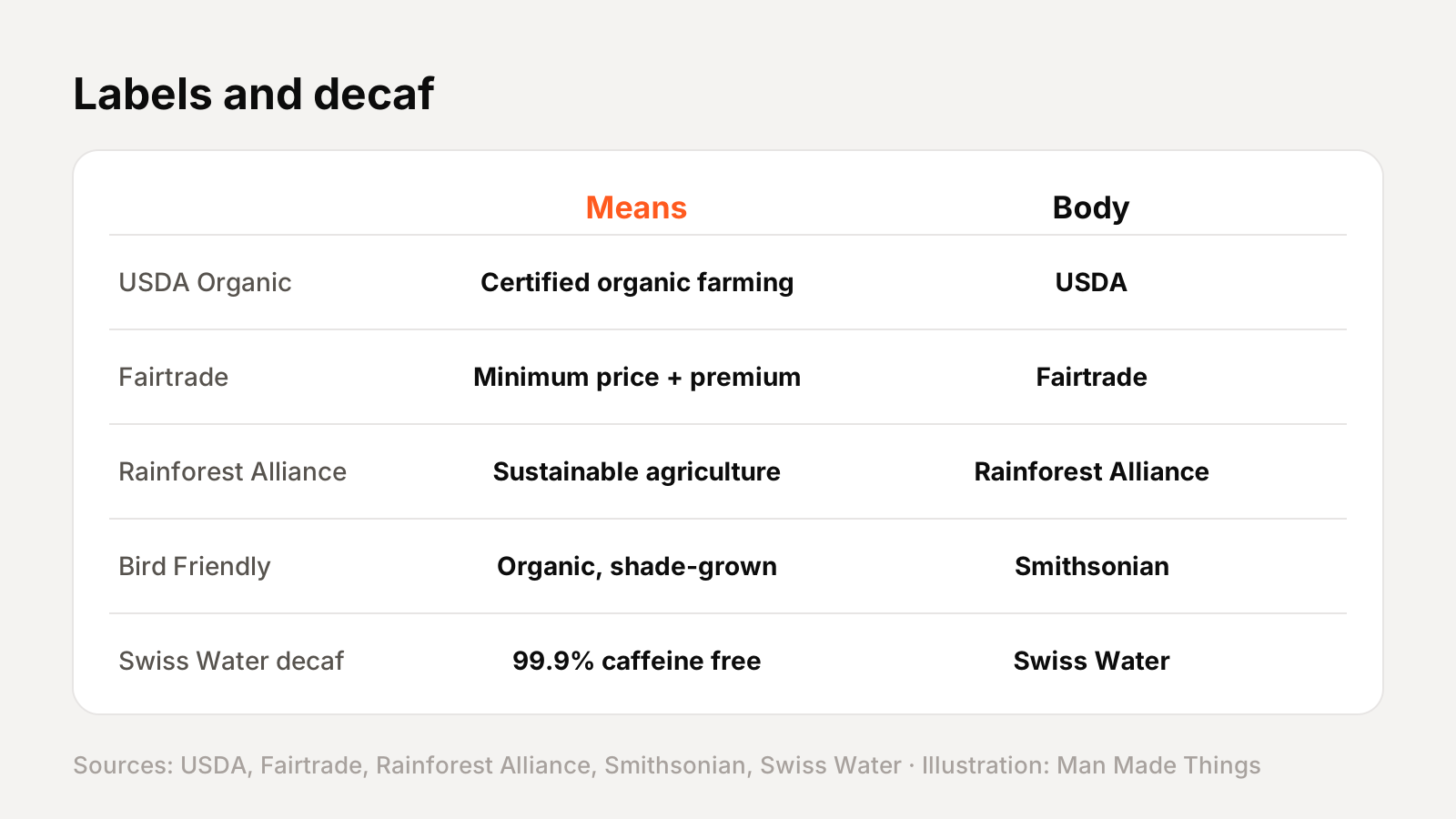
| Label | What it means |
|---|---|
| USDA Organic | Overseen by a USDA-accredited certifier; no genetic engineering, irradiation or sewage sludge |
| Fairtrade | A minimum price "safety net" for farmers, plus a premium for community projects |
| Fair Trade USA | Standards on livelihoods, safe working conditions, the environment and traceability; forced and child labor prohibited |
| Rainforest Alliance | The green frog seal, based on a standard covering forests, livelihoods, human rights and climate |
| Smithsonian Bird Friendly | 100% organic, shade-grown and deforestation-free farms, inspected against Smithsonian criteria |
Decaf: Counter Culture says decaffeination happens before roasting and removes at least 97% of the caffeine.
- Swiss Water Process uses water and green coffee extract, with caffeine captured in carbon filters. Stumptown says its Swiss Water decaf is certified 99.9% caffeine free.
- Sugarcane (ethyl acetate) process uses a compound from sugarcane processing to remove caffeine. Counter Culture uses one from Colombia.
And that valve on the bag? It's a one-way valve that lets carbon dioxide from freshly roasted beans escape without letting oxygen in, Counter Culture explains. Squeeze excess air out through it after opening, and keep beans whole until you brew: Stumptown says ground coffee starts to oxidize immediately. Our best burr coffee grinders can help.
Frequently asked questions
What does single origin coffee mean?
+
Coffee from one place. That can be a country, a region or a single farm, depending on the roaster.
What's the difference between washed and natural coffee?
+
Washed coffee has the fruit removed before drying and tends to taste brighter and cleaner. Natural coffee dries inside the whole cherry and tends to taste fruitier with more body.
How long after the roast date is coffee best?
+
Counter Culture says within 2–4 weeks of roasting, after resting 3–5 days for brewed coffee.
Are tasting notes added flavors?
+
No. Counter Culture says tasting notes describe flavors that occur naturally in the coffee.
Is specialty coffee anything over 80 points?
+
Not anymore. The SCA now defines specialty coffee by its distinctive attributes and extra market value, using its Coffee Value Assessment.
Sources
- SCA: What is specialty coffee
- SCA: Coffee Value Assessment
- SCA: Towards a Definition of Specialty Coffee (PDF)
- SCA: Q Grader
- World Coffee Research: History of arabica
- World Coffee Research: Geisha (Panama)
- World Coffee Research: SL28
- Counter Culture: Single origin
- Counter Culture: Processing
- Counter Culture: Freshness
- Counter Culture: Tasting notes
- Stumptown: How blends are made
- Intelligentsia: Colombia La Mina Anaerobic
- USDA: Organic labeling
- Fairtrade: Coffee
- Fair Trade USA: Coffee
- Rainforest Alliance: What certified means
- Smithsonian: Bird Friendly coffee
- Swiss Water: Our process

Watches & Coffee Writer
Aditya is a passionate coffee lover who loves watches. He covers watches and coffee for Man Made Things.
More from Aditya →