The 5 Best Phono Preamps for Your Turntable
Five phono preamps compared on official specs: the Schiit Mani 3, Fluance PA10, Rega Fono MM MK5, Pro-Ject Phono Box S3 B and Lehmannaudio Black Cube II, plus what a phono preamp does, MM vs MC, and whether you need one.
We may earn a commission when you buy through links on this page. Learn more
Quick answer
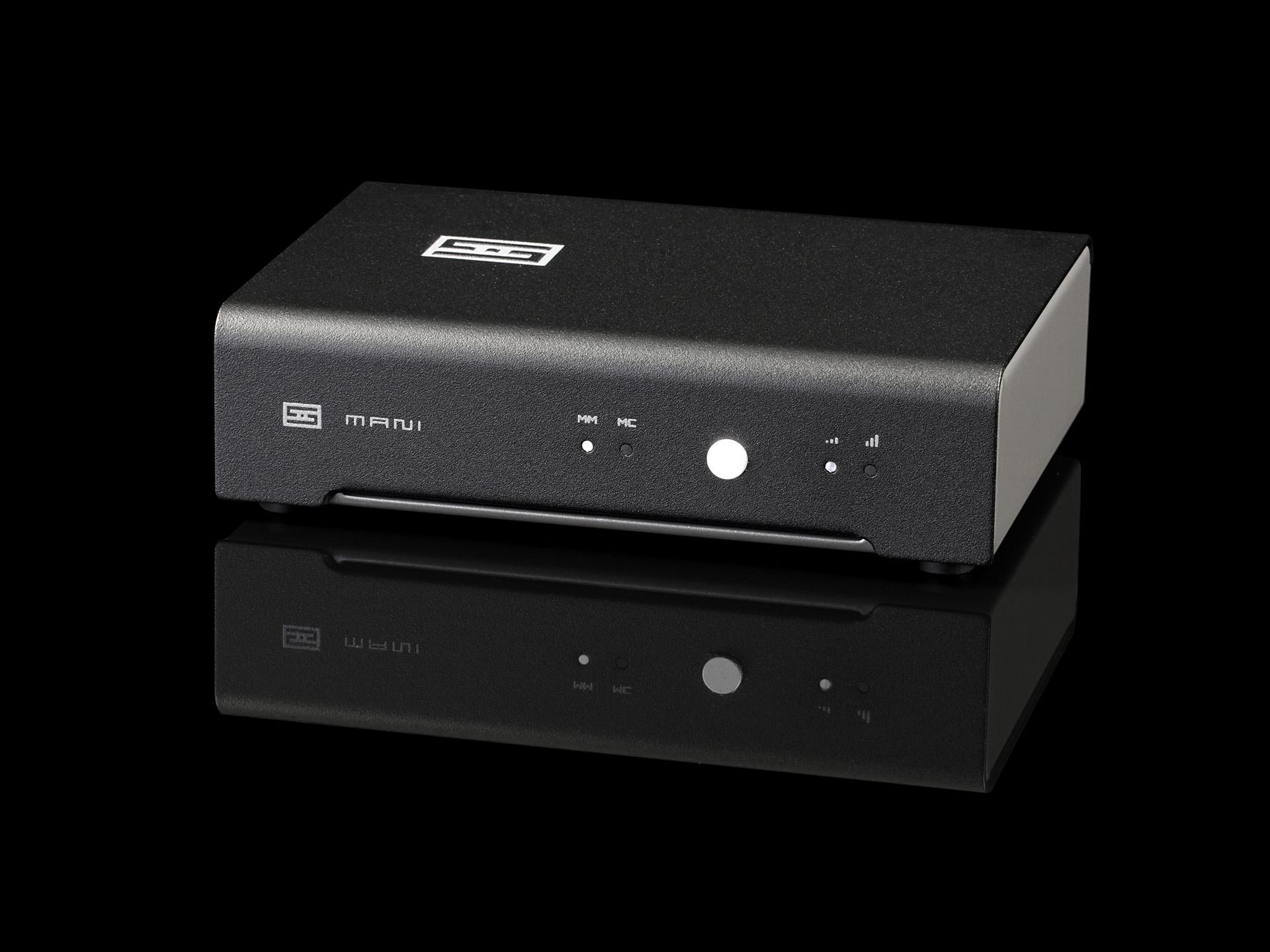
The Schiit Mani 3 ($149) is the best phono preamp for most people: it handles both MM and MC cartridges with four gain settings, adjustable loading, a passive rumble filter and a linear power supply, and it's built in the USA with a 3-year warranty. The Fluance PA10 ($99.99) is the best budget MM pick, the Rega Fono MM MK5 is the best made-in-England MM stage, the Pro-Ject Phono Box S3 B adds balanced XLR outputs, and the Lehmannaudio Black Cube II is the high-end German option.
A turntable's cartridge produces a tiny signal, far too quiet for an amplifier's normal inputs. A phono preamp boosts it to line level and applies the RIAA equalization curve that records are cut with. Fluance puts it simply: a phono preamp is required somewhere in your system for your turntable to play properly.
You may already have one. Fluance notes that some turntables, amplifiers, receivers and powered speakers have one built in. If yours doesn't, or you want better sound or support for a moving coil cartridge, an external phono preamp is one of the most worthwhile upgrades in a vinyl system.
I picked five, from a $99.99 budget box to a German high-end stage. Every spec below comes from each maker's official product page or manual as of November 2026. Only Schiit and Fluance list US prices on their own sites, so for the others I haven't quoted one. These are research-based picks with no star scores. New to vinyl? Start with our best turntables for beginners and how to set up a turntable.
Our picks at a glance
1. Best overall
Schiit Mani 3
Schiit calls the Mani 3 "the phono preamp for everyone," and at $149 it's hard to beat on flexibility. It works with moving magnet, moving coil and moving iron cartridges, with four gain settings, 30, 40, 50 and 60 dB, which Schiit says covers virtually any cartridge from Decca to low-output MC.
Gain and loading switch from the front panel. You choose MM (47k ohms, 50pF) or MC (100 ohms, 50pF), and extra switches let you fine-tune the MM load with 10 and 50 ohm resistive options and 100, 150 and 200pF capacitance. A passive low-frequency filter, at 6 or 12 dB per octave, helps with warped records and rumble.
Inside, Schiit uses Analog Devices' ultra-low-noise AD4898, a passive RIAA network with 2% precision film capacitors and 0.1% thin-film resistors, and a 100% linear power supply, which Schiit says gives an extremely high overload margin. It's designed, built and supported in the USA, with a 3-year limited warranty and 15-day returns.
Pros
- 01MM and MC with four gain settings
- 02Adjustable loading from the front panel
- 03Linear power supply
- 04Built in the USA, 3-year warranty
Cons
- 01No balanced XLR output
- 0215% restocking fee on returns
| Cartridges | MM, MC, MI |
|---|---|
| Gain | 30, 40, 50 or 60 dB |
| Loading | MM 47k/50pF, MC 100Ω/50pF, plus custom options |
| RIAA | Passive network, 2% film caps |
| LF filter | Passive, 6 or 12 dB/octave |
| Power | 100% linear supply |
| Made in | USA; 3-year warranty |
2. Best budget
Fluance PA10 High Fidelity Phono Preamp
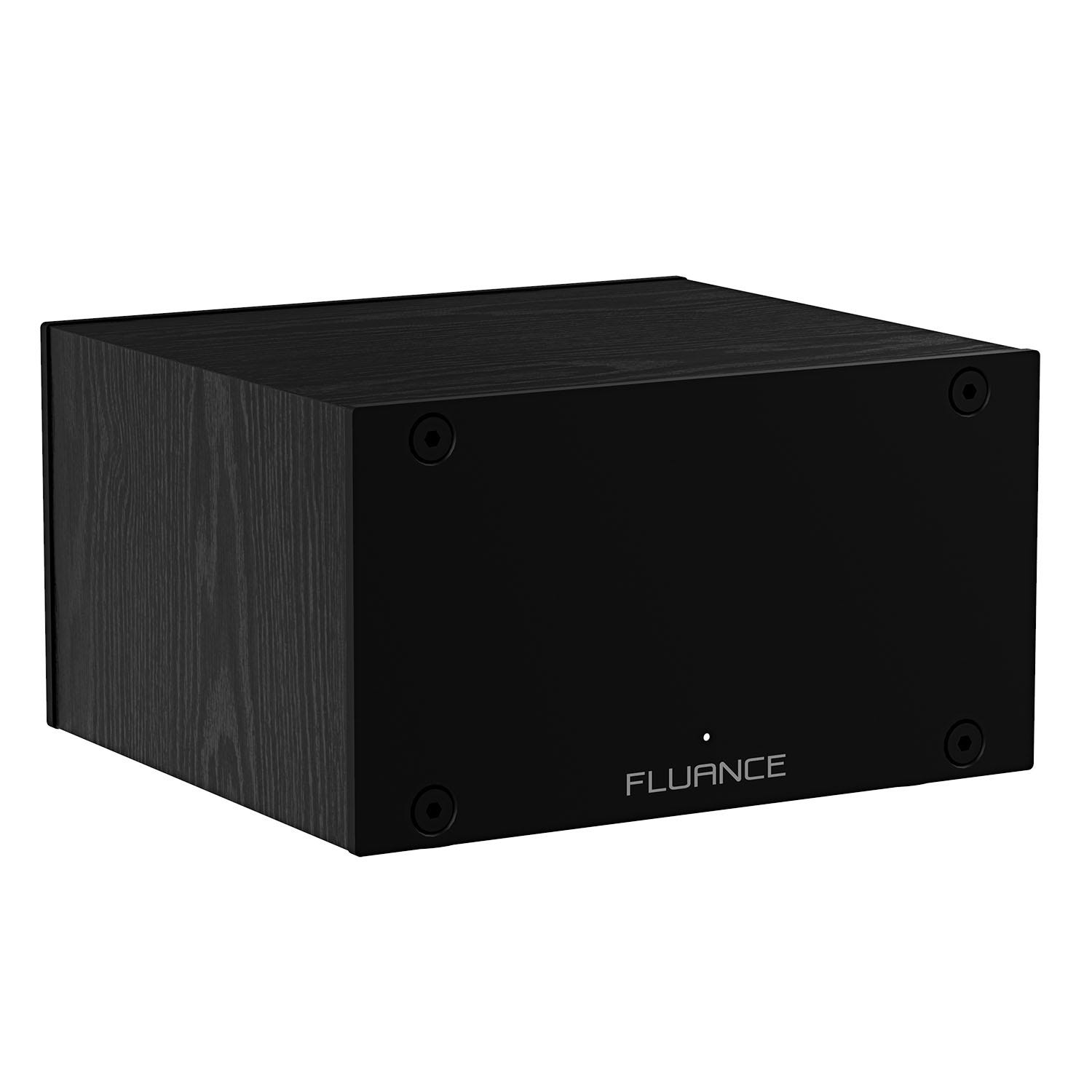
Fluance's PA10 is a simple, affordable upgrade for moving magnet cartridges. Fluance lists it at $99.99.
It provides a fixed 38 dB of gain with the standard 47k ohm, 100pF MM load, and Fluance quotes RIAA accuracy within ±0.5 dB from 20 Hz to 20 kHz, a signal-to-noise ratio above 90 dB and 0.004% distortion. The RIAA equalization is passive, built around Texas Instruments op-amps, and a selectable 20 Hz high-pass filter cuts rumble.
It's housed in an MDF case with a wood-look finish and an internal metal shield, and has RCA inputs and outputs plus a ground terminal. Power comes from an external 24-volt adapter. If you ever move to a moving coil cartridge, you'll need a different preamp, but for most people starting out, the PA10 does the job for less than $100.
Pros
- 01Under $100
- 02Rumble filter
- 03Ground terminal
- 042-year warranty
Cons
- 01MM only
- 02Fixed gain and loading
- 03Wall adapter, not linear supply
| Cartridges | MM only |
|---|---|
| Gain | 38 dB |
| Loading | 47 kΩ / 100 pF |
| RIAA accuracy | ±0.5 dB, 20 Hz–20 kHz |
| S/N | >90 dB |
| Rumble filter | Selectable, 20 Hz |
| Warranty | 2 years |
3. Best made in England
Rega Fono MM MK5
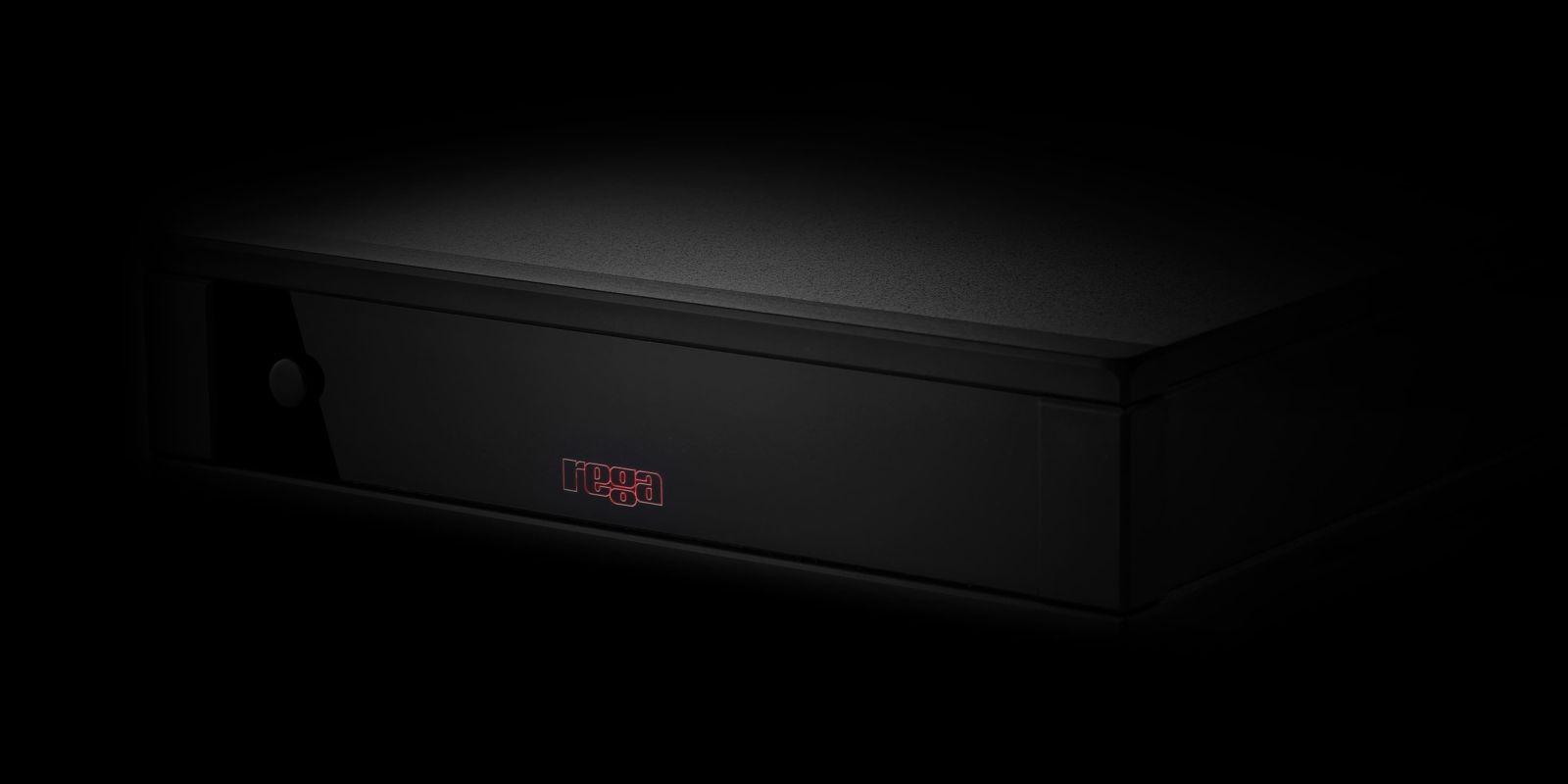
Rega makes turntables as well as phono stages. The Fono MM MK5 is a moving magnet stage that Rega's manual says is made in England.
Rega specifies 41.4 dB of gain at 1 kHz, the standard 47k ohm, 100pF load and a 60 mV maximum input, giving plenty of headroom above its 1.7 mV rated sensitivity. It uses two-stage RIAA equalization, which Rega says is accurate to better than ±0.2 dB from 100 Hz to 100 kHz, the tightest accuracy figure among the MM picks here.
It's powered by Rega's external PS1 supply, with a US version available, and Rega backs it with a lifetime warranty against manufacturing defects. Rega's US distributor lists it but sends buyers to local retailers, so check a dealer for pricing. If you use a moving coil cartridge, Rega's Fono MC MK4 offers 63.5 or 69.5 dB of gain.
Pros
- 01Made in England
- 02±0.2 dB RIAA accuracy
- 0360 mV maximum input
- 04Lifetime warranty
Cons
- 01MM only
- 02No published US price
- 03No rumble filter listed
| Cartridges | MM |
|---|---|
| Gain | 41.4 dB at 1 kHz |
| Loading | 47 kΩ / 100 pF |
| RIAA accuracy | Better than ±0.2 dB, 100 Hz–100 kHz |
| Max input | 60 mV |
| Power | External Rega PS1 |
| Warranty | Lifetime (manufacturing defects) |
4. Best for balanced systems
Pro-Ject Phono Box S3 B
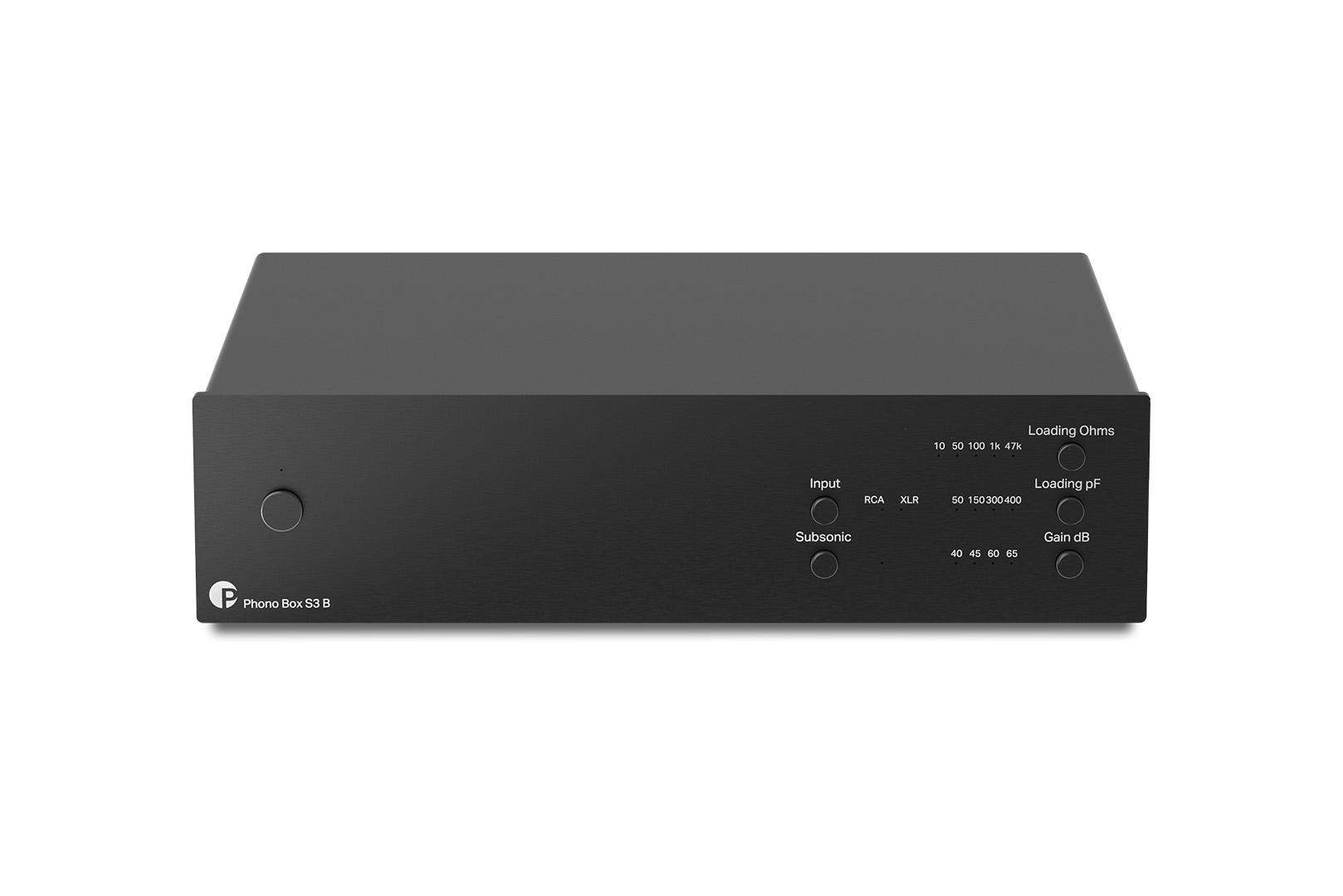
The Phono Box S3 B is the most connected preamp here. Pro-Ject gives it both RCA and balanced XLR outputs, plus two inputs, RCA and a balanced 5-pin mini-XLR, so you can connect two turntables or a tonearm with balanced wiring.
It handles MM and MC cartridges with gain settings of 40, 45, 60 and 65 dB, and Pro-Ject says the XLR outputs add another 6 dB. Loading is the most extensive here, from 10 ohms to 47k ohms and 50 to 400pF, set from the front panel and stored separately for each input. Pro-Ject quotes RIAA accuracy within 0.3 dB and includes a 20 Hz, 18 dB per octave subsonic filter.
Pro-Ject says it uses a fully discrete, symmetrical gain stage, and that it's handmade in the EU. Power is from an external 18-volt supply. Pro-Ject's US distributor site wasn't available when I checked, so I couldn't confirm a US price; check an authorized dealer.
Pros
- 01Balanced XLR outputs
- 02Two inputs, incl. mini-XLR
- 03Widest loading options
- 04Subsonic filter
Cons
- 01No US price confirmed
- 02Most complex to set up
| Cartridges | MM and MC |
|---|---|
| Gain | 40, 45, 60, 65 dB (+6 dB via XLR) |
| Loading | 10Ω–47kΩ and 50–400 pF |
| RIAA accuracy | <0.3 dB, 20 Hz–20 kHz |
| Outputs | RCA and balanced XLR |
| Inputs | RCA and 5-pin mini-XLR |
| Made in | EU (handmade) |
5. Best high-end
Lehmannaudio Black Cube II
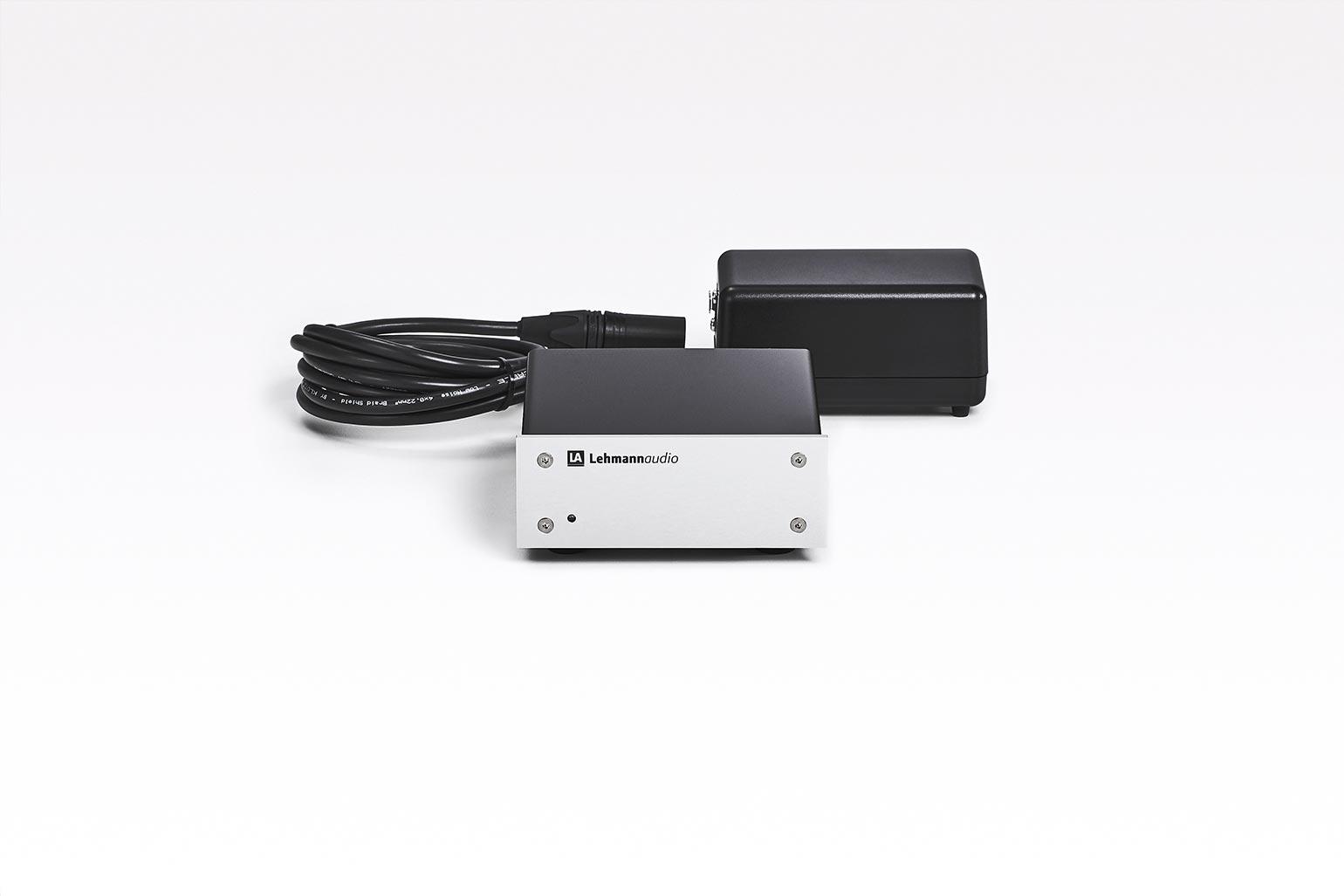
Lehmannaudio's Black Cube II is a German-made MM and MC phono stage. It offers four gain levels, 36, 46, 56 and 66 dB, and loading of 47k ohms, 1k ohm or 100 ohms, plus a custom-load slot per channel; Lehmann says it includes resistors free with an order on request.
Its passive RIAA network uses polypropylene capacitors, and its bass filter is unusually flexible, with 16 settings from 7 Hz up to about 90 Hz, so you can tune out rumble from warped records or a resonant room.
The audio circuit and power supply come in separate boxes. The audio unit is 114 by 124 by 50mm and 0.65 kilograms, with a separate 0.3 kilogram supply. Lehmann's site doesn't list a US price, so check a dealer.
Pros
- 01Made in Germany
- 02Four gain levels for MM and MC
- 0316-step bass filter
- 04Separate power supply box
Cons
- 01No US price published
- 02Outputs not detailed on the product page
| Cartridges | MM and MC |
|---|---|
| Gain | 36, 46, 56 or 66 dB |
| Loading | 47k, 1k or 100Ω, plus custom slot |
| RIAA | Passive, polypropylene capacitors |
| Bass filter | 16 settings, 7 to ~90 Hz |
| Power | Separate external supply |
| Made in | Germany |
MM vs MC cartridges: why gain matters
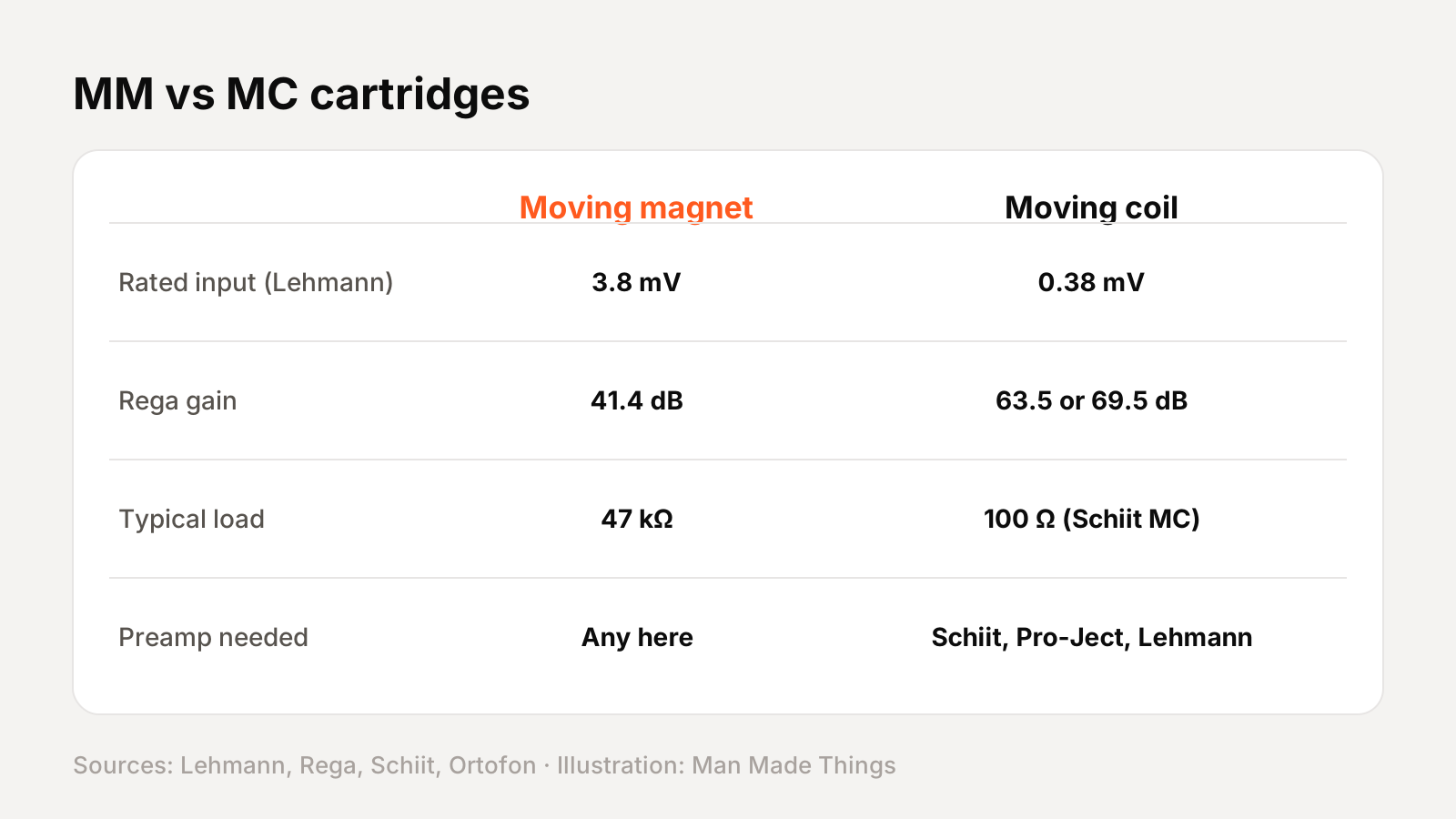
There are two main types of phono cartridge, and they need different amounts of amplification.
Moving magnet (MM): the most common type. Ortofon says MM's high output suits a wide range of phono preamps. Lehmann rates its Black Cube II's MM input for 3.8 mV.
Moving coil (MC): Ortofon explains that MC designs use coils with few turns, giving them low impedance and low output voltage, which needs extra amplification. Lehmann rates its MC input for just 0.38 mV, about a tenth of MM.
That's why gain settings matter. Rega's MM stage uses 41.4 dB, while its MC stage uses 63.5 or 69.5 dB. Ortofon says MC needs either a step-up transformer or an MC phono preamp.
What this means for you: check your cartridge's type and output in its specs. If it's MM, any preamp here will work. If you're upgrading to an MC cartridge, choose the Schiit Mani 3, Pro-Ject Phono Box S3 B or Lehmann Black Cube II.
Do you need a phono preamp?
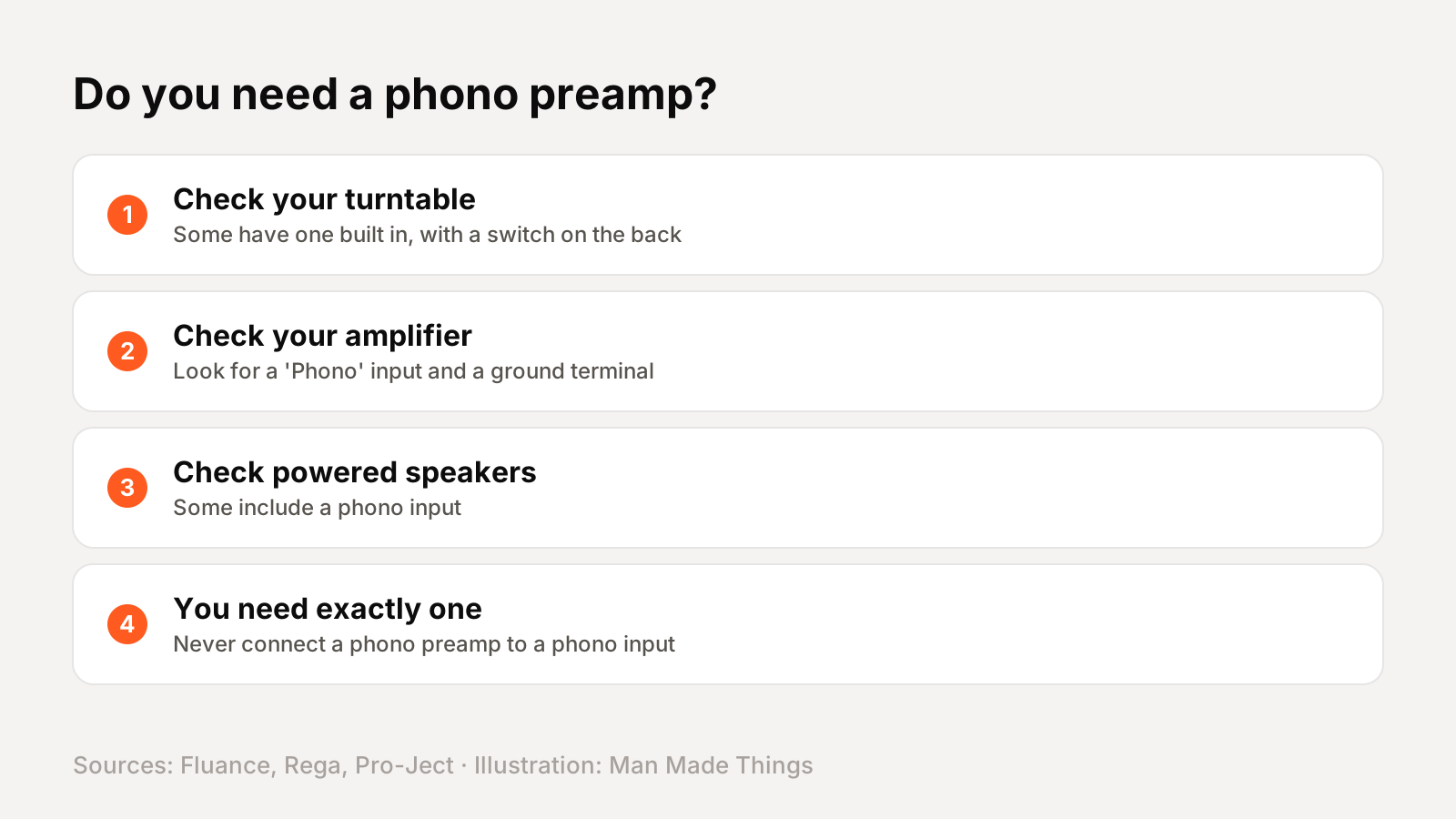
You need exactly one phono stage in your system, no more and no less. Fluance says to look in three places:
- Your turntable: some turntables, like Fluance's RT80 and RT81, have one built in, usually with a switch on the back.
- Your amplifier or receiver: Fluance says the clues are an input labeled "Phono" and a ground terminal.
- Powered speakers: some have a phono input.
Don't double up. Rega's manual is direct: if your integrated amplifier has a built-in phono stage, do not connect the Fono to that input; connect it to a line input instead. Pro-Ject gives the same warning.
Why add one anyway? An external preamp can sound better than a basic built-in one, add a rumble filter, or support MC cartridges. Fluance notes you may need to bypass your turntable's own preamp to use an external or receiver one.
Loading, rumble filters and power supplies
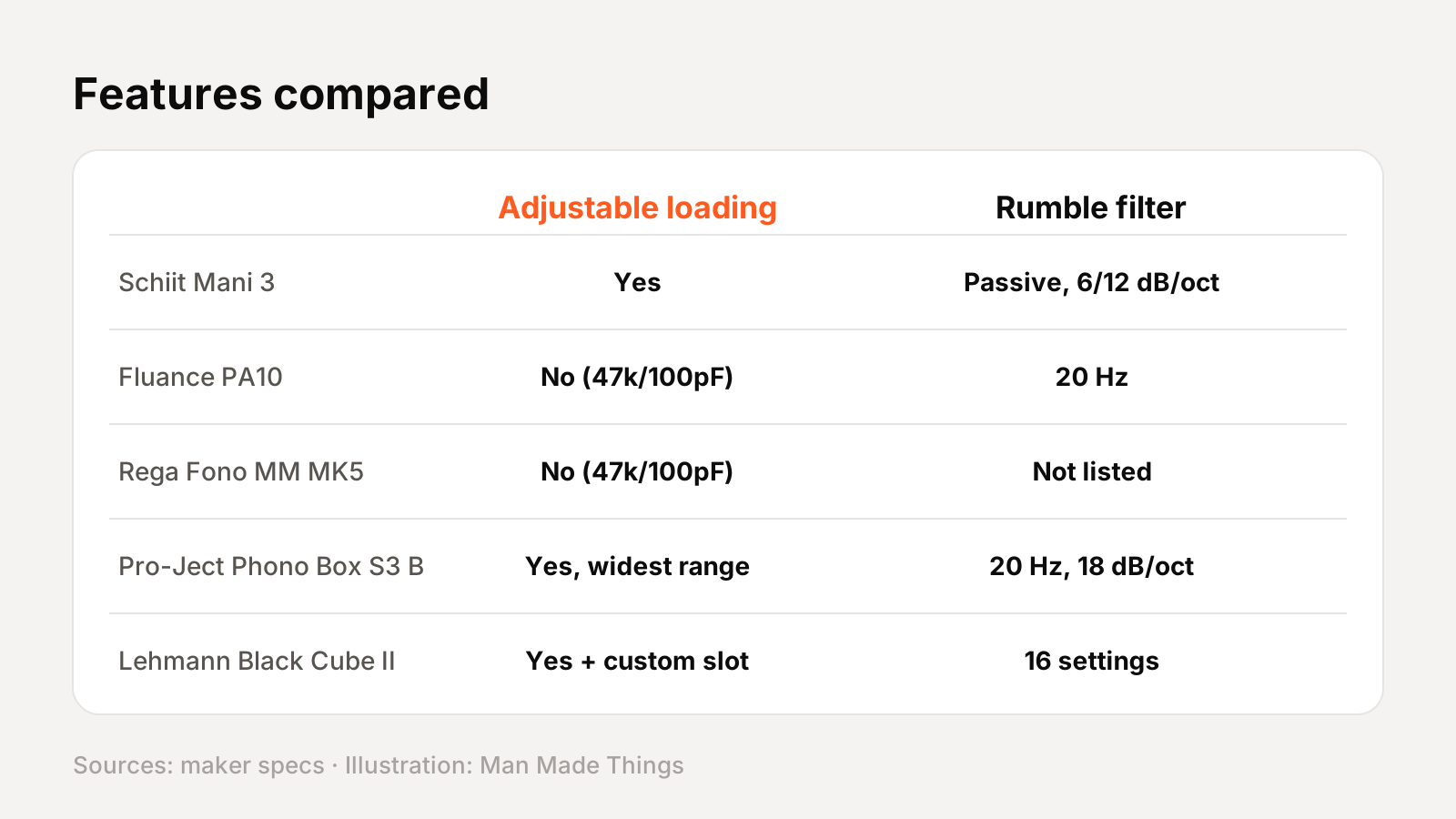
Beyond gain, three features separate basic preamps from better ones.
Loading: cartridges are designed to see a certain resistance and capacitance. The standard MM load is 47k ohms, which every pick here supports. The Schiit, Pro-Ject and Lehmann let you change it, which matters most for MC cartridges. Check your cartridge's recommended load.
Rumble or subsonic filters cut very low frequencies from warped records or turntable vibration. The Fluance has a 20 Hz filter, the Pro-Ject a 20 Hz, 18 dB per octave filter, the Schiit a passive 6 or 12 dB per octave filter, and the Lehmann a 16-step filter.
Power supplies: the picks take different approaches. Schiit uses a 100% linear power supply, Lehmann puts its supply in a separate box, and Rega uses its dedicated PS1.
Once your preamp is set, keep your records and stylus clean for the best sound: see our how to clean vinyl records guide.
Frequently asked questions
What is the best phono preamp?
+
For most people, the Schiit Mani 3 ($149), which handles MM and MC cartridges with four gain settings, adjustable loading and a linear power supply.
Do I need a phono preamp if my amp has a phono input?
+
No. You need exactly one phono stage. Rega warns not to connect an external phono stage to a phono input; use a line input instead.
What's the difference between MM and MC preamps?
+
MC cartridges have much lower output, about 0.4 mV versus about 4 mV for MM on Lehmann's specs, so they need more gain, around 60 dB or more.
What does a rumble filter do?
+
It cuts very low frequencies from warped records or vibration. The Fluance PA10, Schiit Mani 3, Pro-Ject S3 B and Lehmann Black Cube II all have one.
Sources
Editor-in-Chief
Rahul has been writing about gadgets and software since 2013, first at Thetechhacker and now at Man Made Things. He edits every review on the site and signs off on every verdict.
More from Rahul →