The 5 Best Hi-Res Music Players (DAPs): FiiO, Sony and Astell&Kern
Five hi-res digital audio players compared on official specs: the FiiO JM21, FiiO M23, Sony NW-ZX707, Astell&Kern KANN ULTRA and A&ultima SP4000, plus what hi-res audio means and whether you need a 4.4mm balanced output.
We may earn a commission when you buy through links on this page. Learn more
Quick answer
The FiiO M23 is the best hi-res music player for most people: it runs Android for streaming apps, has a 4.4mm balanced output with up to 1,000 mW per channel, and works as a USB DAC. The FiiO JM21 is the best budget pick, the Sony NW-ZX707 has the best battery life (about 23 hours of 96 kHz FLAC), the Astell&Kern KANN ULTRA ($1,600) is the most powerful, and the A&ultima SP4000 ($4,300) is the flagship.
Your phone can play music, so why buy a separate player? Three reasons: a better headphone output, a battery that isn't shared with everything else you do, and support for high-resolution files and balanced headphones that most phones no longer offer. Many phones don't even have a headphone jack anymore.
A digital audio player, or DAP, is built for one job. The five here all play hi-res files up to at least 384 kHz, support native DSD, and have both a standard 3.5mm jack and a 4.4mm balanced output for better headphones.
Every spec below comes from the maker's own website. Astell&Kern lists US prices; FiiO and Sony don't list US prices on their official sites, so I haven't quoted one. Check the retailer before buying. These are research-based picks with no star scores. Need headphones to match? See our best headphones over $3,000 and best wired headphones guides.
Our picks at a glance
1. Best overall
FiiO M23
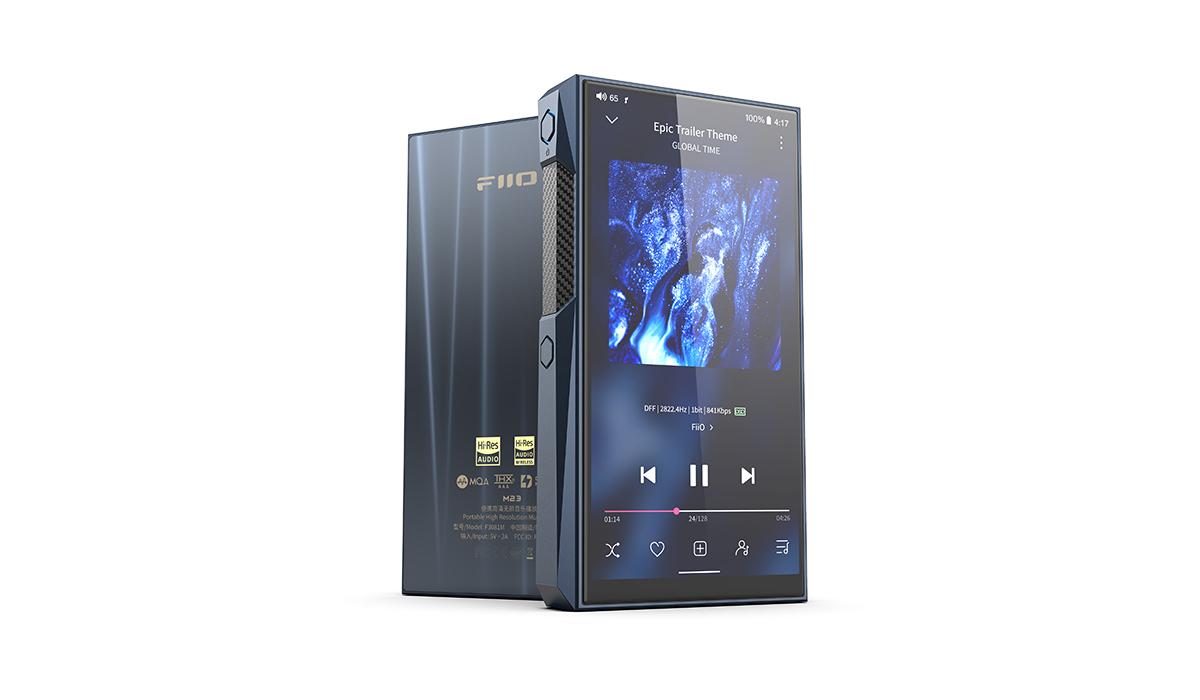
The M23 has the best balance of features for most people. It runs Android with a Snapdragon 660 chip and 4 GB of RAM, so you can install streaming apps, and FiiO also lists a Pure Music mode, AirPlay and Roon Ready support.
Its audio hardware is serious. FiiO pairs AKM's AK4191EQ and AK4499EX chips with a four-way THX AAA-78+ amplifier. From the 4.4mm balanced output, FiiO quotes at least 1,000 mW per channel at 32 ohms in its Super High gain mode, and 240 mW at 300 ohms, enough for demanding headphones. FiiO also claims full MQA decoding.
It's also a hub: it works as a USB DAC for your computer, a Bluetooth receiver and has a coaxial digital output. A separate USB-C power input lets you run it from a charger without draining the battery. FiiO quotes about 10.5 hours from the 3.5mm output and 9 hours balanced. At about 299 grams in its standard finish, it's a pocketable but substantial device.
Pros
- 01Android with streaming apps
- 02Up to 1,000 mW balanced
- 03USB DAC, AirPlay and Roon Ready
- 04Separate power input
Cons
- 01No official US price listed by FiiO
- 02About 299 g, or 392 g in steel
| DAC | AKM AK4191EQ + AK4499EX |
|---|---|
| Max playback | 384 kHz/32-bit, DSD256 |
| Outputs | 3.5mm, 4.4mm balanced, coaxial |
| Power (4.4mm) | Up to 1,000 mW + 1,000 mW at 32Ω |
| Storage | 64 GB + microSD up to 2 TB |
| Battery | 5,500 mAh; about 10.5 h (3.5mm) |
| Bluetooth | 5.0: LDAC, aptX HD, LHDC, AAC |
2. Best budget
FiiO JM21
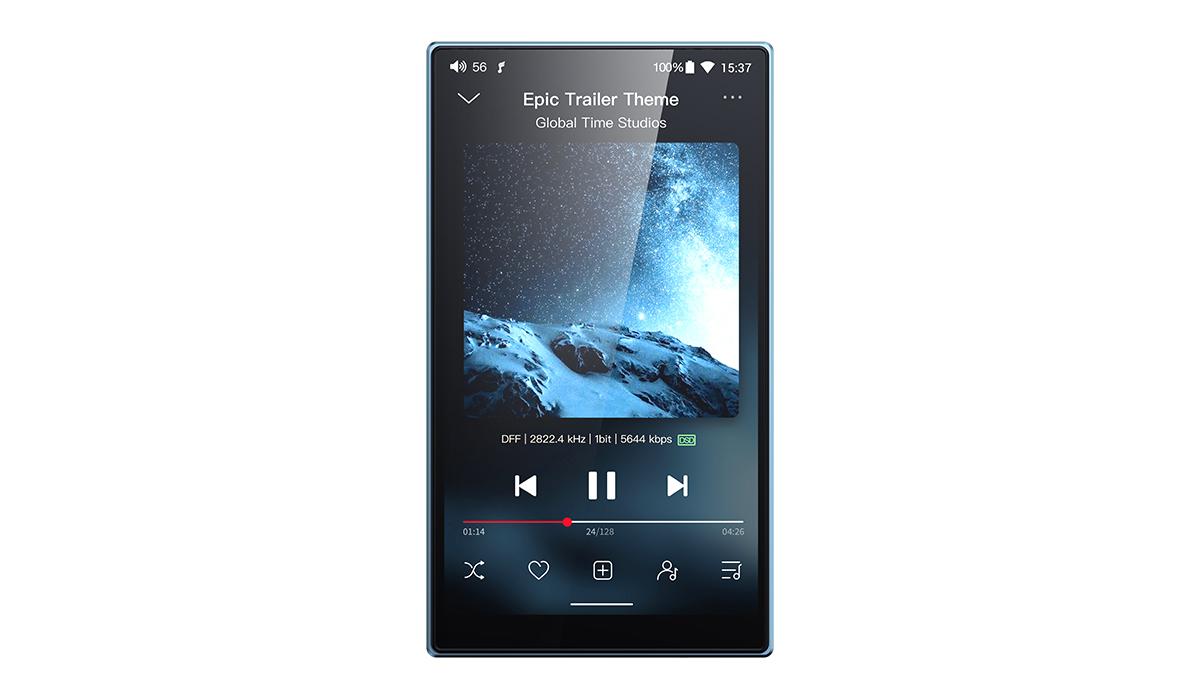
The JM21 is FiiO's compact Android player, and it packs a lot into about 156 grams and 13 mm of thickness. It runs Android 13 on a Snapdragon 680, with a 4.7-inch screen.
Inside are two Cirrus Logic CS43198 DAC chips in a fully balanced design. FiiO quotes 245 mW per channel from the 3.5mm output and 700 mW from the 4.4mm balanced output at 32 ohms, which is a lot of power for a player this small. Both outputs can also act as line outs for an amplifier.
There are two versions. The 3 GB/32 GB model has a 2,400 mAh battery rated for 12.5 hours single-ended, and the 4 GB/64 GB model has a 3,100 mAh battery rated for 16 hours. FiiO itself recommends installing only streaming music apps on the 3 GB model, so if you want more apps, choose the 64 GB version. Both support microSD cards up to 2 TB, AirPlay and LDAC Bluetooth.
Pros
- 01Small and light at about 156 g
- 02700 mW balanced output
- 03Android 13 with streaming apps
- 04Up to 16 h battery (64 GB)
Cons
- 01No official US price listed by FiiO
- 023 GB model is best kept to music apps
| DAC | 2× Cirrus Logic CS43198 |
|---|---|
| Max playback | 384 kHz/32-bit, DSD256 |
| Outputs | 3.5mm, 4.4mm balanced (both line out too) |
| Power (4.4mm) | 700 mW + 700 mW at 32Ω |
| Storage | 32 GB or 64 GB + microSD up to 2 TB |
| Battery | Up to 16 h (64 GB model, 3.5mm) |
| Weight | About 156 g |
3. Best battery life
Sony Walkman NW-ZX707
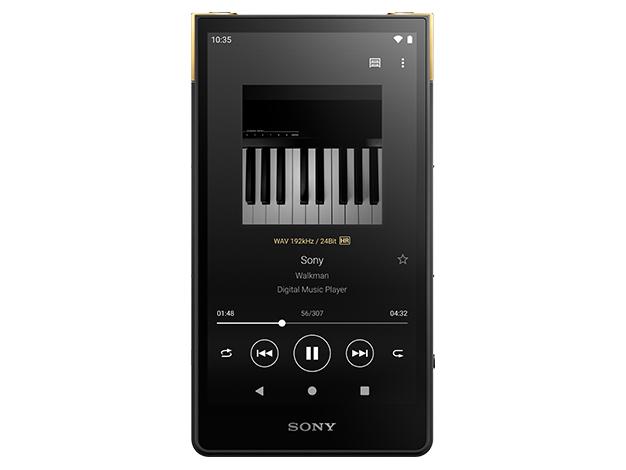
Sony's Walkman name still means something in portable audio, and the ZX707 is its upper-mid model. Its standout feature is battery life: Sony quotes about 23 hours of 96 kHz/24-bit FLAC playback from either the 3.5mm or 4.4mm output, and about 25 hours of MP3. That's well ahead of the other players here.
It uses Sony's S-Master HX digital amplifier rather than a separate DAC chip, and plays FLAC up to 384 kHz and native DSD up to 11.2 MHz, with MQA support. Sony quotes 230 mW per channel from the balanced output at 16 ohms, which is less than the FiiOs, so it's best for efficient headphones and in-ear monitors.
It runs Android with the Google Play Store; Sony says it launched on Android 12 and has been updated to Android 14. It has a 5-inch screen, weighs about 227 grams and works as a USB DAC. Sony has announced a successor, the NW-ZX900, in Japan, but hadn't listed it in the US when I checked.
Pros
- 01About 23 h of hi-res FLAC playback
- 02Android with Google Play
- 03Light at about 227 g
- 04MQA and DSD support
Cons
- 01Less power than the FiiOs
- 02No official US price found
- 03Successor announced in Japan
| Amplifier | S-Master HX digital amp |
|---|---|
| Max playback | 384 kHz FLAC, DSD 11.2 MHz |
| Outputs | 3.5mm, 4.4mm balanced |
| Power (4.4mm) | 230 mW + 230 mW (16Ω) |
| Storage | 64 GB + microSD |
| Battery | About 23 h (FLAC 96 kHz/24-bit) |
| Weight | About 227 g |
4. Most powerful
Astell&Kern KANN ULTRA
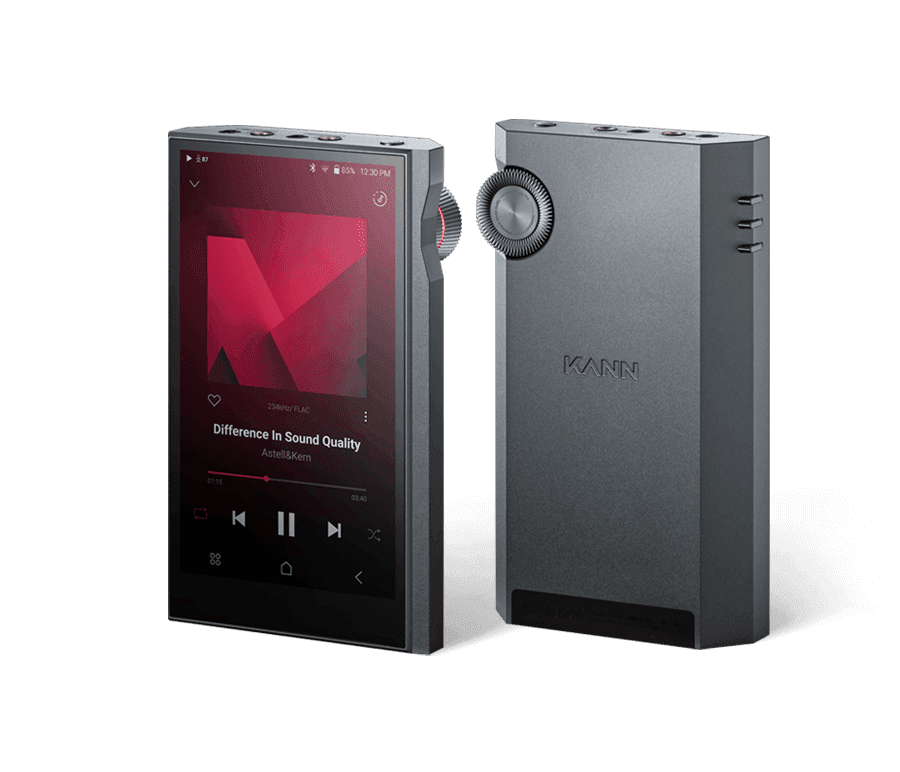
The KANN ULTRA is the most powerful player here. Astell&Kern quotes up to 16 Vrms from the balanced output and 8 Vrms unbalanced in its Super gain mode, with four gain levels in total.
It uses dual ESS ES9039MPRO DAC chips and plays PCM up to 768 kHz/32-bit bit-to-bit and native DSD512, the highest specs in this guide alongside the SP4000. Astell&Kern also lists MQA support.
A practical touch: separate 3.5mm and 4.4mm pre/line outputs, so you can connect it to an amplifier or speakers without unplugging your headphones. It has a big 8,400 mAh battery rated for about 11 hours, 128 GB of storage, a 5.5-inch screen and Bluetooth 5.3 with LDAC and aptX HD. It runs Astell&Kern's own interface with support for streaming services and Roon Ready, rather than standard Android. At 390 grams, it's heavy, but that's the price of the power.
Pros
- 01Up to 16 Vrms balanced
- 02768 kHz/DSD512 support
- 03Separate line outputs
- 04128 GB storage
Cons
- 01Heavy at 390 g
- 02Own interface, not full Android
| DAC | Dual ESS ES9039MPRO |
|---|---|
| Max playback | 768 kHz/32-bit, DSD512 |
| Outputs | 3.5mm, 4.4mm balanced, separate line outs |
| Output level | Up to 16 Vrms balanced (no load) |
| Storage | 128 GB + microSD up to 1 TB |
| Battery | 8,400 mAh; about 11 h |
| Weight | 390 g |
5. Best flagship
Astell&Kern A&ultima SP4000
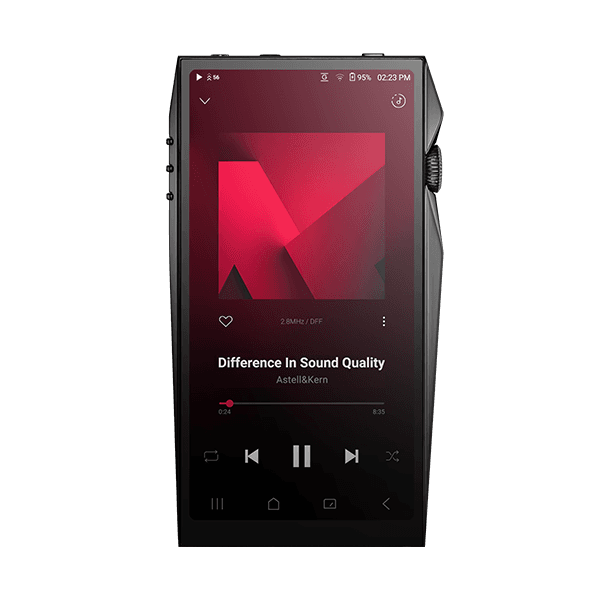
The SP4000 is Astell&Kern's current flagship, and it's built like jewelry: a 904L stainless steel body with a 6-inch screen. Astell&Kern lists it at $4,300 in black or silver, and $4,500 in copper.
Its party piece is what Astell&Kern calls a "Real Quad DAC": four AK4191EQ and four AK4499EX chips. It plays PCM up to 768 kHz/32-bit bit-to-bit and native DSD512, with a 131 dB signal-to-noise ratio from the balanced output, and outputs 8.2 Vrms balanced.
It's also the first Astell&Kern player to run full Android, according to the company, and its A&K Direct Path feature is designed to keep playback bit-perfect even when streaming. Storage is a generous 256 GB, expandable to 1.5 TB, and the battery is rated for about 10 hours. The catch is weight: about 615 grams, or 642 grams in copper, which is more like a small tablet than a music player.
Pros
- 01Eight-chip quad DAC design
- 02Full Android with bit-perfect streaming
- 03256 GB storage
- 04904L stainless steel body
Cons
- 01$4,300 and up
- 02Very heavy at about 615 g
- 03Less output power than the KANN ULTRA
| DAC | 4× AK4191EQ + 4× AK4499EX |
|---|---|
| Max playback | 768 kHz/32-bit, DSD512 |
| Outputs | 3.5mm, 3.5mm optical, 4.4mm balanced |
| Output level | 8.2 Vrms balanced (no load) |
| Storage | 256 GB + microSD up to 1.5 TB |
| Battery | 6,780 mAh; about 10 h |
| Body | 904L stainless steel, about 615 g |
What 'hi-res audio' actually means
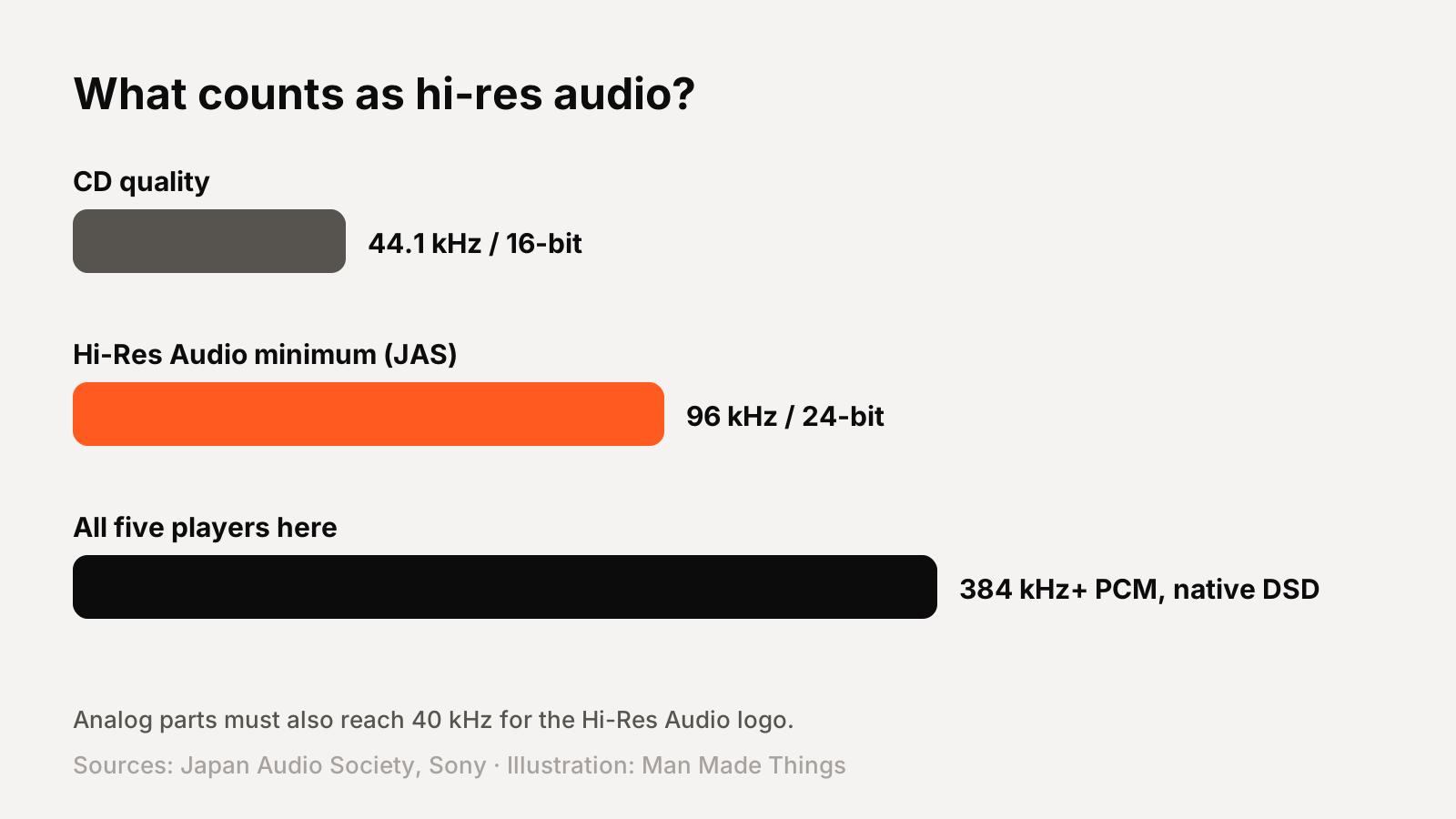
"Hi-res" isn't just marketing; there's an official definition. The Japan Audio Society, which licenses the gold Hi-Res Audio logo, says a product's digital chain must handle 96 kHz/24-bit or higher, including FLAC and WAV playback, and its analog parts must reach 40 kHz or higher.
For comparison, CD audio is 44.1 kHz/16-bit. Sony treats anything above CD quality as a high-resolution source. All five players here go well beyond the JAS standard, supporting at least 384 kHz PCM and native DSD.
There's a separate Hi-Res Audio Wireless logo for Bluetooth, which requires a certified codec. The Japan Audio Society lists codecs including LDAC, LHDC and aptX Adaptive. Every player here supports LDAC, so you can get higher-quality Bluetooth with compatible wireless headphones.
To actually hear hi-res, you need hi-res files or a hi-res streaming service, plus good headphones. A great player won't improve a low-quality MP3.
Do you need a 4.4mm balanced output?
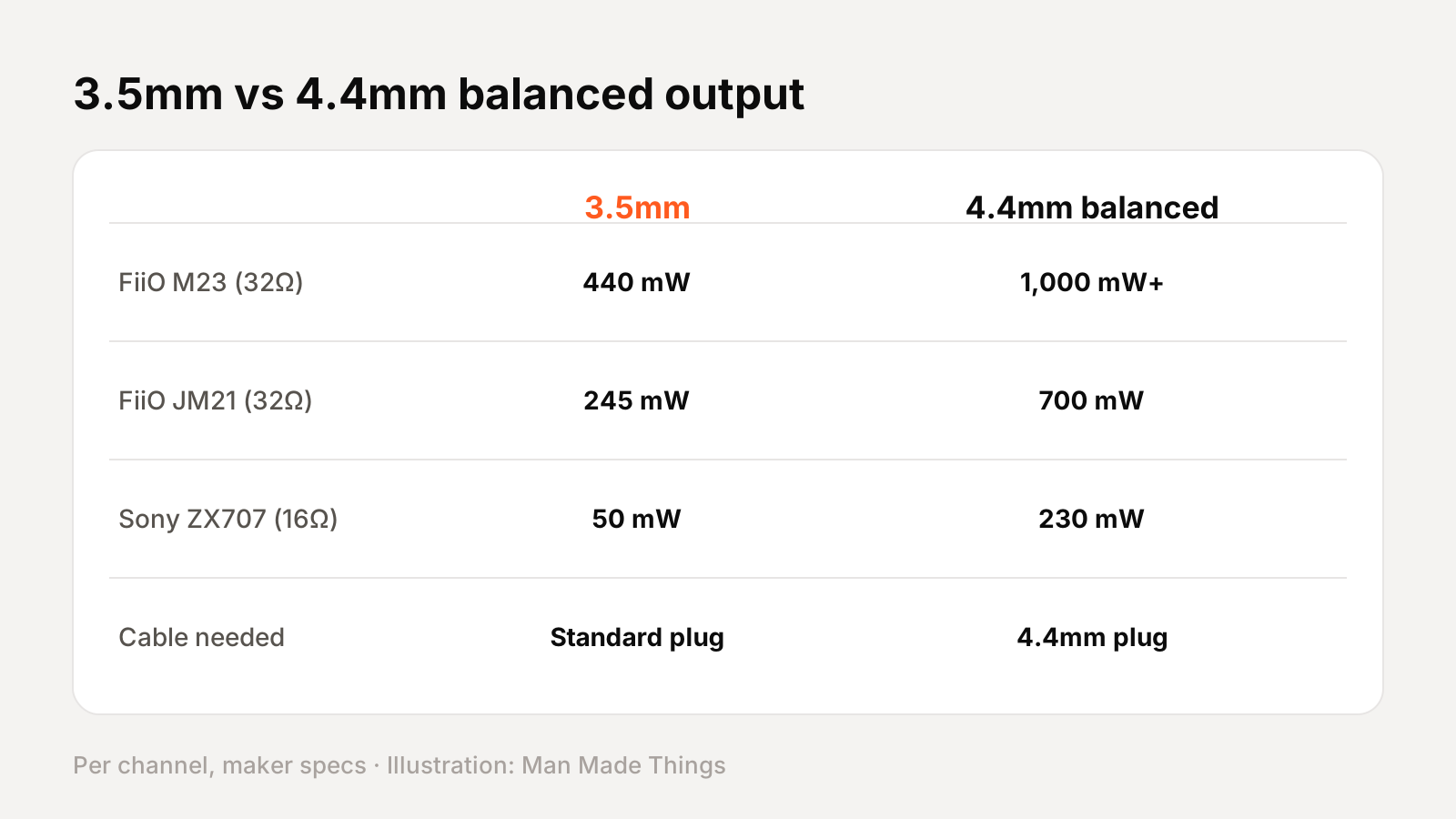
All five players have two headphone jacks: the standard 3.5mm and a 4.4mm balanced output. The balanced jack uses separate connections for the left and right channels, and on every player here it delivers much more power.
The difference is large. On the FiiO M23, output rises from 440 mW per channel at 32 ohms on the 3.5mm jack to at least 1,000 mW on the 4.4mm. On the FiiO JM21, it goes from 245 mW to 700 mW, and on the Sony ZX707 from 50 mW to 230 mW at 16 ohms.
When it matters: if you use full-size, hard-to-drive headphones, a balanced connection gives you more headroom. You'll need a headphone cable with a 4.4mm plug, which some headphones and in-ear monitors include or offer as an option.
When it doesn't: sensitive earbuds and in-ear monitors usually need far less power, so the 3.5mm jack may be all you need. Start with what your headphones need.
How to choose a hi-res music player
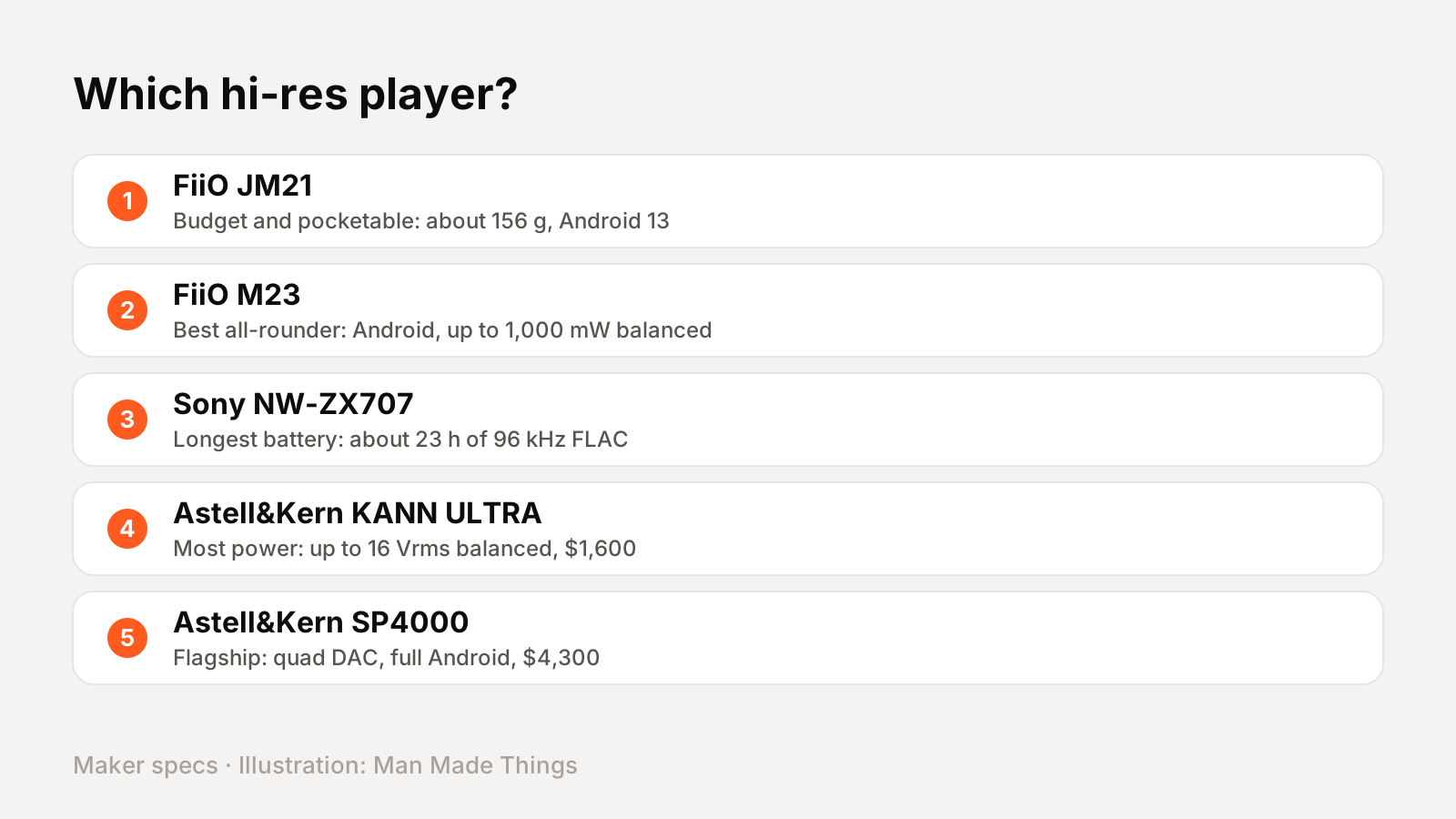
Streaming or local files? If you use Spotify, Apple Music, Tidal or Qobuz, choose a player with full Android: the FiiO JM21, FiiO M23, Sony ZX707 or SP4000. The KANN ULTRA uses Astell&Kern's own interface with support for streaming services, so check yours is supported.
What headphones do you use? Hard-to-drive full-size headphones need power: the KANN ULTRA and M23 lead here. For in-ear monitors, the JM21 or ZX707 is plenty.
Battery or power? The Sony ZX707's roughly 23 hours of hi-res playback is the standout. The more powerful players run closer to 10 to 11 hours.
Size. The JM21 (156 g) and ZX707 (227 g) fit in a pocket easily. The KANN ULTRA (390 g) and SP4000 (615 g) are heavy.
Extras. If you want one device for your desk too, look for USB DAC mode, which all five offer, and line outputs. Want a cheaper way into better sound? A good pair of wired headphones matters as much as the player.
Frequently asked questions
What is a hi-res music player?
+
A dedicated digital audio player (DAP) that plays high-resolution files, at least 96 kHz/24-bit under the Japan Audio Society definition, through a better headphone output than most phones.
Can hi-res music players stream Spotify or Apple Music?
+
Android players like the FiiO M23, FiiO JM21, Sony NW-ZX707 and Astell&Kern SP4000 can install streaming apps.
What is a 4.4mm balanced output?
+
A headphone jack with separate left and right connections. On every player here it delivers more power than the 3.5mm jack.
Which DAP has the best battery life?
+
Of these five, the Sony NW-ZX707, which Sony rates for about 23 hours of 96 kHz/24-bit FLAC playback.
Sources
Editor-in-Chief
Rahul has been writing about gadgets and software since 2013, first at Thetechhacker and now at Man Made Things. He edits every review on the site and signs off on every verdict.
More from Rahul →