Hardside vs Softside Luggage: Which Should You Buy?
Polycarbonate, aluminum, Curv polypropylene or ballistic nylon? How hardside and softside suitcases compare on weight, expansion, pockets, size limits and warranties, using official specs from Away, Rimowa, Samsonite, Briggs & Riley, Tumi and Travelpro.
We may earn a commission when you buy through links on this page. Learn more
Quick answer
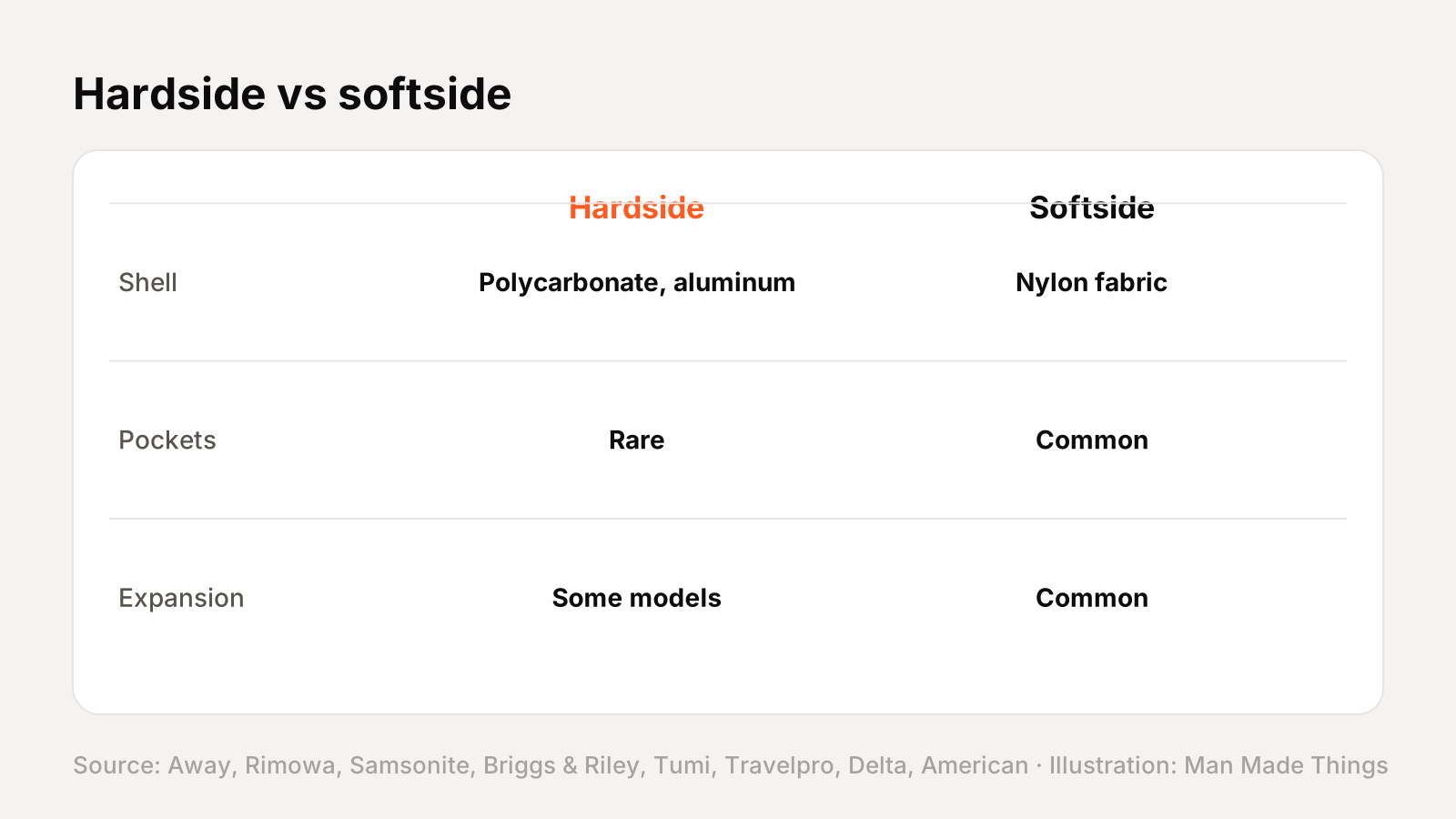
Choose hardside (polycarbonate, aluminum or polypropylene) for a shell that resists impacts and weather, and if you mostly pack inside the case. Choose softside (nylon or ballistic nylon) if you want exterior pockets and more expansion, which helps squeeze in extra items. Away's own comparison sums it up: its softside Carry-On weighs 9.2 lb with expansion and front pockets, its polycarbonate version 7.5 lb, and its aluminum one 10.7 lb with no zipper expansion.
Hardside or softside is the first decision you make when buying a suitcase, and the internet is full of strong opinions. The truth is that both work well; they suit different travelers.
Rather than repeat folklore, I've used official specs and brand statements from Away, Rimowa, Samsonite, Briggs & Riley, Tumi and Travelpro, plus airline size rules from Delta and American, to compare the two on materials, weight, expansion, pockets and warranties. Ready to buy? See our best carry-on luggage and best premium luggage picks.
The quick comparison
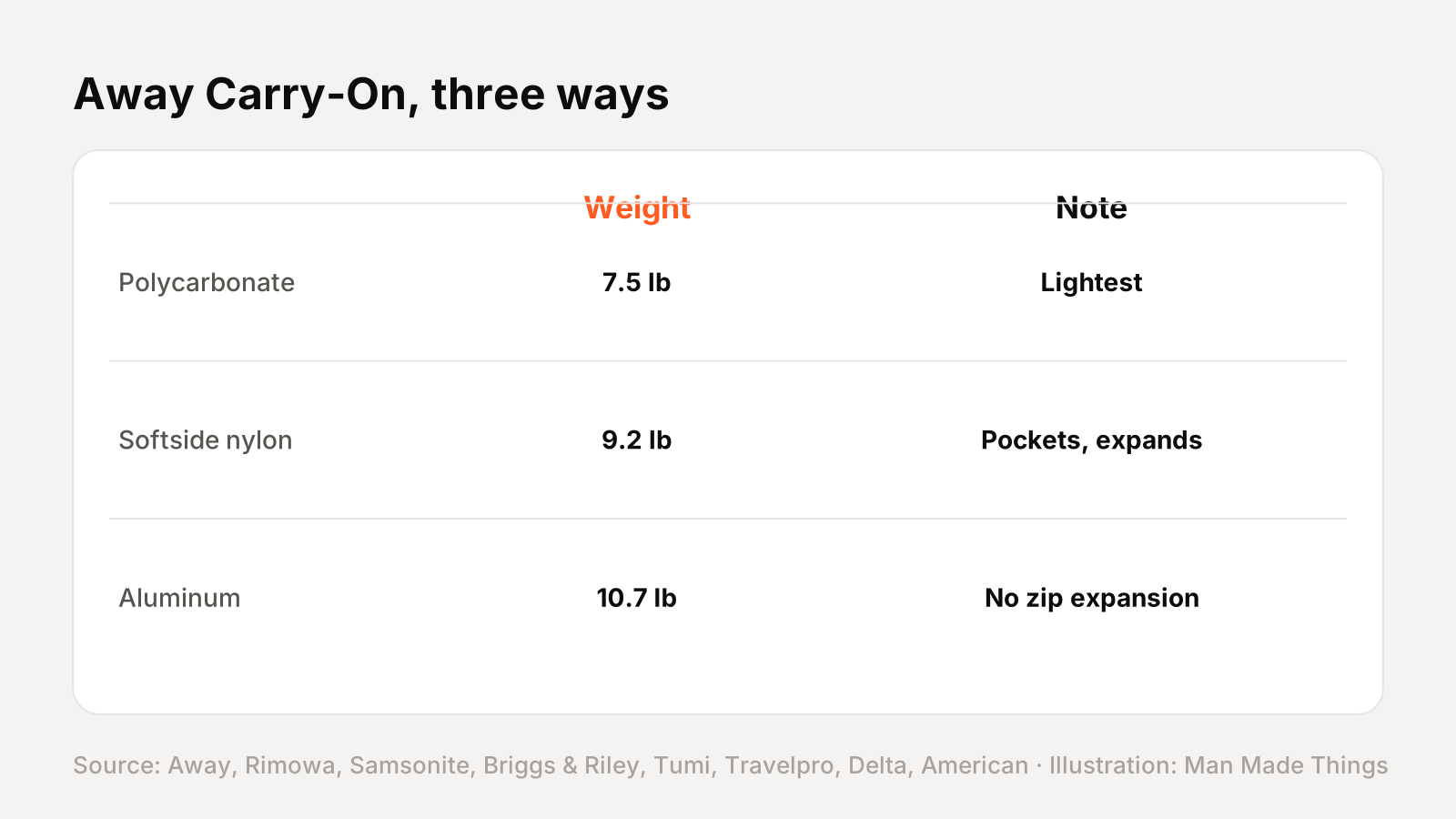
| Hardside | Softside | |
|---|---|---|
| Shell | Polycarbonate, aluminum or polypropylene | Nylon, ballistic nylon or similar fabric |
| Exterior pockets | Rare | Common |
| Expansion | Some models; aluminum often none | Common |
Away's own comparison is a useful benchmark, because it sells the same carry-on in all three materials:
| Away The Carry-On | Material | Weight | Notable |
|---|---|---|---|
| Hardside | "Impact-resistant polycarbonate shell" | 7.5 lb | Lightest |
| Softside | "Abrasion and water-resistant nylon fabric" | 9.2 lb | "Flexible, expandable, front pockets" |
| Aluminum | "Durable aluminum hard shell" | 10.7 lb | No zipper expansion |
Hardside materials: polycarbonate, aluminum and polypropylene
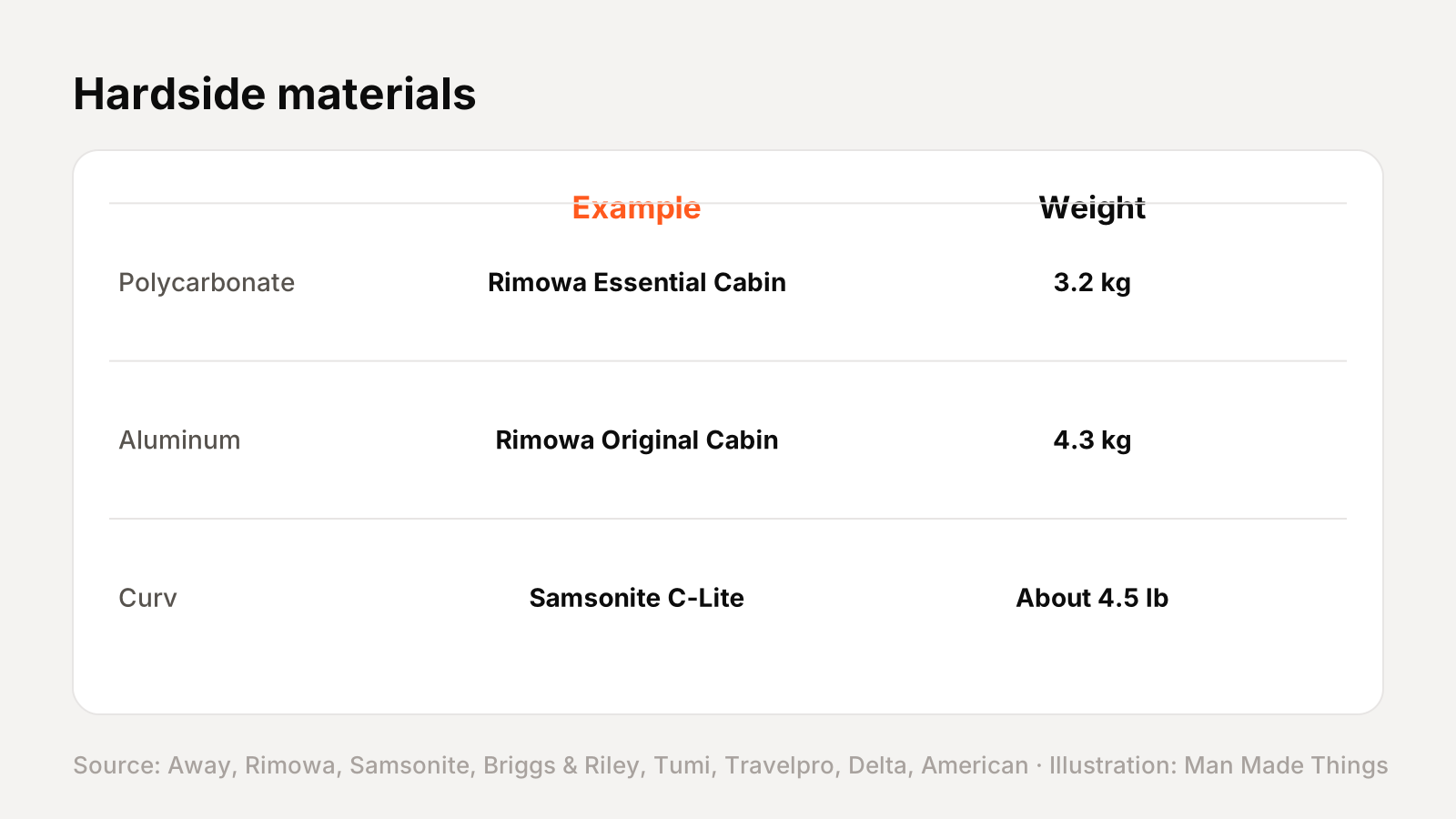
Polycarbonate is the most common hardside material. Away's Carry-On uses a 100% polycarbonate shell, Rimowa's Essential line is polycarbonate, and Tumi's 19 Degree uses polycarbonate with at least 70% recycled content, according to Tumi.
Aluminum is the premium option, made famous by Rimowa's Original line. Rimowa lists the Original Cabin at 4.3 kg (about 9.5 lb), heavier than its polycarbonate Essential Cabin at 3.2 kg (7.1 lb). Away warns that aluminum luggage "is particularly susceptible to Cosmetic Damage," meaning scratches and dents that its warranty doesn't cover.
Polypropylene composites like Samsonite's Curv are made from "layers of woven polypropylene" formed "into self reinforced composite sheets," per Samsonite. Its C-Lite Carry-On Spinner, made with Curv, is listed at about 4.5 lb.
Softside materials: nylon and ballistic nylon
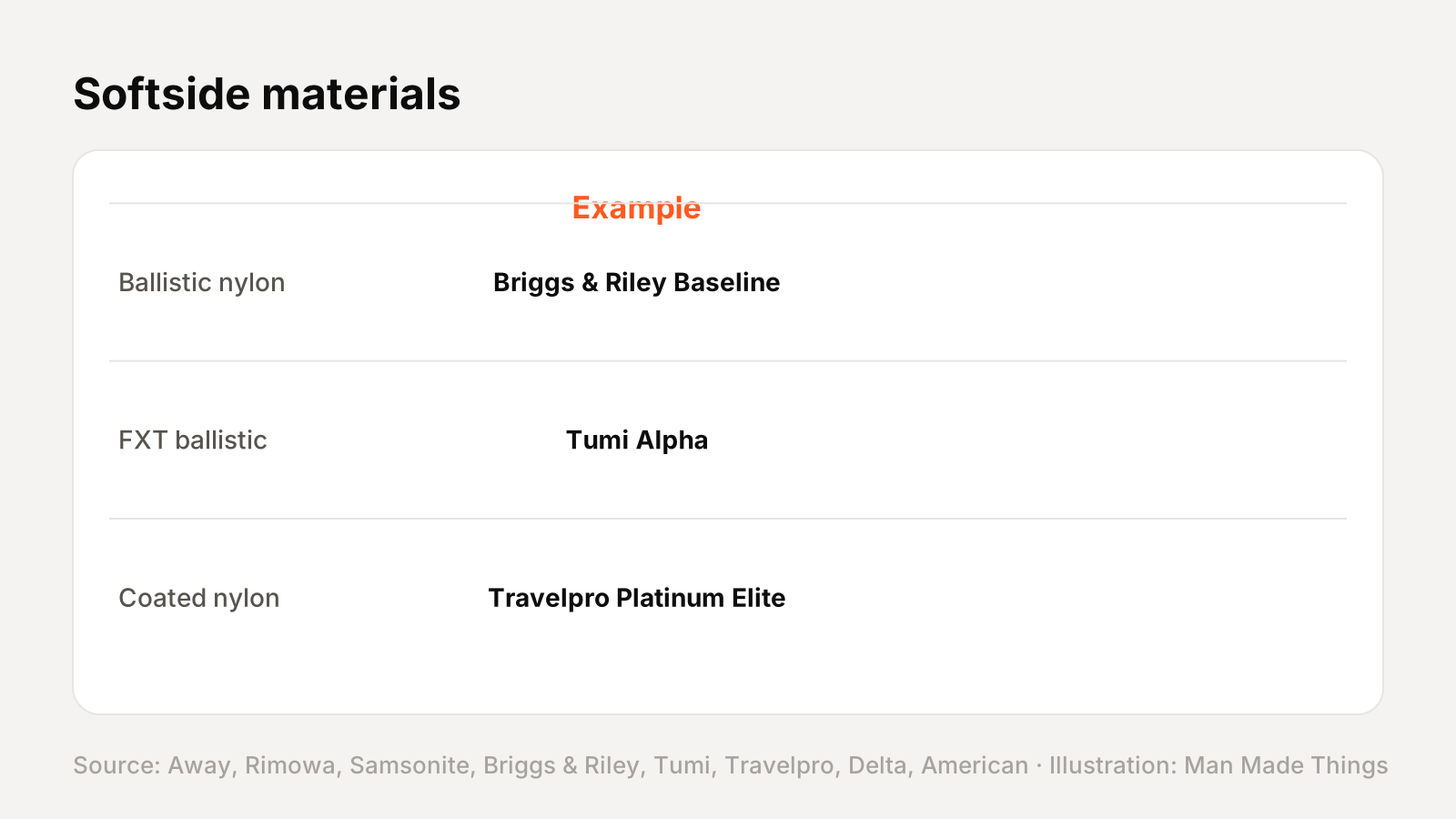
Softside cases use woven fabrics, usually nylon:
- Ballistic nylon: Briggs & Riley's Baseline uses "Premium Ultra-Durable Ballistic Nylon," and Tumi's Alpha line uses its FXT ballistic nylon.
- Cordura: the original Cordura Classic Fabric is nylon 6,6, and Cordura lists 500D and 1000D weights for luggage. "D" stands for denier, a measure of yarn thickness; higher numbers mean heavier, thicker yarn.
- Coated nylon: Travelpro describes the Platinum Elite's "high-density nylon fabric with DuraGuard coating."
Away describes its softside nylon as "abrasion and water-resistant."
Expansion and compression
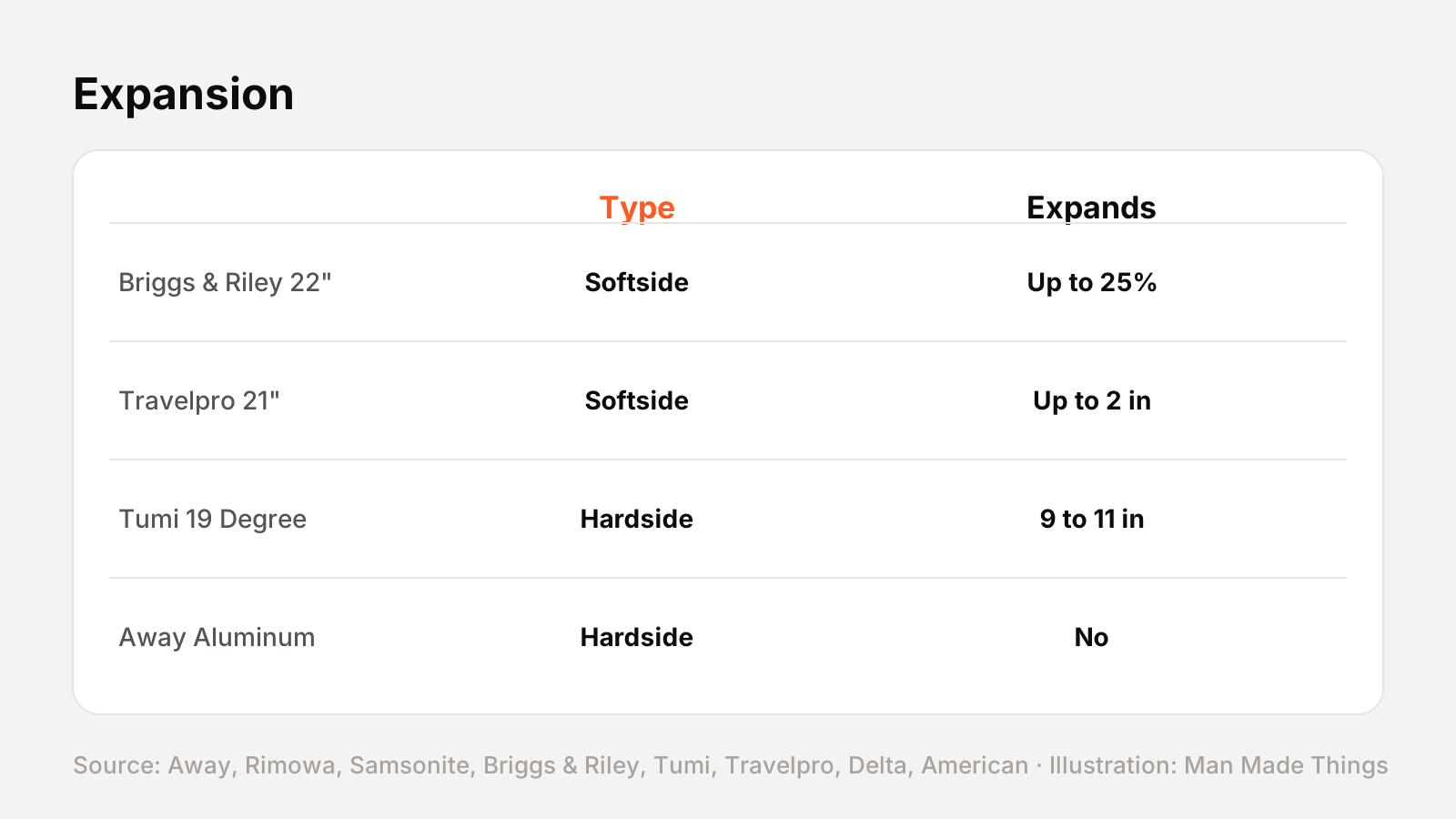
Expansion is where softside luggage usually wins, though some hardside cases expand too:
| Case | Type | Expansion |
|---|---|---|
| Briggs & Riley Baseline Essential 22" | Softside | CX system: "expand your bag up to 25%… then compress it back" |
| Travelpro Platinum Elite 21" | Softside | "Up to 2 additional inches" |
| Tumi 19 Degree Expandable Carry-On | Hardside | 9 in deep, 11 in expanded |
| Away The Carry-On (polycarbonate) | Hardside | "Double-buckle compression pad" inside |
| Away Aluminum Carry-On | Hardside | No zipper expansion |
A warning about expansion: an expanded carry-on may no longer fit airline size limits. Expand on the way home if you must, and check the dimensions first.
Size limits: check the overall dimensions
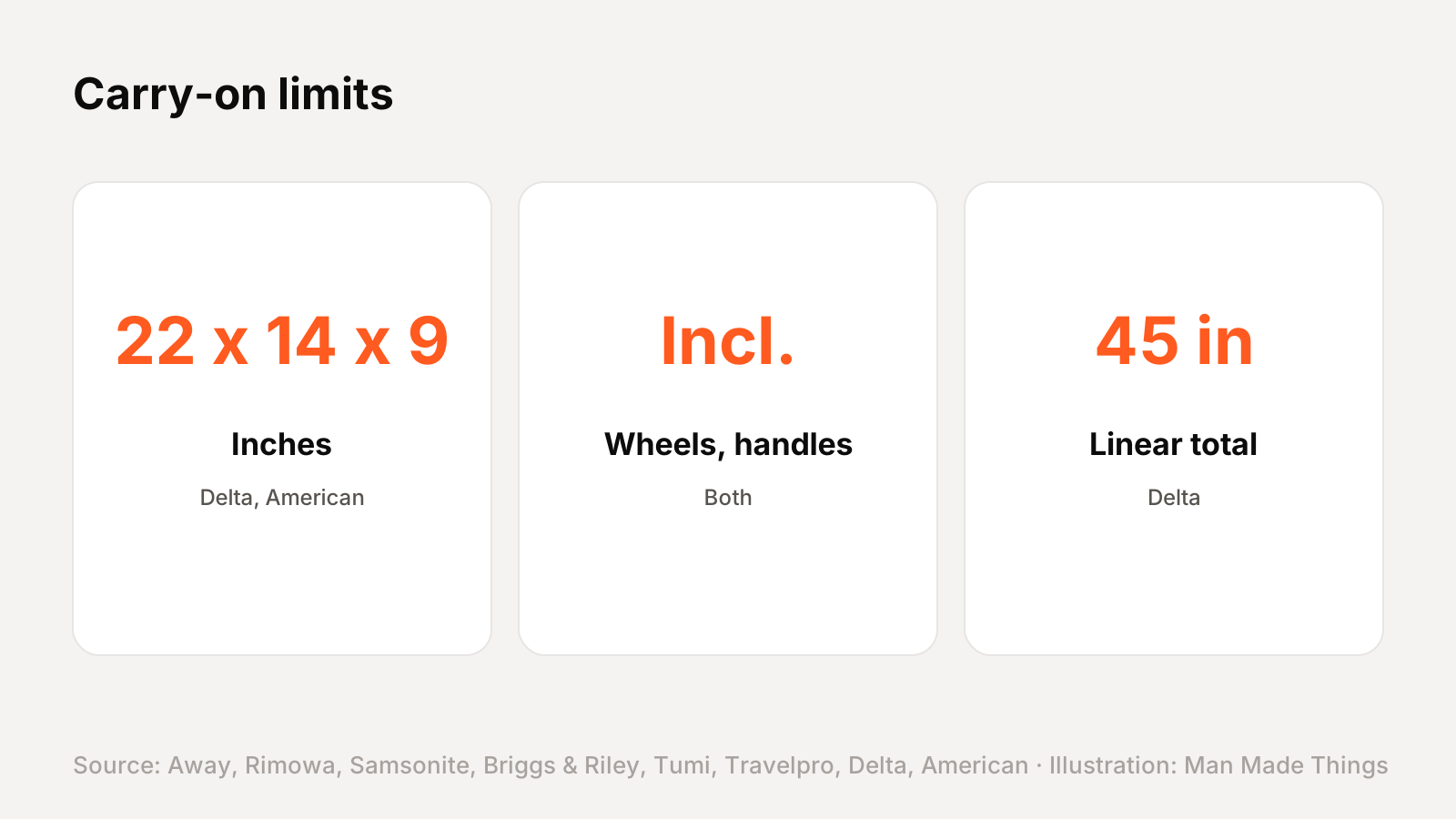
Delta and American both set carry-on limits of 22 x 14 x 9 inches (56 x 35/36 x 23 cm), including handles and wheels. Delta adds a combined limit of 45 linear inches and lists no weight limit.
That "including wheels and handles" matters. Brands sometimes quote body dimensions; Travelpro lists the Platinum Elite 21" body at 21 x 14 x 9 inches, but 23.5 x 14.5 x 9 inches including wheels and handles, which is over the 22-inch limit on paper. Always compare the overall figure.
For airline-by-airline rules, see our carry-on size limits for US airlines.
Popular carry-ons, side by side
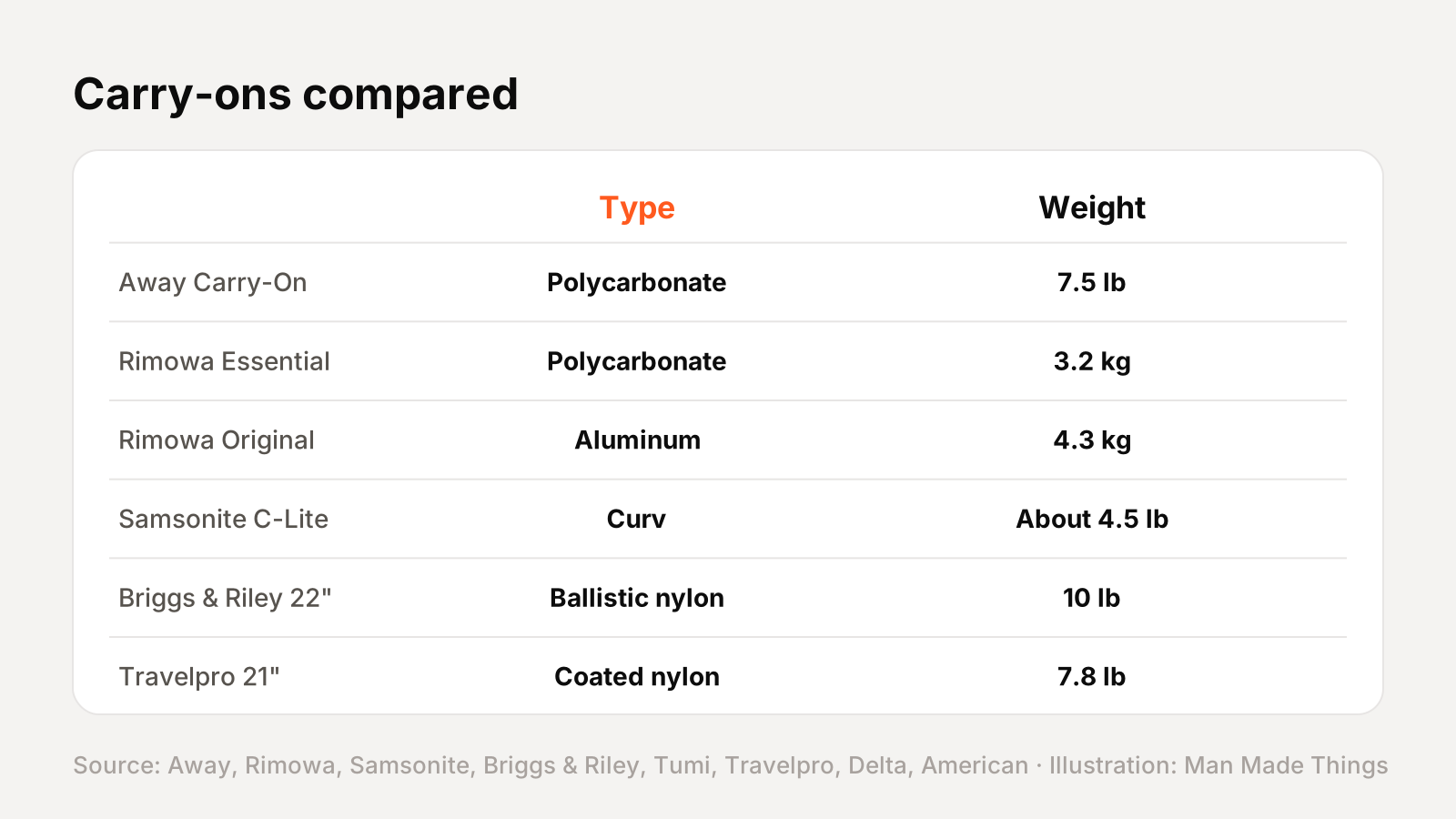
Here are the carry-ons mentioned in this guide, using each brand's listed specs (November 2026). Brands measure differently, so check whether a figure includes wheels and handles.
| Case | Type | Listed size | Weight |
|---|---|---|---|
| Away The Carry-On | Polycarbonate | 21.7 x 14.4 x 9 in (41 L) | 7.5 lb |
| Rimowa Essential Cabin | Polycarbonate | 55 x 39 x 23 cm | 3.2 kg (7.1 lb) |
| Rimowa Original Cabin | Aluminum | 55 x 40 x 23 cm (35 L) | 4.3 kg |
| Samsonite C-Lite Carry-On Spinner | Curv polypropylene | 21.6 x 15.8 x 7.9 in | About 4.5 lb |
| Briggs & Riley Baseline Essential 22" | Ballistic nylon | 22 x 14 x 9 in (11.5 in expanded) | 10 lb |
| Tumi 19 Degree Expandable | Polycarbonate | 21.8 x 14 x 9 in (11 in expanded) | 8.2 lb |
| Travelpro Platinum Elite 21" | Coated nylon | 23.5 x 14.5 x 9 in overall | 7.8 lb |
The lightest cases here are hardside, and the heaviest is the expandable ballistic nylon Briggs & Riley, which trades weight for durability claims, expansion and its warranty. Several cases are wider or taller than 22 x 14 x 9 inches on paper, so measure against your airline's rules before you fly.
Warranties: what the brands promise
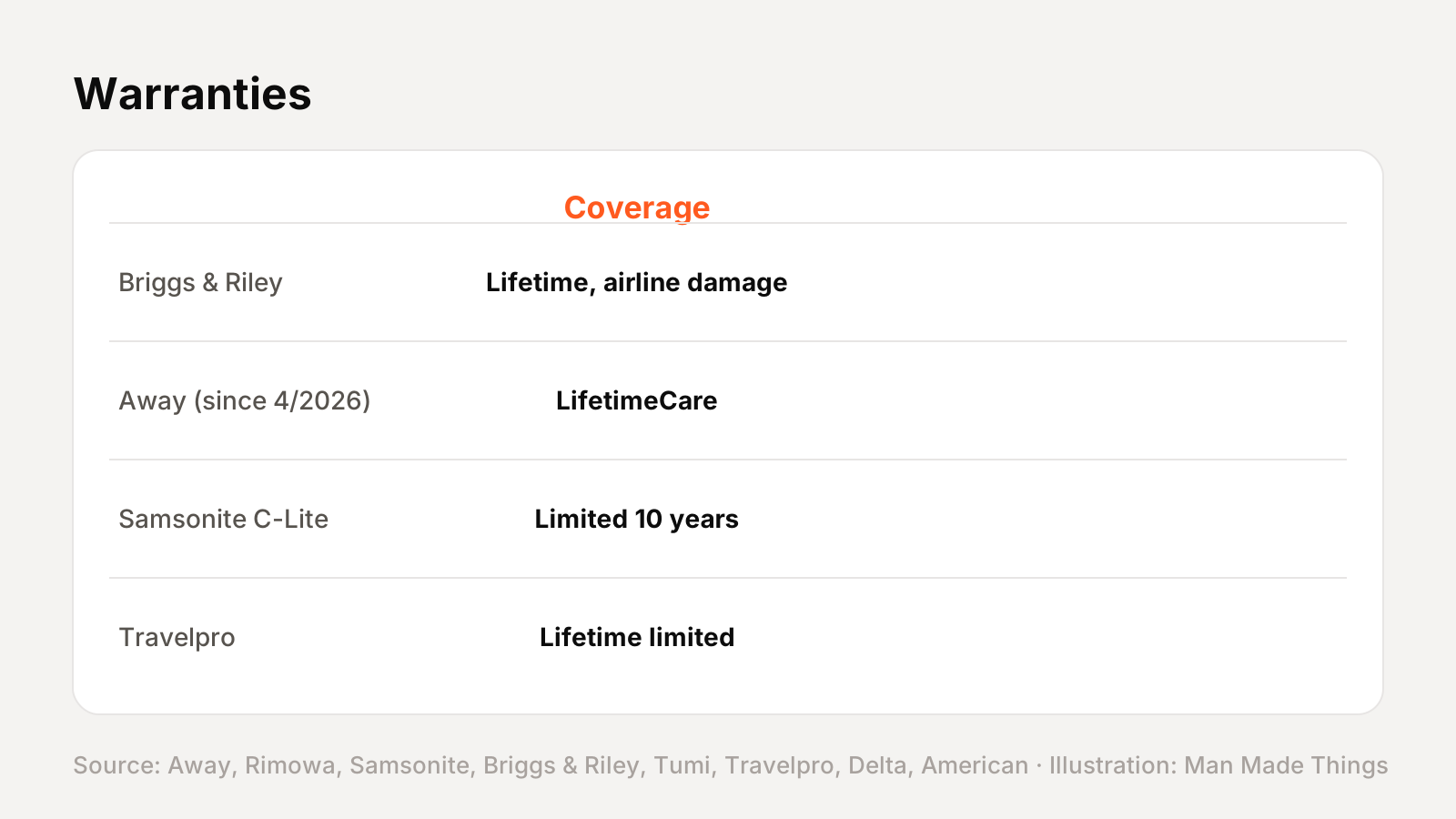
| Brand | Warranty (per brand, November 2026) |
|---|---|
| Briggs & Riley | Lifetime repair of functional damage, "even if an airline causes it," with no proof of purchase |
| Away | Purchases before April 14, 2026: Limited Lifetime Warranty on manufacturing defects. Since then: "LifetimeCare," with five years of free repairs including airline damage, plus one replacement |
| Samsonite C-Lite | "Limited 10 Year Global Warranty" |
| Travelpro Platinum Elite | Lifetime limited, plus airline damage coverage if registered within 120 days |
| Rimowa | Check Rimowa's guarantee page for your region; terms have changed |
Warranties usually exclude cosmetic damage. Read the terms before you buy, and register your bag if the brand requires it.
Which should you buy?
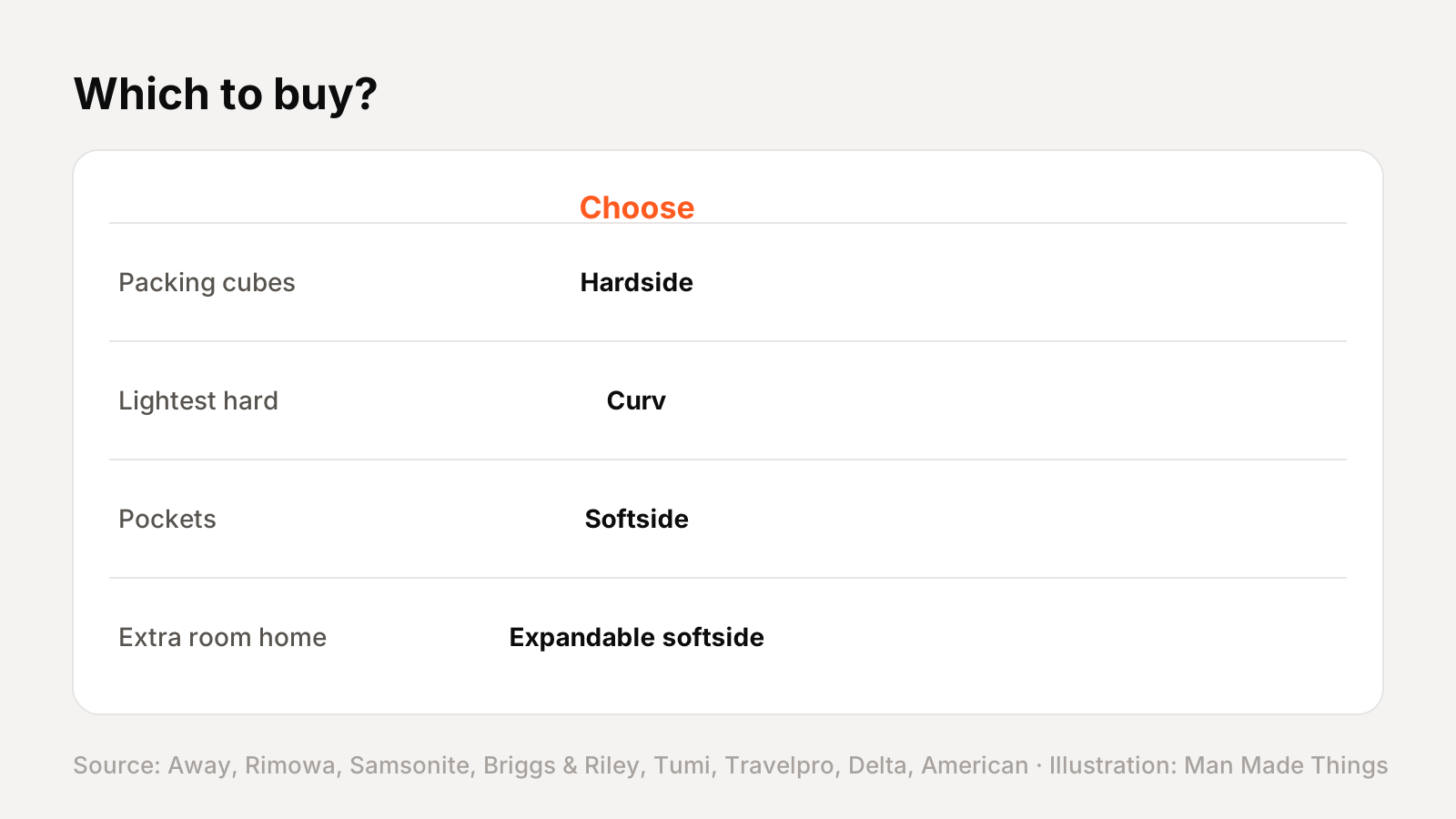
| If you... | Choose |
|---|---|
| Pack with packing cubes and rarely need extra room | Hardside polycarbonate (light and simple) |
| Want the lightest hard case | Polypropylene composite like Curv |
| Want a metal shell and accept cosmetic wear | Aluminum |
| Want exterior pockets for a laptop, jacket or documents | Softside |
| Often come home with more than you left with | Softside with expansion |
| Want the strongest warranty | Check Briggs & Riley and Travelpro terms |
There's no wrong answer: match the case to how you pack. For packing tips, read how to pack a carry-on for a week.
Frequently asked questions
Is hardside or softside luggage lighter?
+
It depends on the material. Away's polycarbonate Carry-On (7.5 lb) is lighter than its softside version (9.2 lb), while its aluminum version is heaviest at 10.7 lb.
Does softside luggage expand more?
+
Usually. Many softside cases expand, such as Briggs & Riley's CX system (up to 25%) and Travelpro's Platinum Elite (up to 2 inches), while many aluminum cases don't expand at all.
What size is a carry-on for Delta and American?
+
22 x 14 x 9 inches, including handles and wheels.
Sources
- Away: Luggage materials
- Away: Warranty information
- Rimowa: Original Cabin
- Samsonite: C-Lite
- Briggs & Riley: Essential Carry-On Spinner
- Briggs & Riley: The Briggs & Riley difference
- Tumi: 19 Degree Expandable Carry-On
- Travelpro: Platinum Elite 21" Spinner
- Cordura: Classic Fabric
- Delta: Carry-on baggage
- American Airlines: Carry-on baggage
Editor-in-Chief
Rahul has been writing about gadgets and software since 2013, first at Thetechhacker and now at Man Made Things. He edits every review on the site and signs off on every verdict.
More from Rahul →