Three field watches worth buying, from a $209 solar Timex to the Hamilton Khaki Field Mechanical, with specs and prices checked on each brand's US site.
We may earn a commission when you buy through links on this page. Learn more
Image: Man Made Things
Quick answer
The Hamilton Khaki Field Mechanical 38mm ($675) is the best field watch for most people, with a hand-wound movement that runs about 80 hours and a sapphire crystal. The Seiko 5 Sports SRPG39 ($315) is the best automatic for the money, and the Timex Expedition Field Post Solar 36mm ($209) is the low-maintenance budget pick that runs for months on light.
If you only own one watch, there's a good chance it should be a field watch. It's the simplest, most honest design in watchmaking: a clear dial, big numbers, a tough case and nothing else. It looks right with a T-shirt, a flannel shirt or a blazer, and it doesn't need babying.
Field watches started as military gear, built to be read in a hurry and cheap enough to replace. That's still the appeal. You don't need to spend thousands to get a great one.
I picked three at very different prices: a hand-wound Swiss watch, an automatic Seiko and a solar Timex. Every spec and price below comes from the brand's own US site. These are research-based picks, so there are no star scores. Let's get into it.
This is the field watch I'd point almost anyone to. Hamilton has been making Khaki watches for decades, and this one is about as close to the original military design as you can buy new today.
The size is perfect. At 38mm across and 9.5mm thick, it sits flat, slides under a cuff and suits almost every wrist. The crystal is sapphire, which shrugs off the scratches a field watch is going to collect.
The movement is hand-wound, so you give the crown a few turns every couple of days. That sounds like a chore, but Hamilton's H-50 runs for up to 80 hours, so you can take it off for a weekend and it'll still be ticking on Monday. Honestly, winding it in the morning becomes a nice little ritual.
The one catch is water resistance. At 50m it's fine for rain and hand washing, but I wouldn't swim in it.
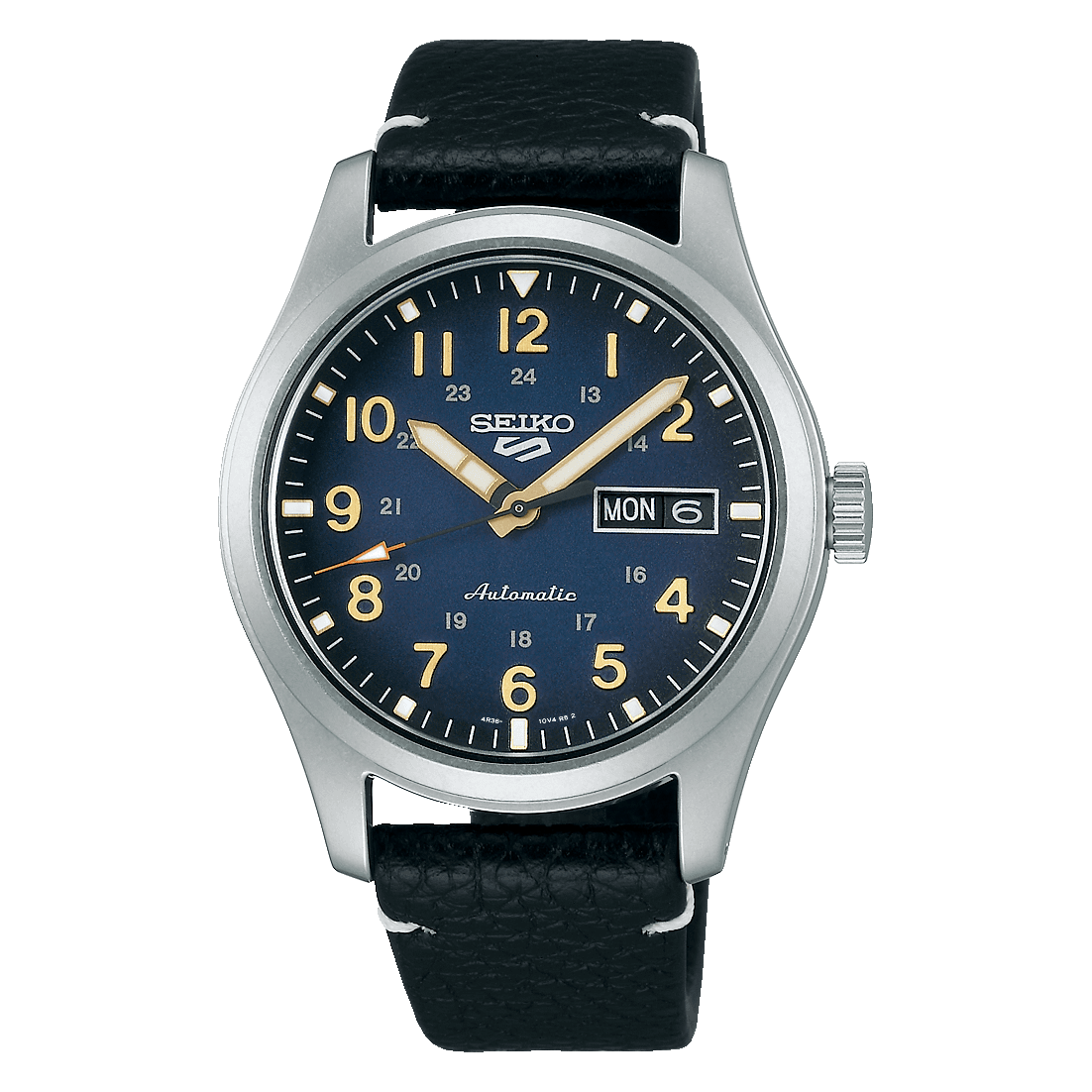
If you'd rather never wind a watch, this is the one. The SRPG39 runs on Seiko's 4R36 automatic, which winds itself as you move. It also hacks (the seconds hand stops when you pull the crown) and you can hand-wind it, two things cheap automatics often skip.
You also get 100m of water resistance, which means you can actually swim with it, plus a day-date and a see-through caseback so you can watch the movement work.
It's a bit thicker than the Hamilton at 13.2mm, and the crystal is Hardlex rather than sapphire, so it's easier to scratch. Seiko has sold some SRPG39 versions as limited editions, so if it's out of stock, look at the other models in the same Seiko 5 field line.
Pros
01Automatic, with hacking and hand-winding
02100 m water resistance
03Day-date display
04Display caseback
Cons
01Hardlex crystal scratches more easily than sapphire
02Thicker than the Hamilton
03Availability can be limited
Case
39.4 mm, 13.2 mm thick, 48.1 mm lug to lug
Movement
Seiko 4R36 automatic, hand-winding, hacking
Power reserve
About 41 hours
Crystal
Curved Hardlex
Water resistance
100 m (10 bar)
Extras
Day-date, see-through screw-down caseback, 20 mm lugs
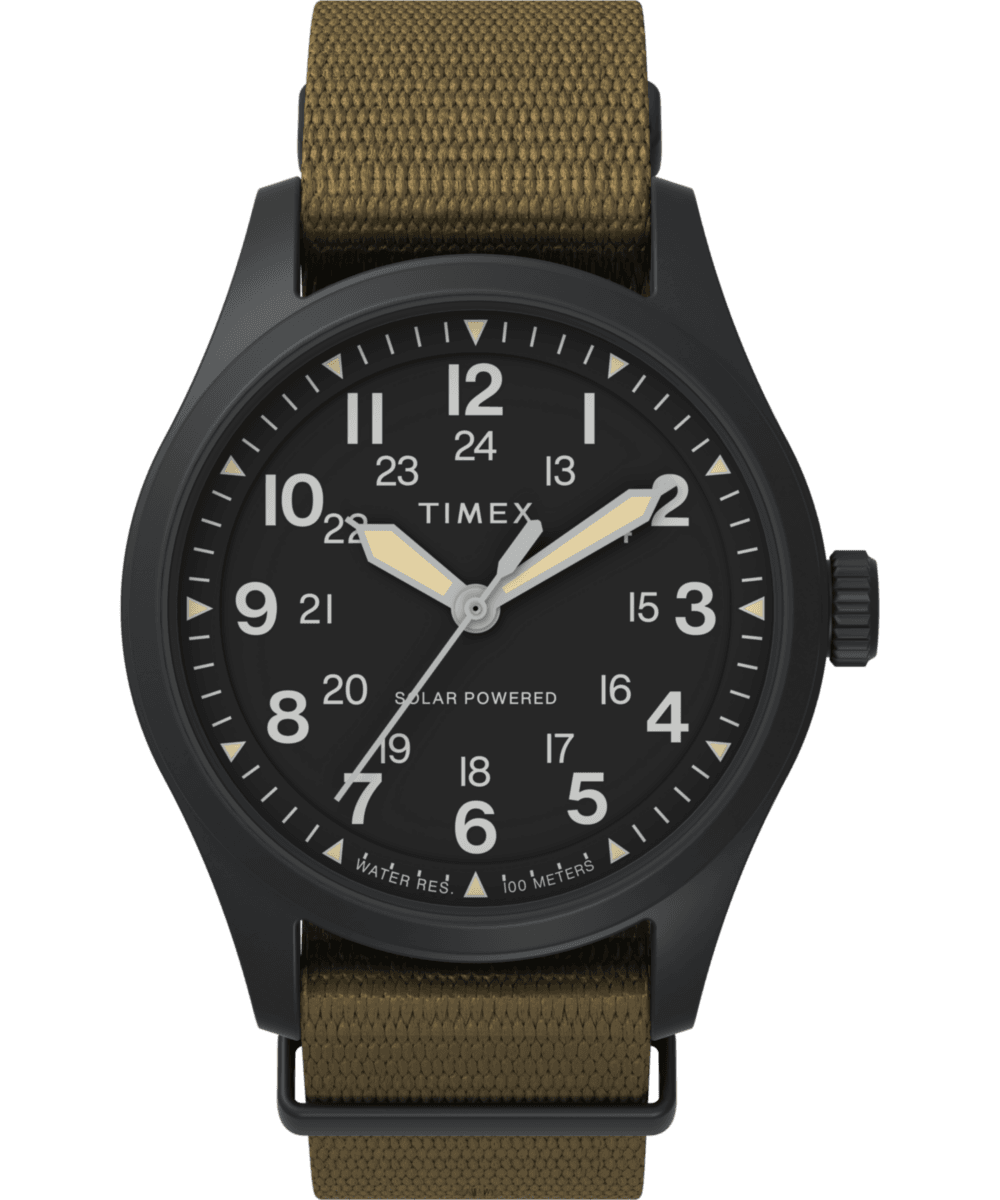
Timex has been making affordable, no-fuss watches for a very long time, and this one is a smart modern take on the field watch. Instead of a battery you change or a movement you wind, it charges from light. Timex says a full charge runs it for up to four months, so even a drawer won't kill it quickly.
What surprised me on the spec sheet is how much you get for $209: a sapphire crystal, 100m of water resistance, and a screw-down crown and caseback. Those are things you usually pay a lot more for.
At 36mm, it's the smallest watch here and has a vintage, military-issue feel. That's great for smaller wrists. If you have bigger wrists, Timex also makes a 41mm Field Post Solar.
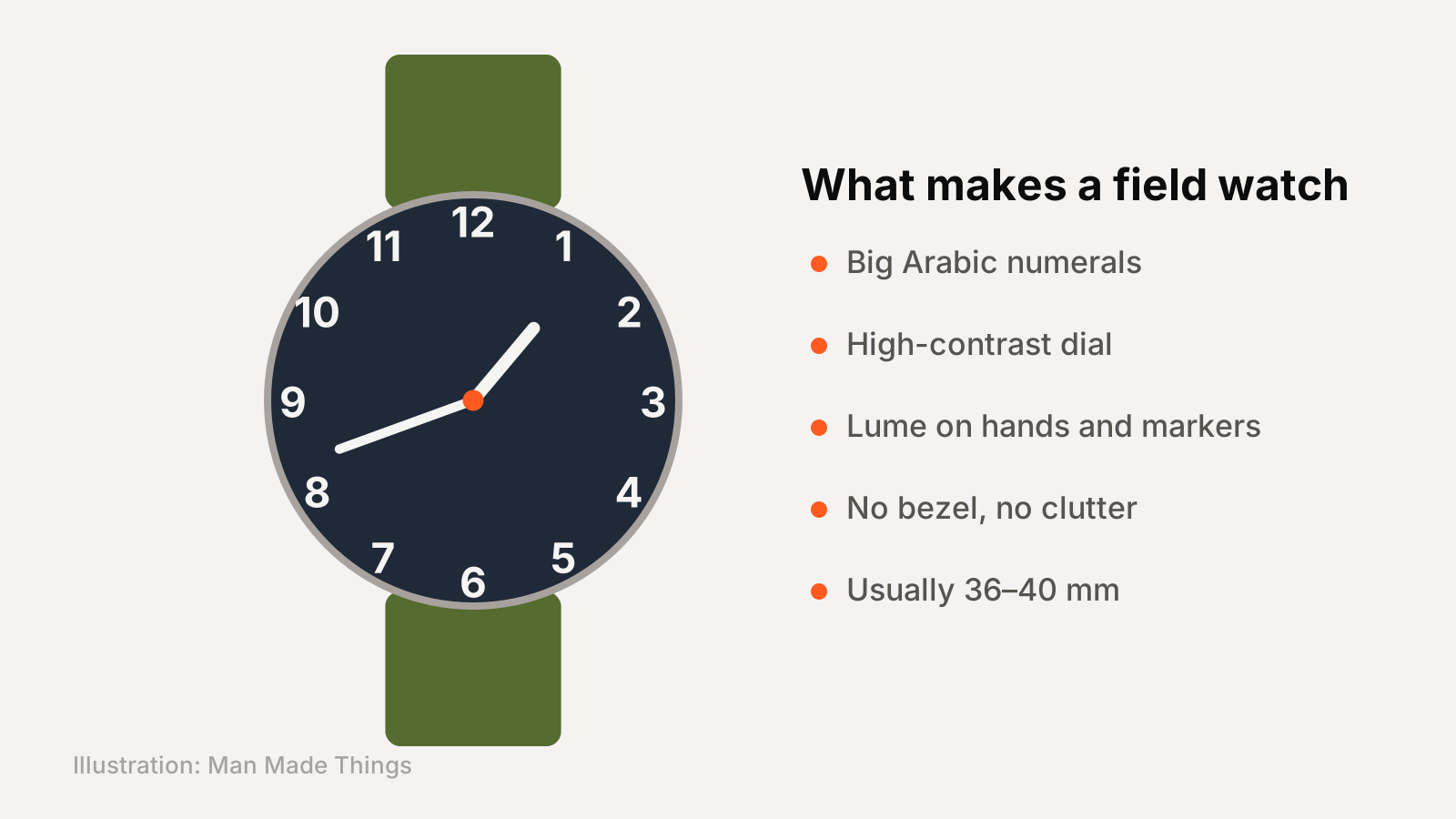
Field watches don't have a formal standard like dive watches do, but the good ones share a few traits:
A dial you can read in a second. Big Arabic numerals, high contrast, and usually a small 24-hour track on the inside.
Lume on the hands and markers. You should be able to read it in the dark.
A sensible size. Most classic field watches are 36 to 40mm. Bigger can work, but the style looks best small.
No extra clutter. No rotating bezel, no complicated sub-dials. Just the time, and maybe the date.
If a watch calls itself a field watch but has a busy dial you have to squint at, it's missing the whole point.
One more thing to love about field watches: straps. Because the designs are so simple, they look great on almost anything. A canvas or nylon strap gives a rugged, outdoorsy look. A brown leather strap dresses it up for the office. Swapping straps is the cheapest way to make one watch feel like three, so check the lug width before you buy straps. The Seiko, for example, uses a common 20mm lug width, so replacement straps are easy to find.
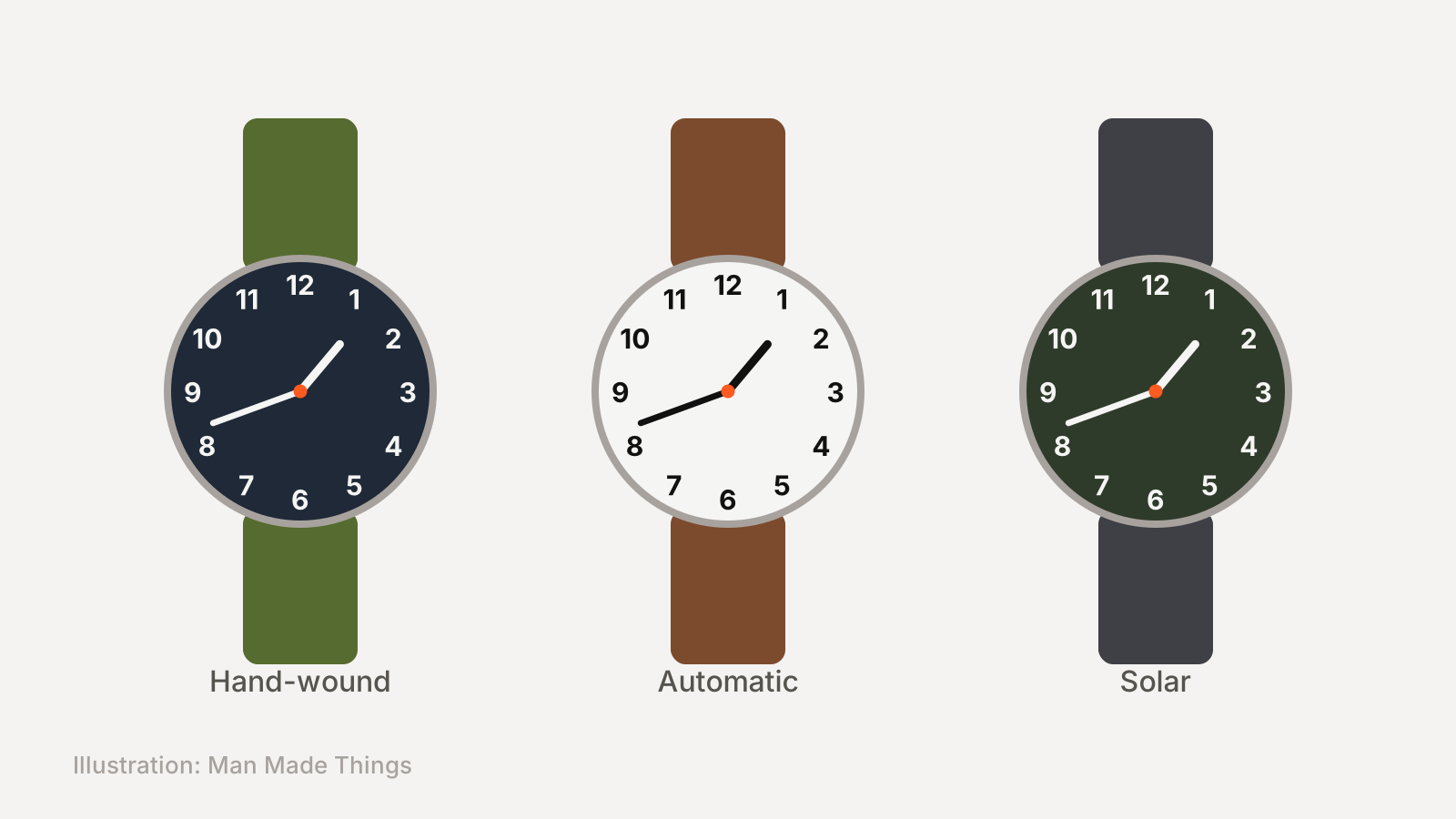
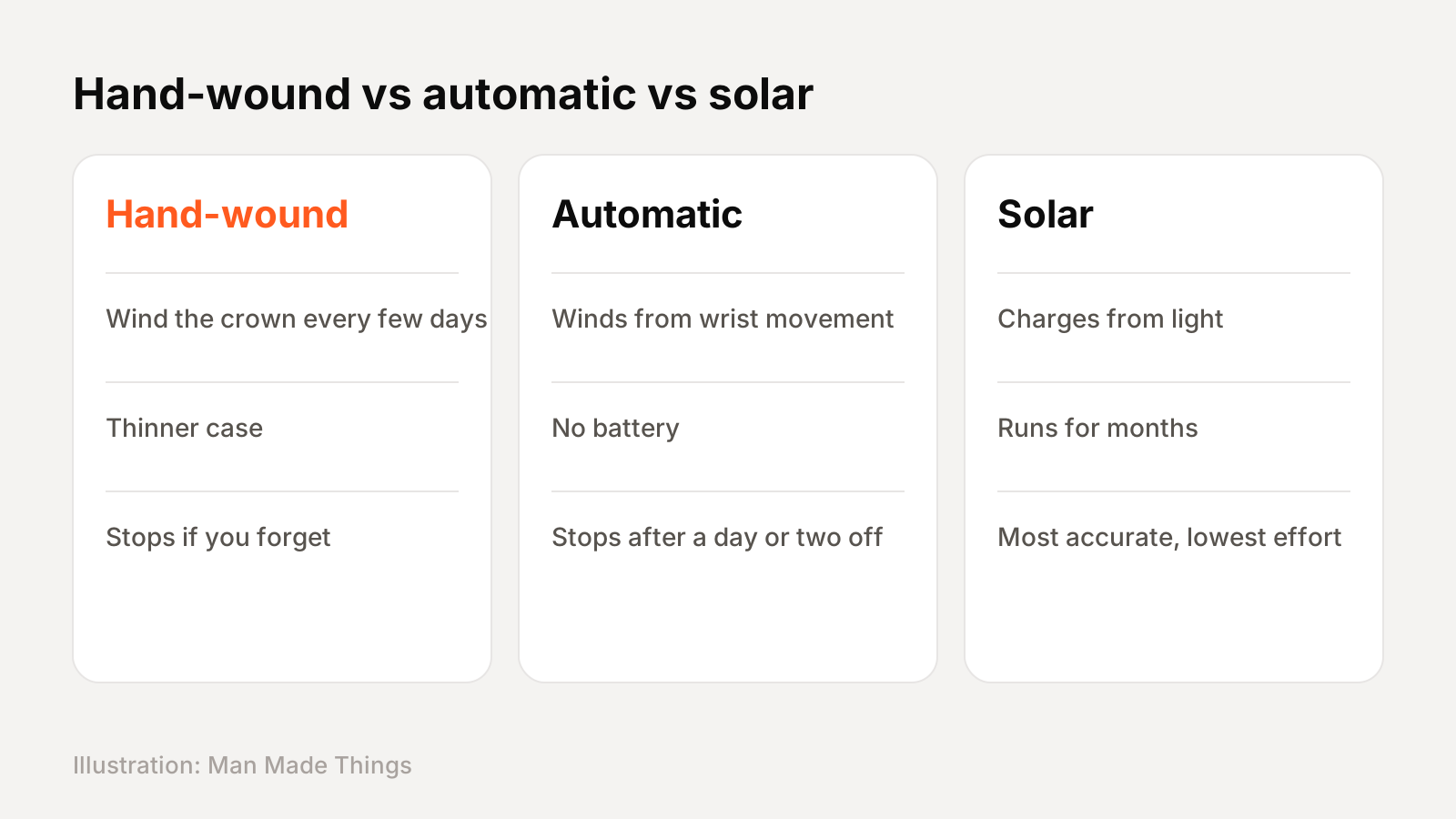
Hand-wound, automatic or solar?
Image: Man Made Things
All three picks use a different kind of movement, and this choice matters more than you'd think.
Hand-wound (Hamilton): you turn the crown every few days. Thin case, and a nice daily ritual. Stops if you forget.
Automatic (Seiko): winds itself from your wrist movement. Great if you wear it daily, but it'll stop after a day or two in a drawer.
Solar (Timex): charges from light and runs for months. The most accurate and lowest maintenance, but there's no mechanical movement inside.
There's no wrong answer. If you love the idea of a little machine on your wrist, go mechanical. If you just want a watch that always shows the right time, go solar.
Frequently asked questions
What is the best field watch under $1,000?
+
The Hamilton Khaki Field Mechanical 38mm at $675 is our top pick, with an 80-hour hand-wound movement and a sapphire crystal.
Can you swim with a field watch?
+
It depends on the rating. The Seiko 5 Sports SRPG39 and Timex Field Post Solar are rated to 100m, which is fine for swimming. The Hamilton Khaki Field Mechanical is rated to 50m, so avoid swimming with it.
What size should a field watch be?
+
Most classic field watches are 36 to 40mm. A 38mm case suits most wrists.
Do hand-wound watches need winding every day?
+
Not always. The Hamilton H-50 movement runs for up to 80 hours, so winding every two or three days is enough.