The Best Espresso Machines for Beginners: Breville and De'Longhi
Three beginner-friendly espresso machines, from an all-in-one Breville with a built-in grinder to a $150 De'Longhi, plus the basic recipe for your first good shot.
We may earn a commission when you buy through links on this page. Learn more
Quick answer
The Breville Barista Express ($699.95) is the best espresso machine for beginners because it has a built-in grinder, so you don't need to buy one separately. The Breville Bambino ($299.95) heats up in 3 seconds and is the best compact pick if you already own a grinder. The De'Longhi Stilosa ($149.95) is the budget way in. Start with 18–20g of coffee, aim for about double that in the cup, in 25–30 seconds.
Home espresso has a reputation for being complicated, expensive and messy. Some of that is fair. But the first time you pull a shot that tastes better than your local café, you'll understand why people get hooked.
The secret most beginners miss is that espresso is really two machines: the espresso maker and the grinder. Espresso needs a very fine, very consistent grind, so a machine is only as good as the coffee you put in it. That's why my top pick has a grinder built in.
I picked three machines at three budgets and checked every spec and price on the brand's own US site. These are research-based picks with no star scores. If you want a separate grinder, see our best burr coffee grinders. Let's get into it.
Our picks at a glance
1. Best overall
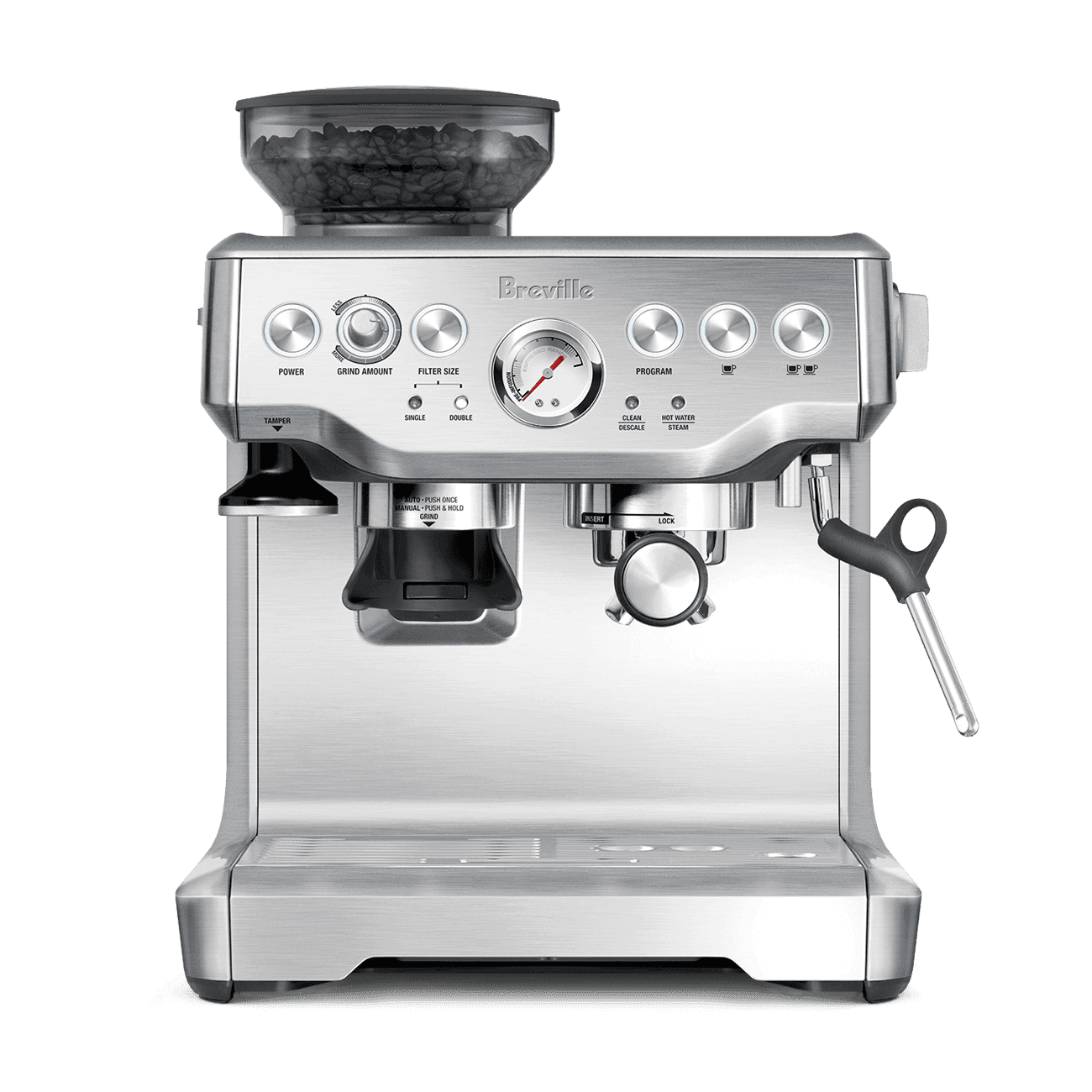
Breville Barista Express
The Barista Express has been the default "first espresso machine" for years, and for good reason. It puts a conical burr grinder right on top of the machine, so you grind straight into the portafilter. One machine, one footprint, no separate grinder to buy.
Breville gives you the tools to learn properly. There's a pressure gauge on the front so you can see what's happening during each shot, low-pressure pre-infusion to soak the coffee before full pressure, and PID temperature control to keep the water steady. A manual steam wand lets you learn proper milk texturing for lattes.
It's big, at nearly 16 inches wide, and the warranty is only one year. If you want more help with dosing and tamping, the Barista Express Impress ($799.95) adds assisted tamping, 25 grind settings and a 2-year warranty.
Pros
- 01Built-in burr grinder, no extra purchase
- 02Pressure gauge helps you learn
- 03PID temperature control
- 04Manual steam wand for latte art
Cons
- 01Large footprint
- 02Only a 1-year warranty
- 0316 grind settings is limited for fine-tuning
| Heating | Thermocoil with PID temperature control |
|---|---|
| Pump | 15 bar, with low-pressure pre-infusion |
| Portafilter | 54 mm, stainless steel |
| Grinder | Built-in conical burrs, 16 settings, ½ lb hopper |
| Steam wand | Manual |
| Water tank | 67 oz |
| Size and weight | 15.9 × 13.1 × 12.4 in, 22.09 lb |
| Warranty | 1 year limited |
2. Best compact
Breville the Bambino
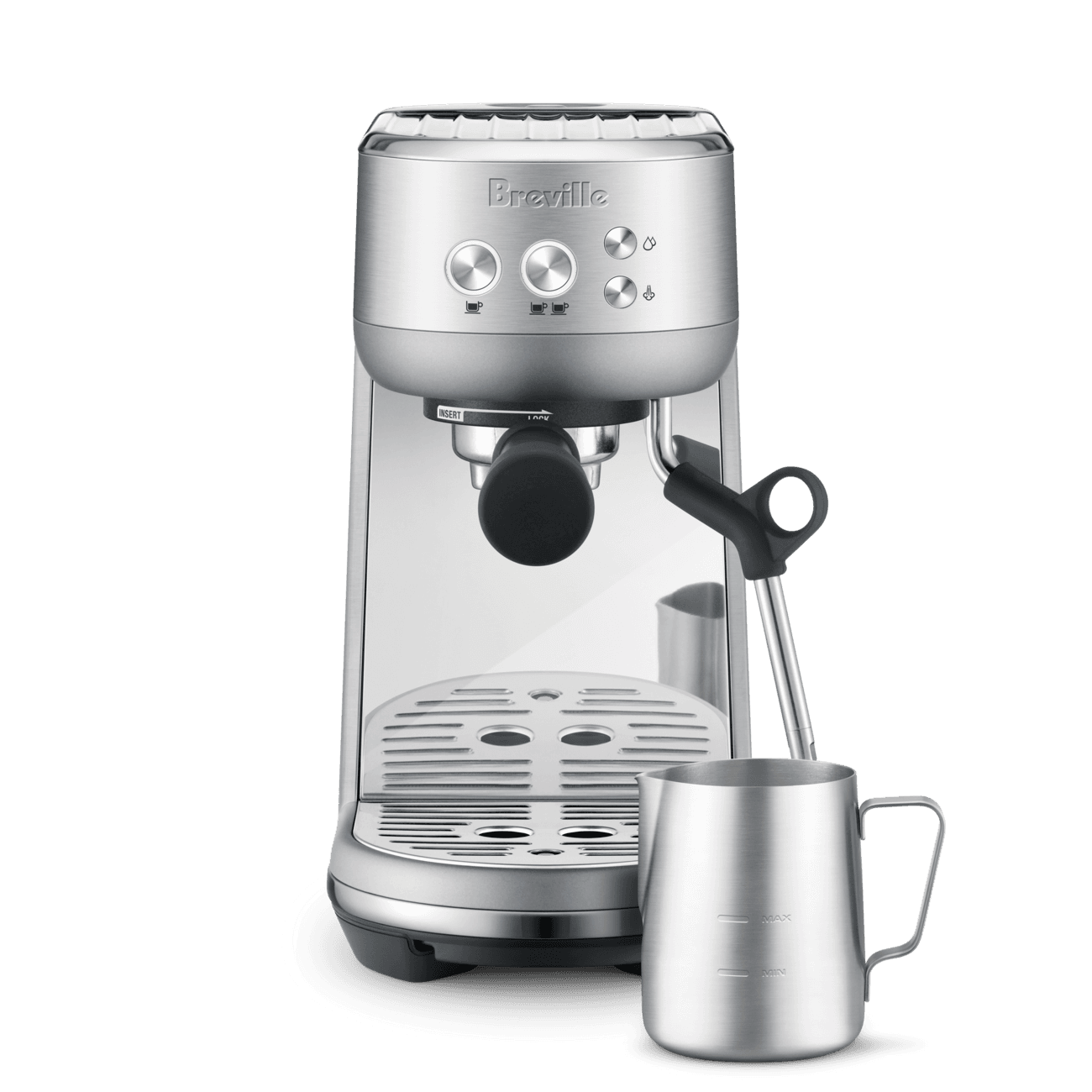
The Bambino is tiny, at just over 6 inches wide, and it's ready to go in 3 seconds thanks to Breville's ThermoJet heating. That's a game-changer for weekday mornings, when you don't want to wait for a machine to warm up.
It uses the same 54mm portafilter size as the Barista Express, with PID temperature control and a manual steam wand. There are simple buttons for one cup, two cups, hot water and steam, and Breville includes both single- and dual-wall baskets, a milk jug, a tamper and descaling powder.
The catch: there's no grinder. You'll need a burr grinder that can go fine enough for espresso, or pre-ground espresso coffee. The Bambino Plus ($499.95) adds automatic milk frothing, but if you want to learn to steam milk yourself, the regular Bambino is the better teacher.
Pros
- 01Ready in 3 seconds
- 02Very compact at 6.1 in wide
- 03PID temperature control
- 04Good accessories in the box
Cons
- 01No built-in grinder
- 02Smaller 47 oz water tank
- 031-year warranty
| Heating | ThermoJet, ready in 3 seconds, PID control |
|---|---|
| Pump | 15 bar |
| Portafilter | 54 mm |
| Grinder | None (needs a separate grinder or pre-ground coffee) |
| Steam wand | Manual |
| Water tank | 47 fl oz |
| Size and weight | 11.9 × 6.1 × 13.5 in, 10.42 lb |
| Warranty | 1 year limited |
3. Best budget
De'Longhi Stilosa Manual Espresso Machine
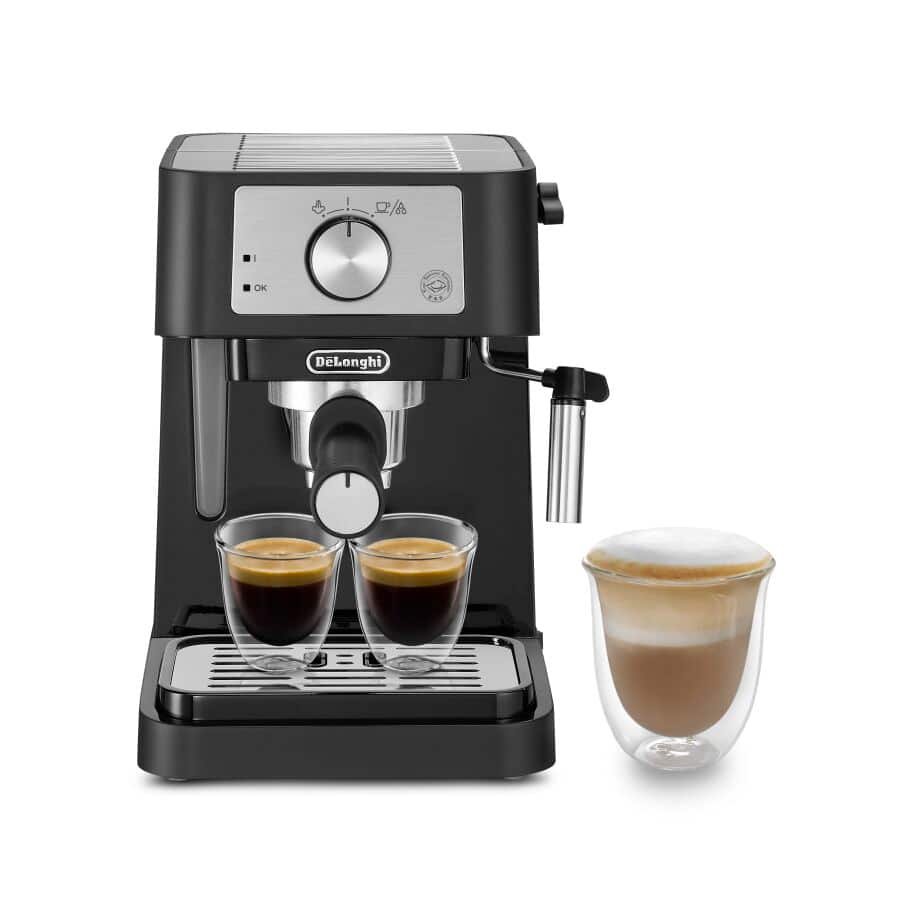
If you're not sure espresso is for you, the Stilosa is a low-risk way to find out. At $149.95, it's a quarter of the price of the Barista Express, and it still has a 15-bar pump, a stainless steel boiler and a manual steam wand for lattes and cappuccinos.
It also works with ESE pods, which are pre-packed paper pods of ground coffee. That's a handy shortcut while you're learning, or if you don't own a grinder yet. De'Longhi gives you a year of warranty, plus a second year if you register the machine.
You'll outgrow it if you get serious. There's no temperature control or pressure gauge to help you learn, and De'Longhi's US page doesn't list the portafilter size. But for a first taste of home espresso, it's hard to argue with the price.
Pros
- 01Very affordable at $149.95
- 02Manual steam wand
- 03Works with ESE pods
- 04Extra year of warranty with registration
Cons
- 01No grinder
- 02No PID or pressure gauge
- 03Portafilter size not listed by De'Longhi
| Heating | Stainless steel boiler |
|---|---|
| Pump | 15 bar |
| Grinder | None; works with ESE pods |
| Steam wand | Manual |
| Water tank | 1.0 L (33.8 oz), removable |
| Power | 1,100 W |
| Warranty | 1 year, plus 1 year with registration |
Your first shot: the basic recipe
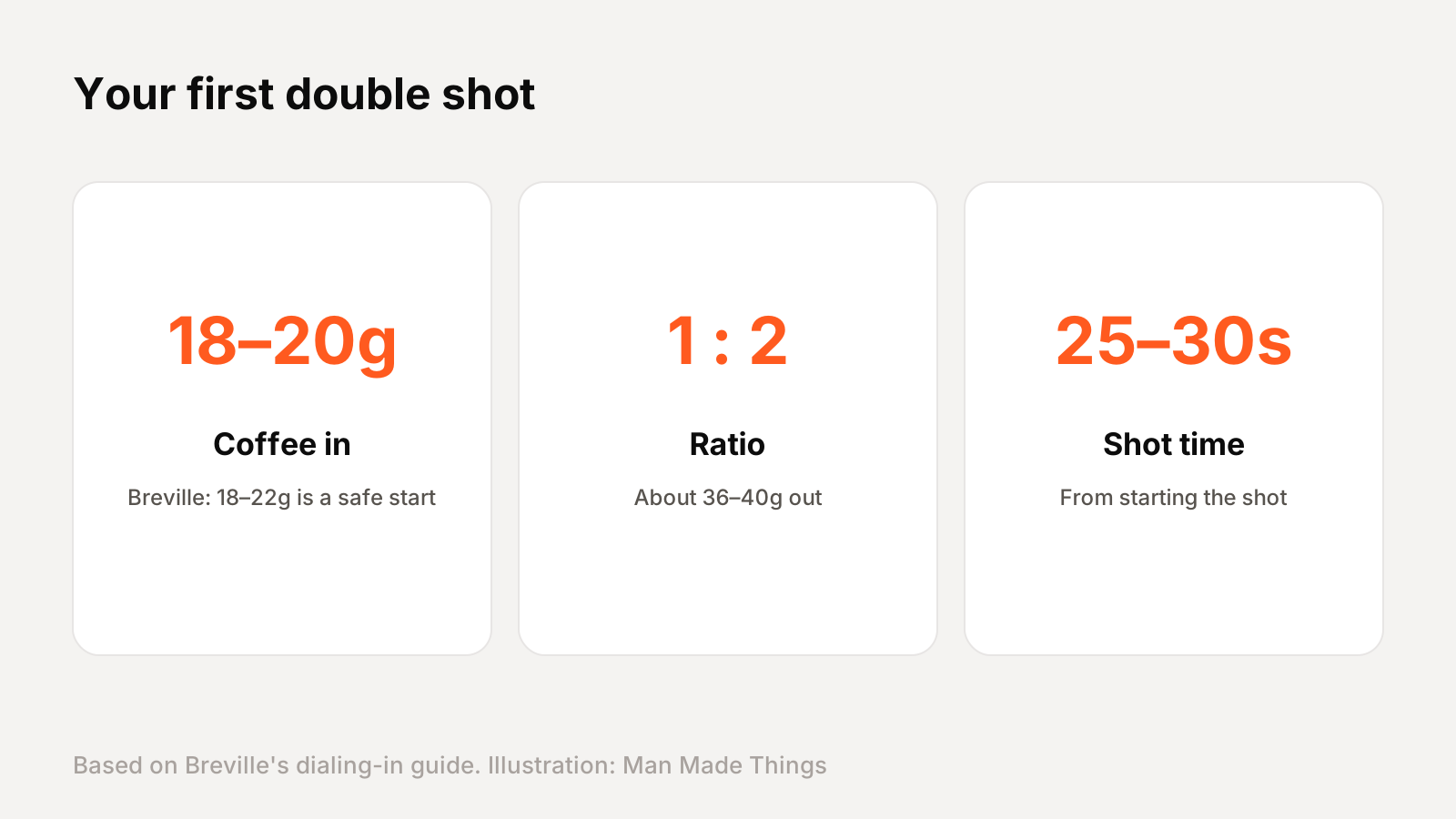
Breville's own dialing-in guide gives a simple starting point that works on any machine:
- Dose: 18 to 22 grams of ground coffee is a safe start for a double shot.
- Ratio: about 1:2. For 20g of coffee in, aim for about 40g of espresso out. Breville calls this the golden standard.
- Time: about 25 to 30 seconds from when you start the shot.
Use a small kitchen scale under your cup to weigh what comes out. Weighing is the single habit that makes beginners improve fastest, because it turns "tastes a bit off" into numbers you can change.
Dialing in: what to change when it tastes wrong
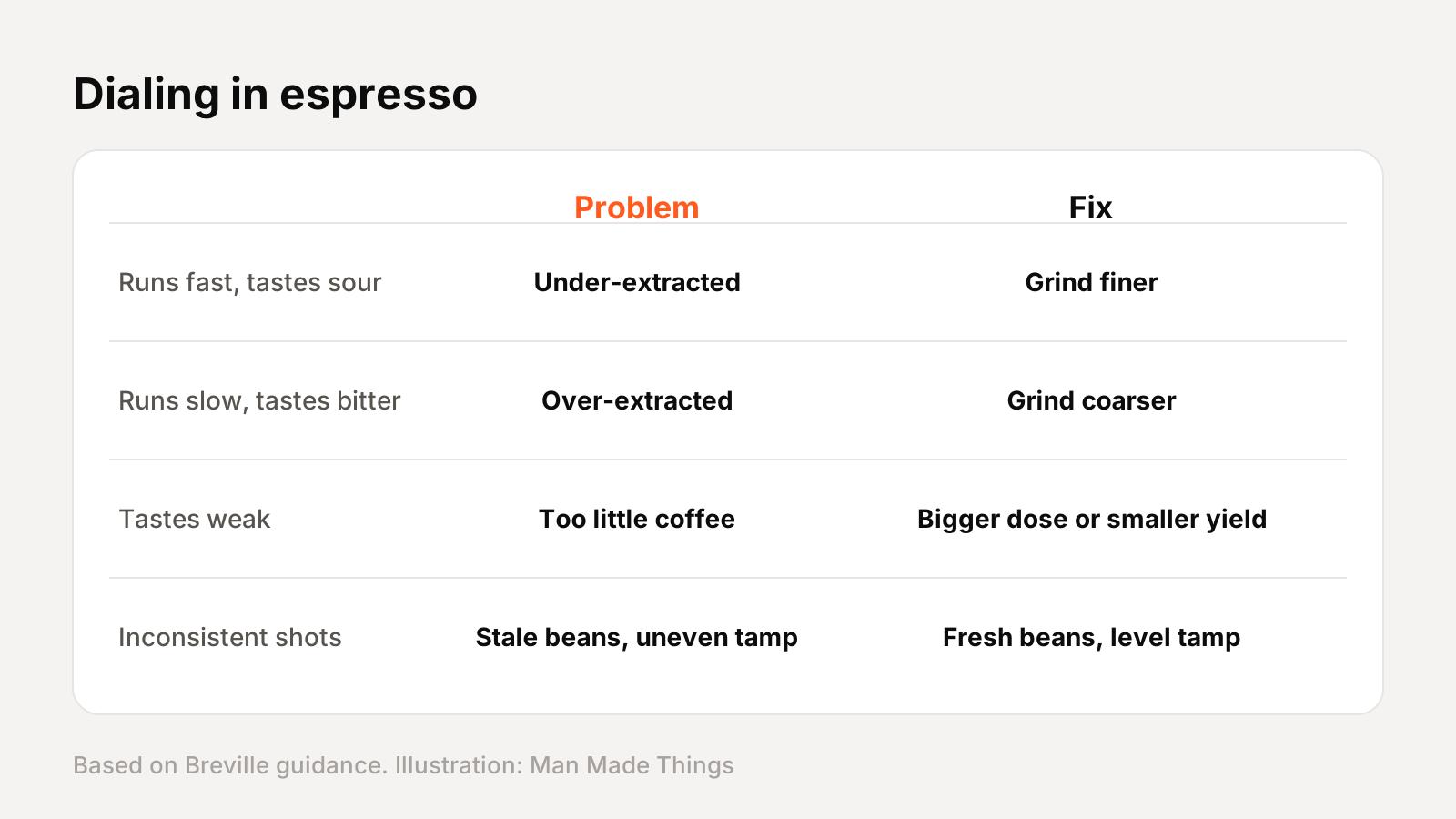
Your first shots won't be perfect. That's normal. Change one thing at a time, and the grind size is usually the first lever.
- Shot runs too fast and tastes sour: grind finer. Breville notes that a finer grind slows the flow.
- Shot runs too slow and tastes bitter: grind coarser to speed it up.
- Tastes fine but weak: try a slightly bigger dose or a smaller yield.
Be patient with the first bag of beans. It often takes four or five shots to dial in a new coffee, and that's normal, not a sign you're doing something wrong. Write down your dose, yield, time and grind setting each time, and you'll get there faster. A cheap notebook next to the machine works perfectly for this. Once a bag is dialed in, those notes mean your next bag of the same coffee takes one shot, not five.
Fresh beans matter too. Coffee roasted within the last few weeks gives much better espresso than a bag that's been open for months. And keep your machine clean: run water through the group head after each shot, and descale as your manual recommends. Both Breville machines here ship with descaling powder.
Frequently asked questions
What is the best espresso machine for a beginner?
+
The Breville Barista Express, because it has a built-in burr grinder, a pressure gauge and PID temperature control, so you only need one machine.
Do I need a separate grinder for espresso?
+
Only if your machine doesn't have one. The Breville Bambino and De'Longhi Stilosa need a separate burr grinder or pre-ground coffee.
How much coffee do you use for a double shot of espresso?
+
Breville suggests 18–22 grams as a safe start, with a 1:2 ratio, so about 36–44 grams of espresso out.
How long should an espresso shot take?
+
Breville says the ideal extraction time is typically 25 to 30 seconds.
Sources

Watches & Coffee Writer
Aditya is a passionate coffee lover who loves watches. He covers watches and coffee for Man Made Things.
More from Aditya →