The Best Chef's Knives Under $150: Zwilling, MAC and Victorinox
Three 8-inch chef's knives under $150: a forged German Zwilling, a thin Japanese-made MAC and the $67 Victorinox, plus how to keep any knife sharp.
We may earn a commission when you buy through links on this page. Learn more
Quick answer
The MAC Chef Series 8" TH-80 ($130) is the best chef's knife under $150 for most cooks: thin, light at 6 oz and made in Japan with a 25-year warranty. The Zwilling Four Star 8" ($149.99 list, often much less) is the best German-style knife, forged in Solingen. The Victorinox Fibrox 8" ($67) is the best budget knife and is dishwasher safe.
If you could only own one knife, it should be a chef's knife. It does about 90% of the work in a kitchen: chopping onions, slicing meat, mincing herbs, smashing garlic. A good one makes cooking faster, safer and a lot more fun.
You don't need to spend hundreds. The big decision isn't really price, it's style. German-style knives are heavier and tougher. Japanese-style knives are thinner, lighter and hold a sharper edge. Both are great, they just feel different in your hand.
I picked one of each, plus a budget knife that professional kitchens have relied on for years. Every spec and price comes from the brand's own US site. These are research-based picks with no star scores. Let's get into it.
Our picks at a glance
1. Best overall
MAC Chef Series 8" Chef's Knife with Dimples
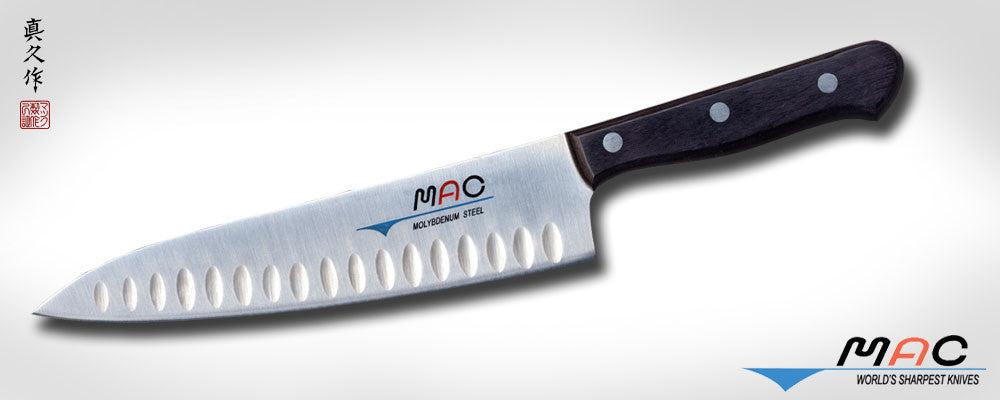
MAC is a Japanese knife maker that a lot of professional cooks quietly swear by, and the TH-80 is one of the best ways into its lineup. It's a gyuto-style knife, which is the Japanese take on a Western chef's knife.
The blade is just 2.0mm thick, and the whole knife weighs 6 ounces. That thinness is what makes it glide through onions and tomatoes instead of wedging them apart. Dimples along the blade help stop sticky foods from clinging. MAC says its knives use an edge of about 15 degrees per side, which is sharper than typical German knives.
Every step of MAC's knife-making happens in Seki, Japan, and MAC backs it with a 25-year warranty against defects. The trade-off with any thin Japanese blade is that it's less forgiving of twisting, bones or frozen food. Use a heavier knife for those jobs.
Pros
- 01Thin, sharp blade glides through food
- 02Light at 6 oz
- 03Made in Japan
- 0425-year warranty
Cons
- 01Thin edge needs more care around bones
- 02MAC doesn't list dishwasher guidance for this model
- 03No bolster for finger protection
| Blade | 7.88 in long, 2.0 mm thick, with dimples |
|---|---|
| Style | Gyuto-style chef's knife |
| Steel | MAC's original molybdenum steel |
| Edge | About 15° per side (MAC's brand-wide spec) |
| Weight | 6.0 oz |
| Made in | Seki, Japan |
| Warranty | 25 years against defects |
2. Best German-style
ZWILLING Four Star 8" Chef's Knife
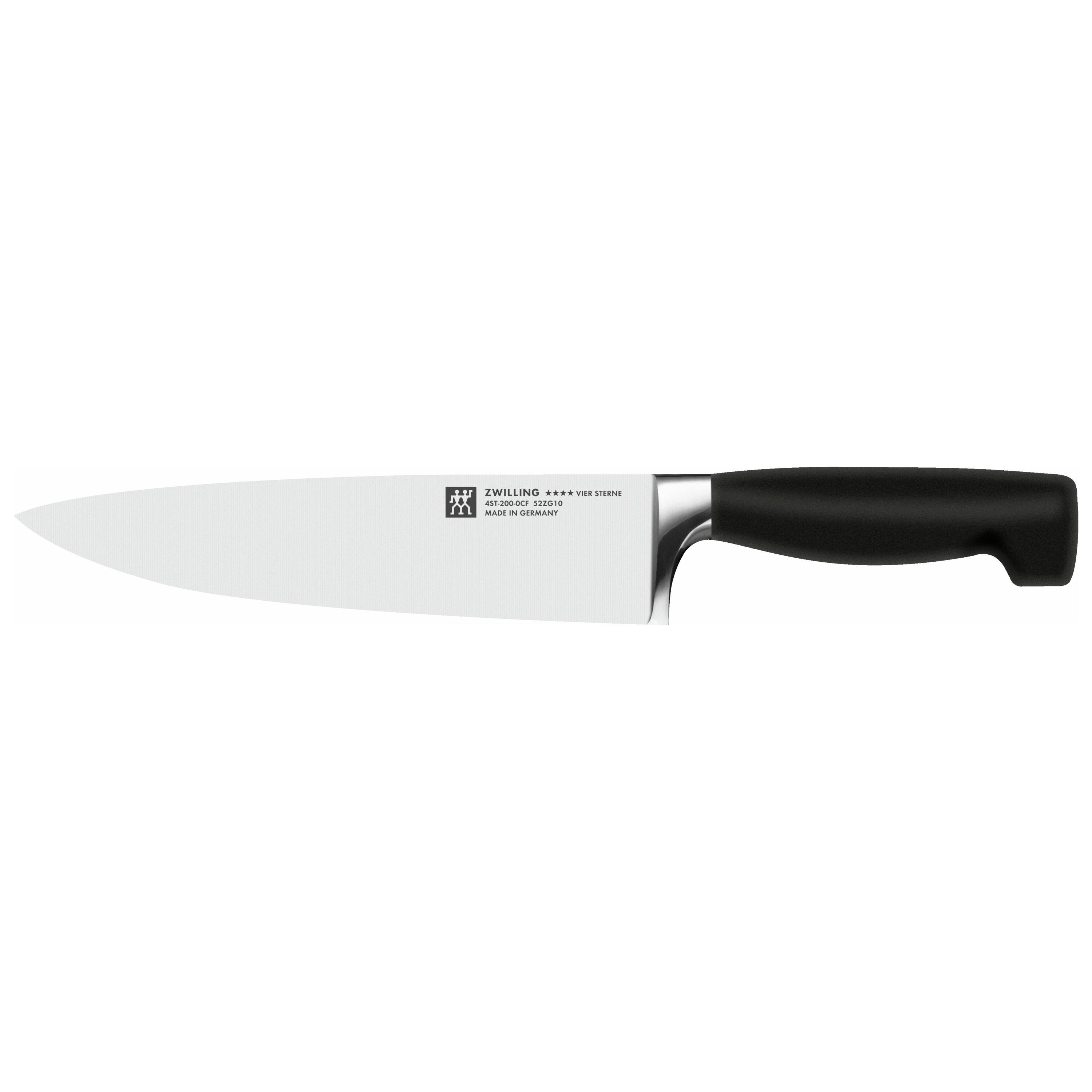
The Four Star is a classic German chef's knife, forged from a single piece of steel in Solingen, Germany. Zwilling ice-hardens the blade, and the pronounced bolster gives your fingers a safe place to rest as you grip the knife.
German knives like this are built to be tough. The blade is a bit softer and thicker than the MAC, which makes it more forgiving if you cut around bones, crack open a squash or occasionally use it a little roughly. It weighs about 6.7 ounces, with a handle made from at least 75% recycled plastic.
Zwilling says it's dishwasher safe but recommends hand washing, and backs it with a lifetime warranty. The list price is $149.99, but Zwilling discounts it heavily and often. It was $59.99 in a Black Friday sale when I checked, so don't pay full price.
Pros
- 01Forged in Solingen, Germany
- 02Tough, forgiving blade
- 03Bolster protects your fingers
- 04Lifetime warranty and frequent big sales
Cons
- 01Heavier and thicker than Japanese knives
- 02Needs sharpening more often
- 03Full price is right at our $150 limit
| Blade | 7.87 in, high-carbon stainless steel |
|---|---|
| Construction | Forged from a single piece (SIGMAFORGE), ice-hardened |
| Hardness | 55–58 HRC (Zwilling also states 57) |
| Bolster | Pronounced bolster |
| Handle | Polypropylene, at least 75% recycled plastic |
| Weight | About 6.7 oz |
| Made in | Solingen, Germany; lifetime warranty |
3. Best budget
Victorinox Fibrox Chef's Knife Extra Wide, 8 in
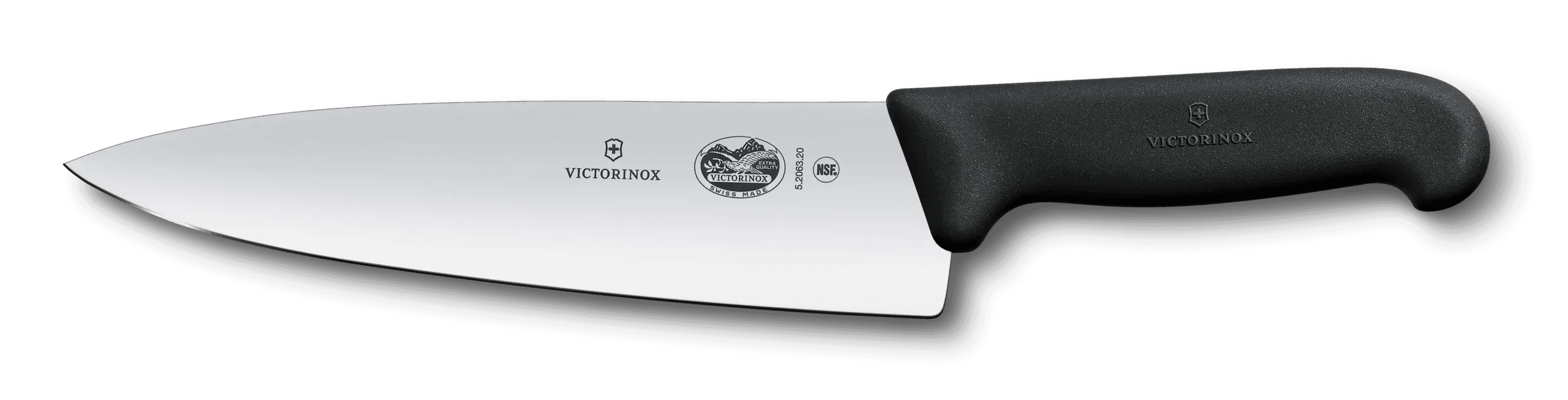
The Victorinox Fibrox is the knife you'll find in a lot of restaurant kitchens and culinary schools, because it's cheap, tough and gets the job done. At $67, it's less than half the price of the other two.
The blade is stamped rather than forged, which keeps the cost down and the weight light at 6.4 ounces. The extra-wide blade gives you plenty of knuckle clearance and helps scoop chopped food off the board. The textured handle stays grippy even when your hands are wet.
Victorinox lists it as dishwasher safe, which makes it a great knife for busy households, though hand washing will keep any blade sharper for longer. It's Swiss made with a lifetime warranty. It won't feel as refined as the MAC or Zwilling, but for the money, nothing beats it.
Pros
- 01Great value at $67
- 02Grippy, non-slip handle
- 03Dishwasher safe
- 04Swiss made with lifetime warranty
Cons
- 01Stamped, not forged
- 02Plain, utilitarian look
- 03Victorinox doesn't list steel type or hardness
| Blade | 7.9 in, extra wide (2.2 in) |
|---|---|
| Construction | Stamped (not forged) |
| Handle | Thermoplastic elastomer (TPE), non-slip |
| Weight | 6.4 oz |
| Dishwasher safe | Yes |
| Made in | Switzerland; lifetime warranty |
German vs Japanese chef's knives
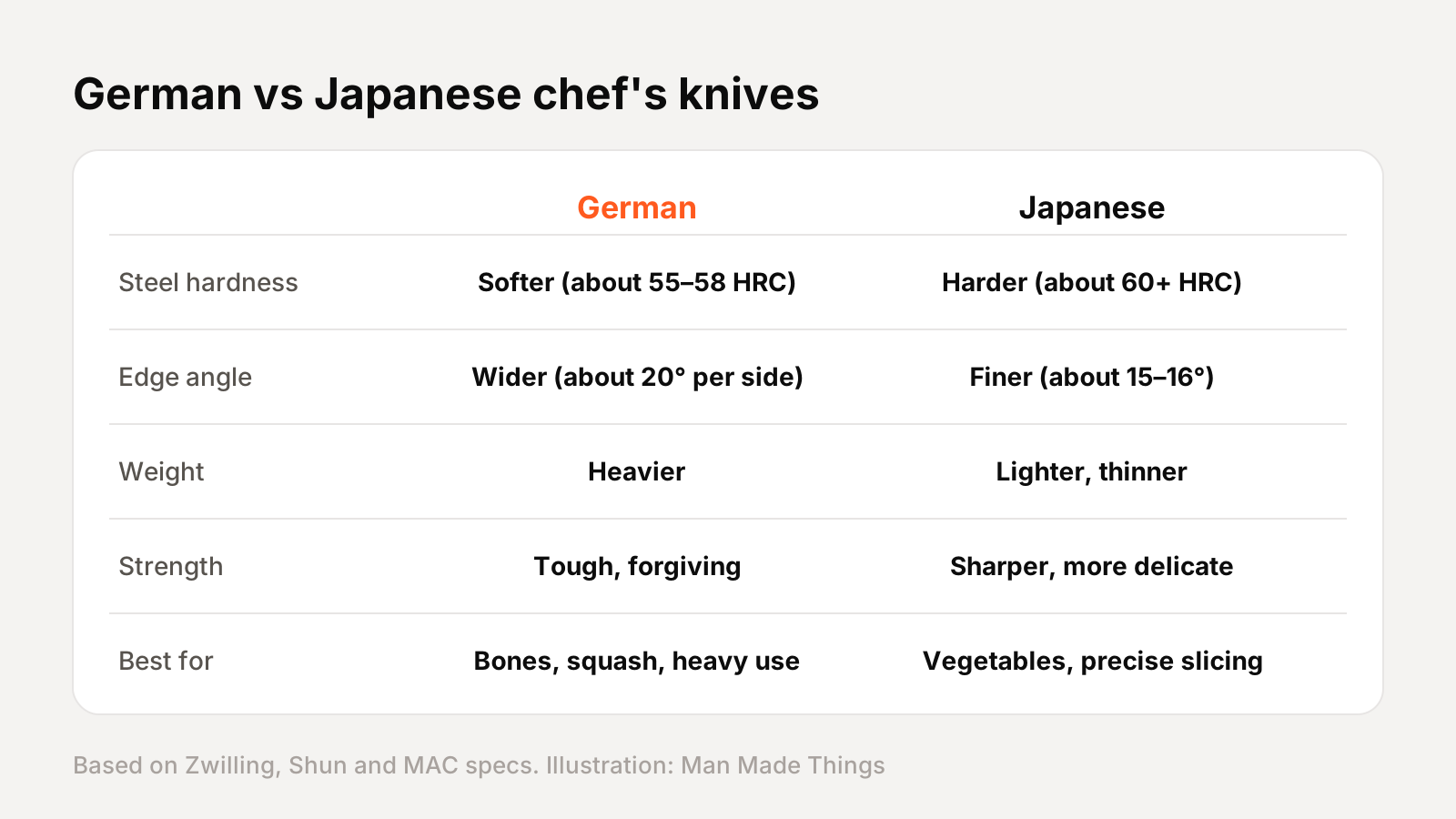
The difference comes down to steel hardness and edge angle.
- German-style knives use slightly softer steel. Zwilling's Four Star is rated 55 to 58 HRC. Shun says German and Western knives are typically sharpened to 20 to 25 degrees per side. That makes them tough and easy to maintain, but less razor-sharp.
- Japanese-style knives use harder steel and a finer edge. Shun hardens its VG10 steel to 60 to 61 HRC and sharpens to 16 degrees per side. MAC says its edges are about 15 degrees per side. They're sharper and stay sharp longer, but the thin edge can chip if you twist it or hit bone.
Neither is better. If you're rough with knives or cut a lot of meat with bones, go German. If you mostly slice vegetables and want the sharpest feel, go Japanese.
Honing vs sharpening: keeping your knife sharp
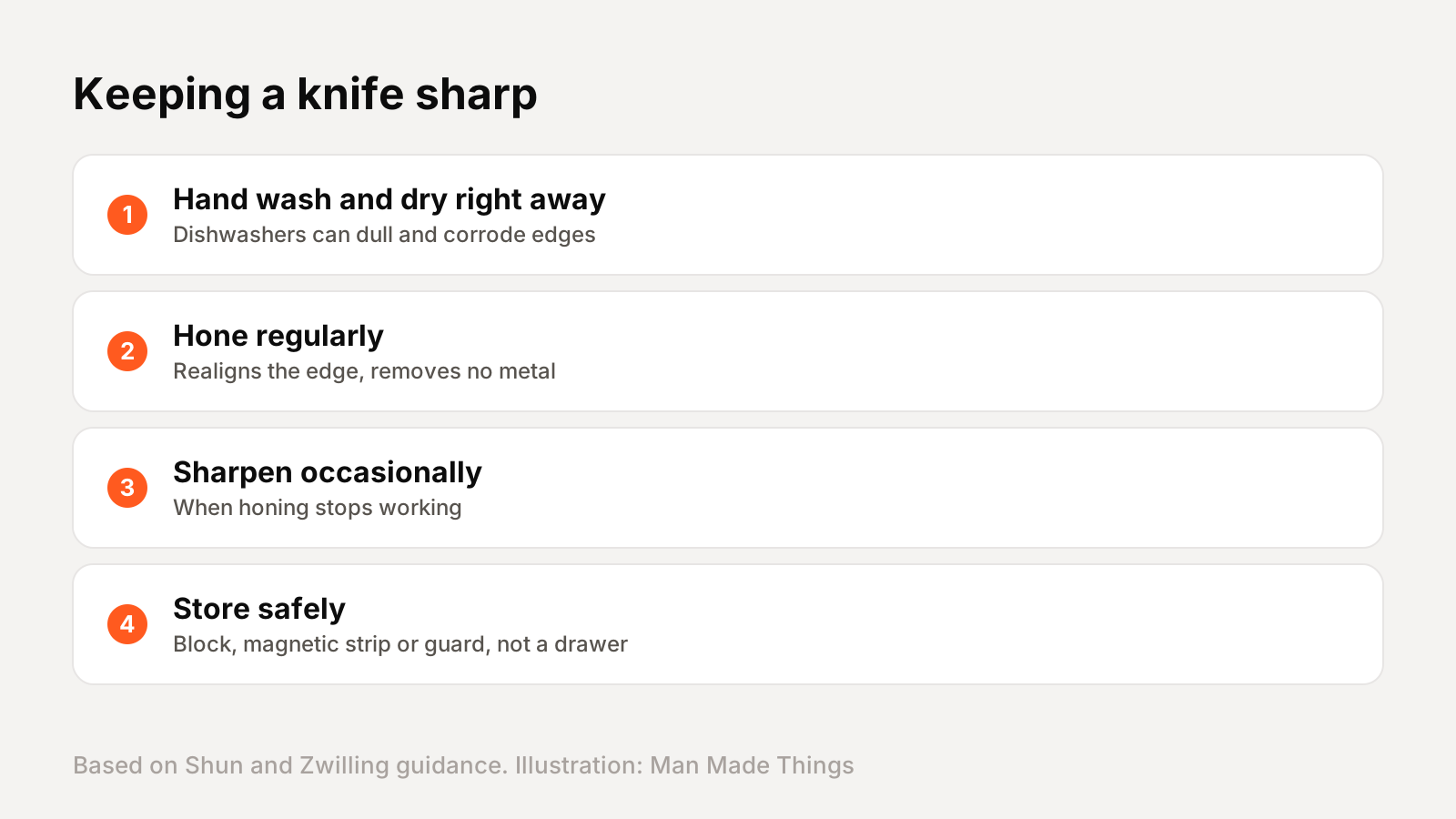
These two get confused all the time.
- Honing straightens a rolled edge without removing metal. Shun explains that honing realigns the edge, and Zwilling says knives should be honed regularly. A few strokes on a honing steel before cooking is plenty.
- Sharpening actually removes metal to create a new edge. Zwilling says to sharpen occasionally, when honing no longer brings the edge back.
Wash by hand. Even when a brand says a knife is dishwasher safe, most recommend hand washing. Shun explains why: knives get knocked around in the dishwasher, and some detergents can cause pitting or corrosion. Wash, dry right away and store the knife in a block, on a magnetic strip or in a blade guard, never loose in a drawer. And use a wood or plastic cutting board. Glass, stone and ceramic boards dull edges very quickly. A sharp knife is also a safer knife, because it cuts where you aim instead of slipping. Dull knives cause more cuts.
Frequently asked questions
What is the best chef's knife under $150?
+
The MAC Chef Series TH-80 at $130. It's thin, light at 6 oz, made in Japan and comes with a 25-year warranty against defects.
Are German or Japanese knives better?
+
Neither is better. German knives are tougher and easier to maintain, while Japanese knives use harder steel and a finer edge, so they're sharper but more delicate.
Can chef's knives go in the dishwasher?
+
Some are listed as dishwasher safe, like the Victorinox Fibrox, but most brands recommend hand washing to protect the edge and avoid corrosion.
What's the difference between honing and sharpening?
+
Honing realigns the edge without removing metal. Sharpening removes metal to create a new edge and is needed less often.
Sources
Editor-in-Chief
Rahul has been writing about gadgets and software since 2013, first at Thetechhacker and now at Man Made Things. He edits every review on the site and signs off on every verdict.
More from Rahul →